ollama
Get up and running with Kimi, GLM, MiniMax, DeepSeek, gpt-oss, Qwen, Gemma and other models.
- 188k
- Go
- MIT
- 8 h ago
A private, ChatGPT-style assistant running Gemma 4 entirely on iPhone: chat, vision, voice, documents and web search, via LiteRT-LM
Repo PowerBeef/Agello, read from GitHub 2 d ago. PowerBeef has not joined Take My Repo.
PowerBeef/Agello is a public repo on GitHub by PowerBeef. A private, ChatGPT-style assistant running Gemma 4 entirely on iPhone: chat, vision, voice, documents and web search, via LiteRT-LM. It declares the Apache-2.0 license on GitHub. It is written mainly in Swift, has 0 stars and last changed on 2026-11-22. Nobody has reviewed it on Take My Repo yet, which says nothing about its quality. Read from GitHub on 2026-11-23.
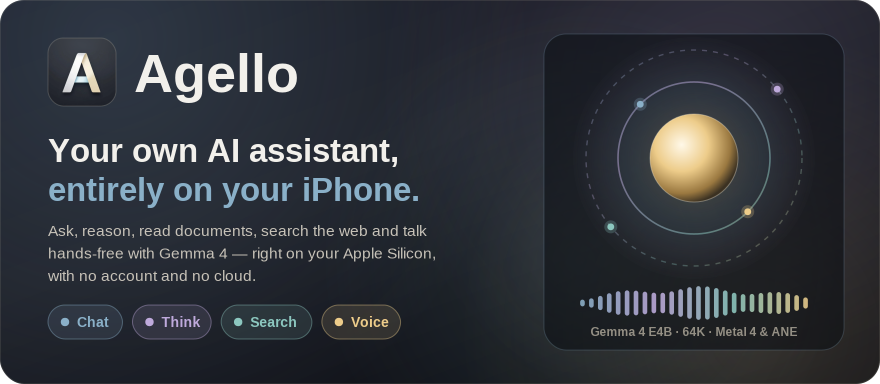
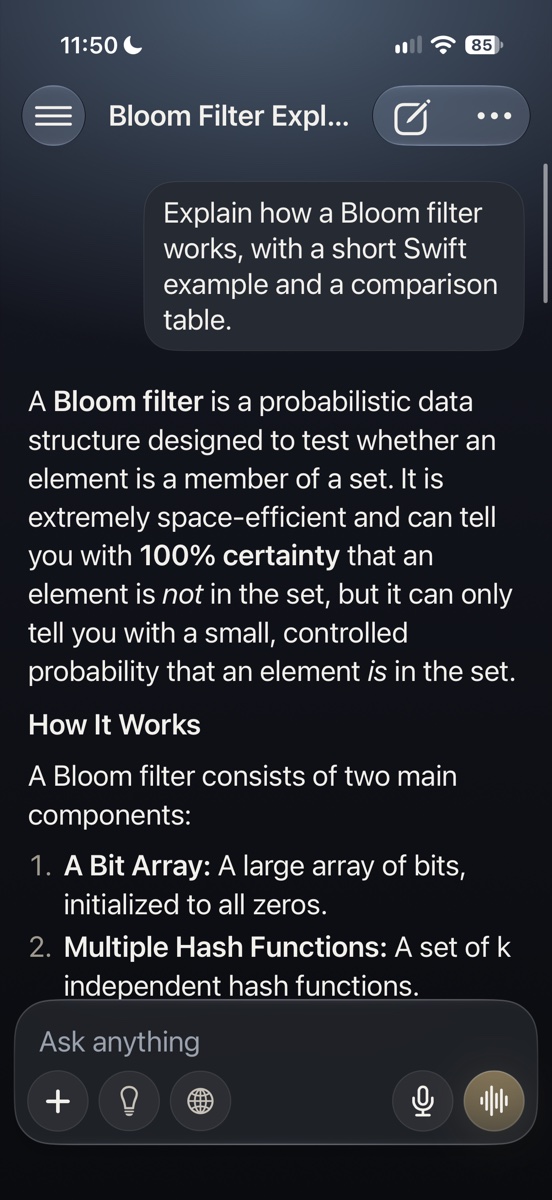
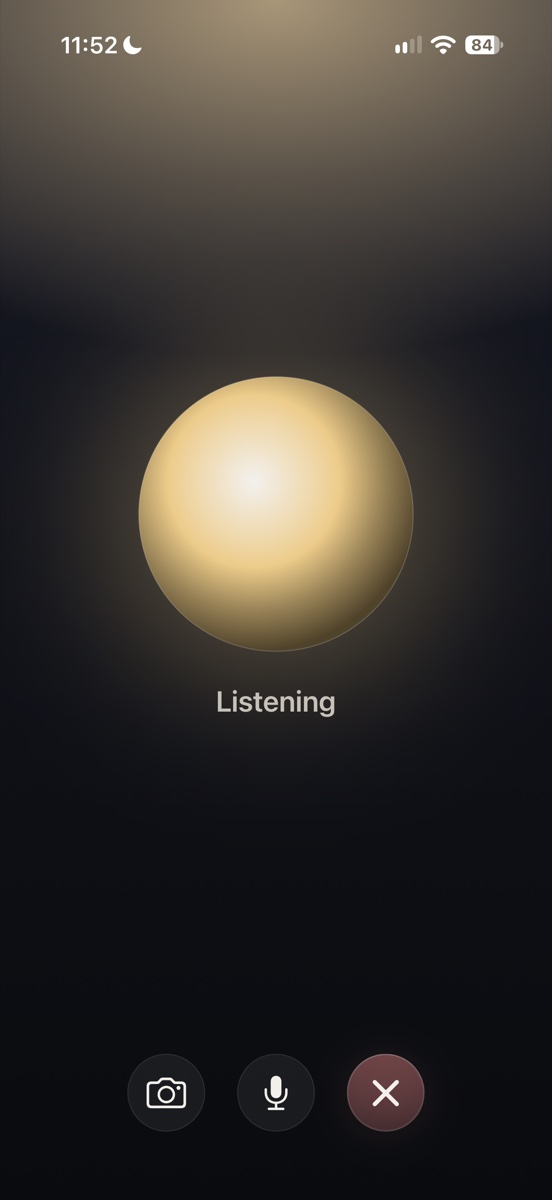
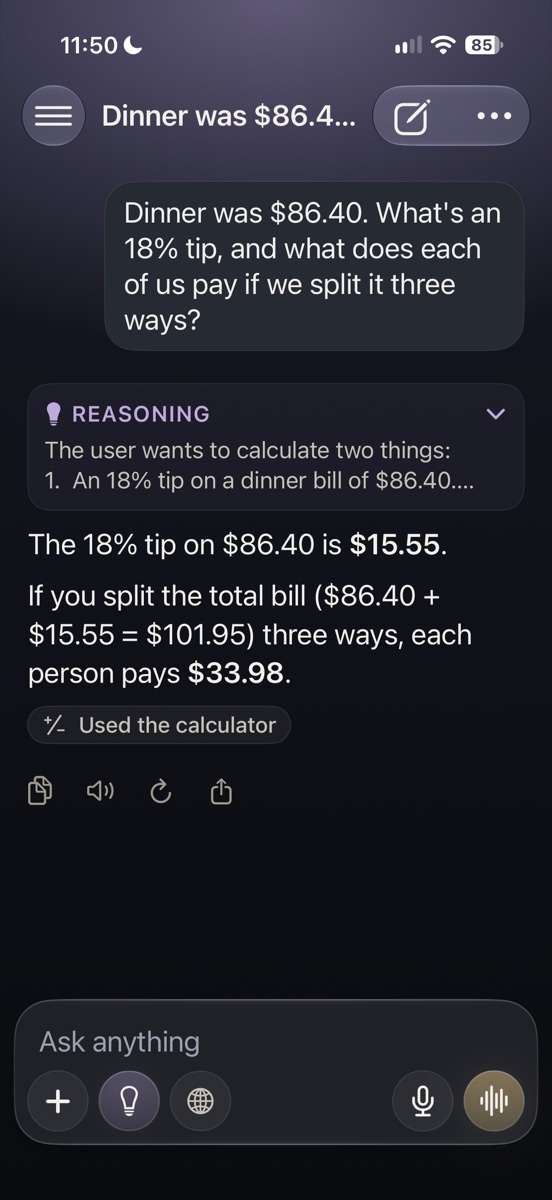
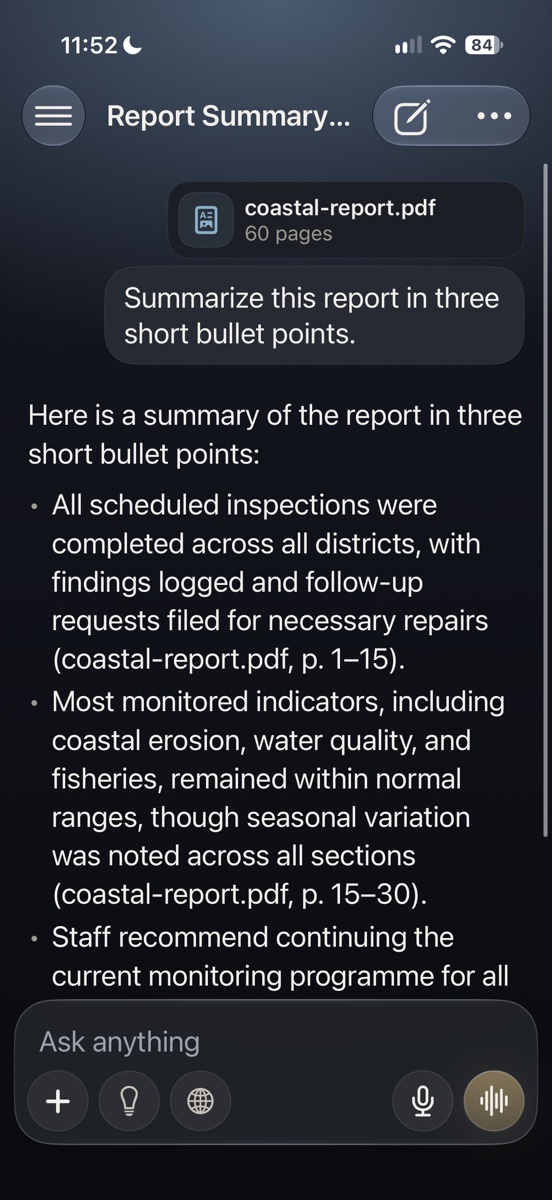
Agello is a private AI assistant for your iPhone. Ask a question, attach a 60-page PDF, snap a photo, or start a hands-free spoken conversation, and Agello answers with Google's Gemma 4 running directly on your phone's own Apple Silicon.
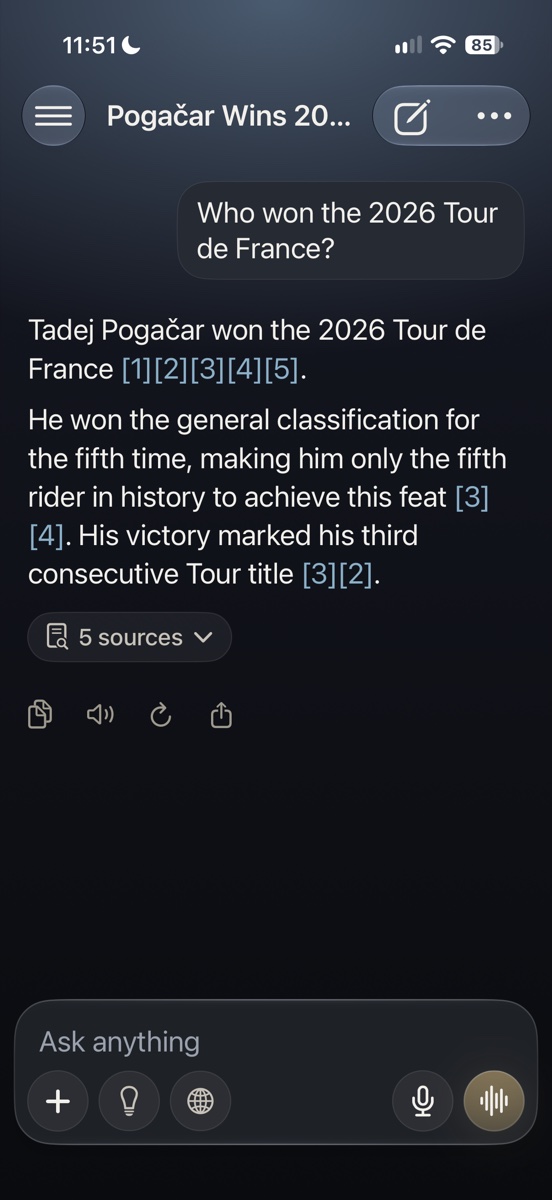
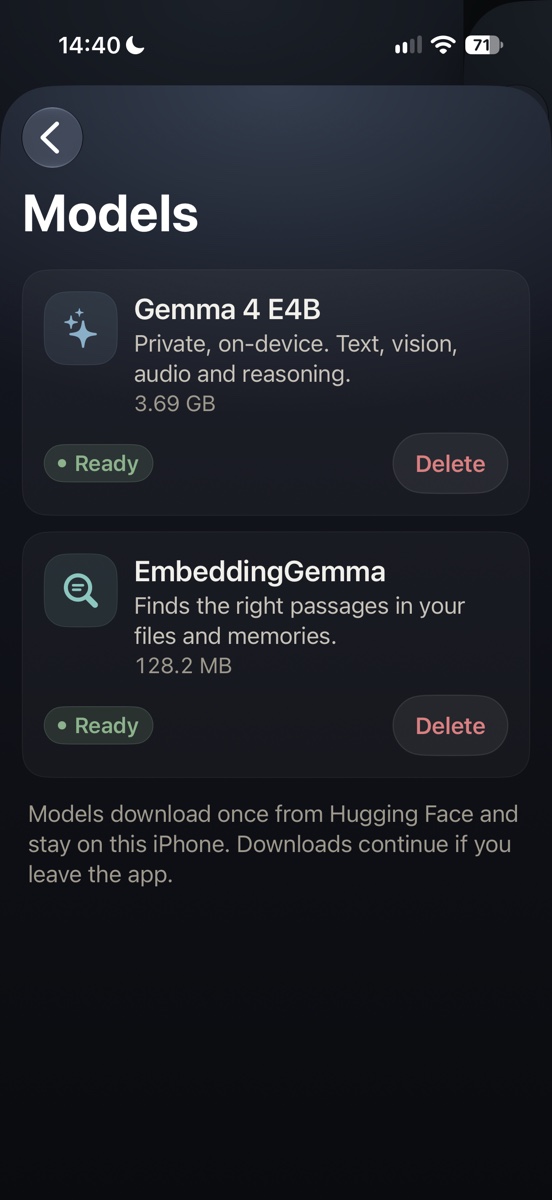
There is no account, no subscription, no API key and no cloud. Your conversations, photos, documents, voice recordings and memories stay on your iPhone. Once the models download, Agello works completely offline — touching the network only when you ask it to search the web.
 |
 |
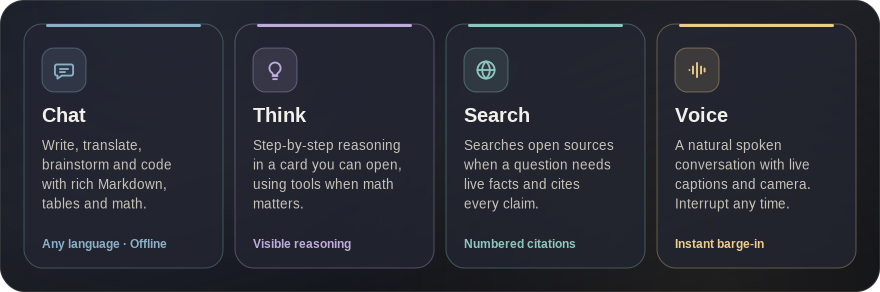
‹ 2/3 ›.[1]-style links.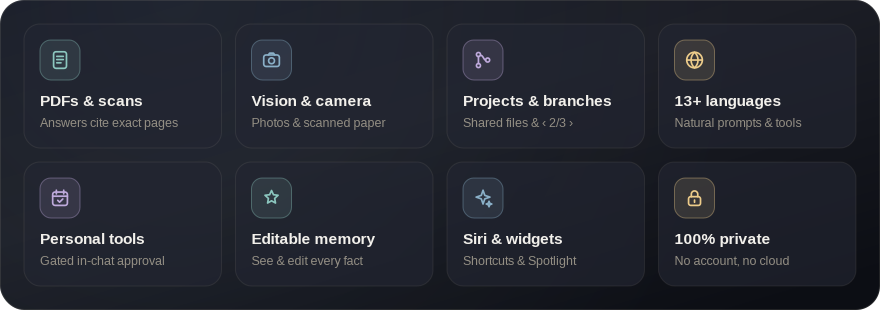
Group related work into Projects with shared instructions and reference files, search your history by words or by meaning ("Japan vacation" finds "Kyoto itinerary"), and opt in to Personal tools (Calendar, Reminders, Contacts and Apple Maps) that always show an explicit in-chat confirmation card before creating an event or reminder. Agello integrates across iOS 27 with Siri and Shortcuts, the Action Button, Spotlight, Home and Lock Screen widgets, Control Center, Live Activities for long multi-document synthesis, and the Share Sheet. → User guide · Privacy policy
 |
 |
 |
 |
[!NOTE] Agello isn't on the App Store yet. You can build it from source for any 12 GB iPhone running iOS 27 (iPhone 17 Pro, iPhone 17 Pro Max, iPhone Air, or newer).
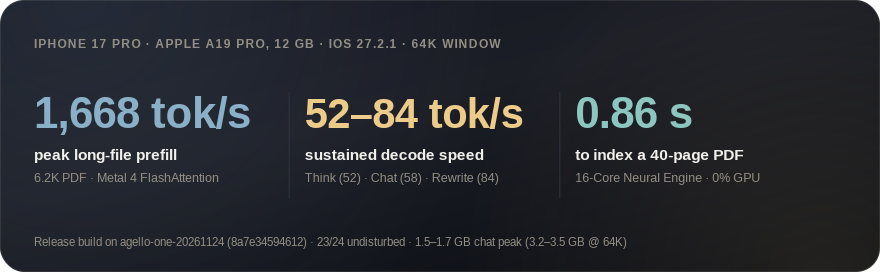
Agello ships our own hard-forked Metal 4 / MSL 4.1 runtime (agello-one-20261124), a graph-patched 64K Gemma 4 E4B model, and a 4-bucket asymmetric INT4 Core AI Neural Engine EmbeddingGemma 2 bundle. With the models warm in unified memory, everyday chats peak at 1.5–1.7 GB, first tokens arrive in 0.65–0.97 s, and sustained decode runs 2× to 3.1× faster than Google's stock v0.18.0 runtime — at double its maximum 32K context window.
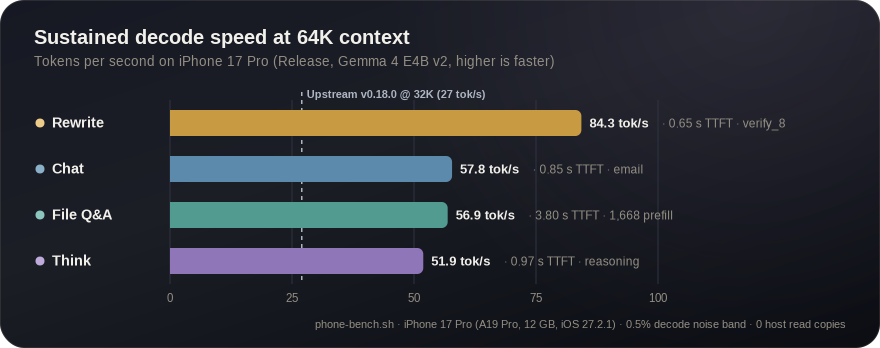
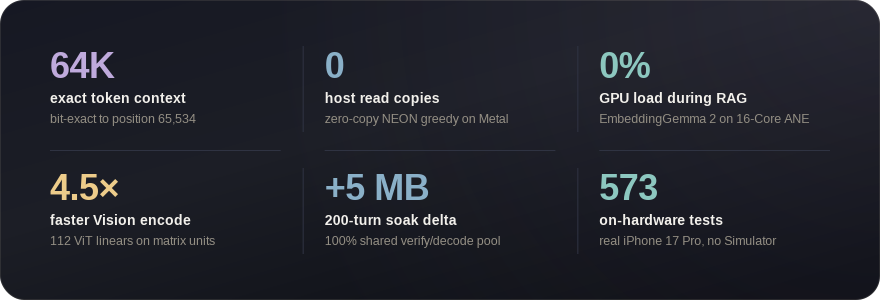
Measured in Release builds via scripts/phone-bench.sh (case-alternating thermal rest, 24/24 launches nominal, 95.8% undisturbed, 0.5% median decode noise band, 0 host read copies) and on-hardware suites on an iPhone 17 Pro (iPhone18,1, Apple A19 Pro, 12 GB, iOS 27.2.1):
| Workload (Agello Metal 4 + v2 64K + Core AI ANE) | Measured on iPhone 17 Pro |
|---|---|
Long-file prefill (file-report, 6,249 tok, 64K) |
1,654 med / 1,668 peak tok/s (3.80 s TTFT) |
Rewrite decode (typo-fix, verify_8 7-draft rounds) |
83.4 med / 84.3 peak tok/s (0.65 s TTFT) |
Chat decode (email, 64K) |
57.3–57.8 tok/s (0.85 s TTFT, 1,599 tok/s prefill) |
File Q&A decode (file-report, 6.2K PDF) |
56.5–56.9 tok/s (1.70 GB kernel peak) |
Think decode (explain, ~1,380 reasoning tok) |
50.6–51.9 tok/s (0.97 s TTFT, up from 37.3) |
Full 64K (65,536 tok) fidelity & peak footprint |
12/12 bit-exact to pos 65,534, 90/90 needles (3.18–3.45 GB) |
200-turn pool soak (test38_PoolSoak) |
+4.95 MB median growth (465 MB final / 5.98 GB free) |
Warm model load (MTLBinaryArchive) |
0.7–1.1 s (0.90 s GPU Vision init, 1.1 s 64K load) |
| 40-page PDF index & query (16-Core ANE) | 0.86 s index (2.2× faster than GPU), 8–11 ms query |
| Concurrent chat index while Gemma 4 streams | 46 ms on ANE (0% GPU contention, 0.9995 FP32 cosine) |
| Live dictation & voice follow-up | 32 ms captions (SpeechAnalyzer), 0.89 s first spoken sentence |
| Lazy Conformer audio load / unload | 3.2–4.3 ms load / 0.9–1.1 ms unload (USER_INTERACTIVE) |
For comparison, on Google's stock LiteRT-LM v0.18.0 binary (October 2026, before our Metal 4 fork), decode on the same iPhone 17 Pro dropped across 43 / 38 / 34 / 27 tok/s at 4K / 8K / 16K / 32K (with no 64K support), TTFT on an 8.6K prompt took 18.9 s, warm load took 1–3 s, and GPU PDF indexing took 1.7–1.9 s. Google's E4B model card (2026-10-15) reports 1,189 tok/s prefill and 25.1 tok/s non-speculative decode on A19 Pro.
Agello treats the A19 Pro+ as a heterogeneous computer rather than a single GPU queue: Swift 6 strict concurrency, one actor owning our custom C++/Metal 4 engine in-process, retrieval and live transcription offloaded to the 16-core Neural Engine, and zero Python or server layers anywhere at runtime.
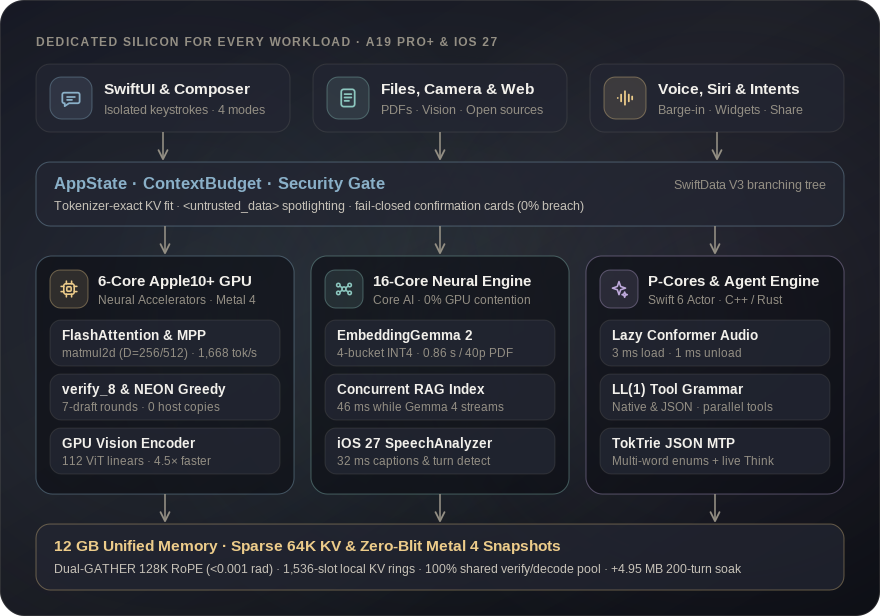
Every turn — typed, edited, regenerated, spoken, or shared — enters one pipeline in AppState, fits cleanly inside the KV budget before touching native memory, streams into a branching SwiftData tree, and snapshots its sparse KV state in zero-blit Metal 4 virtual mappings when background helper tasks extract titles or memories. → Architecture · Runtime audit
 |
An owned Metal 4 / MSL 4.1 runtime on GPU Neural Accelerators. Our fork (PowerBeef/agello-litert-lm, build 8a7e34594612) compiles LiteRT-LM, LiteRT and ML Drift together for Apple10+ GPUs: cooperative-tensor matmul2d FlashAttention (D=256/512, eliminating materialized score buffers), Apple10 INT8/FP16 ConvAppleMPP across both LLM prefill and Vision (all 112 ViT linears and 32 attention matmuls, 4.5× faster), FP32-promoted softmax/PV attention and KV quantization, verify_8 7-draft speculative rounds sharing 100% of their intermediate pool with verify/decode, zero-copy ARM64 NEON greedy sampling directly on shared Metal buffers (0 host read copies, down from >2 GB per long reply), and persistent MTLBinaryArchive PSO deduplication. → The backend · Vendored package |
 |
PowerBeef/Agello is a public repo on GitHub by PowerBeef. A private, ChatGPT-style assistant running Gemma 4 entirely on iPhone: chat, vision, voice, documents and web search, via LiteRT-LM.
It declares the Apache-2.0 license on GitHub.
Its maker tagged it for macOS. That is declared by the maker; Take My Repo has not tested it.
Open "Take it" on its page: Take My Repo writes an install plan for your machine and hands it to your AI agent (Claude Code, Codex or Cursor), which asks you before each step. Take My Repo has not tested it on any machine.
A human-centric, resource-aware Android node for edge computing and federated learning. Orchestrates distributed intelligence with privacy-first localization and empathetic hardware management.
The agent harness performance optimization system. Skills, instincts, memory, security, and research-first development for Claude Code, Codex, Opencode, Cursor and beyond.
Its last change on GitHub was on 2026-11-22. GitHub counts 0 open issues and pull requests. Take My Repo does not judge from that whether it is maintained.
Nobody has reviewed it on Take My Repo yet, which says nothing about its quality.
Take My Repo cannot say: it does not audit code and has not run Agello. What is known comes from GitHub. It declares the Apache-2.0 license on GitHub. Its last change was on 2026-11-22. It has 0 stars, which measure popularity, not safety. Nobody has reviewed it on Take My Repo yet, which says nothing about its quality. Read the source before you run it. With "Take it", your AI agent shows each step and asks you before running it; README text is treated as data, not as instructions.