rayforce q

rayforce-q
The maintainer has not written a description at the source.
- 7
- MIT
- 5 d ago
Repo RayforceDB/rayforce-q, read from GitHub 16 h ago. RayforceDB has not joined Take My Repo.
In short
RayforceDB/rayforce-q is a public repo on GitHub by RayforceDB. It declares the MIT license on GitHub. It is written mainly in C, has 7 stars and last changed on 2026-11-18. Nobody has reviewed it on Take My Repo yet, which says nothing about its quality. Read from GitHub on 2026-11-23.
In the maintainer's words. Shown from GitHub; Take My Repo does not keep a copy.
rayforce-q
Q IPC wire-format client for RayforceDB — a small, language-neutral C core and compiled binary
The core operates purely on rayforce ray_t objects and the public <rayforce.h> API
Embedded binary
make rayforce builds a rayforce binary with both the Q client and the Q server compiled in.
Client
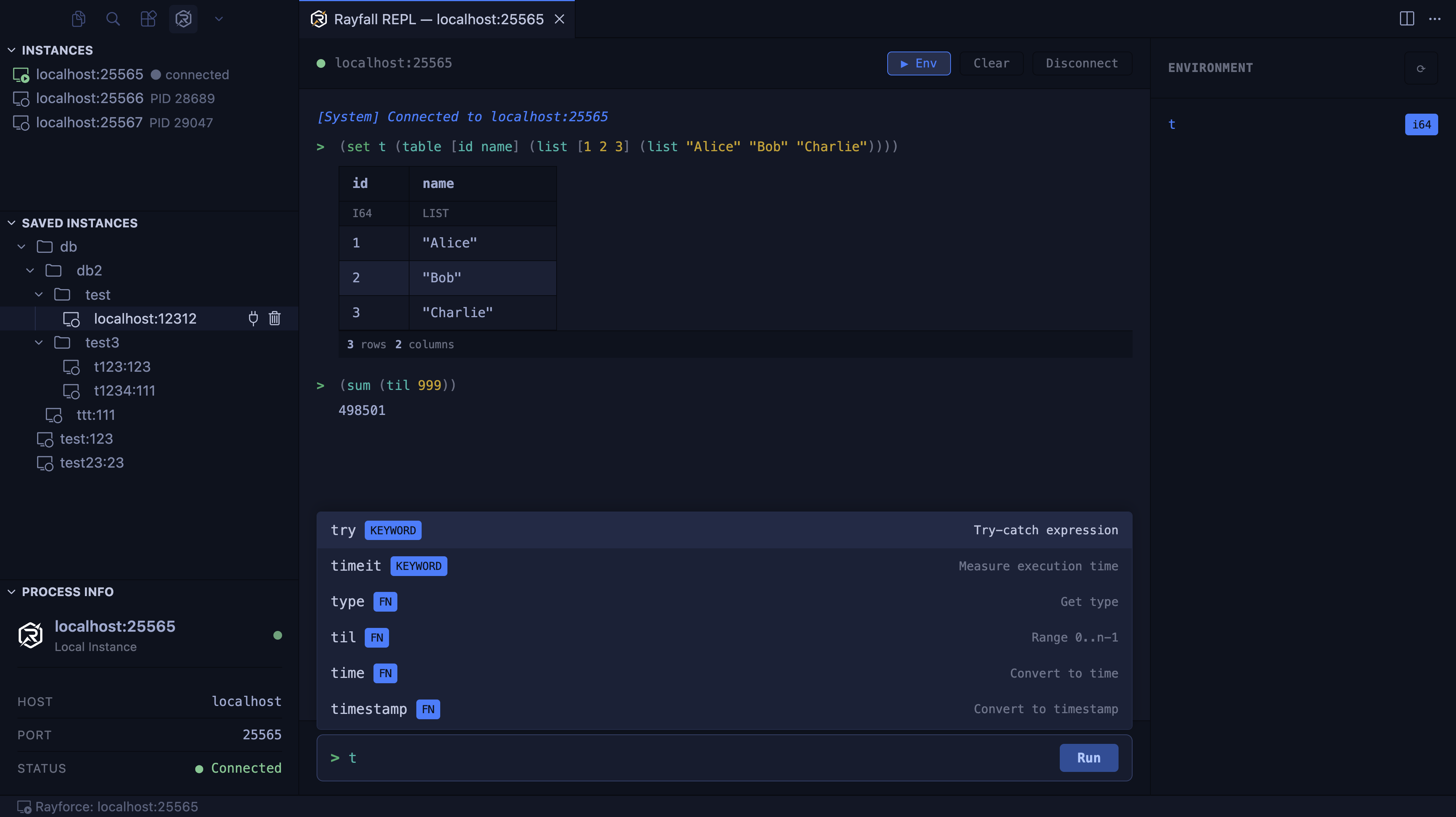
The client is exposed as .q.* rayfall env functions, so any script or REPL session can query a Q server:
(set h (.q.connect "localhost" 5000 "" "" 0))    ;; host port [user password [timeout_ms]]
(.q.send h "([] a:1 2 3; b:`x`y`z)")             ;; -> a rayforce table
(.q.close h)
Connections live on the runtime's event loop, so the peer can push to them — which is all a q subscription is. Frames are routed by message type: a response wakes the .q.send waiting for it, anything else is evaluated. A publisher's (`upd;packet) therefore calls upd, the same dispatch q performs with value x:
(set upd (fn [packet] (insert 'mtr (get packet 'metrics))))
(set h (.q.connect "localhost" 5000 "" "" 5000))
(.q.send h ".net.sub[0]")                        ;; subscribe once — packets then arrive on their own
Inside a handler, (.q.handle) is the connection the frame came in on (the value .q.connect returned), -1 anywhere else — so one process can subscribe to several publishers and still tell whose packet it holds:
(set upd (fn [packet] (record (cluster-of (.q.handle)) packet)))
A host without a poll (a binding that embeds only the client) keeps the plain blocking q.c path and its raw-fd handle.
Every .q.connect connection has TCP keepalive at the core's 60 s default, so a publisher that vanishes without closing (a dropped VPN or NAT flow) fails the connection instead of leaving a subscription waiting forever.
Server
The server is exposed via the -q PORT flag — it shares the REPL's event loop, so the REPL stays interactive while it serves Q clients:
./rayforce -q 25565        # serve Rayfall over the Q wire on 127.0.0.1:25565 (loopback only)
./rayforce -q 0.0.0.0:25565   # every interface, explicitly
RAYFORCE_Q_BIND_HOST=10.0.0.5 ./rayforce -q 25565   # env fallback when -q has no host
Like -p, a -q listener keeps the process running after a startup script (./rayforce -q 25565 init.rfl); a startup script that fails is fatal (exit 1) unless -i is given, and with no script and no terminal the process serves without a REPL.
With -u PW or -U PW, both the q listener and native IPC require the password from the login (user:password, or just password). A wrong or missing password closes the q handshake without a capability reply. The username is not an authorization identity, matching native IPC. Without a password flag, the q listener remains unauthenticated. -U additionally restricts evaluation on that connection; it is not a substitute for a password or transport security. Keep the q port on loopback (the default) or behind your own network controls.
An empty (or whitespace-only) request answers (::), like kdb's h "". An error's text travels with its category, so q sees 'domain: custom failure. With a journal open (.log.open, -l/-L) every inbound sync q frame is journaled before it is evaluated, exactly as the core does for native IPC, and a failed journal write refuses the request with an io error; async frames are not journaled.
Inbound connections get the same handle, push and hook verbs as outbound ones, enough for a kdb-compatible pub/sub server:
;; (.q.handle)         the connection whose frame (or close) is being handled; -1 elsewhere
;; (.q.post h msg)     send msg as a q ASYNC frame on any open q connection, inbound or outbound;
;;                     queued, never waits; null on success, `handle`/`io` errors otherwise
;; (.q.on 'sync  fn)   hook: gets the decoded request, REPLACES the default eval, its value is the reply
;; (.q.on 'async fn)   hook: gets the request, no reply
;; (.q.on 'open fn)    hook: gets the handle, once per inbound connection, when its handshake completes
;; (.q.on 'close fn)   hook: gets the handle, once per inbound connection, just before teardown
;; (.q.handles)        table of the open inbound connections: handle, queued_bytes, limit_bytes
;; (.q.on 'sync 0)     any non-lambda clears the hook
(.q.on 'sync (fn [r]
  (if (== (first r) '.net.sub)               ;; q: h(`.net.sub;5) -- a name the default eval could not call
      (do (set subs (concat subs (list (.q.handle)))) 5)
      (eval r))))
(.q.post (first subs) (list 'upd (dict ['a 'b] [1 2])))   ;; q client receives (`upd;`a`b!1 2) async
Rayforce stores q's legacy temporal kinds in the nearest engine type (z as
TIMESTAMP, m as DATE, and u/v as TIME), so replies normally use q
p/d/t. Reply-local wrappers select the narrower q wire kind explicitly
without changing the stored value or any unrelated send:
(.q.as_kind 'datetime 2026.07.10D09:30:00.123000000) ; q -15h (`z`)
(.q.with_kinds
  (dict ['time 'expiry] ['datetime 'month])
  trades)                                               ; per-column q kinds
Supported kinds are 'datetime, 'month, 'minute, and 'second. Values
must be exactly representable: datetime rejects sub-millisecond timestamps,
month requires the first day, and minute/second require an in-range whole
unit. Typed nulls keep the requested q kind. The wrapper may appear inside a
larger reply such as (list 'upd 'trade wrapped-table) and is recognized
only for that encoding; without one the existing p/d/t mapping is
unchanged. Internally it remains a normal owning two-item LIST, so Rayfall may
inspect or store it; private adapter metadata, not its LIST shape, makes it an
encoding directive. Encoding borrows the wrapper and does not consume it.
For a collection of heterogeneous tables, each table applies the intersection of its columns and the supplied schema. Every schema name must nevertheless match at least one table in that collection, so a misspelled column fails the encode instead of silently using the default wire kind everywhere.
.q.on.* cannot be set from Rayfall (dotted names are reserved), hence the verb; semantics mirror the core's .ipc.on.*. A char-vector request reaches the sync/async hook as an unparsed string ((eval (parse r)) reproduces the default), a hook error is encoded to the client (sync) or logged (async, open, close). (.q.handle) is valid inside all four hooks. Hooks are process-global and live as long as the runtime: ray_poll_destroy releases them after the open connections' close hooks have run, a runtime destroyed without a poll needs q_hooks_release() first, and q_env_register() (once per runtime) drops what an earlier runtime left.
Seeing the connections. 'open fires when the login handshake of an inbound connection completes, before any frame of it is read, so a script learns of a peer that has connected but not yet sent anything; its (.q.handle) is the value every later hook and frame of that connection sees. An error raised by the hook is logged and does not close the connection or stop the listener (as for 'close). (.q.handles) returns one row per open, established inbound q connection (a login in progress, a connection being closed, and connections made with .q.connect are not listed), with the columns of the core's (.ipc.handle h) that mean the same thing: handle (what (.q.handle) yields for it), queued_bytes (bytes of .q.posted or reply frames the socket has not taken yet) and limit_bytes (the cap on that queue, 256 MiB), all i64; with no connection it is an empty table with the same columns. Like .q.post, whose handles it lists, it is refused for a restricted (-U) peer; hooks and the embedding script can call it.
Hooks and the WAL. With a sync hook installed, a sync request that is journaled is recorded as (.q.dispatch_sync (quote <request>)); .q.dispatch_sync applies the sync hook installed at that moment, or evaluates by default when there is none. A replay therefore reproduces the live run if the application installs its hooks (.q.on) before .log.replay, which is the natural order, since it loads its code first; a replay without the hook evaluates the requests by default.
Read-only requests are not journaled. (.q.readonly ['get_seq 'app.status]) declares request heads that are pure reads: a sync request whose head is listed (a call list, an all-symbol call vector, or a string that is one form) is dispatched as usual but not written to the WAL, so polls do not grow the log or replay. The embedder promises the heads are reads (a mutation under one is lost on replay), only the head is examined (nested calls are not), the default is the empty list, and it is process-wide and not persisted, so set it at load time. (.q.readonly) returns it; an empty vector clears it. Details in docs/INTEGRATING.md.
A Q listener evaluates what it is sent, so it binds loopback by default. The address comes from -q HOST:PORT (mirroring the core's --port HOST:PORT), else RAYFORCE_Q_BIND_HOST, else 127.0.0.1; use 0.0.0.0 for the old all-interfaces behaviour. HOST must be an IPv4 address.
Both -q and --q-serve require a decimal TCP port in 1..65535 (optionally HOST:PORT). A
missing or invalid port prints a diagnostic and exits with status 2, so a
service supervisor does not mistake a failed Q listener for a healthy
process. Arguments after -- are passed to the Rayfall application and are
not interpreted as Q-server options.
API
See INTEGRATING.md for more details.
Client
#include "q.h"

/* host/port + optional auth + connect/op timeout (ms; <= 0 blocks). */
int    q_connect(const char *host, int port, const char *user,
                 const char *password, int timeout_ms);   /* -> fd >= 0, or Q_ERR_* */
/* q_connect with the keepalive chosen: Q_KEEPALIVE_AUTO, Q_KEEPALIVE_OFF, or a budget in ms. */
int    q_connect_opts(const char *host, int port, const char *user,
                      const char *password, int timeout_ms, int keepalive_ms);
int    q_close(int fd);
ray_t *q_send(int fd, ray_t *msg, char *err, size_t n);    /* -> ray_t*, or NULL + err */

/* Split form, to release a runtime lock (e.g. the CPython GIL) around just the
 * blocking network wait — q_encode/q_decode touch the rayforce symbol table
 * (hold the lock); q_exchange is pure socket I/O (release the lock). */
int    q_encode(ray_t *msg, uint8_t **req, int64_t *req_len, char *err, size_t n);
int    q_exchange(int fd, const uint8_t *req, int64_t req_len, uint8_t **resp,
                  int64_t *resp_len, int *compressed, char *err, size_t n);
ray_t *q_decode(uint8_t *resp, int64_t resp_len, int compressed, char *err, size_t n);

/* q_decode, but a table keeps only the named columns, in the order named. */
ray_t *q_decode_cols(uint8_t *resp, int64_t resp_len, int compressed,
                     const char *const *cols, int ncols, char *err, size_t n);
The connection handle is the raw socket fd, so the client is thread-safe and unbounded (no shared connection table). q_send returns a freshly-owned
ray_t, which may itself be a RAY_ERROR carrying a Q server-side error. A NULL return signals a transport/serialization failure with a short reason in err.
Keepalive needs rayforce core v2.11.0 or later. See INTEGRATING.md for how a budget maps onto the socket.
q_decode_cols is for a caller that keeps a few columns of a wide table. The other columns are skipped by their serialized length: no allocation per string cell and no symbol interning. A name the table lacks comes back as a RAY_ERROR. See q.h for keyed tables and edge cases.
Server
To be a Q server (the mirror of the client), bindings additionally compile q_server.c / q_server.h and call:
#include "q_server.h"

/* Register a non-blocking Q listener on an existing rayforce poll; the server
 * runs on the same event loop as the REPL/IPC (no thread). Returns a poll
 * selector id (>= 0), or -1. */
int64_t q_serve(ray_poll_t *poll, int port);                       /* all interfaces */
int64_t q_serve_at(ray_poll_t *poll, const char *host, int port);  /* one IPv4 address; NULL/"" = q_serve */

/* Push, hooks (see the Rayfall verbs above). */
ray_t  *q_conn_post(ray_poll_t *poll, int64_t id, ray_t *msg);  /* async frame; NULL or error */
int     q_hook_set(int which, ray_t *fn);   /* Q_HOOK_SYNC / _ASYNC / _CLOSE / _OPEN; non-lambda clears */
ray_t  *q_conn_table(ray_poll_t *poll);  /* open inbound connections: handle, queued_bytes, limit_bytes */
void    q_hooks_release(void);              /* release every hook; heap still alive */
For an untrusted Q peer, call ray_poll_set_restricted(poll, true) before
q_serve or q_conn_attach. Each connection snapshots that setting: pushed
source strings are rejected, and expression lists cannot call builtins marked
RAY_FN_RESTRICTED. A handler installed locally with .q.on remains trusted
and receives the decoded request as data, so it can validate and persist an
allowed update. This is an evaluation boundary, not authentication or
transport encryption.
A connected Q client (real Q hopen, or q_connect) sends a char-vector. The server evaluates it as Rayfall against the embedded runtime and returns the result Q-encoded.
Questions
What is rayforce-q?
RayforceDB/rayforce-q is a public repo on GitHub by RayforceDB. Its maker has not written a description.
Is rayforce-q open source?
It declares the MIT license on GitHub.
Does rayforce-q run on macOS, Windows or Linux?
Its maker has not tagged a system, so it is unknown here. Its README says what it needs.
How do I install rayforce-q?
Open "Take it" on its page: Take My Repo writes an install plan for your machine and hands it to your AI agent (Claude Code, Codex or Cursor), which asks you before each step. Take My Repo has not tested it on any machine.
Is rayforce-q still maintained?
Its last change on GitHub was on 2026-11-18. Take My Repo does not judge from that whether it is maintained.
What do people who ran rayforce-q say?
Nobody has reviewed it on Take My Repo yet, which says nothing about its quality.