ui-ux-pro-max-skill
An AI skill that provides design intelligence for building professional UI/UX across multiple platforms.
- 153k
- Python
- MIT
- 4 h ago
Gp.nvim (GPT prompt) Neovim AI plugin: ChatGPT sessions & Instructable text/code operations & Speech to text [OpenAI, Ollama, Anthropic, ..]
Repo Robitx/gp.nvim, read from GitHub 16 h ago. Robitx has not joined Take My Repo.
Robitx/gp.nvim is a public repo on GitHub by Robitx. Gp.nvim (GPT prompt) Neovim AI plugin: ChatGPT sessions & Instructable text/code operations & Speech to text [OpenAI, Ollama, Anthropic, ..]. It declares the MIT license on GitHub. It is written mainly in Lua, has 1,316 stars and last changed on 2025-08-11. Nobody has reviewed it on Take My Repo yet, which says nothing about its quality. Read from GitHub on 2026-11-23.
An AI skill that provides design intelligence for building professional UI/UX across multiple platforms.
ChatGPT like sessions, Instructable text/code operations, Speech to text and Image generation in your favorite editor.
The goal is to extend Neovim with the power of GPT models in a simple unobtrusive extensible way.
Trying to keep things as native as possible - reusing and integrating well with the natural features of (Neo)vim.
u)neovim, curl, grep and optionally sox).gp.md fileSnippets for your preferred package manager:
-- lazy.nvim
{
    "robitx/gp.nvim",
    config = function()
        local conf = {
            -- For customization, refer to Install > Configuration in the Documentation/Readme
        }
        require("gp").setup(conf)

        -- Setup shortcuts here (see Usage > Shortcuts in the Documentation/Readme)
    end,
}
-- packer.nvim
use({
    "robitx/gp.nvim",
    config = function()
        local conf = {
            -- For customization, refer to Install > Configuration in the Documentation/Readme
        }
        require("gp").setup(conf)

        -- Setup shortcuts here (see Usage > Shortcuts in the Documentation/Readme)
    end,
})
-- vim-plug
Plug 'robitx/gp.nvim'

local conf = {
    -- For customization, refer to Install > Configuration in the Documentation/Readme
}
require("gp").setup(conf)

-- Setup shortcuts here (see Usage > Shortcuts in the Documentation/Readme)
Make sure you have OpenAI API key. Get one here and use it in the 5. Configuration. Also consider setting up usage limits so you won't get suprised at the end of the month.
The OpenAI API key can be passed to the plugin in multiple ways:
| Method | Example | Security Level |
|---|---|---|
| hardcoded string | openai_api_key: "sk-...", |
Low |
| default env var | set OPENAI_API_KEY environment variable in shell config |
Medium |
| custom env var | openai_api_key = os.getenv("CUSTOM_ENV_NAME"), |
Medium |
| read from file | openai_api_key = { "cat", "path_to_api_key" }, |
Medium-High |
| password manager | openai_api_key = { "bw", "get", "password", "OAI_API_KEY" }, |
High |
If openai_api_key is a table, Gp runs it asynchronously to avoid blocking Neovim (password managers can take a second or two).
The following LLM providers are currently supported besides OpenAI:
Below is an example of the relevant configuration part enabling some of these. The secret field has the same capabilities as openai_api_key (which is still supported for compatibility).
	providers = {
		openai = {
			endpoint = "https://api.openai.com/v1/chat/completions",
			secret = os.getenv("OPENAI_API_KEY"),
		},

		-- azure = {...},

		copilot = {
			endpoint = "https://api.githubcopilot.com/chat/completions",
			secret = {
				"bash",
				"-c",
				"cat ~/.config/github-copilot/apps.json | sed -e 's/.*oauth_token...//;s/\".*//'",
			},
		},

		pplx = {
			endpoint = "https://api.perplexity.ai/chat/completions",
			secret = os.getenv("PPLX_API_KEY"),
		},

		ollama = {
			endpoint = "http://localhost:11434/v1/chat/completions",
		},

		googleai = {
			endpoint = "https://generativelanguage.googleapis.com/v1beta/models/{{model}}:streamGenerateContent?key={{secret}}",
			secret = os.getenv("GOOGLEAI_API_KEY"),
		},

		anthropic = {
			endpoint = "https://api.anthropic.com/v1/messages",
			secret = os.getenv("ANTHROPIC_API_KEY"),
		},
	},
Each of these providers has some agents preconfigured. Below is an example of how to disable predefined ChatGPT3-5 agent and create a custom one. If the provider field is missing, OpenAI is assumed for backward compatibility.
	agents = {
		{
			name = "ChatGPT3-5",
			disable = true,
		},
		{
			name = "MyCustomAgent",
			provider = "copilot",
			chat = true,
			command = true,
			model = { model = "gpt-4-turbo" },
			system_prompt = "Answer any query with just: Sure thing..",
		},
	},
The core plugin only needs curl installed to make calls to OpenAI API and grep for ChatFinder. So Linux, BSD and Mac OS should be covered.
Voice commands (:GpWhisper*) depend on SoX (Sound eXchange) to handle audio recording and processing:
brew install soxapt-get install sox libsox-fmt-mp3pacman -S soxyum install soxnix-env -i soxBelow is a linked snippet with the default values, but I suggest starting with minimal config possible (just openai_api_key if you don't have OPENAI_API_KEY env set up). Defaults change over time to improve things, options might get deprecated and so on - it's better to change only things where the default doesn't fit your needs.
:GpChatNew Open a fresh chat in the current window. It can be either empty or include the visual selection or specified range as context. This command also supports subcommands for layout specification:
:GpChatNew vsplit Open a fresh chat in a vertical split window.:GpChatNew split Open a fresh chat in a horizontal split window.:GpChatNew tabnew Open a fresh chat in a new tab.:GpChatNew popup Open a fresh chat in a popup window.:GpChatPaste Paste the selection or specified range into the latest chat, simplifying the addition of code from multiple files into a single chat buffer. This command also supports subcommands for layout specification:
:GpChatPaste vsplit Paste into the latest chat in a vertical split window.:GpChatPaste split Paste into the latest chat in a horizontal split window.:GpChatPaste tabnew Paste into the latest chat in a new tab.:GpChatPaste popup Paste into the latest chat in a popup window.:GpChatToggle Open chat in a toggleable popup window, showing the last active chat or a fresh one with selection or a range as a context. This command also supports subcommands for layout specification:
:GpChatToggle vsplit Toggle chat in a vertical split window.:GpChatToggle split Toggle chat in a horizontal split window.:GpChatToggle tabnew Toggle chat in a new tab.:GpChatToggle popup Toggle chat in a popup window.:GpChatFinder Open a dialog to search through chats.
:GpChatRespond Request a new GPT response for the current chat. Usin:GpChatRespond N request a new GPT response with only the last N messages as context, using everything from the end up to the Nth instance of 🗨:.. (N=1 is like asking a question in a new chat).
:GpChatDelete Delete the current chat. By default requires confirmation before delete, which can be disabled in config using chat_confirm_delete = false,.
:GpRewriteOpens a dialog for entering a prompt. After providing prompt instructions into the dialog, the generated response replaces the current line in normal/insert mode, selected lines in visual mode, or the specified range (e.g., :%GpRewrite applies the rewrite to the entire buffer).
:GpRewrite {prompt} Executes directly with specified {prompt} instructions, bypassing the dialog. Suitable for mapping repetitive tasks to keyboard shortcuts or for automation using headless Neovim via terminal or shell scripts.
:GpAppend Similar to :GpRewrite, but the answer is added after the current line, visual selection, or range.
:GpPrepend Similar to :GpRewrite, but the answer is added before the current line, visual selection, or range.
:GpEnew Similar to :GpRewrite, but the answer is added into a new buffer in the current window.
:GpNew Similar to :GpRewrite, but the answer is added into a new horizontal split window.
:GpVnew Similar to :GpRewrite, but the answer is added into a new vertical split window.
:GpTabnew Similar to :GpRewrite, but the answer is added into a new tab.
:GpPopup Similar to :GpRewrite, but the answer is added into a pop-up window.
:GpImplement Example hook command to develop code from comments in a visual selection or specified range.
:GpContextProvides custom context per repository:
opens .gp.md file for a given repository in a toggable window.
appends selection/range to the context file when used in visual/range mode.
also supports subcommands for layout specification:
:GpContext vsplit Open .gp.md in a vertical split window.:GpContext split Open .gp.md in a horizontal split window.:GpContext tabnew Open .gp.md in a new tab.:GpContext popup Open .gp.md in a popup window.refer to Custom Instructions for more details.
:GpWhisper {lang?} Transcription replaces the current line, visual selection or range in the current buffer. Use your mouth to ask a question in a chat buffer instead of writing it by hand, dictate some comments for the code, notes or even your next novel..
Robitx/gp.nvim is a public repo on GitHub by Robitx. Gp.nvim (GPT prompt) Neovim AI plugin: ChatGPT sessions & Instructable text/code operations & Speech to text [OpenAI, Ollama, Anthropic, ..].
It declares the MIT license on GitHub.
Its maker tagged it for macOS and Linux. That is declared by the maker; Take My Repo has not tested it.
Open "Take it" on its page: Take My Repo writes an install plan for your machine and hands it to your AI agent (Claude Code, Codex or Cursor), which asks you before each step. Take My Repo has not tested it on any machine.
Vim-fork focused on extensibility and usability
VoiceStudio is the open-source, fully-local ElevenLabs alternative — voice cloning, voice design, video dubbing, dictation, transcription & audiobook creation in 646 languages.
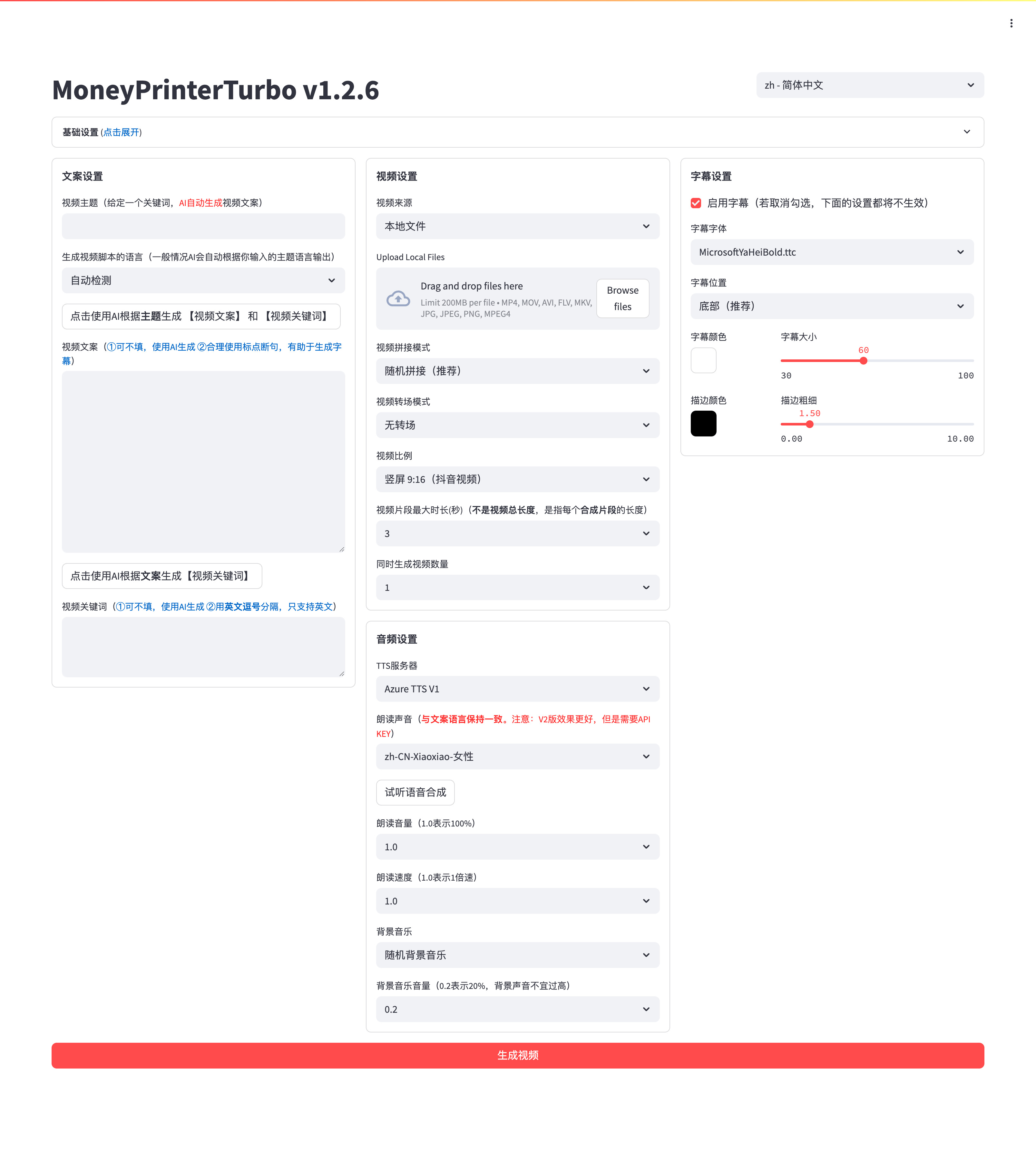
利用 AI 大模型和自动化工作流,根据主题或关键词一键生成高清短视频。Generate HD short videos from a topic or keyword with an automated AI workflow.
Its last change on GitHub was on 2025-08-11. GitHub counts 72 open issues and pull requests. Take My Repo does not judge from that whether it is maintained.
Nobody has reviewed it on Take My Repo yet, which says nothing about its quality.
Take My Repo cannot say: it does not audit code and has not run gp.nvim. What is known comes from GitHub. It declares the MIT license on GitHub. Its last change was on 2025-08-11. It has 1,316 stars, which measure popularity, not safety. Nobody has reviewed it on Take My Repo yet, which says nothing about its quality. Read the source before you run it. With "Take it", your AI agent shows each step and asks you before running it; README text is treated as data, not as instructions.