
Studio
Automated defect detection and smart manufacturing through Deep Learning and Edge-Compute cameras.
- 22
- MIT
- 13 d ago
Repo Robopipe/Studio, read from GitHub 1 d ago. Robopipe has not joined Take My Repo.
In short
Robopipe/Studio is a public repo on GitHub by Robopipe. Automated defect detection and smart manufacturing through Deep Learning and Edge-Compute cameras. It declares the MIT license on GitHub. It is written mainly in TypeScript, has 22 stars and last changed on 2026-11-10. Nobody has reviewed it on Take My Repo yet, which says nothing about its quality. Read from GitHub on 2026-11-22.
Robopipe Studio: AI visual quality inspection software for manufacturing
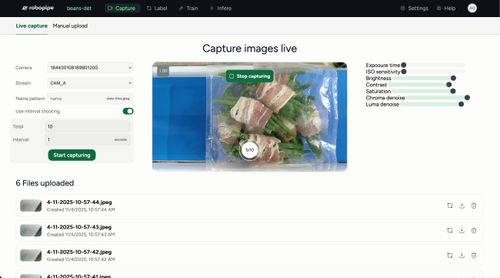
Robopipe Studio is a web application for AI quality control on production lines. Quality and production teams use it to capture images, label defects, train deep-learning models and run them on Luxonis OAK edge cameras.
Studio is the user interface of Robopipe, an industrial machine vision platform from Prague, Czech Republic. It covers the full computer vision pipeline for manufacturing in one tool: capture, label, train and infer. The trained model runs on the camera at the edge, so product images do not have to leave the plant.
Typical tasks are defect detection, foreign object detection, counting, and label and packaging checks. Studio is built for products with natural variation, such as food, where rule-based machine vision often fails.
🇨🇿 Robopipe Studio je software pro AI kamerovou kontrolu kvality ve výrobě. Více na robopipe.io/cs.
 Capture |
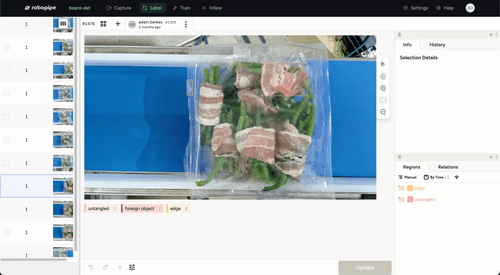 Label |
|---|---|
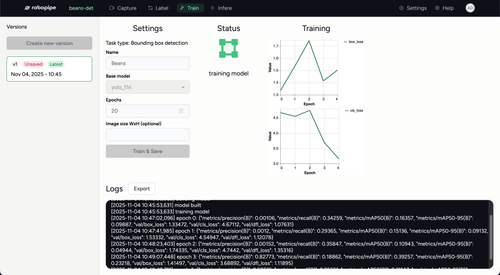 Train |
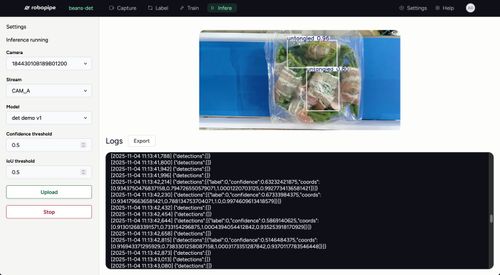 Infer |
Features
- Capture. Find Robopipe controllers and Luxonis OAK cameras on the local network, watch the live stream and capture training images into a project.
- Label. Annotate images in the browser with bounding boxes, polygons and classification labels. Optional AI pre-annotation (
apps/ml-infer, prototype) suggests polygons from an existing model. - Train. Train object detection, instance segmentation and classification models with luxonis-train (
apps/ml). Train YOLO object detection models with Ultralytics (apps/ml-yolo). - Export for the edge. Export models to ONNX and convert them for Luxonis RVC2, RVC3 and RVC4 devices through Luxonis HubAI.
- Infer. Deploy a model to a camera through Robopipe API and see detections live. Sliced inference (SAHI) settings help with small defects.
- Teams and projects. Organisations, users, projects and label sets with JWT authentication.
- REST API. The Studio backend has OpenAPI (Swagger) documentation, so you can automate every step.
How Studio fits into Robopipe
Robopipe has three public parts. Each part works on its own, and together they form a complete visual inspection system.
| Part | What it does | Where it runs |
|---|---|---|
| Robopipe Studio (this repository) | Capture, labelling, training and deployment of AI models | Server or cloud, used in a web browser |
| Robopipe API | REST and WebSocket API for cameras, AI inference and PLC inputs and outputs | Robopipe controller or any Unix-based computer |
| Robopipe OS | Operating system image with Robopipe API preinstalled | Robopipe controller (based on Unipi Patron) |
| Luxonis OAK cameras | Image capture and on-device neural network inference | Above the production line |
Studio talks to the cameras through Robopipe API. It sends the trained model to the camera, and the camera runs inference offline.
Quick start
Run with Docker
Prerequisites: Docker and Docker Compose.
Clone the repository:
git clone https://github.com/Robopipe/Studio.git
cd Studio
Create the environment files for the ML training services:
cp apps/ml/.env.example apps/ml/.env
cp apps/ml-yolo/.env.example apps/ml-yolo/.env
Start all services (PostgreSQL, API, web, ML training):
docker compose up --buildIn a separate terminal, run the database migrations:
docker compose exec api pnpm -F api drizzle:pushOpen the app:
- Web app: localhost:5173
- API documentation (Swagger): localhost:3000/doc
The source code is volume-mounted, so changes reload automatically.
Run from source
Prerequisites:
- Node.js 18 or higher and pnpm 10.28.0 or higher
- PostgreSQL 16 or higher with a database for Robopipe:
psql -c "create database robopipe;" - Git
- Python 3.11, only if you run the ML training services in
apps/mlandapps/ml-yolo
Clone the repository:
git clone https://github.com/Robopipe/Studio.git
cd Studio
Install the dependencies:
pnpm installCreate the environment files:
cp apps/api/.env.example apps/api/.env
cp apps/web/.env.example apps/web/.env.local
Set
DATABASE_URLinapps/api/.envfor your PostgreSQL server.Build the packages and run the database migrations:
pnpm build && pnpm -F api drizzle:pushStart the app:
pnpm devOpen the app:
- Web app: localhost:5173
- API documentation (Swagger): localhost:3000/doc
Storage of images and models
The Studio backend stores images and models in Google Cloud Storage. Set the bucket name in BUCKET_NAME and give the backend Google Cloud credentials (Application Default Credentials).
Repository structure
| Path | Content |
|---|---|
apps/web |
Web app (React, TypeScript, Vite) |
apps/api |
Backend REST API (NestJS, Drizzle ORM, PostgreSQL) |
apps/ml |
Training service for luxonis-train models (FastAPI, PyTorch, ONNX) |
apps/ml-yolo |
Training service for YOLO models (FastAPI, Ultralytics) |
apps/ml-infer |
Prototype for AI pre-annotation with ONNX Runtime |
packages/database |
Shared database schema |
packages/schema |
Shared validation schemas (Zod) |
Robopipe as an alternative to Roboflow, Cognex and Keyence
Robopipe is an alternative to Roboflow, Cognex and Keyence for AI visual inspection on production lines. It is a complete inspection system: camera, controller with PLC inputs and outputs, trained model and line-side dashboards. The edge software (Robopipe API) is open source under the MIT licence.
- Compared with Roboflow. Roboflow is a developer platform for annotation, training and deployment, with a large library of public datasets. Robopipe focuses on the factory floor: hardware, PLC integration, operator dashboards and on-site support in Czechia and the EU. Choose Roboflow if you are a software team that builds its own vision product. Read Roboflow alternatives in 2026.
- Compared with Cognex and Keyence. Cognex and Keyence make excellent rule-based vision systems for gauging, barcode reading and pattern matching. Robopipe uses deep-learning models trained on your own good and defective parts, so it handles natural product variation. Robopipe is offered as a subscription instead of a capital purchase. Choose Cognex or Keyence for high-speed gauging at micron precision or 3D metrology. Read Cognex alternatives in 2026 and Keyence alternatives for machine vision.
Use cases
- Food processing: defects, foreign objects and portion checks at line speed.
- Pharma and healthcare: fill, closure and label verification, for example capsule counting in supplement jars.
- Retail and e-commerce: automated product tagging for the catalogue.
- Logistics: live safety hazard detection and movement statistics.
See the case studies and the Robopipe blog, for example The capture-to-inference pipeline explained and What is a vision system?
Documentation
Read the Robopipe documentation for hardware setup, the API reference and examples.
Feedback and community
Open a GitHub issue for bugs, improvement ideas, documentation or developer experience. Join the Robopipe subreddit to share your apps and ask questions.
License
Robopipe Studio is open source under the MIT License.
Contact
- Website: robopipe.io (česky)
- Book a demo or ask a question: robopipe.io/en/contact
- Pricing: robopipe.io/en/pricing
Robopipe is developed by Robopipe s.r.o., Prague, Czech Republic.
Questions
What is Studio?
Robopipe/Studio is a public repo on GitHub by Robopipe. Automated defect detection and smart manufacturing through Deep Learning and Edge-Compute cameras.
Is Studio open source?
It declares the MIT license on GitHub.
Does Studio run on macOS, Windows or Linux?
Its maker tagged it for macOS, Windows and Linux, or as Docker or cross-platform. That is declared by the maker; Take My Repo has not tested it.
How do I install Studio?
Open "Take it" on its page: Take My Repo writes an install plan for your machine and hands it to your AI agent (Claude Code, Codex or Cursor), which asks you before each step. Take My Repo has not tested it on any machine.
Is Studio still maintained?
Its last change on GitHub was on 2026-11-10. GitHub counts 0 open issues and pull requests. Take My Repo does not judge from that whether it is maintained.
What do people who ran Studio say?
Nobody has reviewed it on Take My Repo yet, which says nothing about its quality.