grin
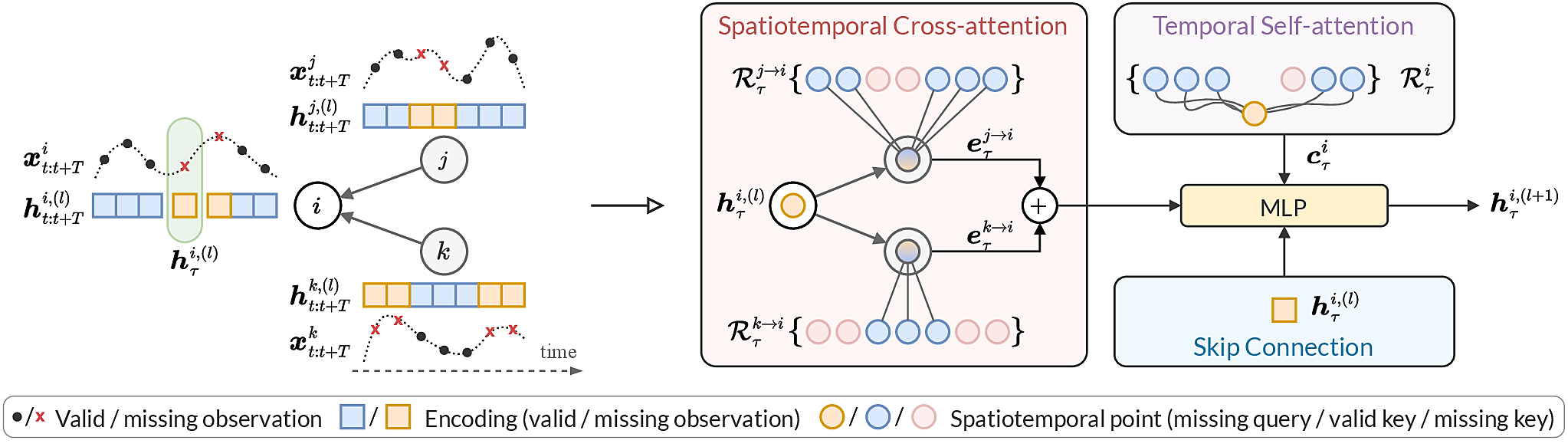
Official repository for the paper "Filling the G_ap_s: Multivariate Time Series Imputation by Graph Neural Networks" (ICLR 2022)
- 195
- Python
- 4 y ago
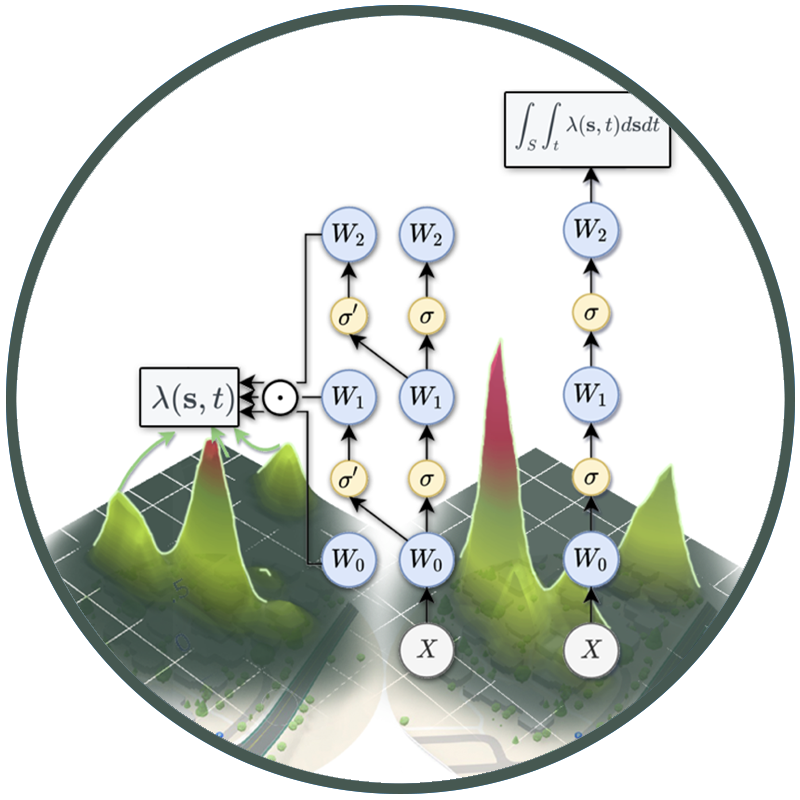
Automatic Integration for Neural Spatio-Temporal Point Process models (AI-STPP) is a new paradigm for exact, efficient, non-parametric inference of point process. It is capable of learning complicated underlying intensity functions, like a damped sine wave.
Repo Rose-STL-Lab/AutoSTPP, read from GitHub 3 d ago. Rose-STL-Lab has not joined Take My Repo.
Rose-STL-Lab/AutoSTPP is a public repo on GitHub by Rose-STL-Lab. Automatic Integration for Neural Spatio-Temporal Point Process models (AI-STPP) is a new paradigm for exact, efficient, non-parametric inference of point process. It is capable of learning complicated underlying intensity functions, like a damped sine wave. It declares the MIT license on GitHub. It is written mainly in Jupyter Notebook, has 25 stars and last changed on 2024-10-14. Nobody has reviewed it on Take My Repo yet, which says nothing about its quality. Read from GitHub on 2026-11-19.
Automatic Integration for Neural Spatio-Temporal Point Process models (Auto-STPP) is a new paradigm for exact, efficient, non-parametric inference of spatiotemporal point process.
[2310.06179] Automatic Integration for Spatiotemporal Neural Point Processes
@article{zhou2023automatic,
  title={Automatic Integration for Spatiotemporal Neural Point Processes},
  author={Zhou, Zihao and Yu, Rose},
  journal={arXiv preprint arXiv:2310.06179},
  year={2023}
}
Dependencies: make, conda-lock
make create_environment
conda activate autoint-stpp
python src/download_data.py
Specify the parameters in configs/autoint_stpp.yaml and then run
make run_stpp config=autoint_stpp
Rose-STL-Lab/AutoSTPP is a public repo on GitHub by Rose-STL-Lab. Automatic Integration for Neural Spatio-Temporal Point Process models (AI-STPP) is a new paradigm for exact, efficient, non-parametric inference of point process. It is capable of learning complicated underlying intensity functions, like a damped sine wave.
It declares the MIT license on GitHub.
Its maker has not tagged a system, so it is unknown here. Its README says what it needs.
Open "Take it" on its page: Take My Repo writes an install plan for your machine and hands it to your AI agent (Claude Code, Codex or Cursor), which asks you before each step. Take My Repo has not tested it on any machine.
Its last change on GitHub was on 2024-10-14. Take My Repo does not judge from that whether it is maintained.
Official repository for the paper "Filling the G_ap_s: Multivariate Time Series Imputation by Graph Neural Networks" (ICLR 2022)
Nobody has reviewed it on Take My Repo yet, which says nothing about its quality.
Official repository for the paper "Learning to Reconstruct Missing Data from Spatiotemporal Graphs with Sparse Observations" (NeurIPS 2022)