

AutoGPT
AutoGPT is the vision of accessible AI for everyone, to use and to build on. Our mission is to provide the tools, so that you can focus on what matters.
- 188k
- Python
- 44 min ago

NOW you can let AI agents make code changes without losing engineering control.
Repo RunWield/runwield, read from GitHub 1 min ago. RunWield has not joined Take My Repo.
RunWield/runwield is a public repo on GitHub by RunWield. NOW you can let AI agents make code changes without losing engineering control. It declares the MIT license on GitHub. It is written mainly in TypeScript, has 60 stars and last changed on 2026-11-23. Nobody has reviewed it on Take My Repo yet, which says nothing about its quality. Read from GitHub on 2026-11-23.
AutoGPT is the vision of accessible AI for everyone, to use and to build on. Our mission is to provide the tools, so that you can focus on what matters.

v0.14.0: RunWield is open source under MIT. The CLI, TUI, personal Workspace, and ACP server remain free forever. Read the announcement · MIT license
Review what the AI plans to do before it touches your code. Then prove it did it.
Millions of developers now spend their days reviewing code they didn't write, from AI agents that never explained what they were building. RunWield fixes that. It's a senior tech lead in a box: it reads your repo, writes a plan you approve before any code changes, has specialized agents build it, and won't call the work done until CI and a separate reviewer confirm it matches the plan. Every decision is recorded, so the next change starts from what your team already learned. The core is free, runs locally, and it works with any model.
Ceremony scales with risk: quick fixes stay quick, and only risky work gets a plan. Big implementations get an expert architect review and a series of plans to implement in manageable chunks.
ideate -> plan -> execute -> record -> use records to plan better
Website · Install · How it works · Documentation

Oh, hello.
curl -fsSL https://raw.githubusercontent.com/RunWield/runwield/main/install.sh | bash
Then, from your project root:
wld
First run asks you to connect a model — a subscription login or your own API key. RunWield works with any provider. Then
run /init once to let it explore the repo and build project context, and just say what you want:
> fix the failing parser test
macOS and Linux, installs to ~/.local/bin, no root required.
For setup details, including model provider authentication, runtime helpers, and running from source, see the Quickstart Guide.
Choose a bundled model preset in /settings → Model Presets: codex, opencode, claude-mixed,
claude-opus, or codex-claude. See the preset reference for model
assignments and customization.
We recommend Gemma4 31B through Ollama Cloud for Router. Starting November 9, 2026, Ollama's Free plan switches to pay-as-you-go billing, and this model requires prepaid usage credits. See Ollama pricing for current rates. Local models remain free to run through Ollama.
I'm looking for five developers to try RunWield on one real, non-trivial change. I'll personally help you get running, fix anything that blocks you within a day, and give you a direct say in the roadmap. Try it with me →
RunWield Core owns local workflow truth. RunWield Connect brings those gates into an external agent host. RunWield Workspace provides the browser Session and collaboration surfaces.
The Claude Code FEATURE Preview keeps the conversation and every model call in Claude Code. Core needs no model
credentials or RunWield account. Install the wld plugin from the RunWield marketplace in Claude Code:
/plugin marketplace add RunWield/plugins
/plugin install wld@runwield
Start with /wld:request. See the Claude guide for setup and migration.
RunWield Connect for Codex provides one explicit $wld:run skill for
starting or resuming work in the desktop app and CLI. The native package is available for FEATURE Preview qualification;
neither surface has a qualified complete workflow yet. The guide distinguishes package probes, live execution, and
desktop evidence, with installation through the same RunWield marketplace.
Both adapters use Core's workflow and can continue the same local repository's saved work across hosts without importing conversation history. Their guides list evidence limits, recovery, and plugin management. Unlike Core's Session flow below, Connect suggests manual checks in the host conversation rather than saving a Manual QA checklist.
Most coding harnesses optimize for getting an agent typing as fast as possible. Chat, and hope.
So the expensive part is never the typing. It's the moment you're staring at a 40-file diff, trying to reverse-engineer what the model thought it was building, and deciding whether to spend an hour reviewing it or an afternoon redoing it. You never got to say "no, not like that" while it was still cheap. And when you finally merge, everything you learned along the way evaporates — the next session starts from zero and makes a version of the same mistake.
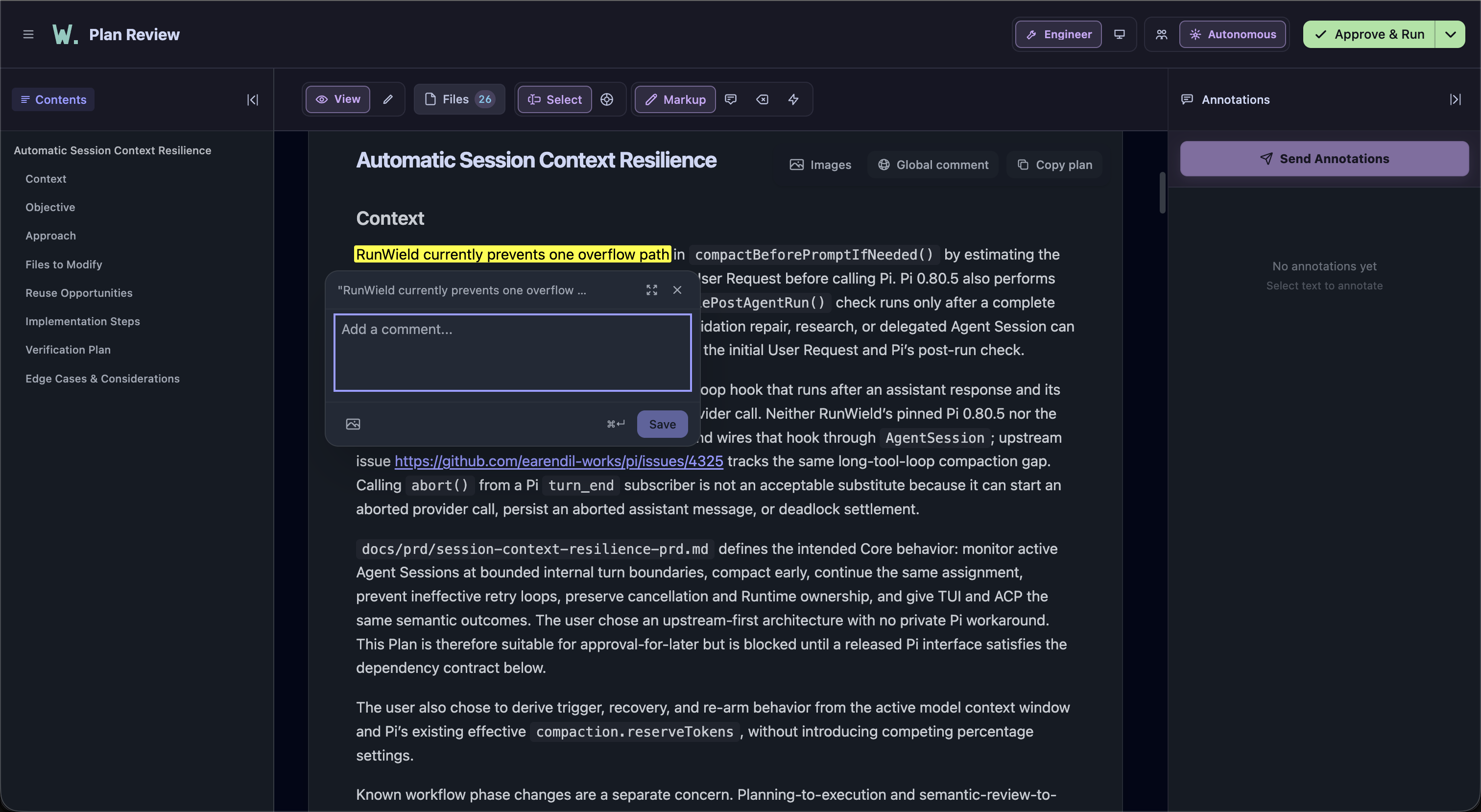
1. You review intent, not just diffs. For anything non-trivial, a Planner agent writes a plan before an Engineer writes code. You review it in a real browser UI — inline comments, revisions, approval — not by squinting at a wall of chat. Redirecting a plan costs a sentence. Redirecting a finished branch costs a day.
2. Ceremony scales with risk. Every request is triaged into one of six intents, and only the expensive ones get the expensive treatment:
| Your request | What happens |
|---|---|
| "how does auth work here?" | Inquiry — Guide just answers. No plan, no ceremony. |
| "should we move to event sourcing?" | Ideation — Ideator researches, interviews you, produces a PRD. |
| "bump the deps and update the lockfile" | Operation — Operator does it directly. No code implementation. |
| "fix the failing parser test" | Quick fix — Engineer implements, then CI has to pass. |
| "add SSO to the admin panel" | Planned Change — bug, feature, or refactor. Planner writes a plan → you approve → Engineer executes → full validation. |
| "migrate the billing system" | Project — Architect designs an Epic, Slicer decomposes it with you into shippable Planned Changes. |
How much ceremony the work gets is tracked separately from what kind of work it is. A gnarly bug that needs a real plan is still recorded as a bug fix, not quietly relabeled a feature.
3. "Done" is proven, not asserted. This is the part most harnesses skip. When an Engineer says it's finished, RunWield doesn't believe it:
verified after Git itself
confirms the sealed implementation commit reached the recorded landing branch. For standalone Plans, that defaults to
plan/<plan-name>; the owner handles the onward merge or PR. Not because an agent said so.4. Your project remembers. Every finished plan produces a Work Record — what changed, why, what was rejected along the way. Combined with searchable project memory, PRDs, and ADRs, the next planning session starts from what you already learned instead of from an empty context window.
Most agent tools are organized around tickets and chat sessions. They help teams run many agents and manage context. RunWield is organized around the Plan and its lifecycle. It decides:
They expose rich session history. RunWield deliberately treats raw conversations as private working space and makes Plans, PRDs, ADRs, and Work Records the durable knowledge layer. All of the artifacts stay in your repo as plain markdown, so you can grep, diff, and version them like any other source file. RunWield will never encrypt or convert those files to keep you trapped. Any other harnesses or coding tools can still make use of them.
You type wld "add rate limiting to the public API". Then:
verified. By default it lands on plan/<plan-name>, ready
for you to merge or open a PR to the intended target. Auto-merge into target branch
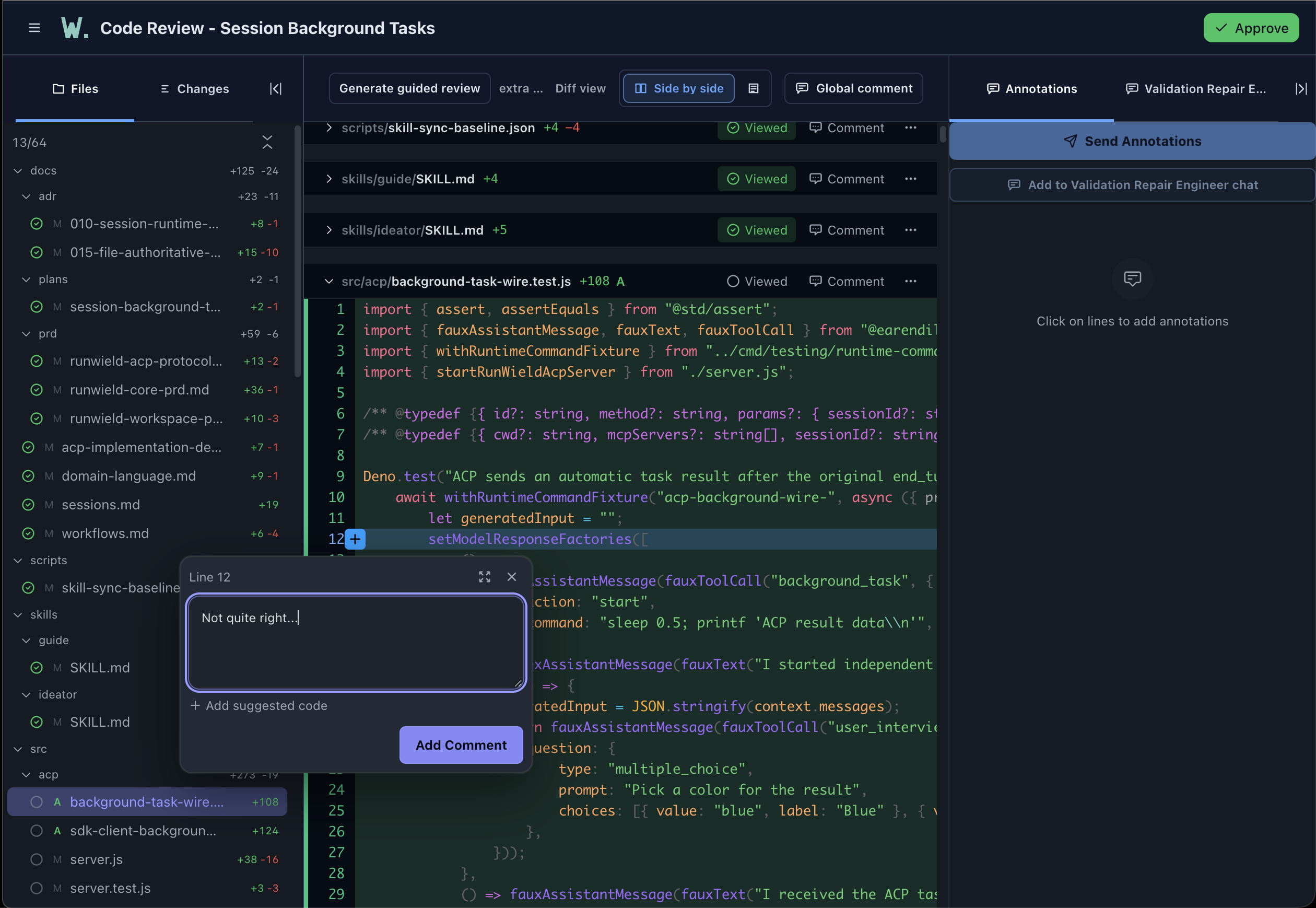
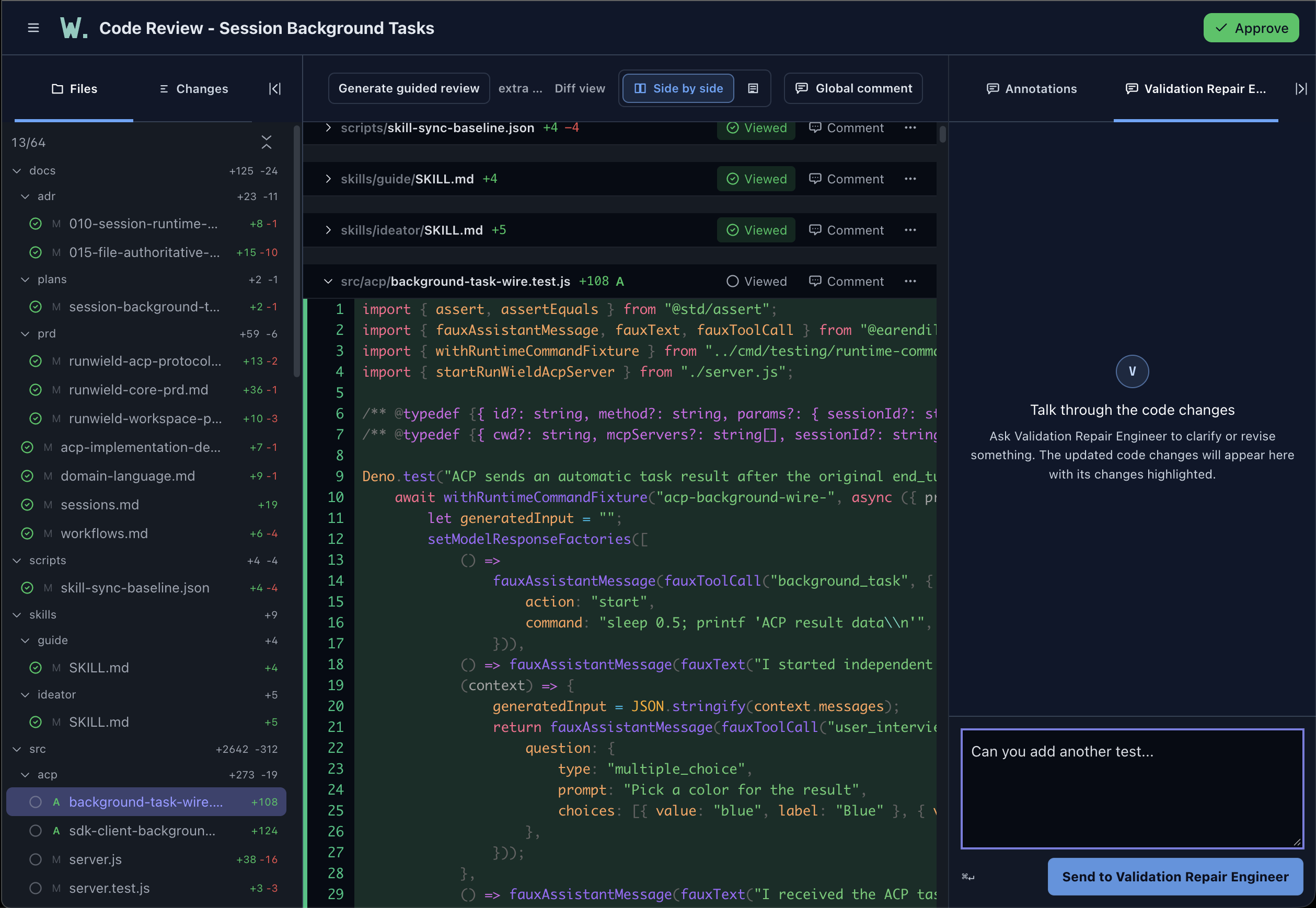
delivers directly to that target when enabled.Every one of those steps is a place you can interrupt, redirect, or stop. That's the whole idea.
Yes, if you work on codebases where a bad change is expensive, you want to steer before code exists instead of after, and you're tired of "done!" meaning "the model stopped typing."
Probably not if you mostly write one-shots or quick scripts where a quick chat with Claude is enough.
I'm looking for five developers to run RunWield on one real, non-trivial change — not a toy repo, not a demo.
In exchange: I'll personally help you get set up, fix whatever blocks you, and you get a direct line into what gets built next.

Just reading along.
RunWield is built on Pi and ships as a single compiled binary.
.bun-version selects the runtime.RunWield/runwield is a public repo on GitHub by RunWield. NOW you can let AI agents make code changes without losing engineering control.
It declares the MIT license on GitHub.
Its maker has not tagged a system, so it is unknown here. Its README says what it needs.
Open "Take it" on its page: Take My Repo writes an install plan for your machine and hands it to your AI agent (Claude Code, Codex or Cursor), which asks you before each step. Take My Repo has not tested it on any machine.
FinceptTerminal is a modern finance application offering advanced market analytics, investment research, and economic data tools, designed for interactive exploration and data-driven decision-making in a user-friendly environment.
The best way to get AI coding agents to solve hard problems in complex codebases.
The agent harness performance optimization system. Skills, instincts, memory, security, and research-first development for Claude Code, Codex, Opencode, Cursor and beyond.
Build Agentic workflows, RAG pipelines, with rich AI model and tool support on one collaborative workspace. Deploy on cloud, VPC, or self-hosted, so teams move from prototype to production without rebuilding the stack.
Its last change on GitHub was on 2026-11-23. Take My Repo does not judge from that whether it is maintained.
Nobody has reviewed it on Take My Repo yet, which says nothing about its quality.
Take My Repo cannot say: it does not audit code and has not run runwield. What is known comes from GitHub. It declares the MIT license on GitHub. Its last change was on 2026-11-23. It has 60 stars, which measure popularity, not safety. Nobody has reviewed it on Take My Repo yet, which says nothing about its quality. Read the source before you run it. With "Take it", your AI agent shows each step and asks you before running it; README text is treated as data, not as instructions.






