dify
Build Agentic workflows, RAG pipelines, with rich AI model and tool support on one collaborative workspace. Deploy on cloud, VPC, or self-hosted, so teams move from prototype to production without rebuilding the stack.
- 162k
- Python
- 5 min ago

Your Software Factory - build faster and better with multi node agents that work 24/7
Repo Runfusion/Fusion, read from GitHub 1 min ago. Runfusion has not joined Take My Repo.
Runfusion/Fusion is a public repo on GitHub by Runfusion. Your Software Factory - build faster and better with multi node agents that work 24/7. It declares the MIT license on GitHub. It is written mainly in TypeScript, has 1,344 stars and last changed on 2026-11-22. Nobody has reviewed it on Take My Repo yet, which says nothing about its quality. Read from GitHub on 2026-11-24.
Build Agentic workflows, RAG pipelines, with rich AI model and tool support on one collaborative workspace. Deploy on cloud, VPC, or self-hosted, so teams move from prototype to production without rebuilding the stack.
 Fusion
Describe what you want — a team of AI agents plans, builds, reviews, and ships it for you. Fusion is your software factory: an assembly line for code that runs across tasks, agents, missions, git, files, and worktrees, with any model, local or cloud.
runfusion.ai → · Docs · GitHub · npm · Discord
English · 简体中文 · 繁體中文 · Français · Español · 한국어 · Português (Brasil)
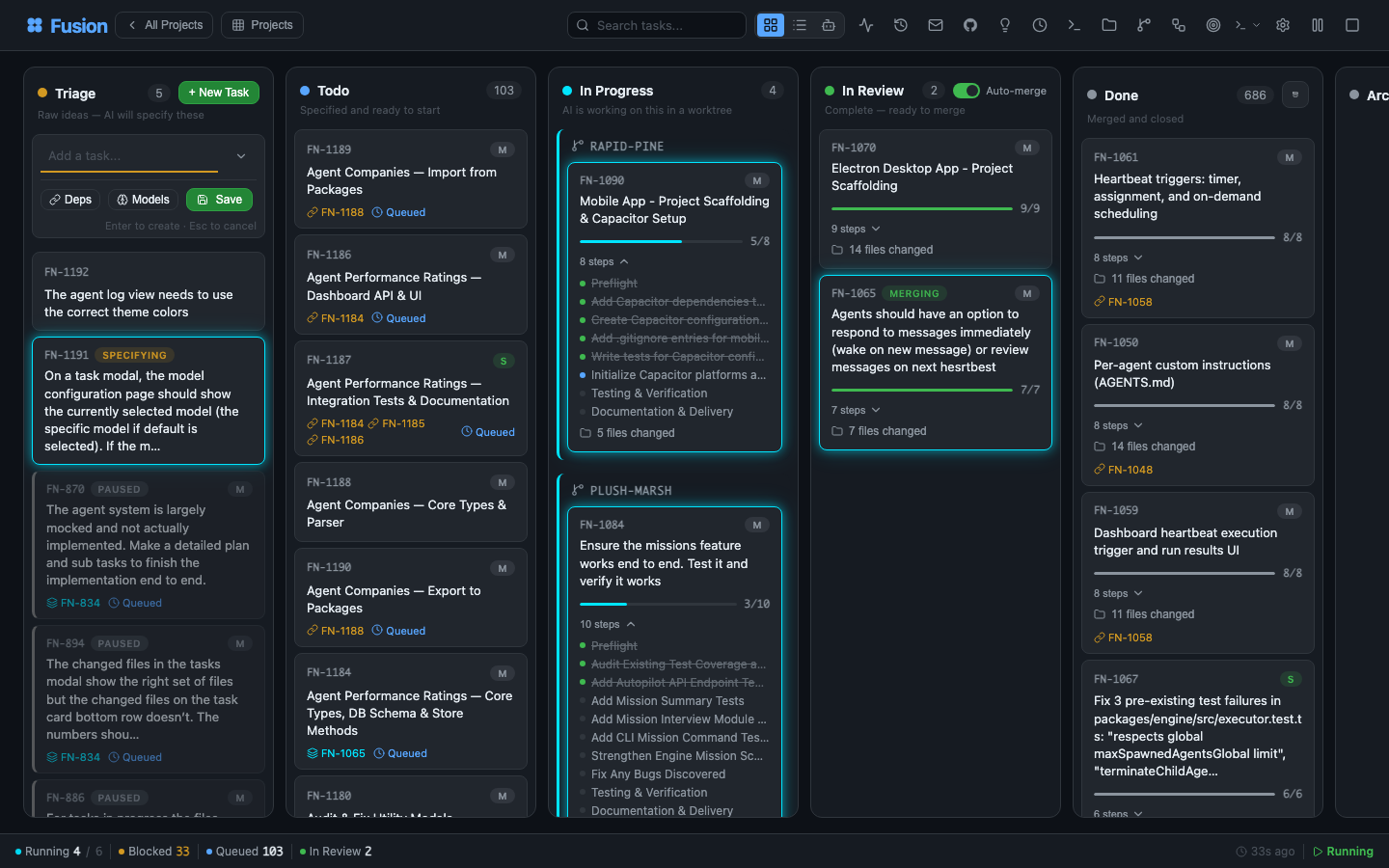
Describe a task in plain language. A planning agent reads your project, understands context, and writes a full PROMPT.md plan — steps, file scope, acceptance criteria. Then Fusion plans, reviews, executes, and reviews again, in an isolated git worktree, with a human approval gate wherever you want one.
One board. Controlled from anywhere. Laptop, Mac mini, Linux server, cloud VM, phone — all connected.
Like Trello, but your tasks get specified, executed, and delivered by AI. Built on the great work of dustinbyrne/kb.
Zero install, straight from npm:
npx runfusion.ai
That launches the dashboard. Subcommands forward through: npx runfusion.ai task create "fix X", npx runfusion.ai --help, etc. (Or verbosely: npx @runfusion/fusion dashboard.)
One-line installer (macOS & Linux — auto-picks Homebrew, falls back to npm):
curl -fsSL https://runfusion.ai/install.sh | sh
fusion dashboard
Homebrew (macOS & Linux):
brew install runfusion/fusion/fusion
fusion dashboard            # or: fn dashboard
Fully-qualified install auto-taps and, on Homebrew 6.0+, trusts only the Fusion formula. If you already ran brew tap runfusion/fusion and short-name install fails with “untrusted tap”, run brew trust --formula runfusion/fusion/fusion then brew install fusion.
npm global:
npm install -g @runfusion/fusion
fn dashboard                # or: fusion dashboard
From a clone (for development):
pnpm dev dashboard
Then click the Open: URL printed in the terminal. It embeds a bearer token
(http://localhost:4040/?token=fn_...) that the browser captures to
localStorage on first visit and reuses automatically thereafter. On the
server side, Fusion now persists the dashboard/daemon token in
~/.fusion/settings.json on first authenticated run and reuses it on later
starts unless you override it (--token, FUSION_DASHBOARD_TOKEN,
FUSION_DAEMON_TOKEN) or disable auth with --no-auth. See
CLI reference → fn dashboard → Authentication
for full precedence and reset/revocation options.
On first launch, Fusion opens the onboarding wizard with three guided steps:
The wizard is dismissible and non-blocking — click Skip for now to use the dashboard immediately. Re-trigger it later from Settings → Authentication → Reopen onboarding guide.
For Capacitor + PWA workflow, see MOBILE.md.
  ①  Describe          ②  Planning             ③  The board           ④  Isolated worktree
  ─────────────        ─────────────         ─────────────          ─────────────────────
  "Add dark mode   →   Agent writes    →   Plan → Review →    →   fusion/FN-123 branch
   toggle to           PROMPT.md           Execute → Review        concurrent, zero
   settings panel"     (steps, scope,      (per step, until        file conflicts
                       acceptance)         done)
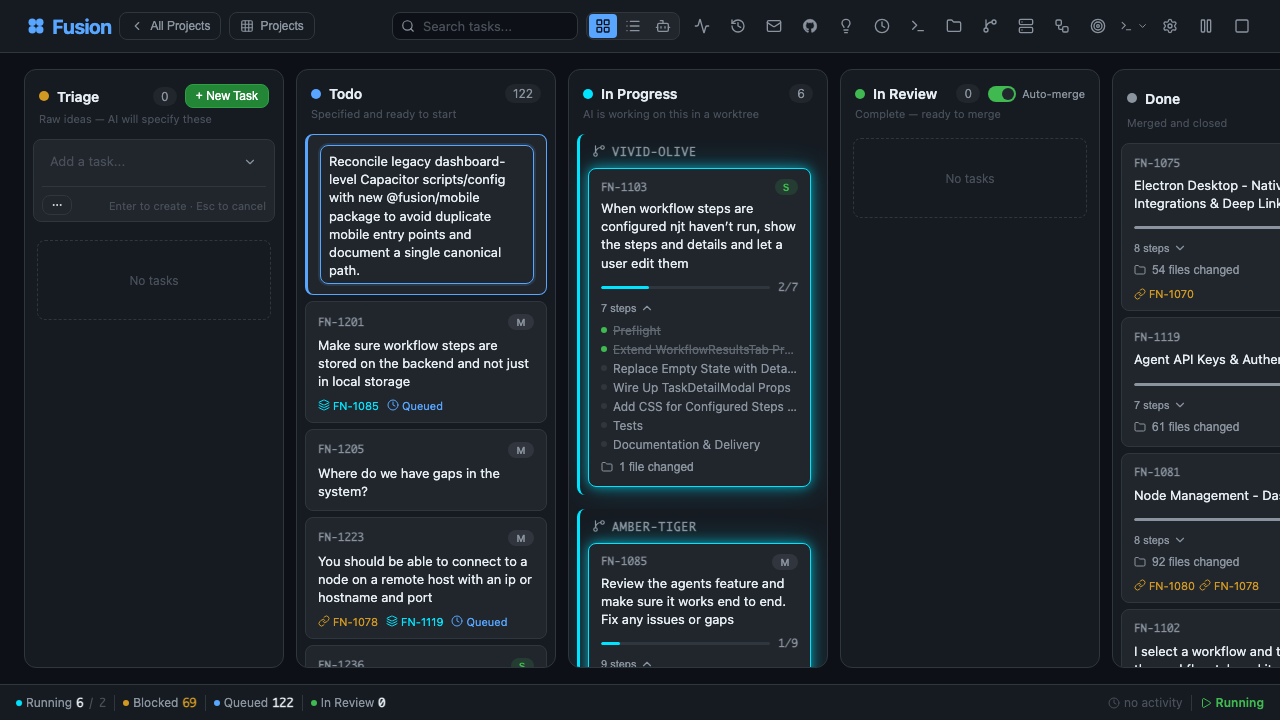
Every task shows its plan, its reviews, its diffs, and its file changes in real time. Jump into an active task and nudge direction, tighten constraints, pause, or re-prompt.
| 🧠 AI planning | Describe a task in plain language. Planning agents turn it into a PROMPT.md plan with steps, file scope, and acceptance criteria. |
| 🔁 Selectable workflows | Built-ins cover coding, quick fixes, review-heavy work, stepwise execution, plugin-gated Compound Engineering, and PR lifecycle fragments. Pick a workflow per task or author custom ones in the Workflow Editor. |
| 🛡️ Planner oversight | Per-task or per-workflow oversight level (off / observe / steer / autonomous) governs how closely a planner overseer watches and intervenes — merge/PR and destructive actions always require explicit human confirmation. See Settings Reference and Dashboard Guide. |
| 🌳 Worktree isolation | Each task runs in its own branch and worktree (fusion/{task-id}). Parallel tasks. Zero conflicts. Optional worktrunk delegation via worktrunk.enabled (see WorktreeBackend abstraction). |
| 🗄️ PostgreSQL by default | Fusion uses zero-config embedded PostgreSQL for local runtime metadata. Legacy SQLite files are one-time migration inputs only; use a shared external database for multi-project and multi-node setups. (Storage) |
| ⚡ Smart merge controls | Passing every gate? Fusion squash-merges and moves on. Opt into manual approval anywhere, inherit the live global auto-merge default, or set explicit per-task auto/manual overrides. |
| 🛰️ Multi-node mesh | Laptop, Mac mini, Linux server, cloud VM, phone — all synced. Desktop, mobile, web. |
| 🧩 Any model | Anthropic, OpenAI, Ollama, Google Generative AI, Z.ai, Kimi K3, local runtimes, and user-defined custom providers. Local and cloud coexist, with workflow model/fallback lanes configurable per project. |
| 🏢 Agent companies | Import pre-built teams — 440+ agents across 16 companies — and run them autonomously for weeks. |
| 📬 Inter-agent messaging | Built-in mailbox between agents. Delegate, clarify, coordinate; engineer-role agents can opt into backlog auto-claim when you want implementation help beyond executor-only pickup. |
| 🗨️ Agent chat | Direct chat, task chat that proactively narrates step progress, failures, and review outcomes, attachments, in-chat question cards, resumable streams, and experimental multi-agent Chat Rooms where mentioned members respond directly and ambient members can join up to a cap. (Chat docs) |
| 🗺️ Missions | Hierarchical planning (Mission → Milestone → Slice → Feature → Task) with autopilot and validation contracts. |
| 🔬 Research | Bounded research runs with web search, GitHub, local docs, and LLM synthesis (plus runtime builtin WebSearch/WebFetch support in planning + synthesis flows when available). Turn findings into tasks. (Docs) |
| 🧪 Self-improvement | Agents reflect on their own output and update their prompts as they learn your codebase. |
| 🔓 Open source. MIT. | No vendor lock-in. Run it on your own hardware. Shipping weekly. |
The newest surfaces in Fusion, at a glance — the live board, your agent team, mission control, visual workflows, agent chat, multi-agent rooms, and inter-agent mail.

Every task, every column, every step — live. Cards carry GitHub links, step counts, review levels, and promote/move/archive actions. Switch to the Graph view to see task dependencies as an interactive node graph:
Board — kanban columns |
 Graph — dependency map |
Here is the same fleet re-skinned into the Ember theme (dark graphite with an orange accent), alongside the Agents roster:
 Board — Ember |
 Agents — Tokyo Night |
Import a team and every agent shows up here — role, reports-to chain, heartbeat, and token share. Each agent card's heartbeat dropdown shows Disabled when scheduling is persisted off; choose Disabled to pause heartbeats while retaining its cadence, or select an interval to re-enable them. The Agents roster in Ember:

Runfusion/Fusion is a public repo on GitHub by Runfusion. Your Software Factory - build faster and better with multi node agents that work 24/7.
It declares the MIT license on GitHub.
Its maker tagged it for macOS, Windows and Linux, or as Docker or cross-platform. That is declared by the maker; Take My Repo has not tested it.
Open "Take it" on its page: Take My Repo writes an install plan for your machine and hands it to your AI agent (Claude Code, Codex or Cursor), which asks you before each step. Take My Repo has not tested it on any machine.
AutoGPT is the vision of accessible AI for everyone, to use and to build on. Our mission is to provide the tools, so that you can focus on what matters.
The agent harness performance optimization system. Skills, instincts, memory, security, and research-first development for Claude Code, Codex, Opencode, Cursor and beyond.
Reverse engineer anything with agents, from app behavior down to native binaries.
An open-source long-horizon SuperAgent harness that researches, codes, and creates. With the help of sandboxes, memories, tools, skill, subagents and message gateway, it handles different levels of tasks that could take minutes to hours.
Its last change on GitHub was on 2026-11-22. GitHub counts 107 open issues and pull requests. Take My Repo does not judge from that whether it is maintained.
Nobody has reviewed it on Take My Repo yet, which says nothing about its quality.
Take My Repo cannot say: it does not audit code and has not run Fusion. What is known comes from GitHub. It declares the MIT license on GitHub. Its last change was on 2026-11-22. It has 1,344 stars, which measure popularity, not safety. Nobody has reviewed it on Take My Repo yet, which says nothing about its quality. Read the source before you run it. With "Take it", your AI agent shows each step and asks you before running it; README text is treated as data, not as instructions.