
Feather-Linux
Lightweight Debian-based Linux distribution optimized for x86-64 Intel Chromebooks.
- 3
- GPL-3.0
- 3 mo ago
Repo SakethSripada/Feather-Linux, read from GitHub 2 h ago. SakethSripada has not joined Take My Repo.
In short
SakethSripada/Feather-Linux is a public repo on GitHub by SakethSripada. Lightweight Debian-based Linux distribution optimized for x86-64 Intel Chromebooks. It declares the GPL-3.0 license on GitHub. It is written mainly in Shell, has 3 stars and last changed on 2026-08-12. Nobody has reviewed it on Take My Repo yet, which says nothing about its quality. Read from GitHub on 2026-11-24.

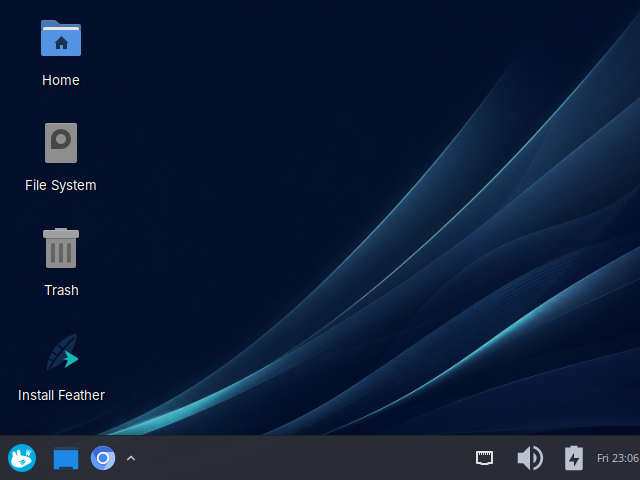
Feather is a lightweight Debian 13 distribution designed to make repurposed x86-64 Chromebooks useful, approachable computers for everyday work and development.
[!CAUTION] Feather is ready for controlled BOTEN hardware testing, not general or internal Chromebook installation.
No board has completed physical validation. Use only a newly built, verified candidate and the staged BOTEN runbook: live USB first, then a disposable external target. Do not install to internal eMMC or treat BOTEN as supported.
Why Feather
- Debian 13 with an XFCE desktop, built specifically for x86-64 Chromebooks.
- Lightweight base sized for the limited memory and storage of Chromebook hardware.
- Configures Chromebook-specific hardware, including the keyboard layout and per-board audio, from pinned, auditable sources.
- Per-board profiles rather than broad, platform-wide changes.
- Single Calamares installer with explicit disk selection.
- Standard Debian packages and security updates, not a custom ecosystem.
- Includes a browser, terminal, editor, file manager, and common networking and development tools.
The first hardware target is the Lenovo 500e Chromebook Gen 3, ChromeOS board
boten. Its profile is now qemu-verified, not supported. QEMU verifies
Feather's detection and configuration logic; it cannot prove that speakers,
touch, sensors, suspend, firmware, or internal storage work on the device.
Project status
| Area | Current evidence |
|---|---|
| Repository configuration and hardware fixtures | Passing locally; CI confirmation pending publication of current commits |
| Clean ISO artifact | 940572672 bytes, QEMU-verified (evidence) |
| UEFI and legacy live boot | QEMU-verified (evidence) |
| BOTEN injected-DMI QEMU test | QEMU-verified, not supported (evidence) |
| Calamares virtual-disk installation | Pending manual QEMU installation evidence |
| NVRAM fallback and disk isolation | Pending QEMU installation/storage evidence |
| Physical Chromebook validation | Ready to begin staged BOTEN live/external testing; no physical evidence yet |
Development is evidence-gated: each status advances only with its required proof (passing tests, a reproducible artifact, or a completed validation run).
Try it in QEMU
Feather runs in a throwaway virtual machine, so nothing on your host is
touched. All writable VM state stays under build/qemu/, and the launcher
refuses physical disks or raw images. Build on Debian 13, on a Linux filesystem
with at least 12 GiB genuinely free (WSL2 works too; see the
build guide).
Install the tools once:
sudo apt install qemu-system-x86 qemu-utils ovmf
One command to build a fresh ISO and open the desktop:
git clone --recursive https://github.com/SakethSripada/Feather-Linux.git feather-linux
cd feather-linux
scripts/preview.sh
scripts/preview.sh builds the ISO (it prompts for your password, because the
build needs root) and then boots it in a graphical QEMU window. Already have an
ISO? Skip straight to the window:
scripts/preview.sh --no-build
Prefer to drive QEMU yourself? Build once, then launch the newest ISO:
sudo scripts/build.sh
ISO=build/artifacts/feather-linux-<exact-build-id>-amd64.iso
scripts/verify-artifacts.sh --iso "$ISO"
qemu-system-x86_64 \
  -machine q35 -m 3072 -smp 4 -boot menu=on \
  -device virtio-vga \
  -device qemu-xhci,id=xhci -device usb-tablet,bus=xhci.0 \
  -device virtio-rng-pci \
  -netdev user,id=net0 -device virtio-net-pci,netdev=net0 \
  -drive if=none,id=cdrom,media=cdrom,readonly=on,file="$ISO" \
  -device ide-cd,drive=cdrom
On a host with KVM, add -accel kvm -cpu host for near-native speed. Without
it (for example on WSL2) QEMU uses software emulation: slower to boot, but it
works everywhere. The usb-tablet device gives you a normal, grab-free mouse.
For a headless boot check and the other bounded test modes (installer, injected-DMI hardware probe, writable sentinel disks), use the launcher directly. See the build guide:
scripts/test-qemu.sh --smoke --timeout 600
Documentation
- Architecture
- Building and QEMU testing
- Hardware support and diagnostics
- BOTEN hardware-test runbook
- BOTEN physical validation checklist
- Dual-boot validation plan, do not follow yet
- User quick start
- Developer quick start
- Contributing
- Security policy
License and independence
Project code is licensed under GPL-3.0. Original artwork has its own CC BY-SA 4.0 terms. Pinned third-party inputs retain their upstream licenses and notices. See the complete licensing map.
Chromebook is a trademark of Google LLC. Feather is an independent project and is not affiliated with or endorsed by Google LLC, Chromebook device manufacturers, MrChromebox, Chrultrabook, or the pinned upstream projects.
Questions
What is Feather-Linux?
SakethSripada/Feather-Linux is a public repo on GitHub by SakethSripada. Lightweight Debian-based Linux distribution optimized for x86-64 Intel Chromebooks.
Is Feather-Linux open source?
It declares the GPL-3.0 license on GitHub.
Does Feather-Linux run on macOS, Windows or Linux?
Its maker has not tagged a system, so it is unknown here. Its README says what it needs.
How do I install Feather-Linux?
Open "Take it" on its page: Take My Repo writes an install plan for your machine and hands it to your AI agent (Claude Code, Codex or Cursor), which asks you before each step. Take My Repo has not tested it on any machine.