gkd
基于无障碍,高级选择器,订阅规则的自定义屏幕点击安卓应用 | An Android APP with custom screen tapping based on Accessibility, Advanced Selectors, and Subscription Rules
- 45k
- Kotlin
- GPL-3.0
- 10 d ago
Interdisciplinary preprint examining shelter as a system of health, dignity, infrastructure, climate resilience, and human security, featuring the original seven-domain SHELTER Framework by SAMUELSON G.
Repo Samuelson777/shelter-systems-framework, read from GitHub 14 h ago. Samuelson777 has not joined Take My Repo.
Samuelson777/shelter-systems-framework is a public repo on GitHub by Samuelson777. Interdisciplinary preprint examining shelter as a system of health, dignity, infrastructure, climate resilience, and human security, featuring the original seven-domain SHELTER Framework by SAMUELSON G. It declares the MIT license on GitHub. It has 0 stars and last changed on 2026-09-10. Nobody has reviewed it on Take My Repo yet, which says nothing about its quality. Read from GitHub on 2026-11-22.
This repository contains the research paper:
Shelter as Infrastructure for Human Survival, Health, Dignity, and Climate Resilience: An Integrative Review and the SHELTER Systems Framework
Author: SAMUELSON G
Document type: Interdisciplinary review and conceptual framework
Status: Preprint — not peer reviewed
Shelter is more than a physical roof. It is a connected human-protection system involving structural safety, public health, water and sanitation, energy, land tenure, social networks, mobility, livelihoods, governance, dignity, accessibility, environmental performance, and long-term resilience.
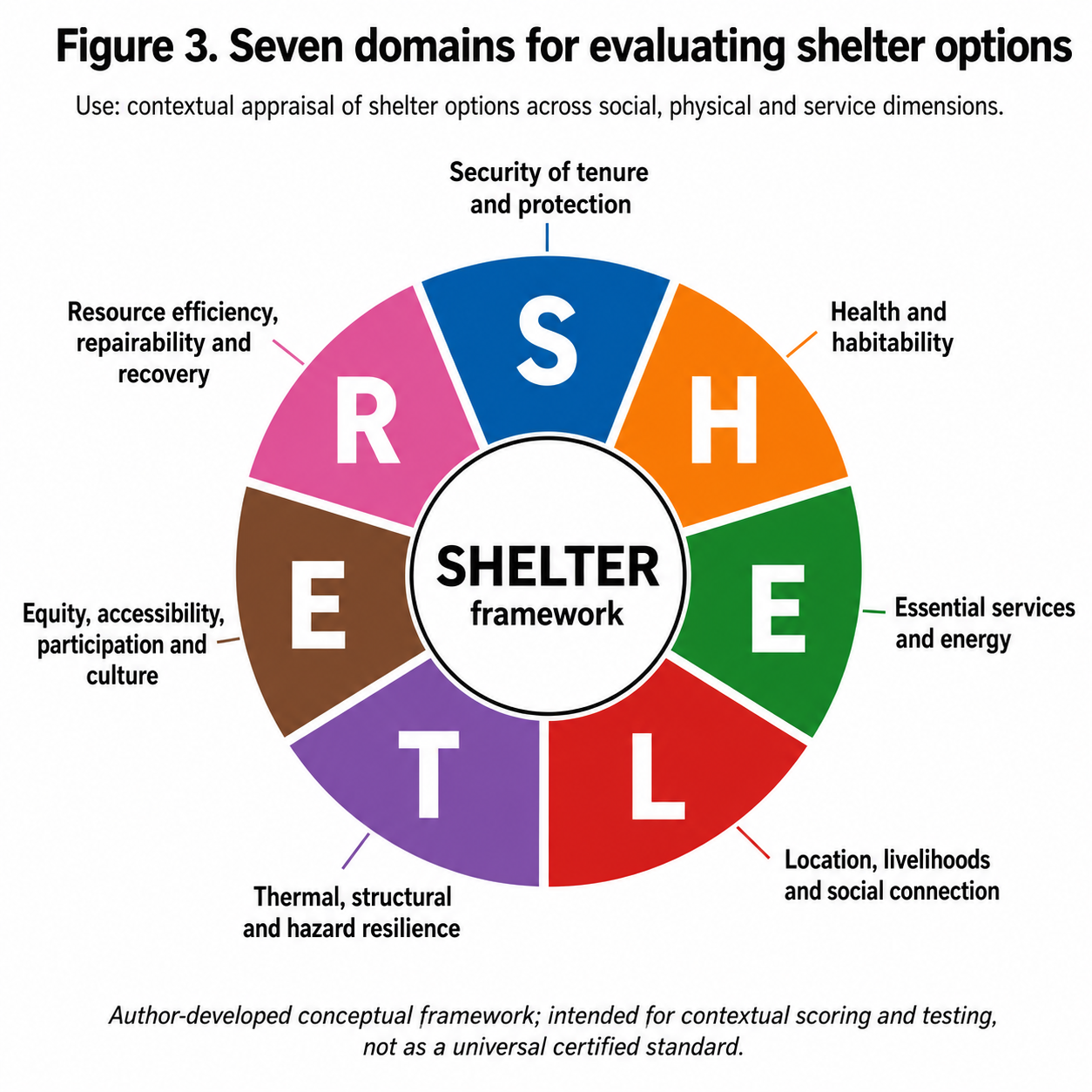
This paper presents an interdisciplinary review of shelter across permanent housing, emergency accommodation, disaster response, displacement, homelessness, climate adaptation, and sustainable development. It introduces the author-developed SHELTER Systems Framework, which evaluates shelter options through seven connected domains:
The central argument is that shelter performance emerges from interactions among these domains. A structurally sound building may still fail as shelter when it lacks secure tenure, sanitation, energy, accessibility, social connection, or protection from environmental hazards.
This study aims to:
The principal contribution of this paper is the SHELTER Systems Framework, an original seven-domain model for assessing whether a shelter solution is safe, healthy, dignified, accessible, service-connected, locally appropriate, and resilient.
The framework is intended for:
It is a conceptual tool and should not be treated as a universal certification standard without empirical validation.
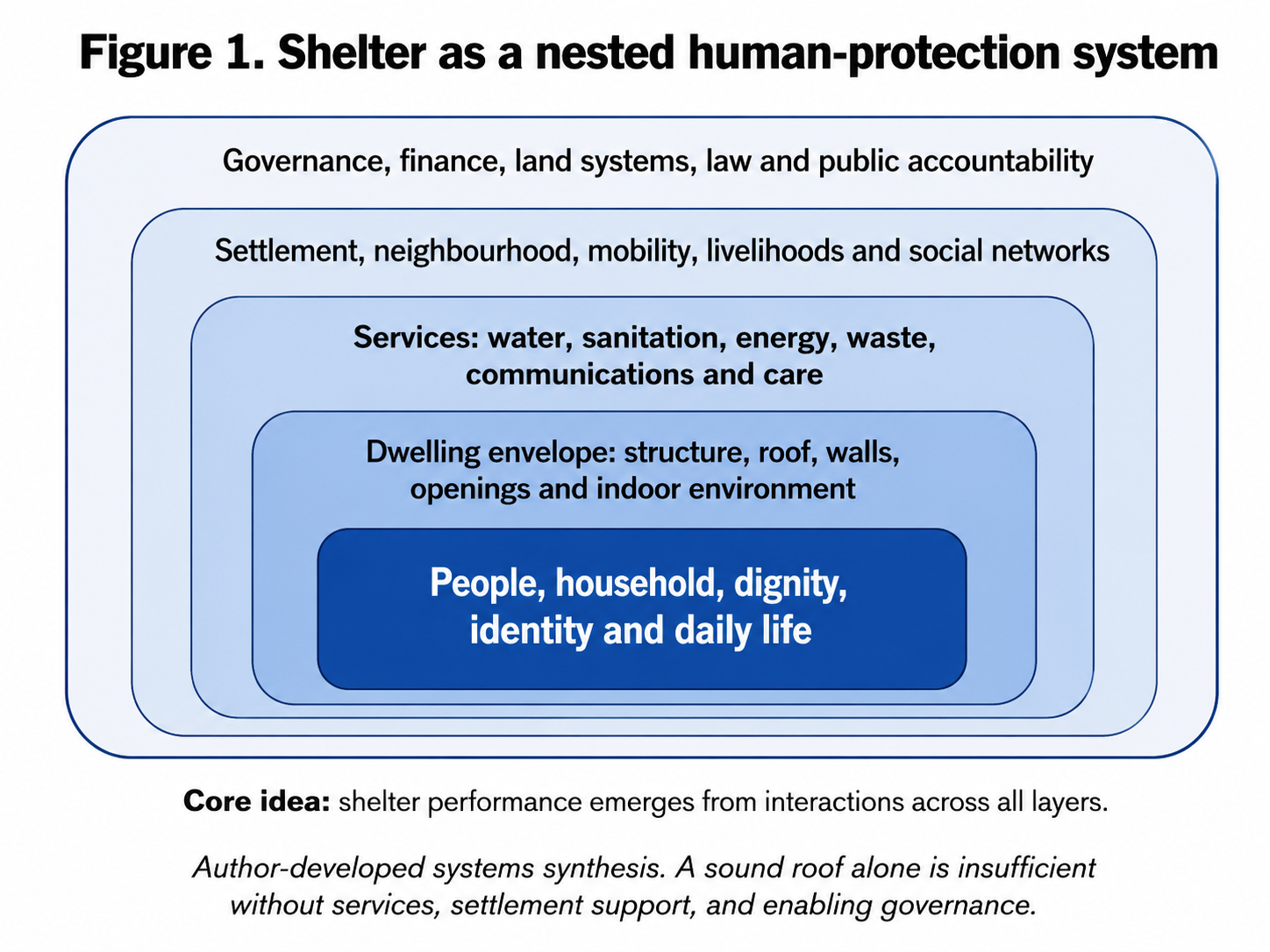
This figure presents shelter as a set of interacting layers:
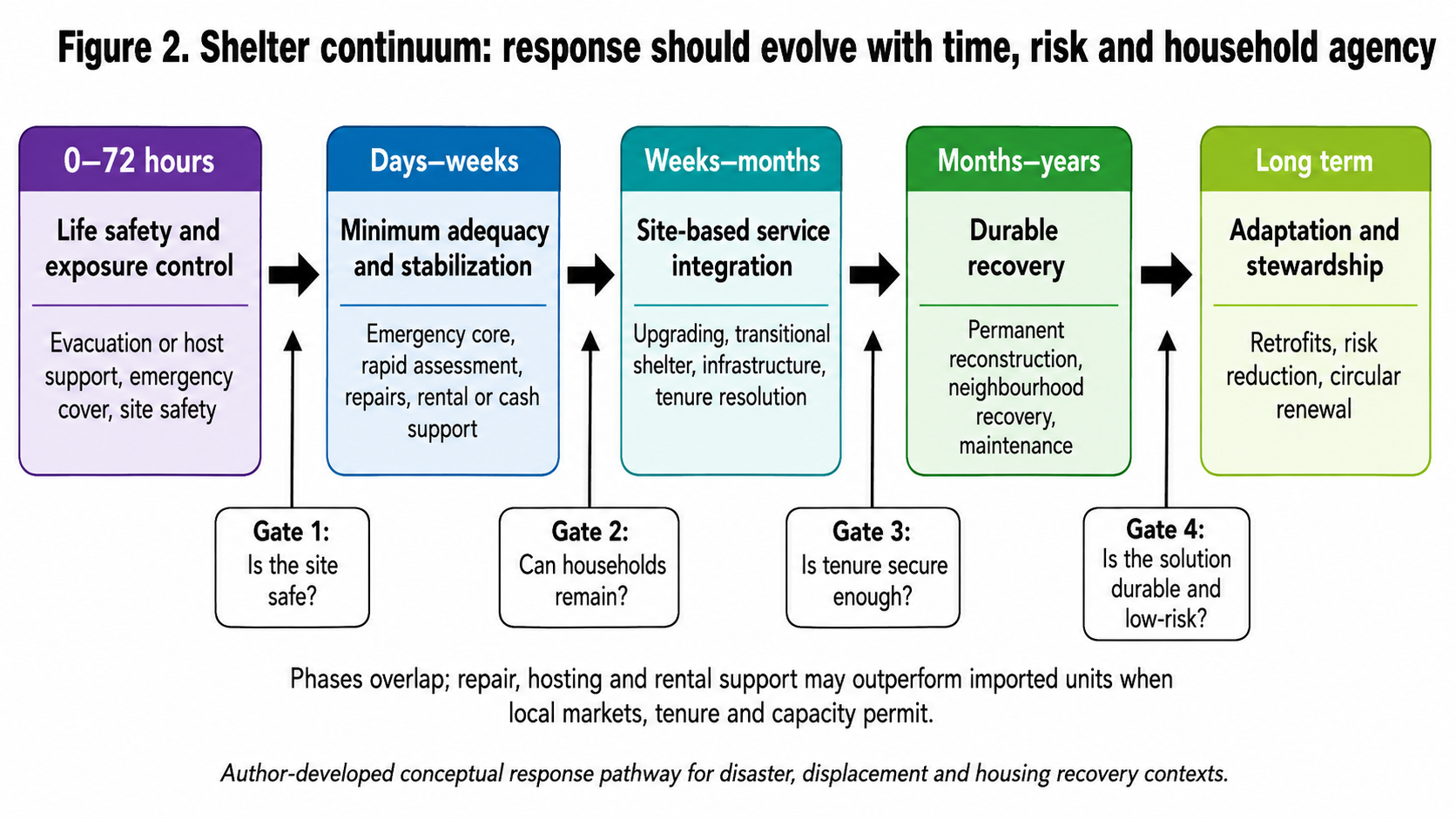
This figure describes the progression from immediate life safety to long-term resilience:
This figure summarizes the seven assessment domains of the proposed framework.
Shelter conditions influence respiratory illness, injury risk, thermal stress, infectious disease transmission, mental health, sleep quality, privacy, safety, and access to care. Health outcomes depend on both building quality and access to essential services.
Emergency shelter must first reduce immediate exposure and mortality risk. However, temporary solutions should not become long-term environments that reproduce insecurity, overcrowding, poor sanitation, isolation, or dependency.
Adequate shelter supports personal safety, identity, family life, privacy, education, employment, and social participation. Housing insecurity can undermine health and economic stability even when a physical structure is available.
Shelter must respond to heat, cold, floods, cyclones, earthquakes, wildfire, sea-level rise, and other hazards. Resilience requires suitable siting, structural design, passive thermal performance, maintenance, early-warning systems, and recovery capacity.
A dwelling cannot function adequately without reliable water, sanitation, drainage, energy, waste management, transport, communication, and access to healthcare, education, and livelihoods.
Shelter systems should consider children, older adults, persons with disabilities, displaced households, low-income communities, women, and groups exposed to discrimination or violence. Participation and culturally appropriate design are central to equitable shelter.
Long-term shelter planning should reduce operational energy use, material waste, avoidable demolition, and lifecycle emissions. Repairability, adaptability, local materials, reuse, and responsible recovery are essential sustainability principles.
The study uses an interdisciplinary integrative-review approach. Evidence and established guidance are synthesized from:
The paper does not report a clinical trial, field experiment, or original human-subject dataset. Its main output is a structured conceptual synthesis and an evaluation framework for future testing.
shelter-research-paper/
├── README.md
├── LICENSE
├── CITATION.cff
├── paper/
│   ├── Shelter_Research_Paper_SAMUELSON_G.pdf
│   └── Shelter_Research_Paper_SAMUELSON_G.docx
├── figures/
│   ├── Figure_1_Nested_Shelter_System.png
│   ├── Figure_2_Shelter_Continuum.png
│   └── Figure_3_SHELTER_Framework.png
├── supplementary/
│   └── SHELTER_Framework_Notes.md
└── references/
    └── references.bib
The framework may be adapted for:
Any application should be adjusted to local hazards, climate, law, culture, household priorities, available services, and resource constraints.
This work has several limitations:
Shelter should be understood as a living system rather than a standalone object. Its success depends on the interaction of people, dwellings, infrastructure, services, neighbourhoods, institutions, environmental conditions, and rights.
The review shows that a roof or enclosure alone is insufficient. A shelter may be structurally intact while remaining unsafe, unhealthy, inaccessible, unaffordable, insecure, isolated, or environmentally unsustainable. Effective shelter therefore requires simultaneous attention to tenure and protection, health and habitability, essential services, location and livelihoods, physical resilience, equity, and resource stewardship.
The proposed SHELTER Systems Framework provides a practical structure for organizing these dimensions. Its value lies not in producing a universal numerical score, but in making hidden failures visible and encouraging decisions that protect life, dignity, agency, and long-term resilience.
Future research should validate the framework across diverse climates, hazards, cultures, settlement types, and recovery phases. Participatory testing with affected communities will be especially important. The long-term goal is to support shelter systems that are not only physically protective, but also healthy, inclusive, adaptable, service-connected, locally grounded, and capable of recovery.
SAMUELSON G
The author declares no known competing financial or personal interests that could have influenced the work.
No external funding was received for this study unless otherwise stated in the published manuscript.
This conceptual review did not involve human participants, identifiable personal data, clinical intervention, or animal experimentation. Formal ethics approval was therefore not required.
Not applicable.
Not applicable.
No original empirical dataset was generated. The study is based on published literature, institutional guidance, and author-developed conceptual synthesis.
Cite the work as:
SAMUELSON G. Shelter as Infrastructure for Human Survival, Health,
Dignity, and Climate Resilience: An Integrative Review and the SHELTER
Systems Framework. Preprint, 2026.
@article{samuelson2026shelter,
  author  = {Samuelson G},
  title   = {Shelter as Infrastructure for Human Survival, Health, Dignity, and Climate Resilience: An Integrative Review and the SHELTER Systems Framework},
  year    = {2026},
  note    = {Preprint},
  doi     = {https://doi.org/10.13140/RG.2.2.21904.16643}
}
The research paper, original framework, and author-created figures are released under the Creative Commons Attribution 4.0 International License (CC BY 4.0), provided that all third-party materials and cited sources are used according to their original licenses.
Code or repository automation files, released under the MIT License.
This repository contains a preprint. It has not yet undergone formal peer review. Readers should evaluate its methods, interpretations, and references accordingly.
SAMUELSON G Email: gsamuelsonguna@gmail.com ORCID: https://orcid.org/0009-0005-8744-8178 DOI: https://doi.org/10.13140/RG.2.2.21904.16643
This repository was prepared to support transparent access, version control, citation, and future development of the SHELTER Systems Framework.
Samuelson777/shelter-systems-framework is a public repo on GitHub by Samuelson777. Interdisciplinary preprint examining shelter as a system of health, dignity, infrastructure, climate resilience, and human security, featuring the original seven-domain SHELTER Framework by SAMUELSON G.
It declares the MIT license on GitHub.
Its maker has not tagged a system, so it is unknown here. Its README says what it needs.
Open "Take it" on its page: Take My Repo writes an install plan for your machine and hands it to your AI agent (Claude Code, Codex or Cursor), which asks you before each step. Take My Repo has not tested it on any machine.
Its last change on GitHub was on 2026-09-10. Take My Repo does not judge from that whether it is maintained.
基于无障碍,高级选择器,订阅规则的自定义屏幕点击安卓应用 | An Android APP with custom screen tapping based on Accessibility, Advanced Selectors, and Subscription Rules
Nobody has reviewed it on Take My Repo yet, which says nothing about its quality.
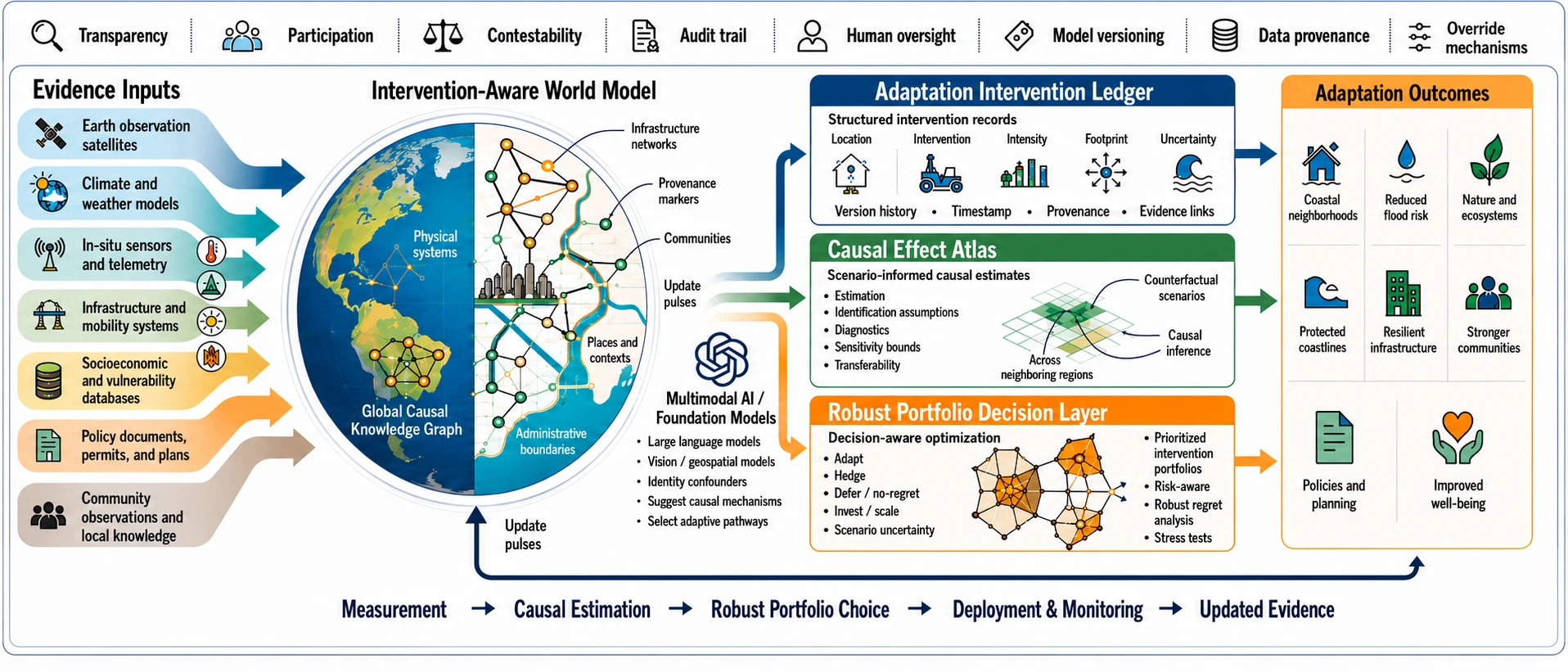
PCA-OS: A Planetary Climate Adaptation Operating System — KDD 2026 Blue Sky Ideas Track paper & project page
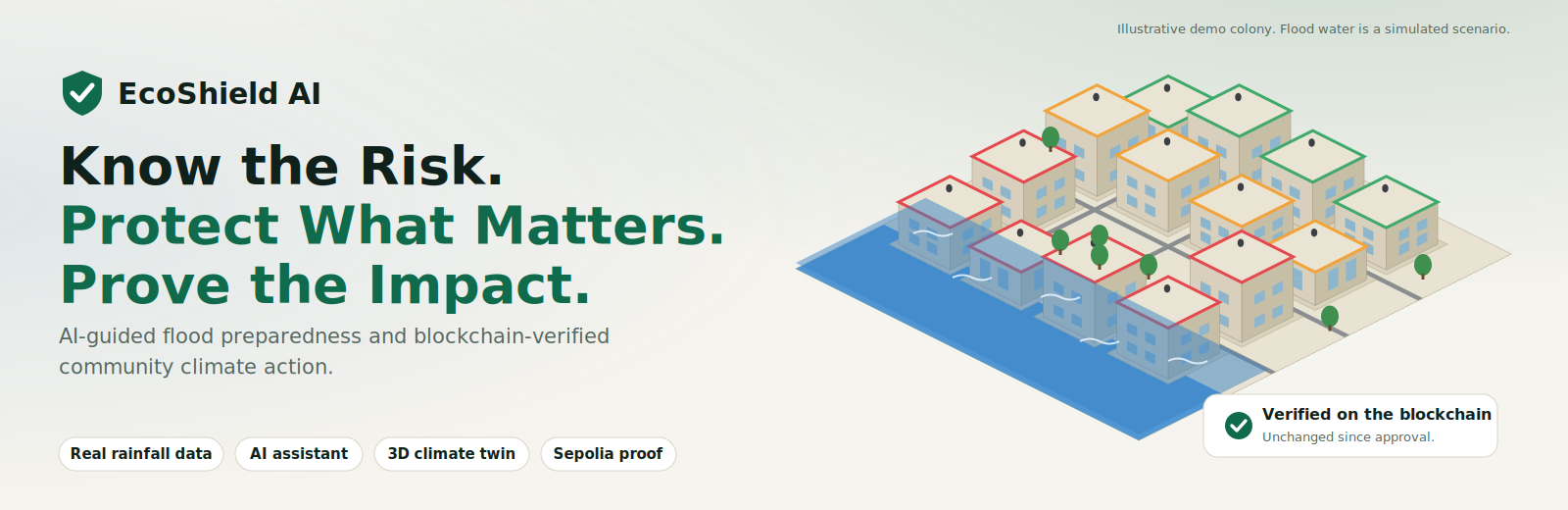
AI-guided flood preparedness + blockchain-verified community climate action. Real rainfall data, 3D climate twin, human-reviewed reports, and a public page that proves evidence hasn't changed. Built for the IEEE ClimateChain Hackathon 2026.
A free, open source, and extensible speech-to-text application that works completely offline.
Open standard for verifying that parametric climate insurance actually paid what it promised. Ontology + SHACL assurance rules + basis-risk replay. CC BY 4.0.
Open-source UAV wing engineering platform combining parametric CAD, CAM, aerodynamics, FEA, optimisation, prototype validation, automation, and an interactive 3D GitHub Pages app.
An interactive browser-based digital twin of a 6-axis industrial robotic arm built with Three.js. Features real-time kinematics, live FEA stress mapping, custom CAD view modes, and a live TCP coordinate HUD.
Open-source CAD/CAM/CAE portfolio for ASTERION FCTA-1, a modular deep-space spacecraft concept developed with Siemens NX, ANSYS, NX CAM, Python, and an interactive Three.js GitHub Pages application.
A review and conceptual synthesis of computer science as a layered discipline, connecting foundations, algorithms, systems, software, AI, cybersecurity, HCI, sustainability, ethics, and societal responsibility.
EpiPredict by Samuelson G: Multimodal deep learning (CNN-LSTM, Transformer) & neuromorphic SNN edge framework for epileptic seizure prediction using wearable EEG, fNIRS, autonomic sensors & big data. Includes paper & interactive web console.
Open-source digital mission engineering lab for spacecraft simulation, Earth observation, secure multi-region operations, workflow orchestration, signed approvals, safety checks, dashboards, and reproducible validation on a home PC.