
terraform-aws-cloudwatch
Terraform module to create AWS Cloudwatch resources 🇺🇦
- 180
- HCL
- Apache-2.0
- 4 wk ago
Enhance Linux security with this Python framework! Audit & remediate against CIS, NIST, DISA STIG, NSA, CISA, ENISA, ISO 27001, & Core baselines (1,100+ checks). Multi-distro support (Debian/Ubuntu/RHEL/Fedora/SUSE/Arch), interactive/automated fixes, reports (HTML/JSON/CSV/XML).
Repo Sandler73/Linux-Security-Audit-Project, read from GitHub 12 h ago. Sandler73 has not joined Take My Repo.
Sandler73/Linux-Security-Audit-Project is a public repo on GitHub by Sandler73. Enhance Linux security with this Python framework! Audit & remediate against CIS, NIST, DISA STIG, NSA, CISA, ENISA, ISO 27001, & Core baselines (1,100+ checks). Multi-distro support (Debian/Ubuntu/RHEL/Fedora/SUSE/Arch), interactive/automated fixes, reports (HTML/JSON/CSV/XML). It declares no license on GitHub. Public does not mean open source: without a license, nobody is granted the right to reuse it. It is written mainly in Python, has 7 stars and last changed on 2026-07-25. Nobody has reviewed it on Take My Repo yet, which says nothing about its quality. Read from GitHub on 2026-11-24.
Terraform module to create AWS Cloudwatch resources 🇺🇦
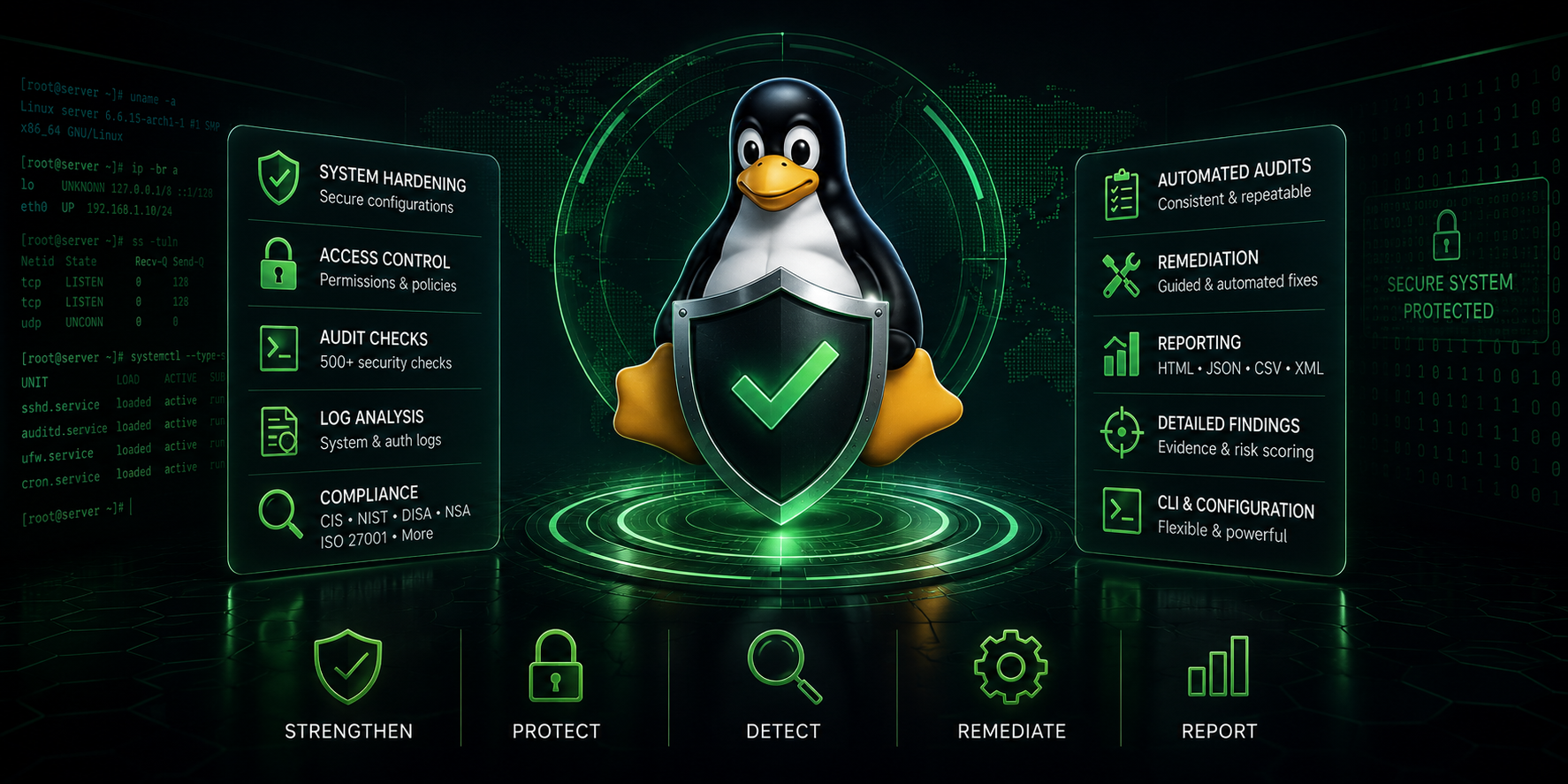
Module-Based Multi-Framework Linux Security Assessment, Auditing, and Remediation Tool
Overview * Key Features * Quick Start * Documentation * Remediation * Contributing
| Distribution Family | Versions | Package Manager | MAC Framework | Status |
|---|---|---|---|---|
| Ubuntu | 24.04, 22.04, 20.04 | APT | AppArmor | [x] Tested |
| Debian | 12 (Bookworm), 11 (Bullseye) | APT | AppArmor | [x] Tested |
| Linux Mint | 21.x, 22.x | APT | AppArmor | [x] Compatible |
| RHEL | 9, 8 | DNF/YUM | SELinux | [x] Tested |
| Fedora | 41, 40, 39 | DNF | SELinux | [x] Tested |
| Rocky Linux | 9, 8 | DNF/YUM | SELinux | [x] Compatible |
| AlmaLinux | 9, 8 | DNF/YUM | SELinux | [x] Compatible |
| CentOS Stream | 9, 8 | DNF/YUM | SELinux | [x] Compatible |
| openSUSE | Leap 15.x, Tumbleweed | Zypper | AppArmor | [x] Compatible |
| SLES | 15 SP5+ | Zypper | AppArmor | [x] Compatible |
| Arch Linux | Rolling | Pacman | AppArmor | [x] Compatible |
| Manjaro | Rolling | Pacman | AppArmor | [x] Compatible |
| Kali Linux | 2024.x+ | APT | AppArmor | [x] Compatible |
Requirements: Root/sudo privileges - Python 3.7+ - 50 MB free disk space - No internet access required
The Linux Security Audit Project is a Python-based security compliance auditing tool that evaluates Linux systems against multiple industry-standard security frameworks. The current release performs 2,297 automated security checks across 16 compliance frameworks, generating interactive reports in HTML, JSON, CSV, XML, and Console formats with actionable remediation guidance.
Every check includes a severity rating (Critical/High/Medium/Low/Informational) and categorization by security domain, enabling compliance scoring from a single audit run. The tool is fully self-contained - zero external dependencies, pure Python stdlib - and supports parallel execution, intelligent caching, compliance scoring with configurable thresholds, and OS-aware checks across Debian, Red Hat, SUSE, and Arch distribution families.
Whether you're conducting compliance audits, hardening systems, maintaining security baselines, or generating evidence for assessors, this tool provides the depth and automation you need.
--parallel with configurable --workers countmodules/ directory--perf-profile flag for execution timing analysis (renamed from --profile in v3.7)command_available, systemd_active, run_command, read_sysctl, read_file_safe, file_exists, directory_exists for 5-30x speedup on multi-module runsHostFacts registry computes ~80 derived host facts (FIM presence, FIPS state, MAC enforcement, firewall tool, container runtime, K8s indicators, tool inventories) once at audit start; modules consume from shared_data["host_facts"] instead of re-deriving--split-reports - one focused report per framework in reports/by-framework/, alongside the combined report--split-only - generate only the per-framework reportsThe --attack-surface flag generates a dedicated assessment report that
re-frames findings around exposure rather than pass/fail compliance. It is
produced from the same audit run and the host-facts registry, so it introduces
no duplicate checks.
--attack-surface - generate the attack-surface report (HTML + JSON)CORE - Attack Surface):ld.so configuration and
writable library pathsgeneric, rhel9, rhel8, ubuntu24, ubuntu22, debian12, alpine, suse15^[a-z][a-z0-9_-]{0,30}$; injection attempts rejectedeval, no JSON/YAML parsing; profiles are auditable Python source--profile NAME and --list-profiles; --list-profiles shows applicable distros and excluded category prefixes per profile--baseline compares against previous audit JSON to identify new failures, resolved findings, regressions, and improvements with compliance-score delta.shared_components/remediation_library.py) - 49 registered tools with per-family install commands, supporting packages, post-install configuration steps, service enable/start commands, and verification commands. AIDE on Debian correctly includes aide-common; ClamAV service name routes per family (clamav-daemon on Debian vs clamd on RHEL); chrony service is chrony on Debian, chronyd elsewhere.OSInfo.pretty_name - accurate human-readable distribution display (e.g. "Ubuntu 24.04.4 LTS", "Rocky Linux 9.3 (Blue Onyx)") with multi-tier fallback chain. Replaces the Linux X.Y.Z-generic string previously rendered by platform.system()/platform.release().tests/test_os_detection.py, tests/test_remediation_library.py) - 25 OS-detection tests covering Ubuntu 22.04/24.04/26.04, Debian 12, Mint, Pop!_OS, Kali, Parrot, RHEL 9, CentOS Stream, Rocky, AlmaLinux, Fedora 40, Oracle 9, Amazon 2023, openSUSE Leap/Tumbleweed, SLES, Arch, Manjaro, EndeavourOS, Alpine 3.19, Gentoo + universal invariants. 12 remediation library tests verify per-family parity, correct package manager syntax, and registered references.wiki/Architecture-and-Design.md - 6 rendered diagrams: system architecture, module execution lifecycle (sequence), cache hierarchy, remediation library flow, OS detection decision tree, audit pipeline phases.int(mode, 8) corrected (file_mode returns int, not string); NIST AU-9(2) audisp_set coerced to bool to prevent TypeError("unsupported operand type(s) for +: 'int' and 'str'").tests/ directory with stdlib-only test runner; no pytest required| Module | Framework | Checks | Focus Areas |
|---|
Sandler73/Linux-Security-Audit-Project is a public repo on GitHub by Sandler73. Enhance Linux security with this Python framework! Audit & remediate against CIS, NIST, DISA STIG, NSA, CISA, ENISA, ISO 27001, & Core baselines (1,100+ checks). Multi-distro support (Debian/Ubuntu/RHEL/Fedora/SUSE/Arch), interactive/automated fixes, reports (HTML/JSON/CSV/XML).
Wazuh - The Open Source Security Platform. Unified XDR and SIEM protection for endpoints and cloud workloads.
This script automates the scanning process using the OpenSCAP Security Guid to hardening Ubuntu systems, aligning with DISA-STIG compliance for Ubuntu 24.04. LTS minimum. It includes a range of security enhancements and configurations designed to strengthen the security posture of Ubuntu servers.
Checks whether a Windows server according to security best practices as defined in the CIS Distribution-Independent Windows Benchmark
Lynis - Security auditing tool for Linux, macOS, and UNIX-based systems. Assists with compliance testing (HIPAA/ISO27001/PCI DSS) and system hardening. Agentless, and installation optional.
It declares no license on GitHub. Public does not mean open source: without a license, nobody is granted the right to reuse it.
Its maker has not tagged a system, so it is unknown here. Its README says what it needs.
Open "Take it" on its page: Take My Repo writes an install plan for your machine and hands it to your AI agent (Claude Code, Codex or Cursor), which asks you before each step. Take My Repo has not tested it on any machine.
Its last change on GitHub was on 2026-07-25. Take My Repo does not judge from that whether it is maintained.
Nobody has reviewed it on Take My Repo yet, which says nothing about its quality.
Take My Repo cannot say: it does not audit code and has not run Linux-Security-Audit-Project. What is known comes from GitHub. It declares no license on GitHub. Public does not mean open source: without a license, nobody is granted the right to reuse it. Its last change was on 2026-07-25. It has 7 stars, which measure popularity, not safety. Nobody has reviewed it on Take My Repo yet, which says nothing about its quality. Read the source before you run it. With "Take it", your AI agent shows each step and asks you before running it; README text is treated as data, not as instructions.


