
gods
GoDS (Go Data Structures) - Sets, Lists, Stacks, Maps, Trees, Queues, and much more
- 17k
- Go
- 21 mo ago
🧵 Dining philosophers reimagined: Multithreaded resource-scheduling simulation in C — coders racing for shared USB dongles under FIFO/EDF arbitration, without deadlock or starvation.
Repo SaraFreitas-dev/Codexion, read from GitHub 1 min ago. SaraFreitas-dev has not joined Take My Repo.
SaraFreitas-dev/Codexion is a public repo on GitHub by SaraFreitas-dev. 🧵 Dining philosophers reimagined: Multithreaded resource-scheduling simulation in C — coders racing for shared USB dongles under FIFO/EDF arbitration, without deadlock or starvation. It declares no license on GitHub. Public does not mean open source: without a license, nobody is granted the right to reuse it. It is written mainly in C, has 3 stars and last changed on 2026-10-21. Nobody has reviewed it on Take My Repo yet, which says nothing about its quality. Read from GitHub on 2026-11-23.
This project has been created as part of the 42 curriculum by sarfreit.
docs/ — extra study notesCodexion is a multithreaded simulation written in C, modeled on the classic dining philosophers problem. Instead of philosophers and forks, the simulation has coders sitting around a circular co-working hub, competing for a limited number of shared USB dongles to compile their code.
Each coder repeatedly cycles through three phases — compile, debug,
refactor — and needs to acquire two dongles (their left and right
neighbor's) simultaneously in order to compile. Dongles are protected by
mutexes, condition variables, and a cooldown period, and access is arbitrated
either FIFO (first come, first served) or EDF (Earliest Deadline
First — whoever is closest to burning out is served first), chosen at
runtime via the scheduler argument.
A separate monitor thread watches every coder and stops the simulation
the moment a coder burns out (fails to compile again within
time_to_burnout milliseconds) — or once every coder has compiled at least
number_of_compiles_required times.
The goal of the project is to implement this simulation without deadlocks, without starving any coder under a feasible EDF configuration, with precise (sub-10ms) burnout detection, and without any memory leaks or data races.
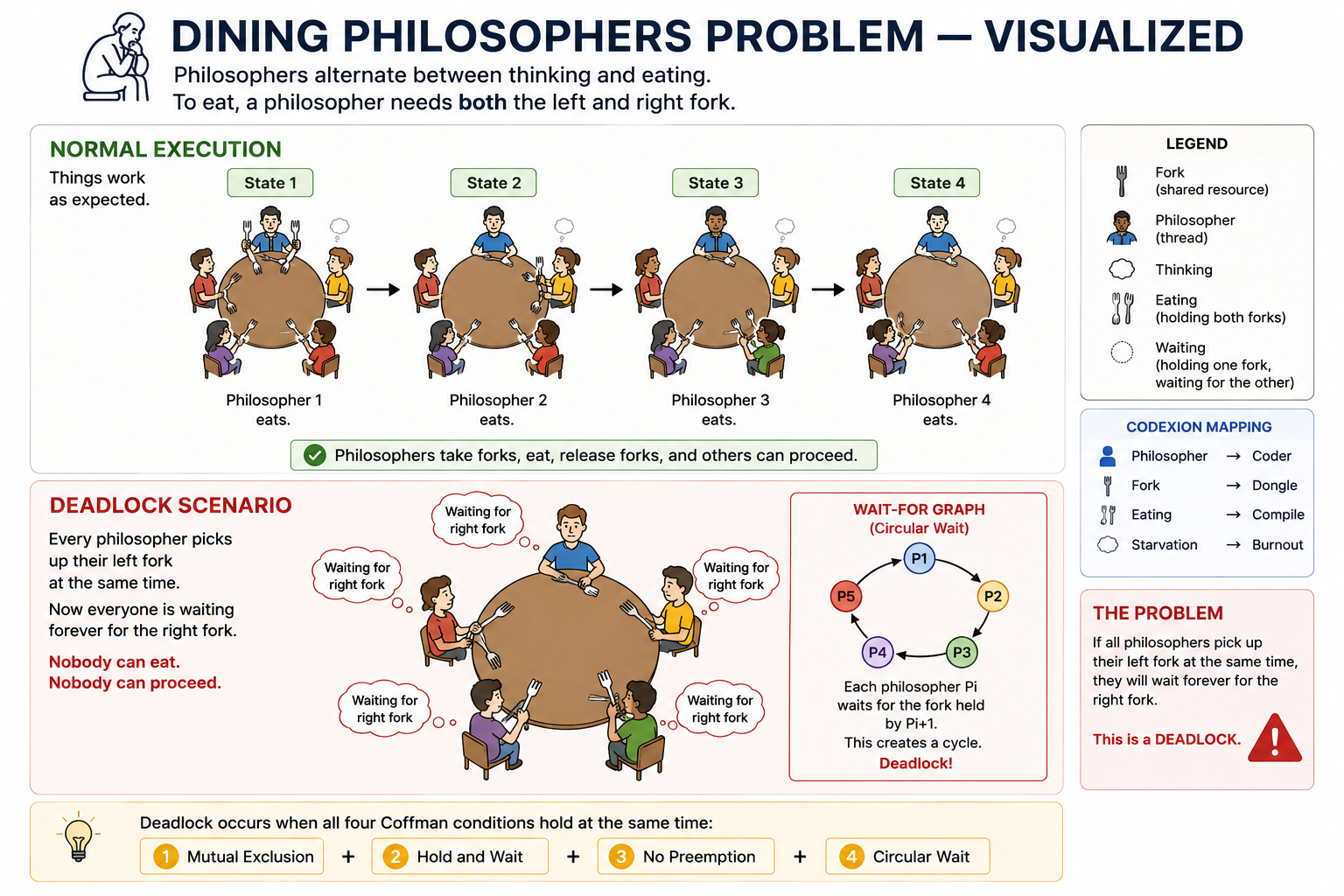
Codexion is a variation of the classic dining philosophers problem (Dijkstra, 1965) — coders instead of philosophers, dongles instead of forks, compiling instead of eating.

A deadlock can only happen if all four of Coffman's conditions hold at
once. Codexion accepts the first three (they're inherent to the problem)
and specifically breaks the fourth — see "Blocking cases handled" below,
and docs/01-dining-philosophers.md
for a deeper walkthrough.
Broken down visually, with the specific example from this project:

codexion/
├── Makefile
├── README.md
├── docs/                      # extra study notes, written before/during
│   │                          # implementation — see below
│   └── ...
├── includes/
│   └── codexion.h             # all structs, the event enum, and function
│                              # prototypes shared across the project
└── src/
    ├── main.c                 # entry point: parses args, initializes the
    │                          # simulation, creates/joins all threads,
    │                          # cleans up
    │
    ├── parser.c               # validates the 8 command-line arguments
    │                          # (counts, ranges, overflow, scheduler value)
    │
    ├── init.c                 # allocates and initializes the simulation,
    │                          # its dongles, and its coders; symmetric
    │                          # cleanup on shutdown
    │
    ├── coder.c                # each coder thread's routine: the
    │                          # compile -> debug -> refactor loop
    │
    ├── dongle.c               # acquiring/releasing a single dongle and
    │                          # both dongles of a coder (cooldown,
    │                          # waiting queue, resource ordering)
    │
    ├── heap.c                 # a binary min-heap implemented from
    │                          # scratch, used as the waiting queue for
    │                          # each dongle
    │
    ├── scheduler_utils.c      # priority calculation (fifo/edf), the
    │                          # tie-breaker rule, and the comparison used
    │                          # by the heap
    │
    ├── monitor.c              # the monitor thread: detects burnout and
    │                          # the "everyone compiled enough" condition
    │
    ├── logs.c                 # formats and prints the required log
    │                          # lines, serialized with a mutex
    │
    └── utils.c                # small shared helpers (current time,
                               # safely reading the shared stop flag,
                               # swapping heap entries)
docs/ — extra study notesThe docs/ folder contains a set of markdown files written while studying
the concepts behind this project (dining philosophers, pthreads,
FIFO/EDF scheduling, the heap, timing precision, and concurrency debugging
tools). They go into more depth than this README and are meant as a
reference for understanding why the implementation is built the way it
is — not as a substitute for reading the code itself.
Examples such as:

make
Compiles the project with -Wall -Wextra -Werror -pthread, producing the
codexion executable at the project root.
Other standard rules are also available:
make clean    # remove object files
make fclean   # remove object files and the executable
make re       # fclean + rebuild from scratch
./codexion number_of_coders time_to_burnout time_to_compile time_to_debug \
	time_to_refactor number_of_compiles_required dongle_cooldown scheduler
scheduler must be exactly fifo or edf. Example:
./codexion 5 800 200 200 200 3 100 fifo
0 1 has taken a dongle
0 1 has taken a dongle
0 1 is compiling
200 1 is debugging
...
make test — an extra, non-mandatory convenience targetThe Makefile also includes a test rule (not required by the subject) that
runs Norminette, Valgrind (leak-check), and Helgrind (race detection) in
one go, using a fixed set of arguments:
make testTo try different parameters, just edit the ARGS_MULTI_STABLE /
ARGS_SINGLE_BURNOUT variables at the top of the Makefile — no need to
change anything else, the target picks them up automatically.
AI (Claude & ChatGPT) was used throughout this project as a learning and review tool, not as a code generator to copy-paste from. Concretely, it was used to:
pthread_cond_wait vs pthread_cond_timedwait) before any
code was written for those parts, through guided questions rather than
ready-made answers — the notes produced this way make up the docs/
folder.take_both_dongles always acquires
the dongle with the lower dongle_id first. Since every coder follows
the same global ordering, no cycle of coders can each be waiting on the
next one's dongle.priority_ms (arrival time under fifo, burnout
deadline under edf) plus a deterministic tie-breaker (request_order
for fifo, coder_id for edf) for the rare case of an exact tie. A
coder only proceeds once it is at the top of that heap, so under edf
the most urgent coder is always served next, preventing it from starving
as long as the given parameters are feasible.is_available is true and dongle_cooldown milliseconds have elapsed
since it was released. Waiting coders use pthread_cond_timedwait with a
deadline computed from the cooldown window, so a coder that wakes up
slightly too early goes back to sleep until the cooldown actually expires
— without ever missing the moment it does, even if nobody signals it
again in the meantime.last_compile_start_ms every 2ms (well under the required 10ms
window) and stops the simulation as soon as any coder exceeds
time_to_burnout.pthread_mutex_t (log_lock), so two threads can never interleave their
output on the same line.number_of_coders == 1 there is only one
dongle on the table, so a coder can never hold two simultaneously. The
coder takes the single dongle and then waits indefinitely — it will
always burn out, which matches the behaviour observed in another public
Codexion implementation of this same subject.should_stop flag
(protected by stop_lock) is checked at multiple points in a coder's
cycle — before compiling, after compiling, and between the debug and
refactor phases — so a coder stops as soon as it next has the chance,
instead of completing an entire extra compile cycle after the simulation
should have already ended.pthread_mutex_t per dongle (dongle->lock). Protects a dongle's
is_available, released_at_ms, and its waiting-queue heap. Any read or
write to these fields happens strictly between a lock/unlock pair.pthread_cond_t per dongle (dongle->cond). A coder waiting for a
dongle sleeps on this condition variable via pthread_cond_timedwait
(not a plain pthread_cond_wait), since becoming available again is
partly time-driven (the cooldown expiring) rather than purely
event-driven. Releasing a dongle calls pthread_cond_broadcast (not
signal), so that every coder waiting on it re-checks the condition —
necessary since more than one coder may be waiting on the same dongle,
and only the one at the top of its priority heap should actually proceed.pthread_mutex_t time_lock per coder. Protects last_compile_start_ms
and times_compiled, which are written by the coder's own thread
(compile_phase) and read concurrently by the monitor thread
(coder_is_in_burnout, coder_compilations_are_finished) and by the
scheduler (calculate_priority, under edf).pthread_mutex_t stop_lock. Protects the shared should_stop flag,
written once by the monitor thread and read repeatedly by every coder
thread and by try_take_dongle (so a coder blocked waiting for a dongle
can also notice the simulation has ended and stop waiting).pthread_mutex_t request_lock. Protects request_counter, a single
shared counter incremented every time any coder requests a dongle, used
to produce each coder's request_order — the fifo tie-breaker.pthread_mutex_t log_lock. Protects the call to printf inside
print_log, so two threads' log lines are never interleaved.Every field that is written by one thread and read by another is only ever
accessed while holding the mutex declared specifically for it (time_lock
for per-coder timing fields, stop_lock for should_stop, request_lock
for the request counter, each dongle's own lock for its state and waiting
queue). No shared field is ever read or written outside of its
corresponding lock — this was verified with Helgrind, which reports no
Possible data race anywhere in the project (only Dubious: associated lock is not held warnings tied to pthread_cond_timedwait, a known
Helgrind/Valgrind limitation unrelated to actual data races — see
docs/06-concurrency-debugging.md).
The monitor thread never communicates with coder threads directly — it
only reads their shared, mutex-protected state (last_compile_start_ms,
times_compiled) and writes to the shared should_stop flag under
stop_lock. Coders, in turn, only ever read should_stop (never write to
it), always through the same lock. This one-way, lock-protected
communication avoids any need for the monitor and the coders to coordinate
more tightly than that.
SaraFreitas-dev/Codexion is a public repo on GitHub by SaraFreitas-dev. 🧵 Dining philosophers reimagined: Multithreaded resource-scheduling simulation in C — coders racing for shared USB dongles under FIFO/EDF arbitration, without deadlock or starvation.
It declares no license on GitHub. Public does not mean open source: without a license, nobody is granted the right to reuse it.
Its maker has not tagged a system, so it is unknown here. Its README says what it needs.
Open "Take it" on its page: Take My Repo writes an install plan for your machine and hands it to your AI agent (Claude Code, Codex or Cursor), which asks you before each step. Take My Repo has not tested it on any machine.
Its last change on GitHub was on 2026-10-21. GitHub counts 0 open issues and pull requests. Take My Repo does not judge from that whether it is maintained.
GoDS (Go Data Structures) - Sets, Lists, Stacks, Maps, Trees, Queues, and much more
Nobody has reviewed it on Take My Repo yet, which says nothing about its quality.
Companion repository to the "Modern Embedded Systems Programming" video course.
After the curriculum moved to Python, the Common Core got a brand new set of projects — and now they have their own achievements.
A complete, fully tested and documented data structure library written in pure JavaScript.
🎓 42 School | Complete Rank 03 (milestone 3) preparation toolkit featuring an interactive PracticeShell simulator and level-based Python solutions.
🎓 42 School | Complete Rank 02 (milestone 2) preparation toolkit featuring an interactive PracticeShell simulator and level-based C solutions.
🎓 42 School | Complete Rank 04 (milestone 4) preparation toolkit featuring an interactive PracticeShell simulator and level-based Python solutions.


