Meow: End-to-End Outline Writing for Automatic Academic Survey
中文版 README
Meow is an end-to-end, metadata-driven model for automatic academic survey outline generation.
Given a target topic and a set of candidate papers (title + abstract), Meow directly generates hierarchical survey outlines that balance structural coherence, content relevance, and academic writing style, providing high-quality foundations for subsequent automatic writing or human authoring.
Highlights
-
End-to-End Outline Generation
From "topic + metadata" directly to "complete hierarchical outline" without relying on multi-agent or multi-stage complex pipelines, making it more suitable for long-context and batch automation scenarios.
-
Large-Scale, High-Quality Survey Corpus [dataset]
- 2,828,998 arXiv paper metadata
- 252,357 bioRxiv and 72,059 medRxiv papers
- Systematically filtered high-quality surveys with extracted human-written outlines and completed reference information (including abstracts retrieved via semantic search).
-
Two-Stage Training: CoT + RL (GRPO)
- Uses DeepSeek-R1 for Chain-of-Thought distillation, learning explicit reasoning processes from literature to taxonomy/outline.
- Followed by Group Relative Policy Optimization (GRPO) reinforcement learning to optimize structural similarity and format compliance rewards.
-
Structure-Aware Reward Design
- Uses Tree Edit Distance (TED) as structural distance metric to measure hierarchical similarity between generated and human-written outlines.
- Combines structural similarity reward with format compliance reward to explicitly encourage structures that "resemble real surveys".
Model Illustration
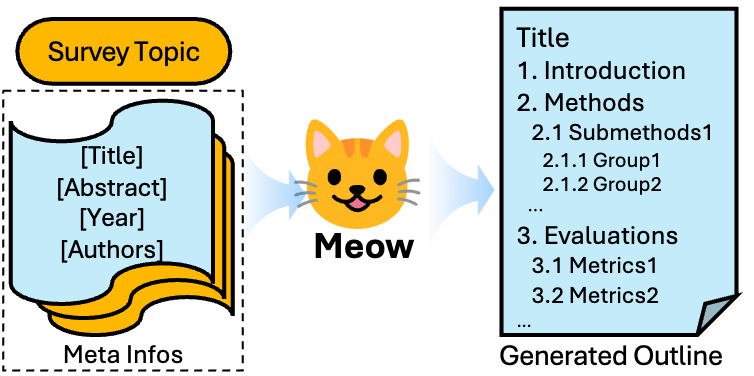
Method Overview
-
Task Definition
Given a topic $\mathcal{T}$ and a paper collection $\mathcal{P} = {p_i}$, where each $p_i = (t_i, a_i)$ consists of title + abstract, the goal is to generate a hierarchical outline $\mathcal{O} = {s_j}_{j=1}^M$, where each section $s_j$ corresponds to a heading $h_j$, requiring:
- Clear structure with reasonable hierarchy
- Distinct content boundaries without redundant overlap
- Good citation coverage and logical organization of input literature
-
Data Curation
- Keyword + structural rules to filter survey papers
- Clean and standardize section structures, removing non-core parts like acknowledgments and appendices
- Vectorize reference titles using
all-MiniLM-L6-v2, retrieve matching abstracts from large-scale metadata to complete citations
- Use DeepSeek-R1 to derive taxonomy and CoT reasoning chains from references for supervised training
-
Training Pipeline
-
Stage 1: CoT Supervised Fine-Tuning (SFT)
Supervised fine-tuning on CoT-augmented data to learn explicit reasoning + generation process from metadata to outline.
-
Stage 2: GRPO Reinforcement Learning
- Sample multiple candidate outlines for each input
- Combine structural similarity + format compliance into total reward $R_{\text{total}}$
- Use GRPO for policy optimization with KL constraint to maintain stability with the reference policy.
Results (LLM-as-a-Judge & Structural Distance)
We compare various mainstream LLMs and academic baseline models on our self-constructed test set and the SurveyX test set. Evaluation uses LLM-as-a-Judge (five dimensions) and Structural Distance metrics, with scores corresponding exactly to Table 1 and Table 2 in the paper.
Our Test Set (Ours-100)
| Model |
Structure Locate ↑ |
Structure Detail ↑ |
Content Exclusion ↑ |
Content Depth ↑ |
Pragmatics Concise ↑ |
Total ↑ |
Structural Distance ↓ |
| Human-written |
7.80 |
7.21 |
7.93 |
6.00 |
8.29 |
37.23 |
0.00 |
| DeepSeek-R1 |
8.09 |
5.31 |
8.15 |
5.75 |
8.85 |
36.15 |
0.48 |
| DeepSeek-V3 |
8.26 |
4.17 |
8.04 |
5.46 |
8.95 |
34.88 |
0.46 |
| GPT-5 Nano |
6.99 |
5.66 |
6.19 |
5.04 |
7.84 |
31.72 |
0.46 |
| Gemini 2.5 Flash-Lite |
8.01 |
5.68 |
8.18 |
5.84 |
8.72 |
36.43 |
0.52 |
| Qwen3-8B |
4.97 |
3.71 |
4.47 |
3.65 |
4.62 |
21.42 |
0.59 |
| Meow-8B-SFT |
7.79 |
6.75 |
7.11 |
5.34 |
8.11 |
35.10 |
0.43 |
| Meow-8B-SFT-GRPO |
8.01 |
6.46 |
7.98 |
5.73 |
8.61 |
36.79 |
0.39 |
SurveyX Test Set
| Model |
Structure Locate ↑ |
Structure Detail ↑ |
Content Exclusion ↑ |
Content Depth ↑ |
Pragmatics Concise ↑ |
Total ↑ |
Structural Distance ↓ |
| Human-written |
8.11 |
7.39 |
8.14 |
5.21 |
8.07 |
36.92 |
0.00 |
| SurveyX |
7.37 |
5.30 |
4.60 |
3.90 |
8.43 |
29.60 |
0.44 |
| Meow-8B-SFT |
6.56 |
5.83 |
7.33 |
5.28 |
7.83 |
32.83 |
0.53 |
| Meow-8B-SFT-GRPO |
7.71 |
6.12 |
7.71 |
5.46 |
8.62 |
35.62 |
0.42 |
The results show that Meow-8B-SFT-GRPO achieves total scores close to human-written outlines on both test sets, along with the lowest or near-lowest Structural Distance among all models, demonstrating that the reinforcement learning stage significantly improves outline structural fidelity and overall writing quality.
Citation
If this work or repository is helpful to your research, please cite:
@article{ma2025meow,
  author={Ma, Zhaoyu and Shan, Yuan and Zhao, Jiahao and Xu, Nan and Wang, Lei},
  booktitle={ICASSP 2026 - 2026 IEEE International Conference on Acoustics, Speech and Signal Processing (ICASSP)},
  title={Meow: End-to-End Outline Writing for Automatic Academic Survey},
  year={2026},
  pages={20561-20565},
}