GDevelop
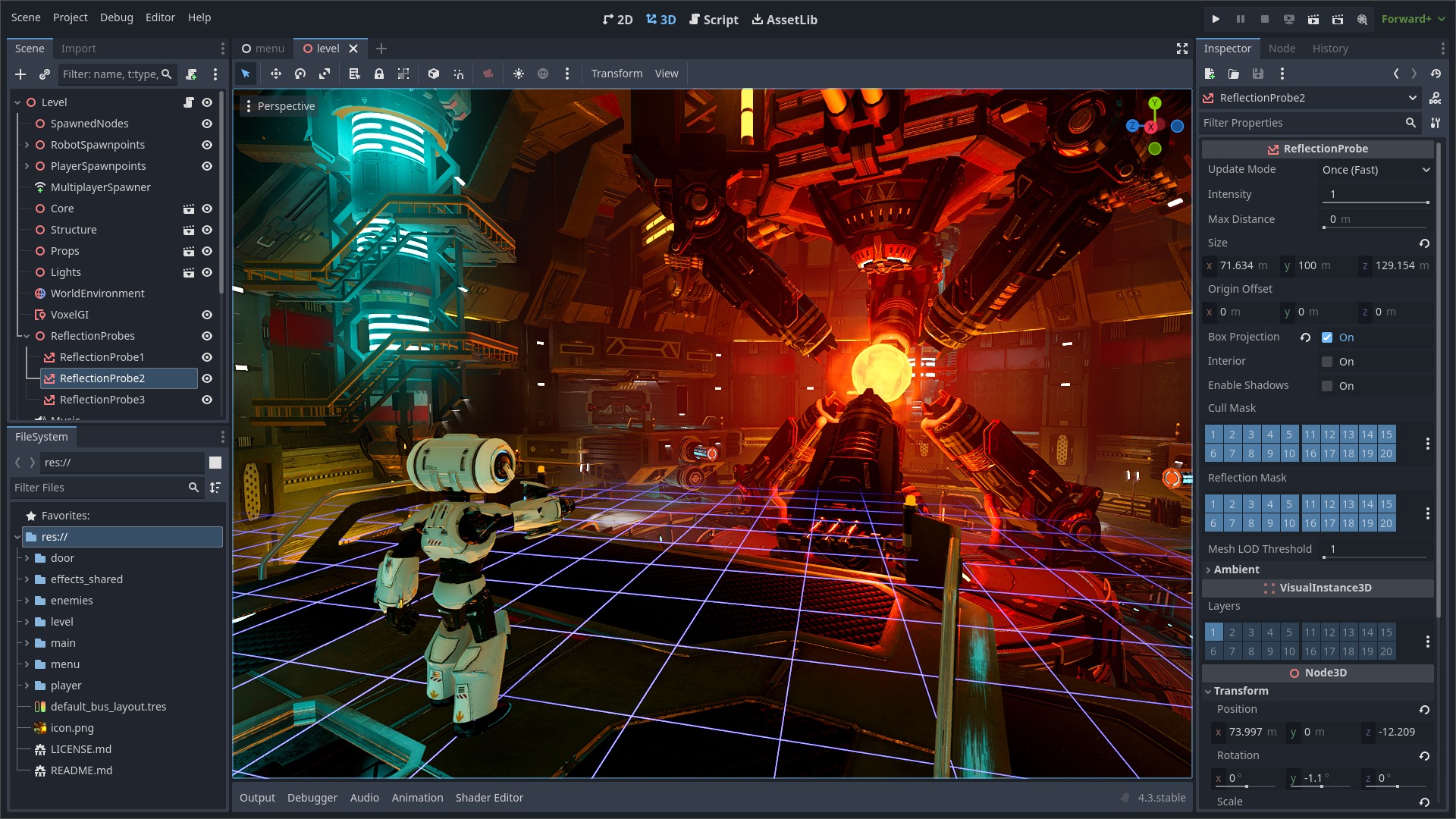
🎮 Open-source, cross-platform 2D/3D/multiplayer game engine designed for everyone.
- 29k
- JavaScript
- 3 h ago
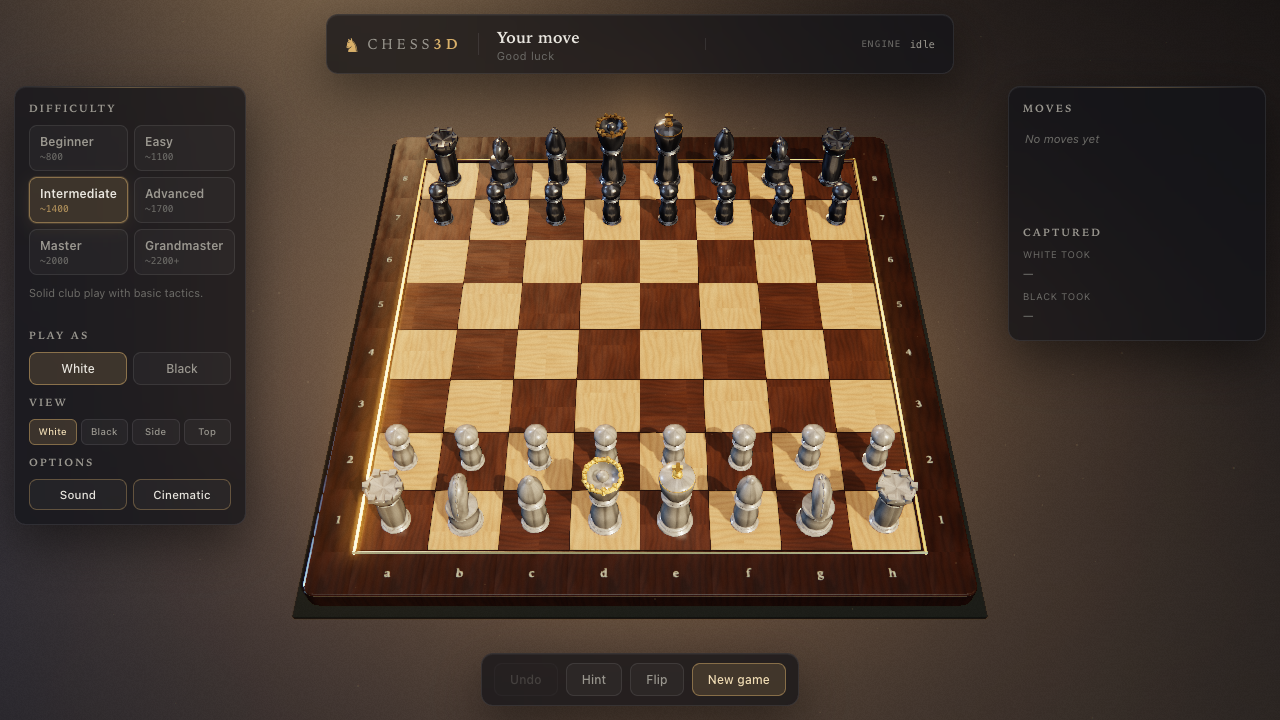
A cinematic 3D chess game built with Three.js, played against an offline AI opponent. Six difficulty tiers, complete rules, and an engine that runs entirely in your browser — no server, no API, no network. Single static page.
Repo ShawTim/chess3d, read from GitHub 1 d ago. ShawTim has not joined Take My Repo.
ShawTim/chess3d is a public repo on GitHub by ShawTim. A cinematic 3D chess game built with Three.js, played against an offline AI opponent. Six difficulty tiers, complete rules, and an engine that runs entirely in your browser — no server, no API, no network. Single static page. It declares no license on GitHub. Public does not mean open source: without a license, nobody is granted the right to reuse it. It is written mainly in JavaScript, has 0 stars and last changed on 2026-10-23. Nobody has reviewed it on Take My Repo yet, which says nothing about its quality. Read from GitHub on 2026-11-24.
A cinematic 3D chess game built with Three.js, played against an offline AI opponent. The entire application is a static site: no server-side code, no API calls, no network requests at runtime, and no external assets. Everything — textures, geometry, sound effects and the chess engine itself — is generated or computed in the browser.
Play it now: https://shawt.im/chess3d/
Because ES modules are blocked over file://, serve the directory over HTTP:
npm run serve # http://localhost:4173
Any static host works. To deploy, publish the repository root as-is (see Deployment).
Gameplay
https://shawt.im/chess3d/#moves=e2e4,e7e5,g1f3), which browsers never send
to the server, so a link needs no backend and no database: whoever opens it
watches the moves replay through the rules engine and gets the position. The
same game can be copied as PGN for any other chess program.Presentation
tests/geometry.test.mjs, which also checks that the creasing stays at the
corners (the rook's straight body reports none).Offline
vendor/three and referenced through an import map.fetch, XMLHttpRequest, WebSocket or CDN reference exists in the game's
source. The only fetch in the repository is the service worker asking for its
own static files, which it then serves from the cache.sw.js) caches the whole game on the first visit, so the
page opens with the network switched off — and the manifest plus this worker
are what make it installable as an app. The AI keeps playing offline, because
the engine was always local; the cache only removes the last thing that still
needed a network, which was fetching the code itself.| Input | Action |
|---|---|
| Click / tap a piece, then a destination | Move |
| Drag on the board | Orbit the camera |
| Scroll or pinch | Zoom |
| Click a move in the list (or focus it and press Enter) | Review the position after that move (click again, or press Esc, to return) |
| Tap Menu (phone) | Open difficulty, side, move list and captured pieces |
| Copy link / Copy PGN (left panel, or the phone sheet) | Copy a link that reopens this position, or the game as PGN |
| How it works (left panel, or the phone sheet) | Open the About panel: what the set, the engine and the offline cache are |
U |
Undo (also cancels an engine search in flight) |
H |
Hint (computed in the worker, so the board keeps rendering) |
N |
New game |
F |
Flip the camera 180 — this does not change sides or restart the game |
Q R B N |
Choose the promotion piece while the promotion dialog is open |
1 2 3 4 |
White / Black / Side / Top view |
Esc |
Close the promotion dialog, leave review, close the phone sheet, or clear the selection |
Difficulty, sound and the cinematic toggle are remembered in localStorage, so
a reload keeps the session's preferences. The game is auto-saved as well: the
move list is written after every move, undo and new game, and a reload replays it
through the rules engine. The position, the move list, the side you took and the
difficulty all come back. Only moves are stored — a stored board is never
trusted — so an entry that no longer replays is discarded instead of reaching the
screen. Everything else — the engine, the textures, the audio — is still
generated in the browser with no network access.
The address bar carries the game for the same reason: after every move it is
rewritten (with history.replaceState, so the back button still leaves the app
rather than walking through your own moves) to #moves=e2e4,e7e5,…. That makes
Copy link a copy of the current URL rather than a separate code path, and it
means a link you paste into a running game is followed — changing only the
fragment does not reload the page, so the controller watches hashchange. A link
that no longer replays is refused: the position on screen stays, and the bar is
put back.
src/
  engine/      Pure chess logic, no rendering or DOM dependencies
    chess.js       Board, move generation, FEN, SAN, game-end detection
    evaluate.js    Static evaluation (material, piece-square tables, structure)
    ai.js          Negamax + alpha-beta, transposition table, quiescence
  render/      Three.js scene construction
    textures.js    Procedural canvas textures, roughness and normal maps
    materials.js   Shared PBR material library
    pieces.js      Lathed and lofted Staunton piece geometry
    board.js       Tiles, frame, coordinate labels, interaction overlays
    pieceViews.js  Piece meshes and every move/capture/promotion animation
    scene.js       Renderer, lighting, IBL environment, post-processing
    camera.js      Orbit controls and the framing solver
  ui/          DOM overlay (HUD, move list, captured trays, modals)
  audio/       Procedural WebAudio sound effects
  game/        Game controller (single owner of state) and auto-save
  worker/      AI Web Worker
The dependency rule is that engine/ imports nothing outside itself. That is
what lets the AI run in a Worker (import maps do not apply inside workers, so the
worker may only use relative imports) and keeps the rules testable in plain Node.
State flows one way: the controller mutates the Chess instance, then calls into
the views and the HUD. Views are pure functions of state, which is why undo and
new-game are simply "change state, rebuild views" and can never desync.
The opponent is not a language model and not a remote service. It is a conventional chess search engine: the same approach that has beaten human world champions since 1997. Nothing about it needs a network connection, because searching a game tree is arithmetic over data already in memory. The AI is computed, not queried.
src/engine/ai.js is roughly 500 lines of plain JavaScript, in three parts.
evaluate.js scores any position in centipawns (100 = one pawn). Positive
favours White; the search negates the score as it descends.
| Term | What it captures |
|---|---|
| Material | Pawn 100, knight 320, bishop 335, rook 500, queen 950 |
| Piece-square tables | Where a piece stands — a knight in the centre is worth far more than one on the rim |
| Pawn structure | Doubled and isolated pawns |
| Bishop pair | Two bishops are worth more than the sum of their parts |
| Rooks | Bonus on open and semi-open files |
| King safety | A pawn shield in front of the king while the queens are on |
| King activity | A separate table for the endgame, where the king should march up the board |
Piece-square tables do most of the work. Instead of hand-writing dozens of rules, one table per piece type encodes the principles directly, and each is a single array lookup at evaluation time.
Negamax with alpha-beta pruning. The engine tries every move, assumes the opponent replies with their best, tries every reply, and so on. Unpruned, the branching factor is about 30, so six plies is 30^6 ~ 700 million positions — hopeless.
Alpha-beta pruning fixes that. As soon as a branch is provably worse than a choice already in hand, the whole branch is abandoned. In the best case this cuts the work to roughly the square root, so six plies costs on the order of 30^3 nodes instead of 30^6.
On top of that:
Each tier pairs a search budget with a little randomness, so the weaker bots feel like a club player who makes mistakes rather than a shallow program:
| Tier | Depth | Time | Randomness | Blunder rate | Book |
|---|---|---|---|---|---|
| Beginner (~500) | 1 | 120 ms | 90 cp | 30% | no |
| Easy (~700) | 2 | 250 ms | 55 cp | 16% | no |
| Intermediate (~950) | 3 | 600 ms | 28 cp | 7% | yes |
| Advanced (~1200) | 5 | 1200 ms | 12 cp | 2% | yes |
| Expert (~1450) | 7 | 2500 ms | 4 cp | 0% | yes |
| Maximum (~1700) | 12 | 5000 ms | 0 cp | 0% | yes |
ShawTim/chess3d is a public repo on GitHub by ShawTim. A cinematic 3D chess game built with Three.js, played against an offline AI opponent. Six difficulty tiers, complete rules, and an engine that runs entirely in your browser — no server, no API, no network. Single static page.
It declares no license on GitHub. Public does not mean open source: without a license, nobody is granted the right to reuse it.
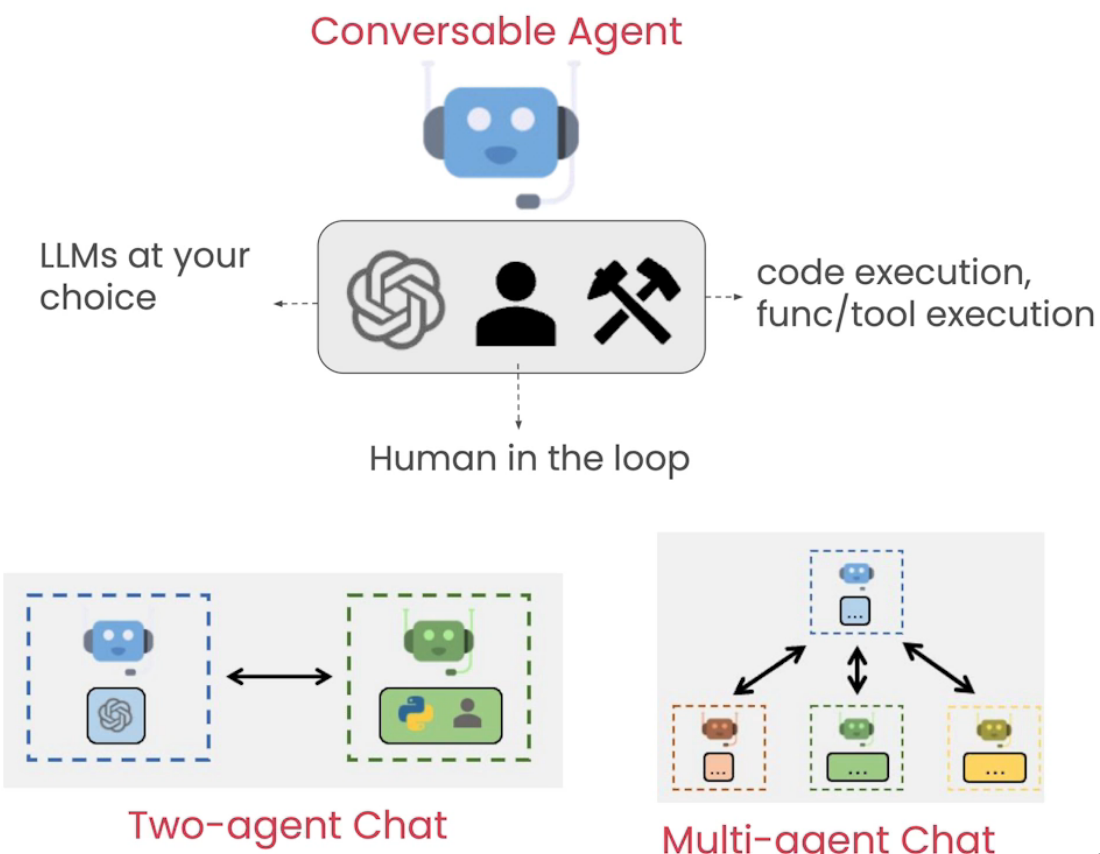
Learn to build and customize multi-agent systems using the AutoGen. The course teaches you to implement complex AI applications through agent collaboration and advanced design patterns.
Community-built comprehensive 2D content creation appplication for graphic design, digital art, and interactive real-time motion graphics powered by a node-based procedural graphics engine
Its maker has not tagged a system, so it is unknown here. Its README says what it needs.
Open "Take it" on its page: Take My Repo writes an install plan for your machine and hands it to your AI agent (Claude Code, Codex or Cursor), which asks you before each step. Take My Repo has not tested it on any machine.
Its last change on GitHub was on 2026-10-23. Take My Repo does not judge from that whether it is maintained.
Nobody has reviewed it on Take My Repo yet, which says nothing about its quality.
Take My Repo cannot say: it does not audit code and has not run chess3d. What is known comes from GitHub. It declares no license on GitHub. Public does not mean open source: without a license, nobody is granted the right to reuse it. Its last change was on 2026-10-23. It has 0 stars, which measure popularity, not safety. Nobody has reviewed it on Take My Repo yet, which says nothing about its quality. Read the source before you run it. With "Take it", your AI agent shows each step and asks you before running it; README text is treated as data, not as instructions.