
ElegantOTA
The original over-the-air update library for wireless microcontrollers (since 2019).
- 1k
- C++
- AGPL-3.0
- 2 wk ago
An educational STARK-based zkVM built from scratch with interactive visualizations of every proving stage.
Repo SrishtiCode/zkVM, read from GitHub 8 min ago. SrishtiCode has not joined Take My Repo.
SrishtiCode/zkVM is a public repo on GitHub by SrishtiCode. An educational STARK-based zkVM built from scratch with interactive visualizations of every proving stage. It declares the MIT license on GitHub. It is written mainly in Rust, has 2 stars and last changed on 2026-08-12. Nobody has reviewed it on Take My Repo yet, which says nothing about its quality. Read from GitHub on 2026-11-20.
The easiest zkVM to understand.
An educational STARK proving framework with an interactive zkVM reference implementation.
Every stage of the proving pipeline—from CPU execution to proof verification—is implemented from scratch, documented, and visualized.
This project is intended to answer one question:
"How does a zkVM actually work internally?"
Unlike production zkVMs, this project intentionally avoids hiding the cryptographic pipeline behind black-box abstractions.
Every algorithm is implemented from scratch and exposed for inspection.
There are production zkVMs with far more features (RISC Zero, SP1, Cairo VM). This project optimizes for a different thing: opening the hood so the whole mechanism is legible, end to end, in one sitting.
                 Program
                     │
                     ▼
              CPU Simulator
                     │
                     ▼
             Execution Trace
                     │
                     ▼
          AIR Constraints
                     │
                     ▼
      Trace Polynomial Interpolation
                     │
                     ▼
       Low Degree Extension
                     │
                     ▼
      Composition Polynomial
                     │
                     ▼
          Merkle Commitments
                     │
                     ▼
                  FRI
                     │
                     ▼
            Fiat–Shamir
                     │
                     ▼
             STARK Proof
                     │
                     ▼
                Verifier
STARKs need no trusted setup — the whole system is built from two primitives: hash functions and polynomial arithmetic over a finite field. That makes them unusually teachable compared to SNARK constructions that route through pairing-based cryptography.
program
  │
  ▼
CPU simulator ──▶ execution trace ──▶ AIR constraints
                                            │
                                            ▼
                polynomials ──▶ composition poly ──▶ FRI folding
                                                            │
                                                            ▼
                                  proof object ──▶ verifier
Every stage writes a JSON artifact (trace.json, air.json, lde.json,
fri_rounds.json, proof.json) consumed by a matching visualizer in web/.
This keeps "the math" and "the visualization" cleanly decoupled — you can
read or test any stage in isolation.
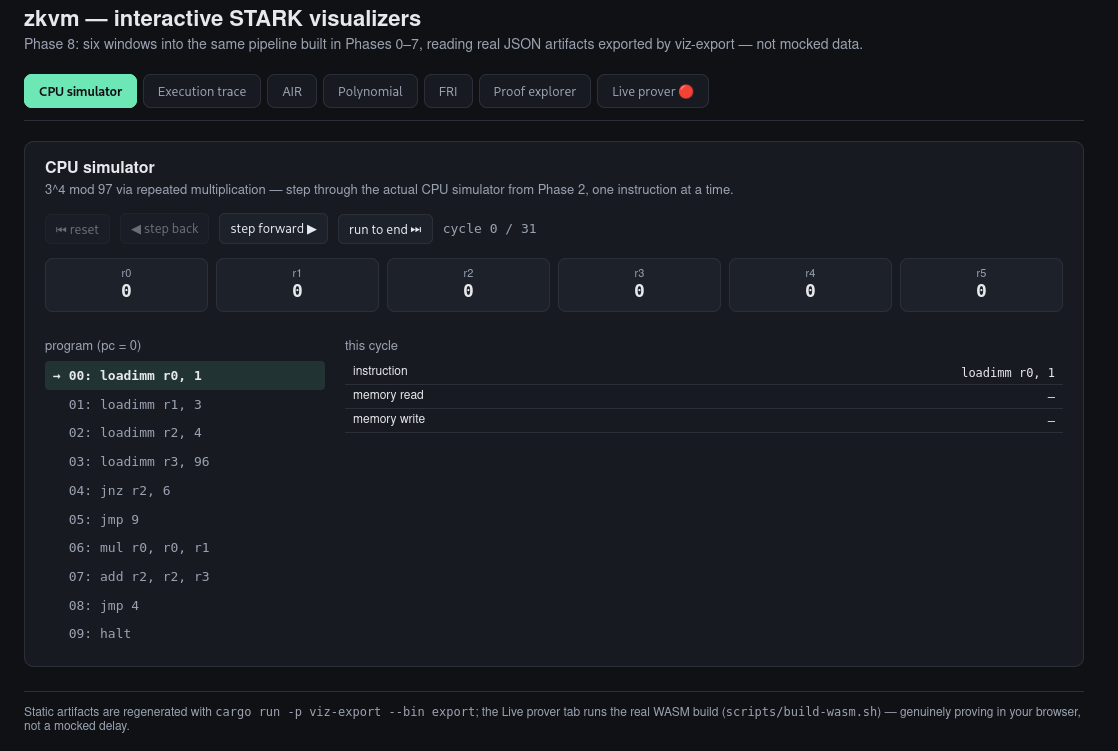
Six tabs walk the exact same run — 3^4 mod 97, computed by repeated
multiplication — through every stage of the pipeline, reading real JSON
artifacts exported by viz-export (not mocked data). A seventh tab compiles
the actual prover and verifier to WASM and proves live in the browser.
Step through the toy program instruction by instruction and watch registers update each cycle.

Every cycle of the same run, all at once — the table air::build_rows turns
into columns for interpolation.

The same run through the AIR's eyes: one-hot opcode/register selectors and every named transition constraint, evaluated row by row.

The trace interpolated to coefficients, then low-degree-extended onto a
coset — the same poly::interpolate + poly::lde pipeline used by the
prover itself.

Folding the composition polynomial in half each round until it's small
enough to send outright, with a Merkle root committed before each round's
β challenge is revealed.

The full proof object — trace Merkle root, FRI layer roots, final polynomial, and randomly-sampled query openings, each a Merkle authentication path from an opened trace value up to the committed root.

The real prover and verifier, compiled to WebAssembly, proving a genuine STARK — interpolation, low-degree extension, Merkle commitments, FRI folding, Fiat–Shamir — entirely in-browser, no server round trip.

Building in order:
[✔] Phase 0 — field arithmetic + polynomial ops (crates/field, crates/poly)
[✔] Phase 1 — toy STARK for a trivial statement (no CPU yet), validating the full pipeline: interpolate → LDE → constraints → FRI → verify
[✔] Phase 2 — minimal ISA + CPU simulator (crates/isa)
[✔] Phase 3 — AIR for that ISA (crates/air)
[✔] Phase 4 — Merkle commitments (crates/merkle)
[✔] Phase 5 — FRI protocol (crates/fri)
[✔] Phase 6 — Fiat–Shamir transcript, non-interactive proofs (crates/transcript)
[✔] Phase 7 — prover + verifier assembly (crates/prover, crates/verifier)
[✔] Phase 8 — the six web visualizers (web/)
[✔] Phase 9 — WASM build so visualizers run a live prover in-browser
See docs/ for a write-up per stage as each one lands.
crates/         one crate per pipeline stage (field, poly, merkle, isa, air,
                 fri, transcript, prover, verifier, viz-export)
bin/zkvm-cli/   command-line entry point: run / prove / verify
examples/       toy programs (fibonacci, squares, collatz)
docs/           one explainer per pipeline stage
web/            the six interactive visualizers (React/TypeScript)
wasm/           compiles the real prover to WASM for live in-browser proving
tests/          integration + conformance tests
.
|-- Cargo.toml
|-- LICENSE
|-- README.md
|-- bin
|   `-- zkvm-cli
|       `-- src
|           `-- main.rs
|-- crates
|   |-- air
|   |   `-- src
|   |       |-- air_for_isa.rs
|   |       |-- constraints.rs
|   |       `-- lib.rs
|   |-- field
|   |   `-- src
|   |       |-- goldilocks.rs
|   |       |-- lib.rs
|   |       `-- field.rs
|   |-- fri
|   |   `-- src
|   |       |-- fold.rs
|   |       |-- layers.rs
|   |       `-- lib.rs
|   |-- isa
|   |   `-- src
|   |       |-- cpu.rs
|   |       |-- lib.rs
|   |       |-- opcodes.rs
|   |       `-- trace.rs
|   |-- merkle
|   |-- poly
|   |   `-- src
|   |       |-- fft.rs
|   |       |-- interpolate.rs
|   |       |-- lde.rs
|   |       `-- lib.rs
|   |-- prover
|   |   `-- src
|   |       |-- lib.rs
|   |       `-- proof.rs
|   |-- src
|   |-- transcript
|   |   `-- src
|   |       `-- lib.rs
|   |-- verifier
|   |   `-- src
|   |       `-- lib.rs
|   `-- viz-export
|       `-- src
|           |-- air_json.rs
|           |-- fri_json.rs
|           |-- lib.rs
|           |-- poly_json.rs
|           |-- proof_json.rs
|           `-- trace_json.rs
|-- docs
|-- examples
|-- frontend
|   `-- src
|       |-- lib.rs
|       `-- trace.json.rs
|-- test
|   |-- conformance
|   `-- integration
|-- wasm
|   `-- src
|       `-- lib.rs
`-- web
    |-- package.json
    `-- src
        |-- App.tsx
        |-- data
        |   `-- artifacts.ts
        `-- viewers

38 directories, 37 files
# core pipeline
cargo run -p zkvm-cli -- run examples/fibonacci/program.zkasm
cargo run -p zkvm-cli -- prove examples/fibonacci/program.zkasm
cargo run -p zkvm-cli -- verify examples/fibonacci/proof.json

# regenerate the static JSON artifacts the visualizers read
cargo run -p viz-export --bin export

# visualizers (tabs 1-6 read the static artifacts above)
cd web && npm install && npm run dev

# Live prover tab: builds the real prover to WASM
./scripts/build-wasm.sh
2^64 - 2^32 + 1)
are too large to display meaningfully. A small prime field (mod 97) with a
tiny domain (8–16 elements) is used by default so every number in the
polynomial/FRI viewers is human-graspable. A "real mode" toggle switches to
the production-size field to show the same code scales.This project stands on the shoulders of excellent existing work:
This project is licensed under the MIT License. See the LICENSE file for details.
SrishtiCode/zkVM is a public repo on GitHub by SrishtiCode. An educational STARK-based zkVM built from scratch with interactive visualizations of every proving stage.
It declares the MIT license on GitHub.
Its maker has not tagged a system, so it is unknown here. Its README says what it needs.
Open "Take it" on its page: Take My Repo writes an install plan for your machine and hands it to your AI agent (Claude Code, Codex or Cursor), which asks you before each step. Take My Repo has not tested it on any machine.
Its last change on GitHub was on 2026-08-12. Take My Repo does not judge from that whether it is maintained.
Nobody has reviewed it on Take My Repo yet, which says nothing about its quality.
The original over-the-air update library for wireless microcontrollers (since 2019).
Libraries for finite field, elliptic curve, and polynomial arithmetic
Polymorph is a real-time network packet manipulation framework with support for almost all existing protocols
Constantine: modular, high-performance, zero-dependency cryptography stack for verifiable computation, proof systems and blockchain protocols.
A structured roadmap for learning Zero-Knowledge Proofs, from math foundations to zkVMs.
It is a project made in python using Google mediapipe library. It can recognize the pose you are making up with your hand.
Vulnerability Scanner is a Bash-based automated reconnaissance and vulnerability scanning tool designed for penetration testers and cybersecurity professionals. It allows users to perform fast and full-range network scans, brute-force attacks, and gather useful intelligence on discovered targets.
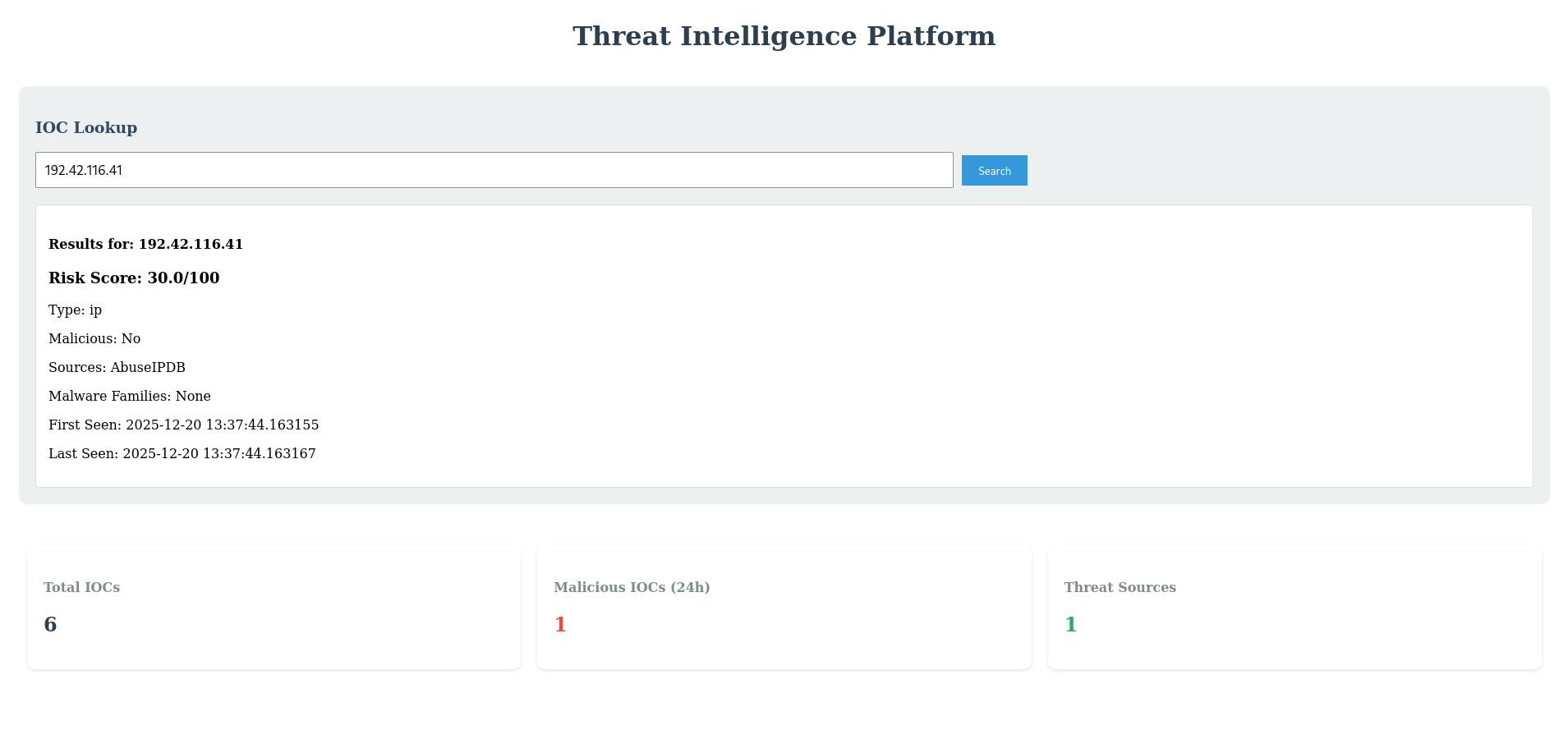
Threat Intelligence Platform is a Python-based project aimed at automating the collection, correlation, and visualization of cyber threat data from various open sources (OSINT). It’s designed to help analysts monitor indicators of compromise (IOCs), score risk levels, and visualize threats via an interactive dashboard.
Master cybersecurity skills with this TryHackMe free path, includes a collection of my write-ups, solutions and progress tracking.