
berth
Berth is a lightweight GPU resource manager written in Go. It controls which applications get access to your GPU, when they get it, and how that access is handed off.
- 300
- Go
- Apache-2.0
- 4 d ago
Intelligent orchestration for local and frontier AI
Repo T-Crypt/ModelHelm, read from GitHub 1 min ago. T-Crypt has not joined Take My Repo.
T-Crypt/ModelHelm is a public repo on GitHub by T-Crypt. Intelligent orchestration for local and frontier AI. It declares the GPL-3.0 license on GitHub. It is written mainly in Python, has 1 stars and last changed on 2026-08-26. Nobody has reviewed it on Take My Repo yet, which says nothing about its quality. Read from GitHub on 2026-11-20.
In the maintainer's words. Shown from GitHub; Take My Repo does not keep a copy.
Intelligent orchestration for local and frontier AI.
ModelHelm is an MCP-native AI model orchestration platform that allows AI agents to intelligently delegate work across local and cloud-hosted models.
ModelHelm is designed around a simple principle:
Use the right model for the task, not the same model for every task.
A frontier model such as Claude can remain the high-level supervisor responsible for planning, architecture, ambiguity, and final review, while ModelHelm delegates appropriate implementation and execution workloads to capable local models running on the user's hardware.
Model selection can incorporate hardware capabilities, model capabilities, context requirements, performance, cost, and policy through integrations such as llmfit.
ModelHelm is more than an MCP server.
The MCP server is the primary interface through which AI agents interact with ModelHelm, while the underlying platform provides the orchestration and execution layer.
                         AI Agent
                       Claude Code
                           │
                           │ MCP
                           ▼
                  ┌──────────────────┐
                  │    ModelHelm     │
                  │    MCP Server    │
                  └────────┬─────────┘
                           │
                  ┌────────▼────────┐
                  │  ModelHelm Core  │
                  │                  │
                  │ Task Routing     │
                  │ Model Selection  │
                  │ Context          │
                  │ Policy           │
                  │ Task Execution   │
                  │ Telemetry        │
                  └────────┬─────────┘
                           │
                 ┌─────────┼─────────┐
                 ▼         ▼         ▼
              llmfit   LM Studio   Ollama
                 │         │         │
                 └─────────┼─────────┘
                           ▼
                     Local Models
The initial implementation focuses on Claude Code + MCP + LM Studio, but the architecture is intentionally designed to remain agent-, model-, and runtime-agnostic.
The long-term goal of ModelHelm is to become an intelligent execution layer for AI agents.
Instead of an AI agent performing every operation itself, it can delegate work to the most appropriate available model.
For example:
User
 │
 ▼
Claude
 │
 ├── Architecture ───────────────► Claude
 │
 ├── Repository exploration ────► Local model
 │
 ├── Implementation ────────────► Qwen
 │
 ├── Test generation ───────────► Local model
 │
 ├── Debugging ─────────────────► Local model
 │
 └── Final review ──────────────► Claude
ModelHelm becomes the layer responsible for deciding:
ModelHelm is intended to consist of several independent layers.
The core orchestration engine is responsible for:
The core should not depend on MCP.
This allows the same orchestration engine to eventually support multiple interfaces.
MCP provides the AI-facing interface.
Tools implemented in Phase 1:
get_status()
list_models()
recommend_model()
delegate_task()
get_task_status()
cancel_task()
resume_task()
Added in Phase 2:
classify_task()
classify_task(description) previews how a description would be classified — returning its task class, disposition (local or claude), and the keyword that matched — without creating a task or running anything.
Planned for later phases:
get_project_context()
update_project_context()
get_usage()
Claude Code is the initial consumer, but MCP should not be treated as a Claude-specific protocol.
ModelHelm should eventually support multiple execution backends:
LM Studio          (Phase 1 — implemented)
Ollama
llama.cpp
OpenAI-compatible endpoints
Cloud providers
The orchestration layer should remain independent of the runtime.
ModelHelm should eventually route tasks based on multiple signals rather than simply selecting the largest available model.
Potential routing inputs include:
| Signal | Example |
|---|---|
| Task type | Coding, debugging, architecture |
| Complexity | Low / medium / high |
| Model capability | Coding, reasoning, tools |
| Hardware | GPU, VRAM, RAM, CPU |
| Context | Required context window |
| Runtime | LM Studio, Ollama, cloud |
| Latency | Interactive vs batch |
| Cost | Local vs cloud |
| Reliability | Historical task success |
| Risk | Safe vs sensitive operation |
| Policy | User-defined routing rules |
Example:
Task:
Implement a Python REST API client

             │
             ▼
       ModelHelm Router
             │
             ▼
          llmfit
             │
             ▼
      Qwen3-Coder-30B-A3B
             │
             ▼
         LM Studio
A more difficult architectural task could instead remain with Claude.
Phase 1 ships a thin version of this router: tasks are classified default-local, and the best available tool-use-capable model is selected by llmfit fit score. Phase 2 (see roadmap below) extends this into full multi-signal routing.
ModelHelm is designed around local-first execution where practical.
Local models are particularly valuable for high-volume operations such as:
Frontier models remain valuable for:
The goal is not to eliminate cloud models.
The goal is to avoid spending expensive frontier-model inference on tasks that capable local models can perform successfully.
A major part of the long-term project is independent project context.
ModelHelm should eventually maintain project-local AI state such as:
.ai/
├── project.md
├── architecture.md
├── conventions.md
├── decisions.md
├── environment.md
├── current-task.md
├── discoveries.md
├── failures.md
├── completed.md
└── state.json
This allows ModelHelm to provide models with the context relevant to the current task without repeatedly sending an entire conversation or repository.
Context management should eventually support:
ModelHelm supports autonomous local task execution.
A delegated task follows a loop such as:
Receive task
     │
     ▼
Inspect repository
     │
     ▼
Understand existing implementation
     │
     ▼
Implement change
     │
     ▼
Run tests
     │
     ▼
Analyze failures
     │
     ▼
Fix problems
     │
     ▼
Run tests again
     │
     ▼
Return structured result
ModelHelm places configurable limits around this loop (max_iterations in modelhelm.yaml) rather than allowing agents to execute indefinitely.
Local execution should not be forced when it is failing.
ModelHelm recognizes conditions such as:
and escalates the task back to the supervising agent or another model.
Local Model
     │
     ├── Attempt 1 ──► Failed
     ├── Attempt 2 ──► Failed
     └── Attempt 3 ──► Failed
                       │
                       ▼
                  Escalation
                       │
                       ▼
                    Claude
ModelHelm is designed for controlled automation.
The system supports configurable policies:
ALLOW
ASK
DENY
Shipped Phase 1 defaults:
File write                → ALLOW  (scoped to the target repository)
File delete                → ALLOW  (scoped to the target repository)
Git commit                 → ASK
Git push                   → ASK
Force push                 → DENY
Destructive commands       → DENY
Production changes         → DENY
run_command routes git commit/git push/--force flags through the same policy gates as the dedicated tools, and a hardened pattern list blocks common destructive shell commands (rm -rf variants, git reset --hard, dd, mkfs, pipe-to-shell, etc.) across bash and PowerShell. Reading sensitive files (.env, .pem, .key, credentials*, .git/config) is denied outright. ModelHelm never silently performs a destructive or high-impact operation — every write stays hard-scoped to the target repository regardless of policy setting.
ModelHelm should eventually measure the effectiveness of local delegation.
Potential metrics include:
Tasks delegated locally
Tasks completed successfully
Tasks escalated
Local inference time
Model used
Runtime used
Agent iterations
Tests passed/failed
Estimated cloud tokens avoided
Estimated cloud cost avoided
Local task success rate
This allows ModelHelm to answer an important question:
How much development work can this machine perform locally without sacrificing quality?
Phase 1's TaskResult contract already reports duration_seconds, files_changed, iterations, and estimated_cloud_tokens_saved (a size-based heuristic, not real token accounting) per task. Real usage analytics land in a later phase.
The first milestone established the basic working architecture, end to end:
Claude Code
    │
    │ MCP
    ▼
ModelHelm
    │
    ▼
LM Studio
    │
    ▼
Qwen3-Coder-30B-A3B
    │
    ▼
Repository
Phase 1 proved that ModelHelm can:
llmfit + LM Studio stateThis was validated with a real end-to-end integration test against a running LM Studio instance with qwen3-coder-30b-a3b loaded — not just mocks — and went through a full security review (bypass of the policy engine via run_command, a weak destructive-command blocklist, and a stale-approval replay bug were all found and fixed before merge).
See:
docs/superpowers/specs/2026-08-25-phase1-mcp-agent-loop-design.mddocs/ModelHelm-Spec.mdqwen3-coder-30b-a3bCreate a virtual environment and install ModelHelm:
python -m venv .venv
.\.venv\Scripts\python.exe -m pip install -e ".[dev]"
Unit tests:
.\.venv\Scripts\pytest.exe tests/unit/ -v
Integration tests:
.\.venv\Scripts\pytest.exe tests/integration/ -v
Integration tests require LM Studio to be running with a compatible model loaded.
.\.venv\Scripts\python.exe -m modelhelm.mcp.server
Configure ModelHelm through:
modelhelm.yaml
The repository configuration contains the default settings, including the safety policy.
In progress — Milestone 1 (task-aware routing) is complete.
Every task is now classified before delegation. Classification is keyword-based and runs first, so a task classified as architecture, security, high-risk, or final review never reaches the router, the registry, or LM Studio — delegate_task short-circuits and returns escalation_recommended, recommending Claude handle it directly.
Each task class carries a disposition:
local — exploration, implementation, refactoring, testing, debugging, documentation, contextclaude — architecture, security, high_risk, final_reviewA description matching both a claude and a local class resolves to the claude class, and a description matching nothing falls back to the ambiguous class, which always escalates. Both behaviors are deliberate and fail safe: escalating a borderline task costs tokens, whereas running a security or high-risk change on a local model costs correctness.
The resolved class is persisted as task_class on DelegatedTask and returned as task_class on TaskResult, so the routing decision is auditable after the fact. Use classify_task() to preview a classification without creating a task.
The keyword table can be replaced in modelhelm.yaml:
classification:
  classes:
    - name: security
      disposition: claude
      keywords: ["security", "auth", "credential", "vulnerability", "encrypt"]
When a classification: section is present it replaces the built-in table wholesale rather than merging into it, so a custom table must list every class you want matched. Order matters — classification is first-match-wins in list order, so list claude-disposition classes first to preserve the fail-safe. ambiguous cannot be redefined: it is the internal fallback and always escalates, and declaring a class by that name is rejected at startup, as is any class with an empty keyword (which would match every description).
Remaining Phase 2 capabilities:
llmfit integration (beyond fit-score selection)Example:
Task
 │
 ▼
ModelHelm
 │
 ├── Complexity
 ├── Context
 ├── Hardware
 ├── Model capability
 ├── Cost
 └── Policy
 │
 ▼
Best execution target
Expand beyond LM Studio.
Planned runtimes:
LM Studio        (Phase 1 — implemented)
Ollama
llama.cpp
OpenAI-compatible endpoints
Cloud providers
ModelHelm should be able to switch execution backends without changing the agent-facing interface.
Introduce the .ai/ project context system.
Capabilities:
Support multiple specialized agents:
                 Task
                   │
        ┌──────────┼──────────┐
        ▼          ▼          ▼
      Coder     Tester    Investigator
        │          │          │
        └──────────┼──────────┘
                   ▼
                Reviewer
Different models can be assigned to different roles.
Use historical execution data to improve routing decisions.
ModelHelm could learn that:
Qwen:
Python implementation → excellent

Qwen:
Simple refactoring → excellent

Local reasoning model:
Log analysis → excellent

Claude:
Complex architecture → excellent
Routing becomes based not only on static model capabilities, but observed performance.
Long-term, ModelHelm could treat multiple computers as AI workers.
                         ModelHelm
                             │
             ┌───────────────┼───────────────┐
             ▼               ▼               ▼
         Workstation       Server           NAS
         RTX 4090          GPU Node        CPU Node
             │               │               │
           Qwen            Large LLM        Small LLM
The orchestration layer could select the best available worker for each task.
ModelHelm ultimately aims to become a general-purpose model orchestration layer for AI agents.
The final architecture could look like:
                         AI Agents
                            │
          ┌─────────────────┼─────────────────┐
          │                 │                 │
      Claude Code         IDEs          Custom Agents
          │                 │                 │
          └─────────────────┼─────────────────┘
                            │
                           MCP
                            │
                    ┌───────▼───────┐
                    │   ModelHelm   │
                    │               │
                    │ Orchestration │
                    │ Routing       │
                    │ Context       │
                    │ Policy        │
                    │ Telemetry     │
                    └───────┬───────┘
                            │
             ┌──────────────┼──────────────┐
             ▼              ▼              ▼
          Local          Remote          Cloud
          Models         Models          Models
The important abstraction is:
Agents decide what needs to be accomplished. ModelHelm decides how and where the work should be executed.
ModelHelm should remain:
Do not design the core around Claude Code.
Do not assume Qwen is the only useful local model.
LM Studio is the starting point, not the architectural boundary.
Prefer local inference when it provides sufficient capability.
Users control what the system is allowed to execute.
Delegation decisions and results should be inspectable.
New models, runtimes, agents, and routing strategies should be addable without rewriting the core.
MCP should be the primary AI-agent integration mechanism.
Phase 1 — MCP Server + Local Agent Loop: Complete
Claude Code
     │
     ▼
ModelHelm MCP
     │
     ▼
LM Studio
     │
     ▼
Qwen3-Coder-30B-A3B
     │
     ▼
Local Repository
The full delegation chain — MCP tool call → router → policy-gated agent loop → LM Studio tool calling → repository edit → human-approved commit — is implemented, tested (109 unit tests + a real end-to-end integration test), and security-reviewed.
Phase 2 — Intelligent Model Routing: Milestone 1 (task-aware routing) complete. Tasks are classified before delegation, and architecture, security, high-risk and final-review work escalates to Claude instead of reaching a local model.
For the detailed technical requirements and architecture, see:
docs/superpowers/specs/2026-08-25-phase1-mcp-agent-loop-design.md
docs/ModelHelm-Spec.md
T-Crypt/ModelHelm is a public repo on GitHub by T-Crypt. Intelligent orchestration for local and frontier AI.
It declares the GPL-3.0 license on GitHub.
Its maker has not tagged a system, so it is unknown here. Its README says what it needs.
Open "Take it" on its page: Take My Repo writes an install plan for your machine and hands it to your AI agent (Claude Code, Codex or Cursor), which asks you before each step. Take My Repo has not tested it on any machine.
Its last change on GitHub was on 2026-08-26. Take My Repo does not judge from that whether it is maintained.
Nobody has reviewed it on Take My Repo yet, which says nothing about its quality.
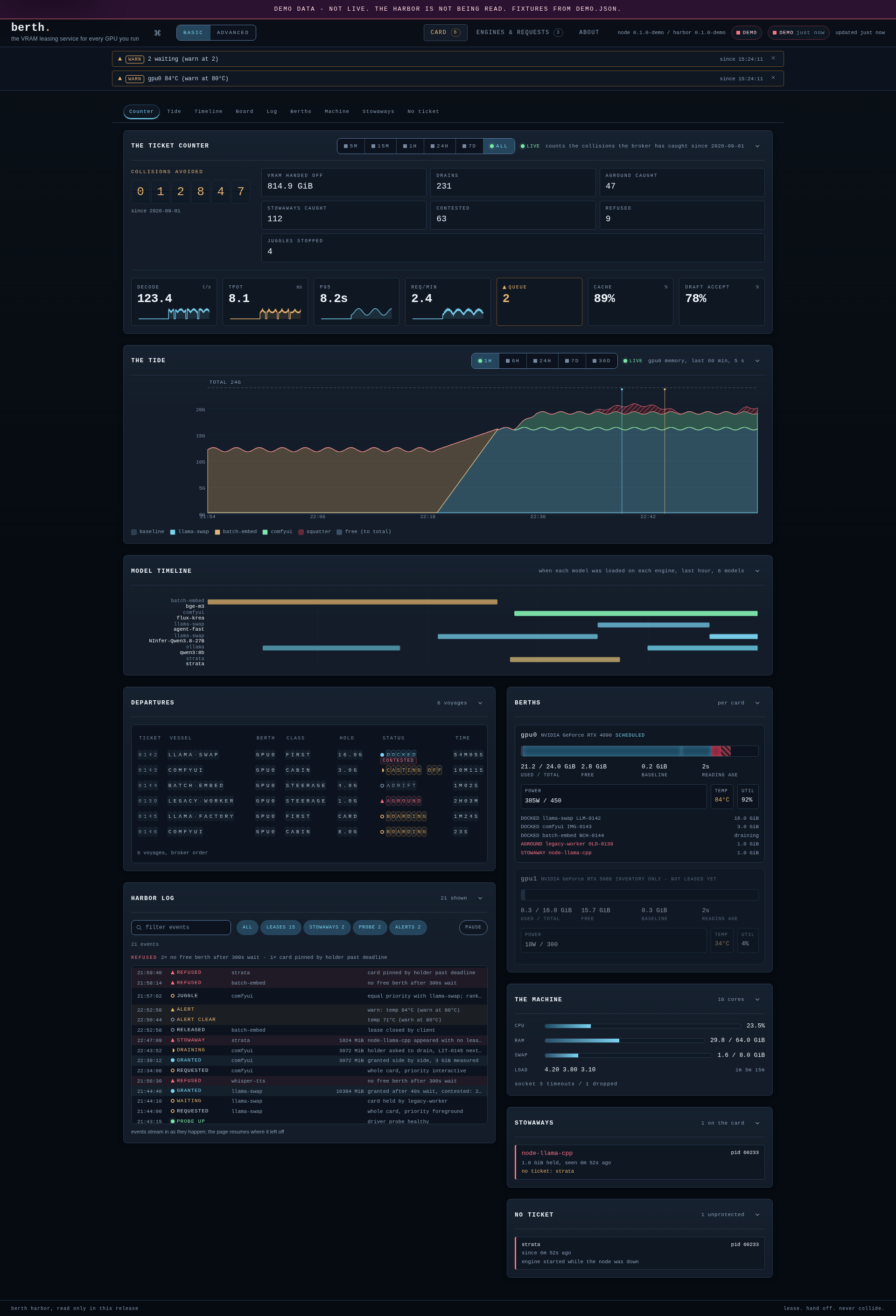
Berth is a lightweight GPU resource manager written in Go. It controls which applications get access to your GPU, when they get it, and how that access is handed off.
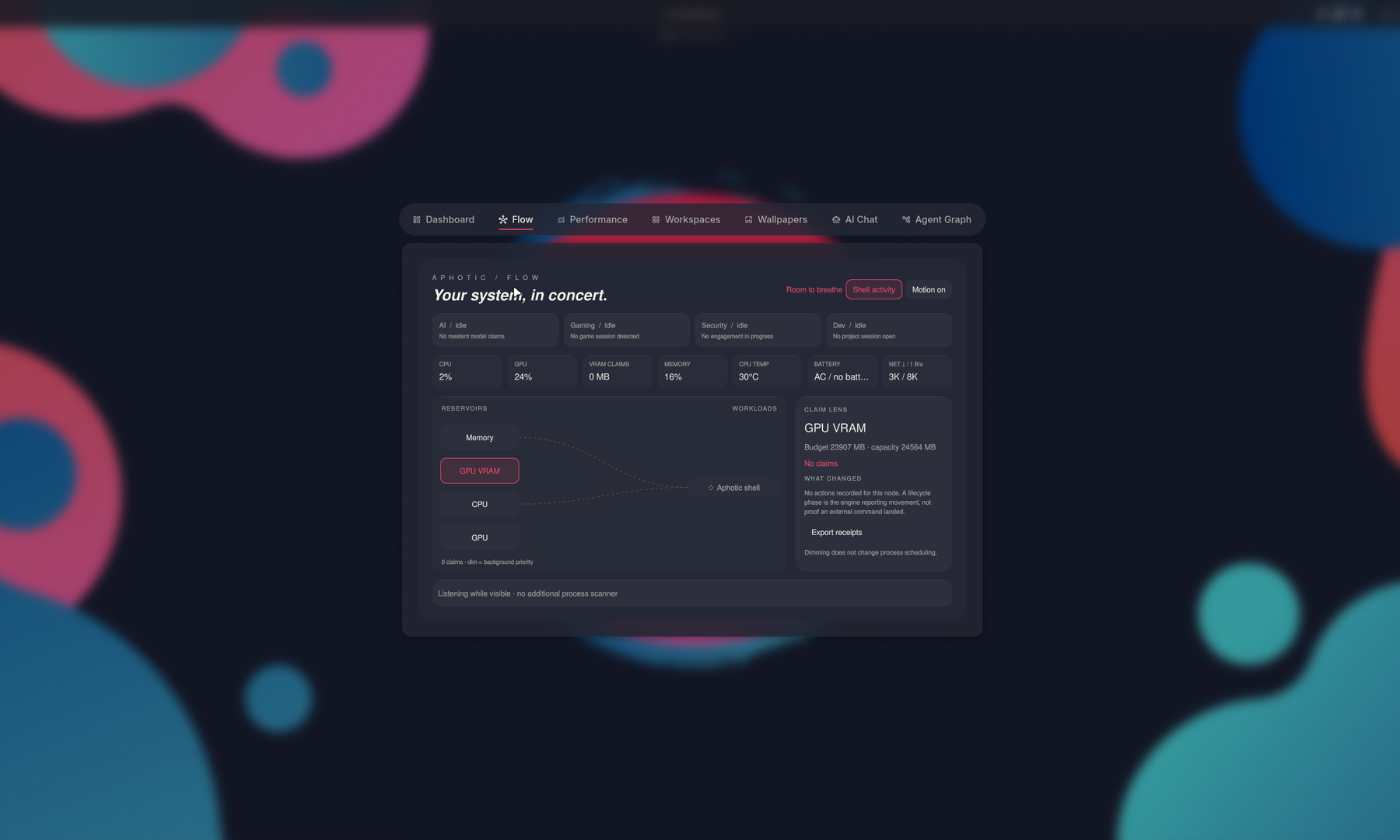
Four identities. One desktop. Modular Plugins · Live Hot-Swapping · Seamless Customization · Resource-Aware (personal project)
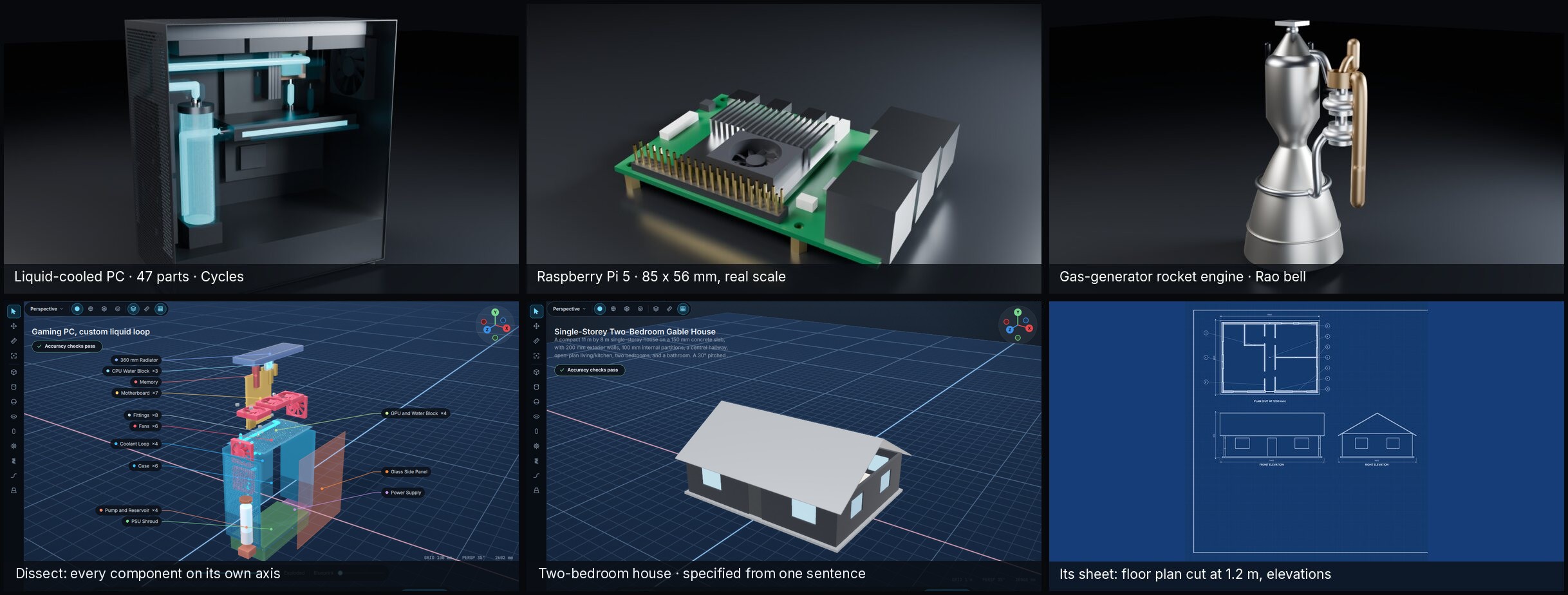
You specify it, you build it. A workshop where a sentence becomes a validated build program, an exact solid, a measured report and a STEP, DXF, STL or URDF file. Any OpenAI-compatible model; agents over MCP.
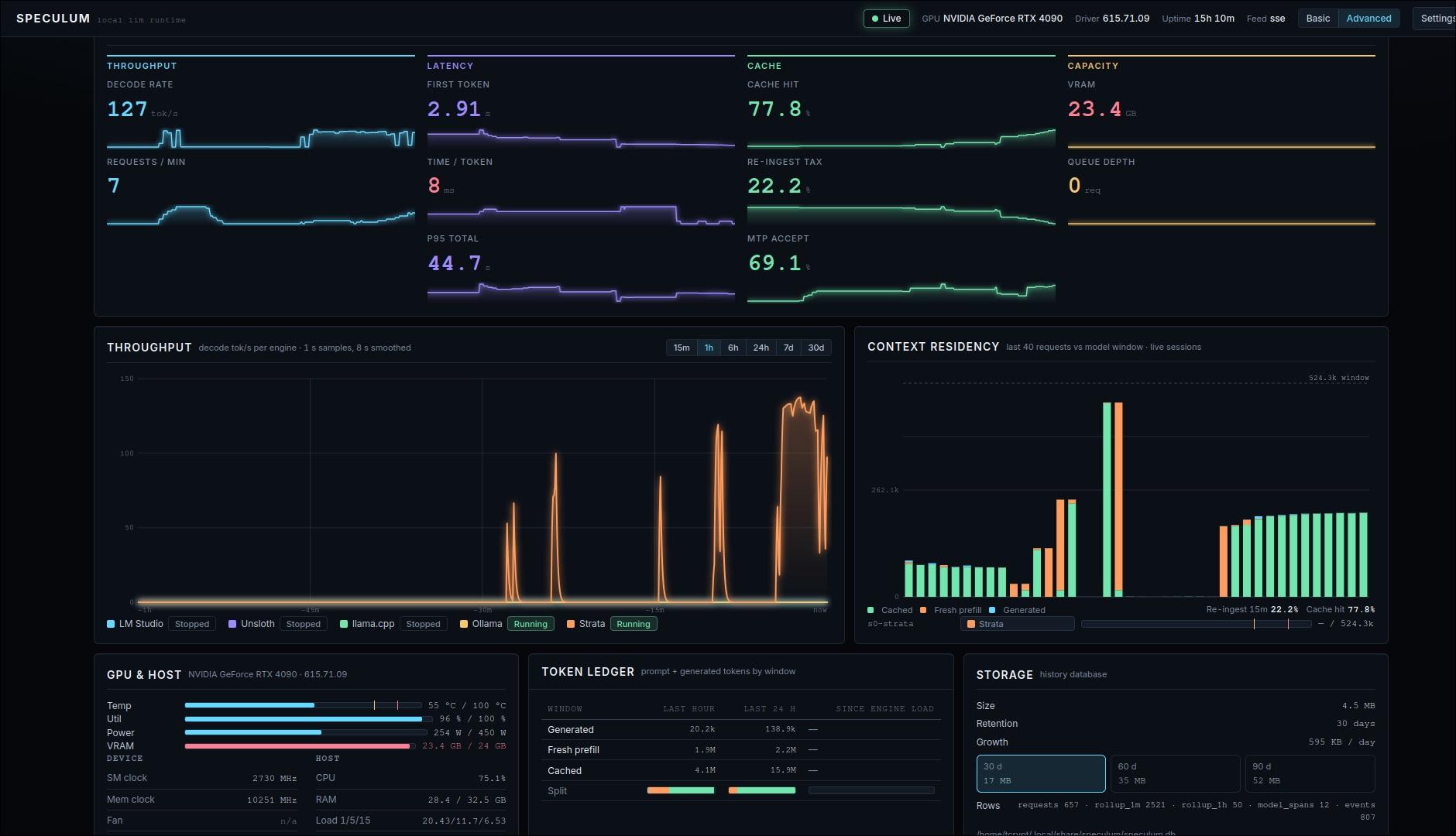
monitor for a local LLM runtime (llama-swap, NInfer, Strata, more) -- metrics ported to berth.
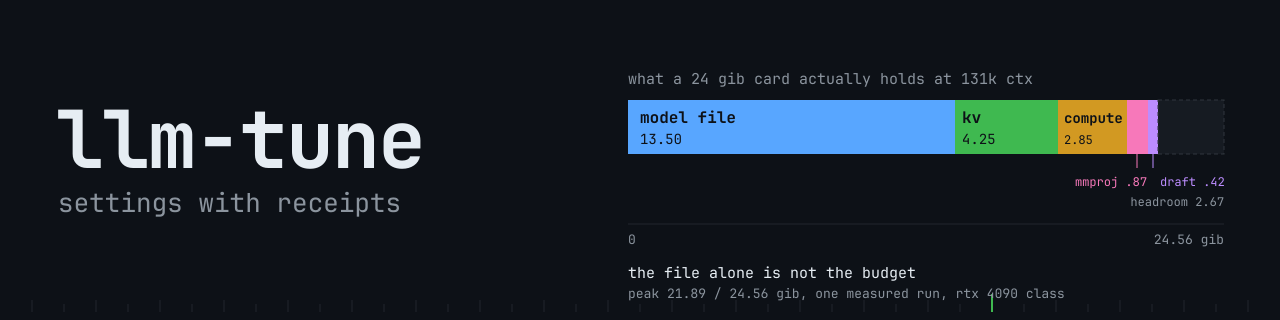
Agent skill: evidence-based local LLM tuning - quant, context, KV, sampling, harness settings, measured on one 24 GB RTX 4090
This page is also available as structured data, with the same sources and dates.
/api/v1/resources/gh/T-Crypt/ModelHelmTake My Repo has not tested this on your machine. Requirements come from the project's own documentation.
