DeepDive
DeepDive: Advancing Deep Search Agents with Knowledge Graphs and Multi-Turn RL
- 351
- 5 mo ago
Repo THUDM/DeepDive, read from GitHub 1 min ago. THUDM has not joined Take My Repo.
In short
THUDM/DeepDive is a public repo on GitHub by THUDM. DeepDive: Advancing Deep Search Agents with Knowledge Graphs and Multi-Turn RL. It declares no license on GitHub. Public does not mean open source: without a license, nobody is granted the right to reuse it. It is written mainly in Python, has 351 stars and last changed on 2026-06-17. Nobody has reviewed it on Take My Repo yet, which says nothing about its quality. Read from GitHub on 2026-11-22.
DeepDive: Advancing Deep Search Agents with Knowledge Graphs and Multi-Turn RL

🔥 News
- [2026/06/17] Released the training code with the DeepDive slime rollout setup.
- [2025/10/02] Released the complete data construction pipeline — now fully available in the repository.
- [2025/09/17] QA pairs and SFT trajectories have been fully open-sourced, totaling 4,108 entries. Check them out on Hugging Face Dataset DeepDive.
- Model checkpoints are currently under development – coming soon!
Overview
DeepDive presents an automated approach for training deep search agents that can navigate complex, multi-step information-seeking tasks. Our method combines automated data synthesis from knowledge graphs with end-to-end multi-turn reinforcement learning to create agents capable of sophisticated long-horizon reasoning and web browsing.
Key Features
- Automated Deep Search Data Synthesis: Generate challenging QA pairs from knowledge graphs through controlled random walks
- Multi-Turn RL Training for Browsing: End-to-end reinforcement learning for deep search capabilities
- Test-Time Scaling: Supports scaling via tool calls and parallel sampling
Method Overview
Stage 1: Automated Data Synthesis from Knowledge Graphs

We propose an automated method to synthesize complex, difficult, and hard-to-find questions from open knowledge graphs. The process involves three key steps:
Knowledge Graph Random Walks: Starting from an initial node $v_0$, we navigate through the graph for $k$ steps to form a path $P=[v_0, v_1, \ldots, v_k]$, where each step $(v_i, v_{i+1})$ is a valid edge in the graph. We choose longer path lengths ($k > 5$) to increase reasoning complexity.
Entity Obfuscation: We combine each node $v_i$ in the path with its corresponding attributes to form an attribute-rich path:
$$P_A = [(v_0, [a_0^0, a_0^1, \ldots]), (v_1, [a_1^0, a_1^1, \ldots]), \ldots, (v_k, [a_k^0, a_k^1, \ldots])]$$
An LLM then obfuscates information along the entire path, generalizing specific details and creating "blurry entities" that require deep search to resolve.
Difficulty Filtering: We use a frontier model (GPT-4o) with basic search to attempt each question four times. Only questions that the frontier model fails in all attempts are retained, ensuring high difficulty.
Stage 2: End-to-End Multi-Turn Reinforcement Learning

We apply end-to-end multi-turn RL to enhance the agent's long-horizon reasoning and browsing capabilities. The training process follows an iterative cycle where at step $t$, the agent generates chain-of-thought $c_t$, executes browsing action $a_t$, and observes web content $o_t$.
Multi-Turn GRPO Training: We employ Group Relative Policy Optimization with normalized advantages:
$$ A_i = \frac{r_i - \text{mean}({r_k}_{k=1}^G)}{\text{std}({r_k}_{k=1}^G)} $$
Strict Binary Rewards: A trajectory receives reward +1 if and only if both format correctness and answer accuracy are satisfied:
$$ r(\mathcal{T}) = \begin{cases} 1, & (\forall i, \text{Format}(c_i, a_i)) \wedge \text{Judge}(a_{\text{eos}}, a^*) \ 0, & \text{otherwise} \end{cases} $$
This strict reward mechanism ensures high-quality trajectories and prevents reward hacking.
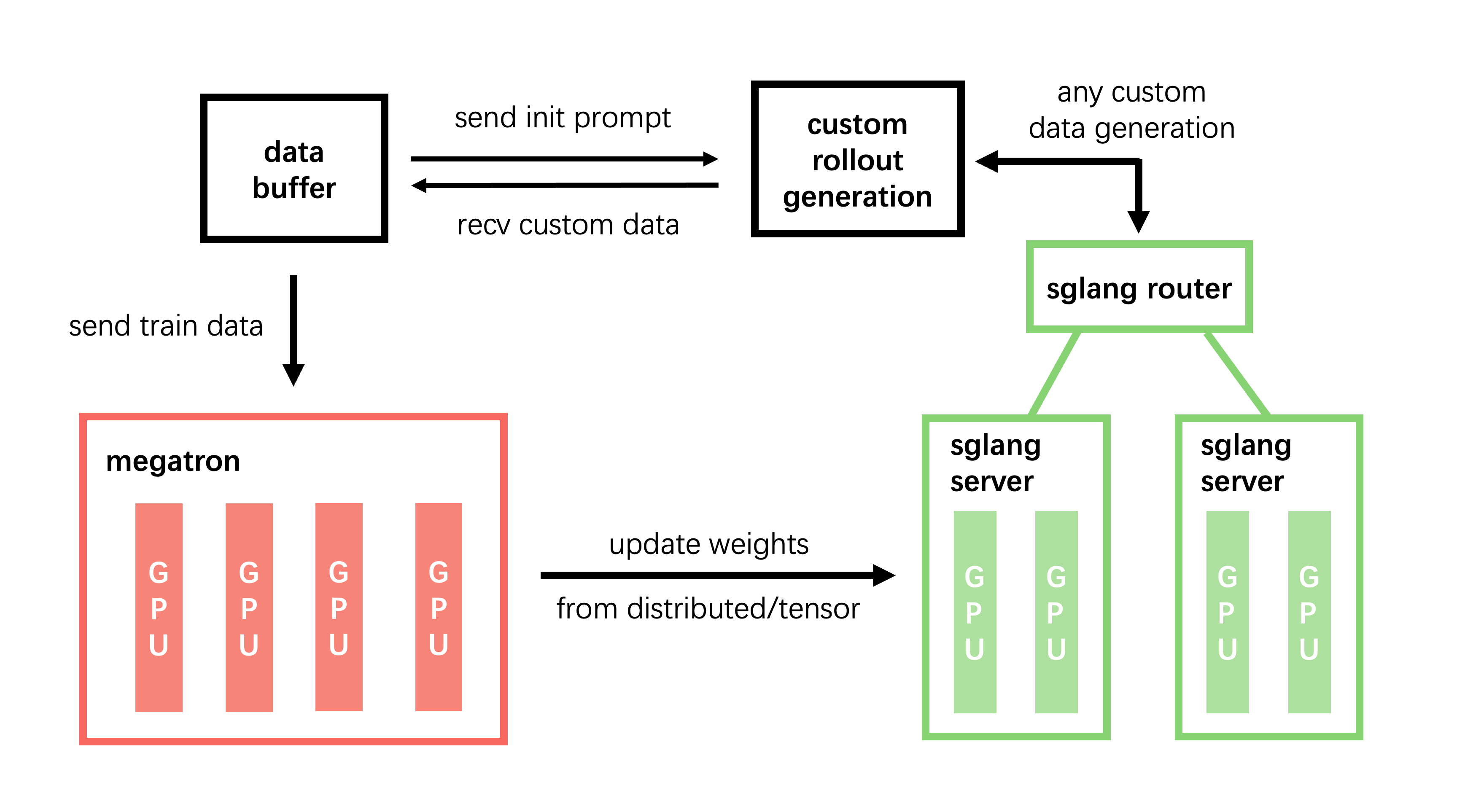
For the recommended DeepDive training interface and slime rollout setup, see
training/README.md.
Models
| Model | Parameters | HuggingFace Hub | Performance (BrowseComp) |
|---|---|---|---|
| DeepDive-9B | 9B | coming soon | 6.3% |
| DeepDive-32B | 32B | coming soon | 14.8% |
Data
Synthetic Dataset Construction
Our automated data synthesis pipeline creates challenging QA pairs through knowledge graph random walks, entity obfuscation, and difficulty filtering. The process uses multi-hop paths (k=5-9) through KILT and AMiner knowledge graphs.
| Component | Size | Explanation |
|---|---|---|
| Total Dataset | 3,250 | All QA pairs in the training corpus |
| SFT Portion | 1,016 | Subset of the data used for Supervised Fine-Tuning (SFT) |
| ↳ SFT Trajectories | 858 | Search Traces from the SFT QA pairs via reject sampling |
| RL Portion | 2,234 | Subset of the data used for Reinforcement Learning (RL) |
Data Example

Results
Main Results
We evaluate DeepDive on four challenging deep search benchmarks: BrowseComp, BrowseComp-ZH, Xbench-DeepSearch, and SEAL-0. The results demonstrate consistent improvements over existing open-source models.
| Model | Reason | Browse | BrowseComp | BrowseComp-ZH | Xbench-DeepSearch | SEAL-0 |
|---|---|---|---|---|---|---|
| Proprietary Models | ||||||
| GPT-4o | ✗ | ✗ | 0.9* | 11.1 | 18.0* | 0.9 |
| GPT-4o† | ✗ | ✓ | 1.9* | 12.8 | 30.0 | 9.1 |
| Claude-3.7-Sonnet | ✗ | ✗ | 2.3 | 11.8 | 12.0 | 2.7 |
| Claude-3.7-Sonnet† | ✗ | ✓ | 4.5 | 14.2 | 29.0 | 14.4 |
| o1 | ✓ | ✗ | 9.9* | 29.1* | 38.0 | 11.7 |
| o4-mini | ✓ | ✗ | 6.1* | 15.2* | 22.3* | 2.7 |
| Claude-4-Sonnet-Thinking | ✓ | ✓ | 2.6 | 21.5 | 27.0 | 9.0 |
| Claude-4-Sonnet-Thinking† | ✓ | ✗ | 14.7 | 30.8 | 53.0 | 37.8 |
| Grok-DeepResearch | ✓ | ✓ | - | 12.9* | 50+ | - |
| Doubao-DeepThink | ✓ | ✓ | - | 26.0* | 50+ | - |
| DeepResearch | ✓ | ✓ | 51.5* | 42.9* | - | - |
| Open-Source Models | ||||||
| GLM-Z1-9B-0414 | ✗ | ✗ | 0.6 | 2.4 | 8.0 | 7.2 |
| GLM-Z1-9B-0414† | ✗ | ✓ | 0.6 | 1.7 | 3.0 | 2.7 |
| Qwen2.5-32B-Instruct | ✗ | ✗ | 0.6 | 9.3 | 8.7* | 2.7 |
| Qwen2.5-32B-Instruct† | ✗ | ✓ | 1.5 | 1.7 | 12.0 | 0.9 |
| Qwen3-235B-A22B-Instruct-2507 | ✗ | ✗ | 0.9 | 17.6 | 17.0 | 6.3 |
| Qwen3-235B-A22B-Instruct-2507† | ✗ | ✓ | 0.9 | 14.9 | 26.0 | 9.1 |
| Qwen3-235B-A22B-Thinking-2507 | ✗ | ✗ | 3.1 | 20.1 | 22.0 | 9.0 |
| Qwen3-235B-A22B-Thinking-2507† | ✗ | ✓ | 4.6 | 22.5 | 37.0 | 13.5 |
| QwQ-32B | ✓ | ✗ | 1.7 | 13.5 | 10.7* | 5.4 |
| QwQ-32B† | ✓ | ✓ | 1.3 | 14.5 | 27.0 | 4.5 |
| DeepSeek-V3-0324 | ✗ | ✗ | 1.5 | 24.6 | 36.0 | 6.3 |
| DeepSeek-R1 | ✓ | ✗ | 2.0 | 23.2 | 32.7* | 5.4 |
| DeepSeek-R1-0528 | ✓ | ✗ | 3.2 | 28.7 | 37.0 | 5.4 |
| GLM-4.5-Air | ✓ | ✓ | 21.3 | 36.3 | 65.0 | 30.6 |
| GLM-4.5 | ✓ | ✓ | 26.4 | 37.5 | 68.0 | 36.0 |
| Web Agents | ||||||
| Search-o1-32B | ✓ | ✓ | 2.8* | 17.9* | 25.0* | - |
| WebThinker-32B | ✓ | ✓ | 2.8* | 7.3* | 24.0* | - |
| WebDancer-32B | ✓ | ✓ | 3.8* | 18.0* | 39.0* | - |
| WebSailor-7B | ✓ | ✓ | 6.7* | 14.2* | 34.3* | - |
| WebSailor-32B | ✓ | ✓ | 10.5* | 25.5* | 53.3* | - |
| DeepDive (Ours) | ||||||
| DeepDive-9B (sft-only) | ✓ | ✓ | 5.6 | 15.7 | 35.0 | 15.3 |
| DeepDive-9B | ✓ | ✓ | 6.3 | 15.1 | 38.0 | 12.2 |
| DeepDive-32B (sft-only) | ✓ | ✓ | 9.5 | 23.0 | 48.5 | 23.9 |
| DeepDive-32B | ✓ | ✓ | 14.8 | 25.6 | 50.5 | 29.3 |
Note
* represents reported performance from existing studies. † represents equipping browsing via function call.
Generalization on Simple Search Tasks
We evaluate DeepDive not only on challenging search tasks (e.g., BrowseComp, BrowseComp-ZH) but also on simpler benchmarks such as HotpotQA, Frames, and WebWalker. DeepDive-32B (SFT and RL) consistently outperforms strong baselines, achieving >60 points on WebWalker, surpassing WebShaper-72B (52.2). These results demonstrate DeepDive’s strong and generalizable search capabilities.

Test-Time Scaling
DeepDive demonstrates remarkable test-time scaling capabilities through two mechanisms:
Tool Call Scaling: Allowing DeepDive more tool calls during inference leads to higher accuracy on complex, multi-step tasks. As shown in the BrowseComp and BrowseComp-ZH benchmark results:
- When the maximum number of tool calls is increased, accuracy rises steadily. On BrowseComp, performance improves from 8% accuracy at 8 tool calls to 15% at 128 tool calls, showing that the model benefits from additional search and reasoning opportunities.
- DeepDive-32B consistently outperforms its SFT-only variant, especially when the allowed tool calls exceed 32. This indicates that the reinforcement learning stage better equips the model to utilize long tool call horizons.

Parallel Sampling: Beyond a larger tool call budget, DeepDive leverages parallel sampling to further boost performance. For each question, DeepDive generates 8 independent reasoning trajectories in parallel.
- Three answer selection strategies are considered: single-shot inference, majority voting among samples, and choosing the answer that required the fewest tool calls before submission.
- Empirical analysis reveals a clear trend: answers submitted earlier with fewer tool calls are usually more accurate. In practice, selecting the answer with minimal tool calls among 8 samples raises accuracy from 12.0% (single-shot) to 24.8%, more than doubling performance. Majority voting also helps (18.8% accuracy), but is outperformed by minimal tool-call selection.

Additional Study: Semi-Automated i.i.d. Deep Search QA for RL
To further boost performance on deep search tasks, we create a semi-automated framework for generating i.i.d. QA pairs.
Training with i.i.d. data brings larger improvements. The 32B-RL model reaches 22.2% accuracy on BrowseComp, up from 14.8%, and also performs better on Chinese benchmarks.
| Model | Data | BrowseComp | BrowseComp-ZH | Xbench-DeepSearch | SEAL-0 |
|---|---|---|---|---|---|
| 32B (sft-only) | KG | 9.5 | 23.0 | 48.5 | 23.9 |
| 32B | KG | 14.8 | 25.6 | 50.5 | 29.3 |
| 32B (sft-only) | i.i.d. | 11.4 | 26.6 | 47.5 | 22.5 |
| 32B | i.i.d. | 22.2 | 33.9 | 56.0 | 23.0 |
Note
Given the contamination analysis, both the KG data and i.i.d. data are adopted by the open
 GLM-4.5 / GLM-4.6 models, which show strong performance on BrowseComp.
Acknowledgments
- Built on top of GLM-4 and QwQ base models
- Uses Slime framework for RL training
- Powered by Serper and Jina APIs for web access
Citation
If you find DeepDive useful for your research, please cite our paper:
@misc{lu2025deepdiveadvancingdeepsearch,
      title={DeepDive: Advancing Deep Search Agents with Knowledge Graphs and Multi-Turn RL},
      author={Rui Lu and Zhenyu Hou and Zihan Wang and Hanchen Zhang and Xiao Liu and Yujiang Li and Shi Feng and Jie Tang and Yuxiao Dong},
      year={2025},
      eprint={2509.10446},
      archivePrefix={arXiv},
      primaryClass={cs.CL},
      url={https://arxiv.org/abs/2509.10446},
}
Questions
What is DeepDive?
THUDM/DeepDive is a public repo on GitHub by THUDM. DeepDive: Advancing Deep Search Agents with Knowledge Graphs and Multi-Turn RL.
Is DeepDive open source?
It declares no license on GitHub. Public does not mean open source: without a license, nobody is granted the right to reuse it.
Does DeepDive run on macOS, Windows or Linux?
Its maker has not tagged a system, so it is unknown here. Its README says what it needs.
How do I install DeepDive?
Open "Take it" on its page: Take My Repo writes an install plan for your machine and hands it to your AI agent (Claude Code, Codex or Cursor), which asks you before each step. Take My Repo has not tested it on any machine.
Is DeepDive still maintained?
Its last change on GitHub was on 2026-06-17. GitHub counts 0 open issues and pull requests. Take My Repo does not judge from that whether it is maintained.
What do people who ran DeepDive say?
Nobody has reviewed it on Take My Repo yet, which says nothing about its quality.
More from THUDM
AgentBench
A Comprehensive Benchmark to Evaluate LLMs as Agents (ICLR'24)