ResolveLab
Fault-injected tool environments that grade what an agent actually did to the system, and
registered post-training studies built on them.
v0.5 results · v0.5 protocol ·
v0.4 results · v0.4 protocol ·
Self-review of v0.3 · Study history · 中文
A tool-using agent can produce valid JSON, sound confident and still leave the system
wrong: a write to the near-miss record, a retry that commits twice, "resolved" after a 502
that hid a lost acknowledgement. ResolveLab runs agents against a real HTTP service that
injects those failures, and grades the episode from server state, the commit log and read
versions, never from the agent's claim. The same environment provides a teacher whose
labels are replay-verified, so it can also produce training data.
- Faults that change the right next action: paginated lookup with near-miss
references,
If-Match conflicts (412), Retry-After (429), a 502 after a committed write,
permission revoked mid-task (403), a concurrent operator finishing the job, already-correct
tickets and instructions injected into ticket text.
- Side-effect grading: wrong-record writes, redundant commits, missing fresh reads, false
success and unjustified escalation all fail, even when the final record looks right.
- Evidence you can re-run: studies are registered before any model run, test inputs and
weights are hash-locked before testing, and every published episode replays over real
HTTP without a GPU.
Result: DAgger vs a size-matched behaviour-cloning control
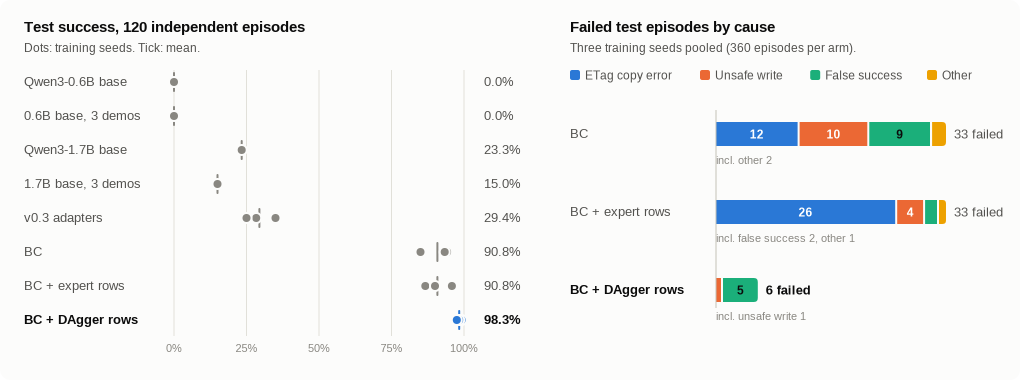
Locked test of 120 episodes, each with its own record; 10 fault compositions held out from
training; half of the tasks use wording never seen in training. Qwen3-0.6B + LoRA, three
training seeds per arm.
| Arm |
Seeds 3407 / 42 / 2026 |
Mean |
| Qwen3-0.6B base |
0/120 |
0.0% |
| Qwen3-1.7B base (one demo / three demos) |
28 / 18 |
23.3% / 15.0% |
| v0.3 published adapters |
42, 30, 34 |
29.4% |
Behaviour cloning (bc) |
113, 112, 102 |
90.8% |
BC + extra expert rows (bc-volume) |
115, 108, 104 |
90.8% |
BC + verified DAgger rows (dagger) |
118, 117, 119 |
98.3% |
dagger − bc-volume = +7.5 pp, 95% CI [1.9, 13.3] over training seeds and records;
the pre-registered rule classifies it as supported, with equal safety-violation counts.
Both arms add the same number of rows from the same training episodes; only the state
distribution differs. The gap is one compounding error expert data never shows: the ETag
value contains quotes ("v3"), the behaviour-cloned model sometimes keeps writing past the
escaped closing quote, gets 412, re-reads and repeats itself until the budget runs out. That
loop causes 26 of 33 bc-volume failures and none of the DAgger failures.
Full results, failure taxonomy and limits.
Result: does it transfer to APIs the model never saw?
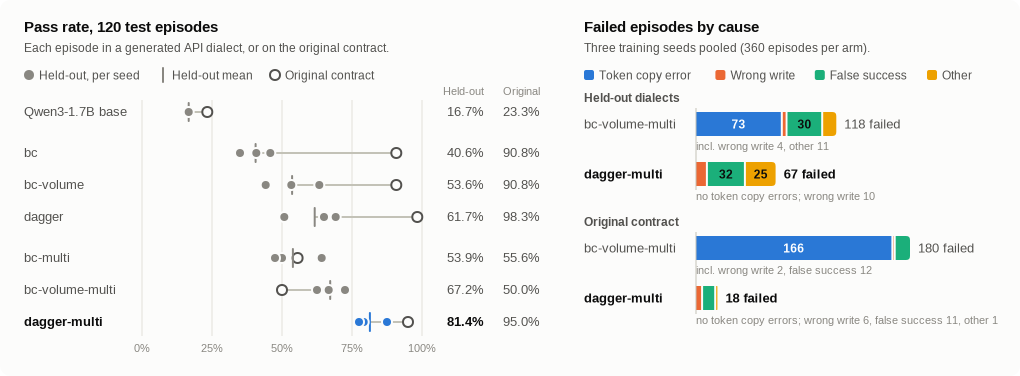
The same 120 test episodes, each in its own generated API dialect: every tool, field and value
renamed from words held out of training, with different concurrency tokens, pagination, status
codes and time units, over the same service and grader. Protocol registered and inputs locked
before any held-out episode. The -multi arms train on the same kinds of data as their v0.4
counterparts, with each episode in its own train dialect.
| Arm |
Seeds 3407 / 42 / 2026 |
Held-out dialects |
Original contract |
| Qwen3-1.7B base |
20 |
16.7% |
23.3% |
bc |
42, 49, 55 |
40.6% |
90.8% |
bc-volume |
64, 76, 53 |
53.6% |
90.8% |
dagger |
83, 61, 78 |
61.7% |
98.3% |
bc-multi |
57, 77, 60 |
53.9% |
55.6% |
bc-volume-multi |
87, 75, 80 |
67.2% |
50.0% |
dagger-multi |
105, 93, 95 |
81.4% |
95.0% |
- Skill does not transfer for free. Every v0.4 adapter loses at least 36 pp on an unseen
contract.
- Training across dialects helps, at a cost for behaviour cloning.
bc-multi − bc =
+13.3 pp, 95% CI [1.1, 26.1], supported under the registered rule, but bc-multi falls
from 90.8% to 55.6% on the original contract.
- DAgger helps most, and fails the safety limit.
dagger-multi − bc-volume-multi =
+14.2 pp, 95% CI [4.2, 23.9]. The registered verdict is supported but fails safety
non-inferiority: 17.0 vs 14.0 episodes per 120 with a safety violation, against a limit of
+2, driven by unsafe writes in 13 vs 4 episodes.
- The v0.4 mechanism carries across contracts. Mangled concurrency tokens cause 73 of 118
bc-volume-multi failures in held-out dialects and none of dagger-multi's 67.
Full results, safety analysis, deviations and limits.
Quick start (no GPU, no API key)
Python 3.11+.
git clone https://github.com/Ta0p1/ResolveLab.git && cd ResolveLab
python -m pip install -e ".[dev]"
python examples/casedesk_quickstart.py
The example runs one registered test episode with the scripted teacher while the service
injects a 429 and a 412, then replays two recorded model runs on the same episode:
  (excerpt)
  Recorded Qwen3-0.6B + behaviour cloning (bc-volume, seed 2026), replayed:
    patch_ticket  {"ticket_id": "T-8945-2", "etag": "\"v3\","}   -> 412
    ... 16 more calls
    grader: FAIL (unfinished); claim=None, commits=0
  Recorded Qwen3-0.6B + DAgger (seed 2026), replayed:
    patch_ticket  {"ticket_id": "T-8945-2", "etag": "\"v3\""}    -> 200
    grader: PASS; claim=resolved, commits=1
Audit the whole published study (hashes, every DAgger label, every test episode):
python scripts/verify_casedesk_v2.py                                  # full, ~20 min
python scripts/verify_casedesk_v2.py --dagger-every 20 --replay-every 10   # CI sample, ~4 min
python scripts/verify_dialect_transfer.py                             # v0.5 study, full, ~25 min
Each audit runs on a snapshot of the source its study locked, and checks the snapshot against the
lock's hash first. Provider and CLI fixes in src/ leave the audits valid; an edit to the study
core fails CI (CONTRIBUTING.md).
python examples/dialect_episode.py plays the same episode in a generated API dialect the
study never used: every tool, field and value renamed, integer revisions instead of ETags,
page numbers, millisecond waits and different status codes, over the same service and
grader (docs/dialects.md).
resolvelab serve opens a local workbench with the earlier studies' trajectory inspectors
(v0.1–v0.3); see docs/demo.md.
Evaluate your own model
resolvelab casedesk run --episode test-test_conflict_rate-07 --model ollama:qwen3:4b
resolvelab casedesk eval --pool dev --model ollama:qwen3:4b --output runs/qwen3-4b-dev.json
resolvelab casedesk eval --pool dev --model openai:<model> --option base_url=http://localhost:8000/v1 --output runs/vllm-dev.json --workers 16
resolvelab casedesk eval --pool dev --model anthropic:claude-opus-5-5 --output runs/opus-dev.json   # pip install "resolvelab[anthropic]"
Every model sees the study's prompt, demonstration and tool contract; reports and traces use
the published format and are resumable, and --workers N runs N episodes at once. Local
Transformers (hf:), Ollama, any OpenAI-compatible server and Claude are supported.
Options and what is comparable to the registered study.
How it works
flowchart LR
    P["Policy<br/>(HF model + LoRA, teacher)"] -->|JSON-Schema constrained action| A["Typed adapter<br/>httpx"]
    A -->|real TCP| S["CaseDesk service<br/>FastAPI + fault injection"]
    S -->|observations only| P
    S -.->|state, commit log, read versions| G["Grader v2"]
    T["Off-policy-safe teacher"] -.->|label any state, verify by replay| D["DAgger data"]
The model sees the task and tool observations only; fault flags and expected state stay on
the server. The decoder constrains types and enums, never IDs, ETags or the next tool. The
teacher is a pure function of the task text and observations, so it can label states a
learner reached; a label is kept only if the teacher, continuing from exactly that state,
passes the grader.
Benchmark (benchmarks/casedesk-v2.json) |
|
| Episodes |
64 + 64 train, 40 dev, 120 test, each with its own record and reference |
| Declared factors |
3–9 records, target slot (≥ 1/5 in slot 0), six near-miss shapes, partial matches, six wordings (two test-only), split-disjoint injection texts |
| Compositions |
single faults in train; disjoint pairs/triples in dev and test |
| Grader |
v0.3 checks + escalation discipline; diagnostics for lookup and fault exposure |
As an RL environment: CaseDeskEnv exposes the same service step by step
(reset / step / state, sparse verifiable reward from grader v2, test pool opt-in) and is
tested to reproduce published model traces exactly. python examples/casedesk_env_loop.py
shows the reward a trainer would see (teacher 1.0, random policy 0.0 on dev).
Environment API.
Reproduce the study (one 8 GB GPU)
python -m pip install -e ".[dev]" -r requirements-training.txt   # CUDA PyTorch first
python scripts/run_casedesk_v2.py dev --v03-adapters <v0.3 .local dir>
python scripts/lock_casedesk_v2.py
python scripts/run_casedesk_v2.py test --three-demo --v03-adapters <v0.3 .local dir>
python scripts/analyze_casedesk_v2.py test --output .local/v04/analysis-test
The job runner is resumable and memory-aware; the dev phase trains nine adapters. The
protocol lists every arm, budget and decision rule.
Repository layout
| Path |
What it holds |
src/resolvelab/casedesk/ |
v0.4 benchmark: record generator, teacher, grader v2, DAgger data, evaluation, statistics; CaseDeskEnv and the resolvelab casedesk CLI |
src/resolvelab/providers/ |
model providers for the CLI: local Transformers, Ollama, OpenAI-compatible servers, Claude |
src/resolvelab/dialects/ |
generated API dialects of the CaseDesk contract, and the tooling of the v0.5 transfer study |
src/resolvelab/httpdesk/ |
the CaseDesk HTTP contract: service, adapter, schema, v0.3 grader (frozen) |
src/resolvelab/durable/ |
the same contract on a persisted store in worker processes that crash, restart and race; exactly-once grading (docs) |
src/resolvelab/*.py |
the original SQLite sync service and workbench (v0.1–v0.2) |
benchmarks/ |
registered manifests and study configurations |
artifacts/v0.* |
each study's results, locks, reports and zipped traces |
scripts/ |
pipelines, audits and figure generation |
examples/ |
runnable entry points |
Where it is going
The studies above run on one synthetic service. The next releases make the method usable on
other APIs (roadmap):
- 0.6: a fault proxy that runs in front of any HTTP service and a declarative grader over
state snapshots and the request log (design); durable
idempotency receipts with crash and restart faults (built for CaseDesk:
durable recovery).
- 0.7: reference services beyond ticketing (refunds, inventory), published results for
hosted and local models, and an MCP server mode.
- 0.8: grader-verified training data from strong-model teachers, larger trained models and
RL on the environments.
Scope and limits
Synthetic, process-local services with a known contract: held-out compositions, records and
wording, not new tools, domains or production incidents. One model family (Qwen3, 0.6B
trained; 1.7B and three-demo baselines), three seeds, one DAgger iteration. Rows, not tokens,
were matched between the two key arms. The teacher is hand-written; real agents rarely have
a queryable expert. Results are measured on one RTX 4060 Ti; the evidence bundle shows every
failure.
Citation and credits
If you use the environment or the evidence, see CITATION.cff. Every published
number is reproducible from the files above.
Inspired by executable agent evaluation in τ²-bench
and AIOpsLab; ResolveLab does not reproduce their
tasks or scores. MIT licensed; models keep their own licenses.