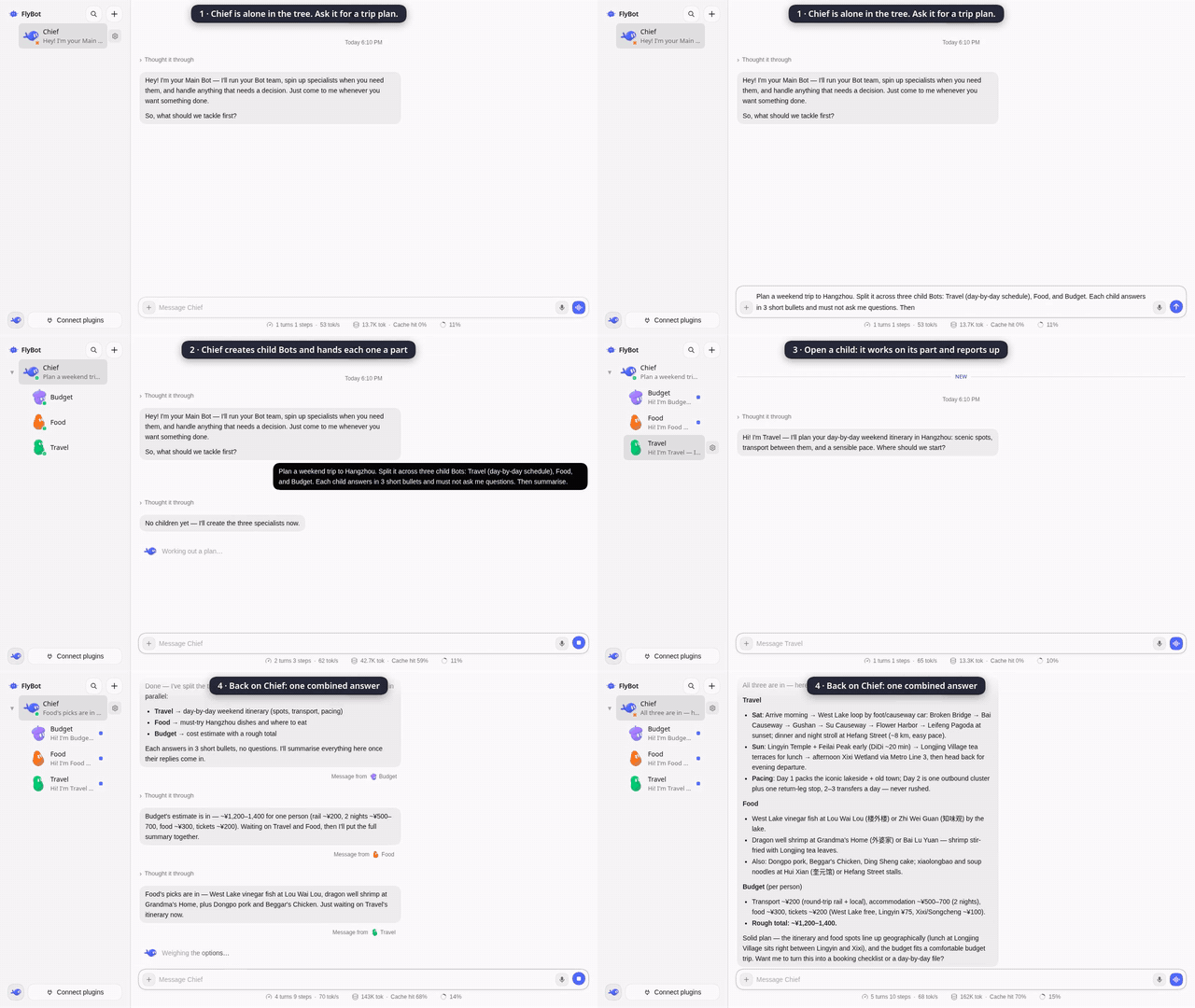
Carry your bot messages on the fly
Repo ThinkFlowLab/FlyBot, read from GitHub 58 min ago. ThinkFlowLab has not joined Take My Repo.
read_own_chat now says how many of the part's messages it still shows — only its newest 12 of 15 messages — instead of only its newest messages, so a message the cap left out no longer reads as if it never existed (#3144).2 more not shown (还有 2 条未显示 in a Chinese window) instead of growing with every failing card, and a failure reason the host passes through whole is cut at 200 code points, so one batch can no longer fill the alert (#3158).Workflow in the middle of Chinese copy whose page header already said 工作流 (#3129).text: draft on a node and text:draft on its edge are one fact.https://example.com/page#123 used to name issue #123 and write a card for an issue nobody meant, while owner/repo#12, a bare #12 and GitHub issue and pull-request links keep naming the issue they point at (#2435).conversation.input.dock is session-scoped, so opening another chat unmounted the dock and coming back drew the still pending hold as Waiting for approval again and offered a Retry that had already been sent. The records are keyed <approval id>:<session id> and go when the hold leaves the two lists the dock reads; nothing is pruned before both lists have answered.ended status id (#3090).已结束 10月19日 14:05 instead of Ended Oct 19 14:05, a room that never ended says 开始, and the title rebuilt from the room's members reads 面对面 · Alice · 10月19日 14:05. The stored room name and the rules that parse it are untouched, so an English window shows exactly what it showed before (#3098).打开 面对面 · Alice · 10月19日 14:05 for the row and 成员 for the people on it, instead of the English Open … and Members. Both words come from the dictionary, so an English window keeps exactly the names it had before; only the text read out changes, never the stored room name (#3100).Workflow badge on a workflow row now follows the window's language: a Chinese window reads 工作流 in the sidebar row and in the Hand a task to a Workflow target list, instead of the English word standing beside an already-translated page header (#3102).scripts/i18n-usage.mjs sees copy a helper hands back: a return of a sentence — or of a ?: / || expression built from sentences — is reported by --missing instead of staying invisible to both i18n checks, as long as the helper is drawn (called at a copy position, or rendered as an h(Component, …)). A helper whose value is data — a status id the file compares, a React key, a class name, a URL or a location.href template — is not reported. Product measured five such sites in plugins/social/client.js; the missing-entry baseline grows by 34 pins of English a reader can still see untranslated, and the bare-draw and template-draw counts are unchanged.scripts/i18n-usage.mjs now closes the ] it opens: an indexed read like list[0] no longer leaves the scan inside a bracket it can never close, so a literal beside it (return list[0] || 'None yet') is reported by --missing instead of being swallowed along with the rest of the file. The same walk also records the names a ${} hole interpolates, so a sentence a helper builds from a local counts as read rather than as a dead local. The missing-entry baseline grows by one pin — Your own Bots stay shared. {} can share it again., the other branch of a sentence already pinned — and the bare-draw and template-draw counts are unchanged. See #3077.changelog.mjs release defaults to it; --date still overrides) (#3064).plugins/social/client.js: a Bot Social hold whose send failed now keeps a Not sent card, with the reason and Retry, until it leaves the queue — the dock remembers the failure itself instead of only the one error line the next click clears, so the 5 s poll that still lists the hold as pending can no longer draw it back as waiting. Its Retry sends the same approval again (approve), once per card that actually went out, and a second click on a card that already went out sends nothing. A local failed hold keeps the host's own retry, which can be tried again while the host keeps answering with a failure.core/src/client/i18n.js already carried, instead of English. Text a user or a Bot stored — a friend's name, a send error — is still shown exactly as stored, never translated. See #2973 and #2994.https), so two servers on one host — https://social.example/team-b and https://social.example/team-c — no longer produce byte-identical "Could not reach …", redirect, HTTP-status and "did not answer like a Bot Social server" sentences. See #2975.… when something was dropped. An emoji at the 80-character bound stays one character, so the created issue title no longer shows a replacement square and the tool result carries no lone surrogate. See #2978.Every minute instead of Every 1 minutes on the task card and in the form, and the form's unit reads singular beside a count of 1 (1 minute) with the four unit words translated. See #2979.t() as a key, and the folder case was joined at runtime, so no dictionary entry could ever match it. Both sections now carry the empty case as a key with the folder as a parameter, so a zh window reads 决策/会议 empty states in Chinese while an English window reads exactly the sentence it read before; a read that failed still appears as the host's own sentence. (#2984)Dev Ops (two spaces) is stored as Dev Ops, so creating or renaming to it while Dev Ops exists is refused with the existing sentence instead of leaving two rows that draw the same name and answer @ only once. A line break is still refused as a line break, not folded. See #2986.Dev Ops is read as Dev Ops, so @Dev Ops now reaches that Bot instead of a twin created afterwards. Creating or renaming to the single-space spelling is refused while the old name is there, and when two saved names fold onto one, the Bot that already held the folded spelling keeps it and a log line names the one that did not. See #2992.{time} left to join line, whose countdown now carries the number alone so the sentence around it can be translated. A zh window now reads all five in Chinese, and an English window reads exactly the bytes it read before. (#2999)read_group_chat's newest N of M no longer shrinks when a co-seat mention's booking sits below the reader's join floor: the count now discounts only the bookings at or above that floor, so a Bot that joined after a busy room's bookings are told the lines it can see (newest 30 of 211 instead of newest 30 of 201) rather than a total short by one per mention. (#3037)superseded by <id> on a retried run and retry of <id> on its retry — the only words on that row that never went through tr, so they sat beside translated time and status chips. Both lines are now drawn through tr as 已被 {id} 取代 / {id} 的重试 in a zh window, an English window reads exactly the bytes it read before, and the raw id stays in the line's tooltip. No dictionary entry was added and the client bundle is unchanged. (#3040)recall of a topic name that cannot be a topic file — ../x, a/b, a name with a backslash — no longer answers with the whole MEMORY.md: it is refused with the same sentence remember gives, naming the allowed form, while a name that is merely unknown still says so and lists the topics this Bot knows (#3042).read_group_chat's newest N of M no longer trusts a booking list shorter than the room's own count: a room that kept only its booking count and recorded one number afterwards reported fewer lines than its window holds (newest 30 of 206 where 196 are there), because the unrecorded bookings were counted as if every one sat inside the window. Such a room's placements are unknown, so it keeps the room-wide discount. (#3046)message_friend_bot's files description carries the same route. A credential, a private FlyBot file and an unsupported extension keep their own refusal words (#3048).scripts/i18n-usage.mjs has a third scan (#3049): a copy drawn through a template literal with a ${} hole (superseded by ${id}) is now reported by --template-draws instead of being invisible to both i18n checks, with one {} per hole, so the fix is one tr() key. The draw is counted where copy is read — an h() copy attribute or child, a text: prop, a copy table value — including a template the reader reaches through a name. The bare-draw and missing-entry counts are unchanged, and each of those reports now ends with one line counting the template draws it cannot judge.