
browser
A web browser where pages render as native GPUI elements instead of a web view. It is cursed. It kind of works.
- 5
- Apache-2.0
- 2 wk ago
Repo Toyz/browser, read from GitHub 1 min ago. Toyz has not joined Take My Repo.
In short
Toyz/browser is a public repo on GitHub by Toyz. A web browser where pages render as native GPUI elements instead of a web view. It is cursed. It kind of works. It declares the Apache-2.0 license on GitHub. It is written mainly in Rust, has 5 stars and last changed on 2026-11-12. Nobody has reviewed it on Take My Repo yet, which says nothing about its quality. Read from GitHub on 2026-11-25.
Feather 🪶
A web browser with no web engine. It's called Feather because it's so light. It runs JavaScript anyway, in a JavaScript engine written in Rust.
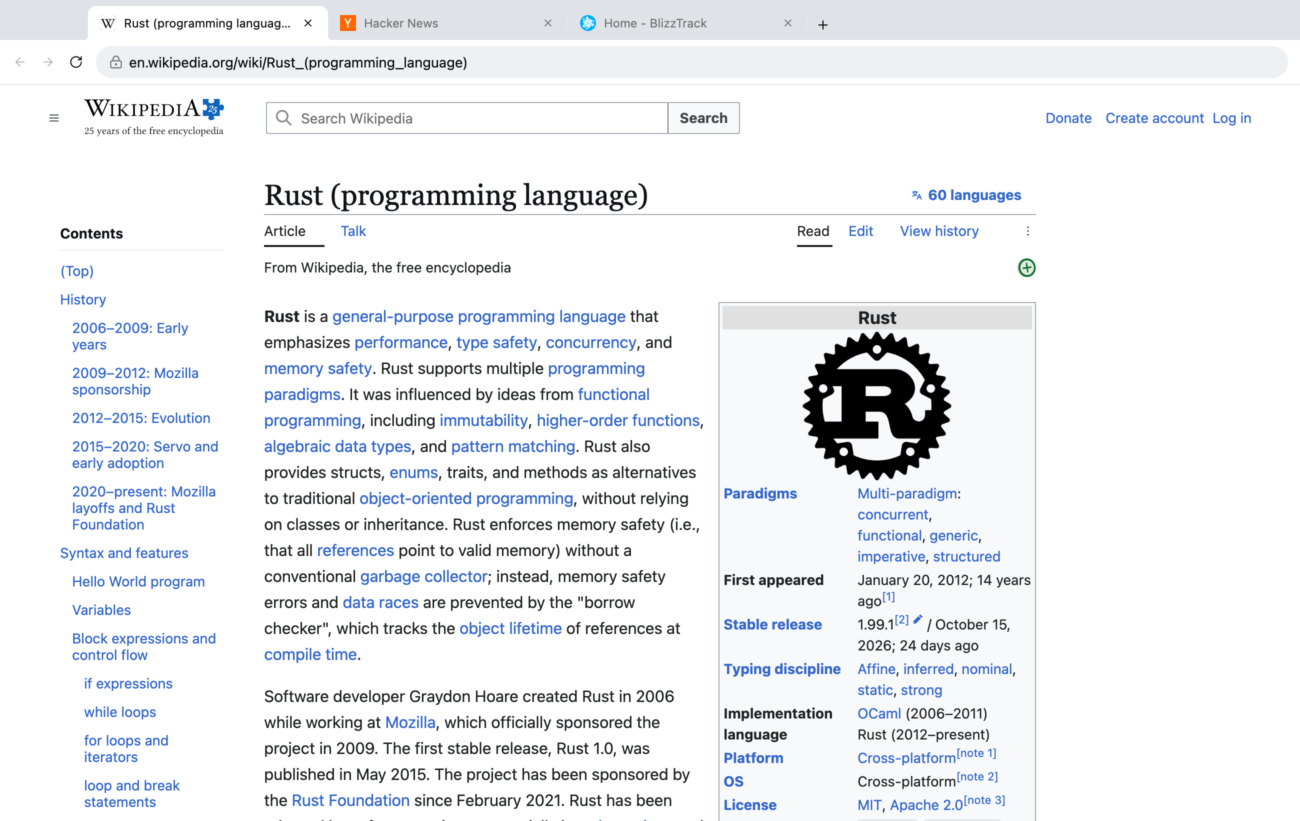
Feather parses HTML, runs the CSS through a cascade it wrote itself, and turns the page into native GPUI elements, the same UI framework the Zed editor is built with. There's no WebView, no Blink, no WebKit, no Servo in a trench coat. Every paragraph is a GPUI element. Every <div> is a GPUI div(). The text fields are code-editor text fields. It's Rust from the HTML tokenizer to the tab strip.
It is deeply cursed, and it renders Wikipedia.

The cursed parts
- Blocks are flexboxes. CSS has "block flow". We don't. Every block is a GPUI
flex_col(), and margin collapsing is arithmetic we do before Taffy ever sees it. - Long pages are virtualized by tearing them apart. Any container that can be sliced horizontally without anyone noticing is dissolved into rows of a GPUI
list(), and each row re-creates the containers around it. Wikipedia's article is ~440 independently rendered rows, which is why scrolling a huge page costs about a millisecond a frame. - CSS grids are sliced like bread. A grid of 100 cards becomes 50 two-card grids stacked on top of each other, one list row each. They agree on column widths because they have the same template and the same width. GPUI only knows "N equal columns", so
grid-template-areaslayouts are placed by hand and rebuilt from flex rows. When one column holds the whole article (Wikipedia), it stays splittable, and the sidebar hangs off the article's first row as an absolutely positioned box. - Tables are flex rows that agree on column widths. Column widths are estimated from character counts before layout, then every cell in a column gets the same flex basis, so the rows independently land on the same grid.
- Inline layout is hand-rolled. GPUI's text element does one font size per block. The web puts superscripts mid-sentence. So our own element shapes text with GPUI's shaper, breaks lines itself, builds CSS line boxes from ascent, descent and line-height, and paints each run at its own baseline.
- Inline-blocks are laid out with last frame's homework. GPUI's layout engine can't be re-entered from text measurement, so an inline-block containing real blocks is laid out as an absolutely positioned child, line breaking uses the size it had last frame, and if that was wrong it asks for another frame. It settles in one.
- Hover doesn't restyle the page. When
:hoverchanges, only the elements entering or leaving it are restyled, and if only paint changed (colors, backgrounds, radii, transforms) the new values are patched into the existing layout. About half a millisecond, no re-layout. - Links load before you click them. Rest the pointer on a link for 60ms and Feather fetches, parses, styles and lays out the whole page in the background. By the time you click, it's done.
- Form fields are code editors. Each
<input>is a box drawn from the page's CSS with a gpui-kit text editor sitting inside it. Buttons don't have click handlers: their content links tofeather-activate:<node id>, a URL scheme that exists only so the inline layout's link hit-testing can press buttons. - View source is a full code editor. CSS, JavaScript and JSON responses, and
view-source:pages, open in a highlighted editor with line numbers and folding. Minified code is un-minified first, by hand-written token-level pretty-printers for all four languages. - Mask icons are SVGs smuggled through the asset system, inline
<svg>is serialized back into a string and "downloaded" from adata:URL, and the screenshot tool renders frames into an offscreen texture instead of taking screenshots.
 |
 |
 |
 |
What works
- The browser: Chrome-style tabs in the title bar with favicons; an omnibox with history suggestions, inline completion and DuckDuckGo search; instant back/forward with scroll position; a new-tab page of your most visited sites; dark mode that follows macOS
- HTML: html5ever parsing into our own arena tree, quirks mode,
<meta http-equiv=refresh>,file://pages and directory listings,view-source: - CSS:
<style>,<link>,@import,@media(re-evaluated as you resize),@supports,@layer, nesting (&), container query units; selectors via Servo'sselectorscrate (:is,:where,:not,:has,nth-child...); the full cascade with!important,style="", presentational attributes, custom properties andvar();calc(),min(),max(),clamp(), colors up tooklch() - Layout: flexbox, CSS grid (templates, areas, auto-placement), tables, floats (approximately),
position: relative/absolute/fixed,transform(translate, and rotate/scale for icons and shapes),::before/::after(text or boxes), backgrounds (with real linear/radial/repeating gradients and patterns), borders, radii, images withsrcsetandobject-fit, mask icons, inline SVG,text-overflow: ellipsisand-webkit-line-clamp, inline-blocks on their text baseline - Interaction: links,
:hover,:active,:focus,:target,:checked, cursors - Forms: text fields, textareas, checkboxes, radios, selects, buttons, labels; GET and POST submission
- Dark mode:
prefers-color-scheme,color-scheme,light-dark() - Fonts and motion:
@font-faceweb fonts (WOFF, WOFF2, variable fonts instanced per weight),box-shadow, CSS transitions and@keyframesanimations
JavaScript
Pages' scripts run in Boa, a JavaScript engine written in Rust, on a thread per page that owns the page's DOM. Every task that changes the DOM sends the tab a snapshot, which is restyled and laid out like any page. The DOM API is mostly JavaScript (a prelude over a few dozen native functions that take node ids), so wrappers and listeners live where the garbage collector can see them.
What's there: the DOM (queries through our own selector engine, innerHTML through html5ever, events with capture/bubble/preventDefault and shadow-DOM retargeting, inline handlers), timers, promises and async, ES modules (static and dynamic import, imports prefetched in parallel), custom elements and shadow DOM (slots, declarative <template shadowrootmode>, scoped and constructed stylesheets), the CSSOM (insertRule, so CSS-in-JS works), fetch and XMLHttpRequest with real CORS (preflights, credentials, exposed headers) and streamed bodies (ReadableStream, NDJSON), EventSource, WebSocket, crypto.subtle, localStorage/sessionStorage and document.cookie on the real cookie jar, FormData, Intl (ICU, with time zones from Temporal), history.pushState with popstate, new Image() and load events, <canvas> 2D drawing (tiny-skia), layout reads (getBoundingClientRect, ResizeObserver, IntersectionObserver, from the tab's real layout), MutationObserver, inert <template> contents (Polymer stamps its templates), import maps, mouse, wheel and keyboard events with coordinates, form fields and submit events. Wikipedia gets its JavaScript layout, blizztrack's search works, crates.io (SvelteKit) and BBC News (styled-components) render, badgedirectory.com — a web-component single-page app on WebSockets and signed RPC — works throughout, down to its animated canvas graph, GitHub's React app and Amazon's home page render, and YouTube (Polymer) shows its home page, search results (thumbnails, durations, chapters, channels) and watch pages, though not the videos themselves.
Boa is patched (see vendor/): its parser and compiler looked up names by scanning each scope's list, which made closure-compiled bundles quadratic (YouTube's 9.5 MB app took 12.6 s to parse and compile; now 1.5 s), and its garbage collector ran whenever the heap grew 40% past what survived. A page's scripts and stylesheets are fetched in parallel as soon as its HTML is parsed. cargo run --release -p js --example parse_bench -- file.js times Boa on one script.
What doesn't (yet)
Video and audio playback, canvas text (fillText), getImageData, rotating text and photos, position: sticky, text wrapping around floats, text selection, iframes. Google Search, Cloudflare-protected sites and others that screen for bots (DuckDuckGo's script-driven results, NYTimes, IMDb, eBay, Twitch's API) show their checks or nothing; the omnibox searches DuckDuckGo's HTML results. See PLAN.md. FEATHER_NO_JS=1 turns scripts off.
Running it
cargo run --release -- https://en.wikipedia.org/wiki/Rust_(programming_language)
Several URLs open as tabs. Developed on macOS; GPUI also runs on Linux and Windows, but nobody has tried Feather there.
| Keys | Action |
|---|---|
| Cmd-L | Omnibox |
| Cmd-T / Cmd-W | New tab / close tab |
| Cmd-1…9, Ctrl-Tab | Switch tabs |
| Cmd-click | Open a link in a background tab |
| Cmd-[ / Cmd-] | Back / forward |
| Cmd-R | Reload |
| Cmd-U | View source |
Dev tools
# Layout rows and timings (several URLs share the cache).
# TREE=1: big blocks' structure; CLASS=name: boxes of elements with that class; WIDTH=px: viewport
cargo run --example dump -- https://news.ycombinator.com 20

# Offscreen screenshots: render, save PNGs, quit
cargo run --features screenshot -- https://example.com --screenshot out.png \
    [--pages 3] [--size 1100x800] [--dark|--light] [--mouse "X,Y;X,Y"] \
    [--click X,Y] [--keys 'typed text\n'] [--type "omnibox text"] [--bench FRAMES] \
    [--wait MS] [--frames N --interval MS]
--bench scrolls a row per frame and prints frame times, --mouse times each hover, and BROWSER_DEBUG=1 logs prerenders, hover patches and page loads. FEATHER_EVAL=probe.js runs a script in the page FEATHER_EVAL_DELAY ms (default 5000) after it starts, to inspect a live page's state from console.log; FEATHER_DUMP_DOM=out.html keeps the latest DOM snapshot.
How it's put together
net ──► html ──► page (the "DOM") ──► js (Boa) ──► style (cascade) ──► render (boxes → GPUI) ──► shell (Feather)
| Crate | What it does |
|---|
Questions
What is browser?
Toyz/browser is a public repo on GitHub by Toyz. A web browser where pages render as native GPUI elements instead of a web view. It is cursed. It kind of works.
Is browser open source?
It declares the Apache-2.0 license on GitHub.
Does browser run on macOS, Windows or Linux?
Its maker tagged it for macOS, Windows and Linux, or as Docker or cross-platform. That is declared by the maker; Take My Repo has not tested it.
How do I install browser?
Open "Take it" on its page: Take My Repo writes an install plan for your machine and hands it to your AI agent (Claude Code, Codex or Cursor), which asks you before each step. Take My Repo has not tested it on any machine.