mem0
The Memory Layer for AI Agents - Drop-in memory infrastructure for AI agents and apps. Context that persists. Built for production.
- 69k
- Python
- Apache-2.0
- 19 h ago
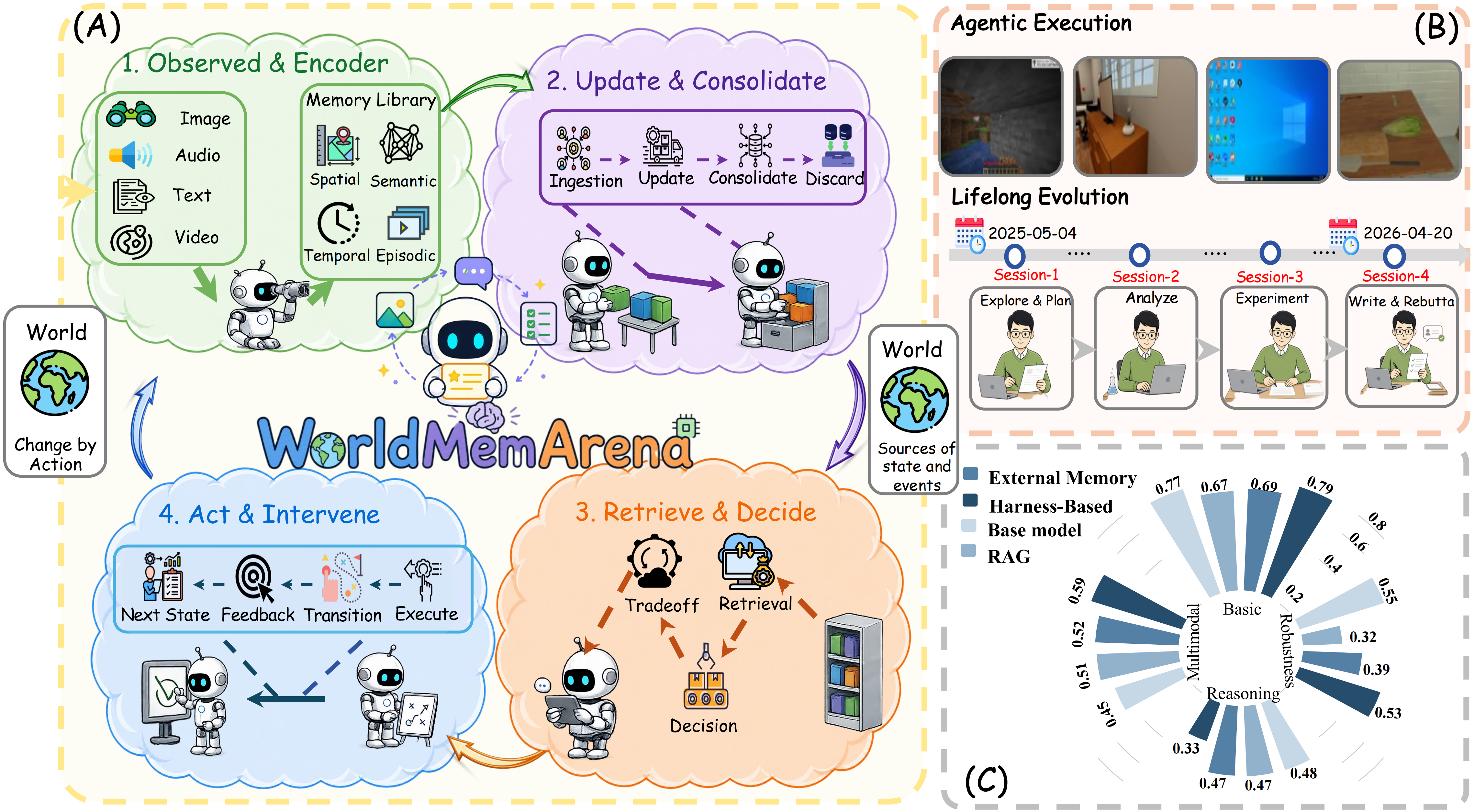
[NeurIPS 2026] Official codebase for the paper "WorldMemArena: Evaluating Multimodal Agent Memory Through Action–World Interaction"
Repo UCSB-AI/WorldMemArena, read from GitHub 42 min ago. UCSB-AI has not joined Take My Repo.
UCSB-AI/WorldMemArena is a public repo on GitHub by UCSB-AI. [NeurIPS 2026] Official codebase for the paper "WorldMemArena: Evaluating Multimodal Agent Memory Through Action–World Interaction". It declares the MIT license on GitHub. It is written mainly in Python, has 34 stars and last changed on 2026-05-29. Nobody has reviewed it on Take My Repo yet, which says nothing about its quality. Read from GitHub on 2026-11-26.
The Memory Layer for AI Agents - Drop-in memory infrastructure for AI agents and apps. Context that persists. Built for production.
The agent harness performance optimization system. Skills, instincts, memory, security, and research-first development for Claude Code, Codex, Opencode, Cursor and beyond.

A unified evaluation framework for benchmarking lifelong memory systems on the WorldMemArena dataset. Supports 19 baselines spanning retrieval-augmented memory, embedding-based memory, long-context VLMs, terminal-agent harnesses, and base-model answering paradigms.
# 0. Clone and enter the project
git clone https://github.com/eric-ai-lab/WorldMemArena.git
cd WorldMemArena

# 1. Install dependencies
pip install -r requirements.txt

# 2. Configure API keys
cp .env.example .env       # then edit .env with your keys (gitignored)

# 3. Download the dataset (one-time, ~10 GB)
huggingface-cli download LCZZZZ/WorldMemArena --repo-type dataset \
  --local-dir ./WorldMemArena

# 4. Run a baseline on the 150-sample subset
python -m eval_framework.cli \
  --dataset ./WorldMemArena \
  --split small \
  --baseline SimpleMem \
  --output-dir ./exp_results
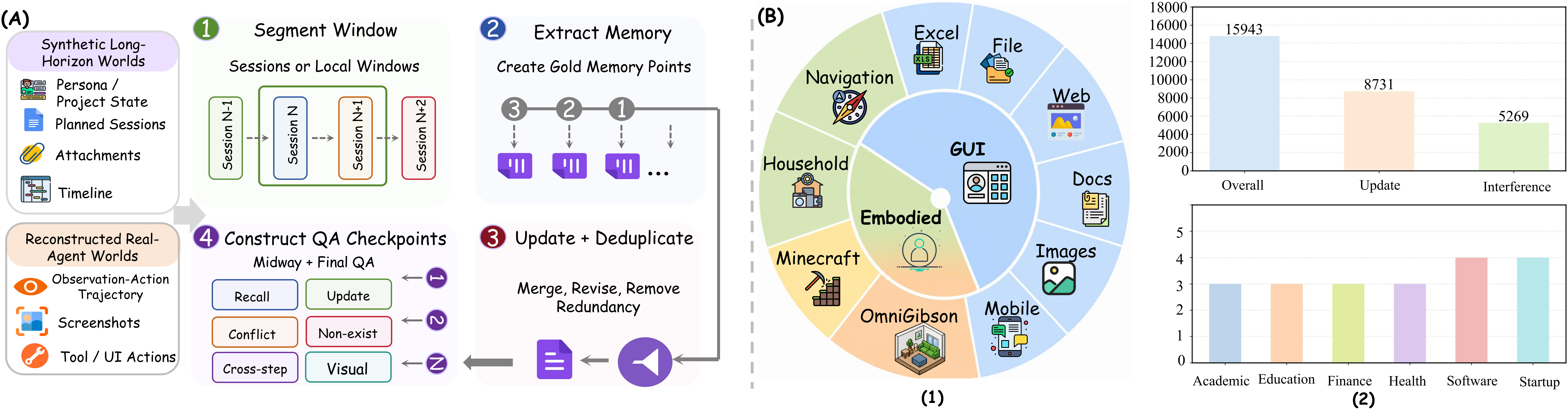
Two evaluation splits are supported via --split:
| Flag | Use case |
|---|---|
all |
Full benchmark |
small |
Balanced subset for fast iteration |
Download (WorldMemArena):
huggingface-cli download LCZZZZ/WorldMemArena --repo-type dataset \
  --local-dir ./WorldMemArena
or in Python:
from huggingface_hub import snapshot_download
snapshot_download("LCZZZZ/WorldMemArena", repo_type="dataset",
                  local_dir="./WorldMemArena")
| # | Baseline | Type | Embedding | GPU |
|---|---|---|---|---|
| 1 | A-Mem | Agentic + ChromaDB | text-embedding-3-small |
No |
| 2 | MGMemory | Mem-Gallery text | text-embedding-3-small |
No |
| 3 | SimpleMem | LanceDB hybrid | text-embedding-3-small |
No |
| 4 | Omni-SimpleMem | Multimodal FAISS | text-embedding-3-small |
No |
| 5 | M2A | Milvus Lite | text-embedding-3-small |
No |
| 6 | ViLoMem | Dual-stream logic+visual | text-embedding-3-small |
No |
| 7 | MIRIX | LLM-driven agents | None (pure LLM) | No |
| 8 | AUGUSTUSMemory | Multimodal GME | vLLM GME :8014 |
Yes |
| 9 | Qwen3-VL-Embedding-8B | VL embedding | vLLM Qwen3-VL-Embed :8013 |
Yes |
| 10 | UniversalRAGMemory | Multimodal GME RAG | vLLM GME :8014 |
Yes |
| 11 | MMFU_Single | Long-context window | GPT-2 tokenizer (bundled) | No |
| # | Baseline | Agent | Default Model |
|---|---|---|---|
| 1 | OpenClaw-GPT | OpenClaw CLI | gpt-5.4-nano |
| 2 | Harness-OpenClaw-DeepSeek | OpenClaw CLI | deepseek-v4-flash |
| 3 | Harness-Codex | Codex CLI | gpt-5.4-nano |
Direct long-context VLM answering — no memory module, no retrieval. Useful as a frontier-LLM reference.
| # | Baseline | Provider | Default Model |
|---|---|---|---|
| 1 | BaseModel-qwen | OpenRouter | qwen/qwen3.6-plus |
| 2 | BaseModel-gemini | OpenRouter | google/gemini-3-flash-preview |
| 3 | BaseModel-openai | OpenAI | gpt-5.4-mini |
| 4 | BaseModel-deepseek | DeepSeek | deepseek-v4-pro |
| 5 | BaseModel-claude | OpenRouter | anthropic/claude-haiku-4.5 |
All configuration lives in a single .env file at the project root. The framework auto-loads .env (i.e. WorldMemArena/.env) on import. Defaults to a fallback eval_framework/.env if the root file is missing.
| Variable | Purpose |
|---|---|
OPENAI_API_KEY |
Main LLM + embedding key |
OPENAI_BASE_URL |
OpenAI-compatible chat endpoint |
OPENAI_MODEL |
Chat model used by all memory baselines |
OPENAI_API_KEY_JUDGE |
LLM-judge key (can differ from main) |
OPENAI_BASE_URL_JUDGE |
LLM-judge endpoint |
OPENAI_MODEL_JUDGE |
LLM-judge model |
HF_HOME |
HuggingFace model cache directory |
VLLM_PYTHON |
Python interpreter with vLLM installed (GPU baselines) |
GME_* / QWEN_VL_EMBED_* |
vLLM embedding server config (GPU baselines only) |
See .env.example for the complete annotated template.
OPENAI_MODEL, OPENAI_BASE_URL, and OPENAI_API_KEY control the chat LLM for all memory baselines. They accept any OpenAI-compatible endpoint.
Local vLLM server (e.g. Qwen3-VL-7B):
# Start server
CUDA_VISIBLE_DEVICES=0 $VLLM_PYTHON -m vllm.entrypoints.openai.api_server \
  --model /path/to/Qwen3-VL-7B --served-model-name qwen3-vl-7b --port 8015

# In WorldMemArena/.env
OPENAI_BASE_URL=http://127.0.0.1:8015/v1
OPENAI_MODEL=qwen3-vl-7b
OPENAI_API_KEY=EMPTY
Cloud provider (e.g. DeepSeek):
OPENAI_BASE_URL=https://api.deepseek.com/v1
OPENAI_MODEL=deepseek-v4-flash
OPENAI_API_KEY=sk-your-deepseek-key
BaseModel-*baselines use their own per-provider config atbaselines/_clients/base_model_config.yamland are not affected by these env vars.
Required only for baselines 8–10. Download the weights once:
huggingface-cli download Alibaba-NLP/gme-Qwen2-VL-2B-Instruct
huggingface-cli download Qwen/Qwen3-VL-Embedding-8B
Update GME_MODEL_PATH and QWEN_VL_EMBED_MODEL_PATH in .env to the downloaded snapshot paths. Then start the bundled vLLM servers:
bash eval_framework/scripts/run_gme_vllm.sh           # port 8014 — AUGUSTUSMemory, UniversalRAGMemory
bash eval_framework/scripts/run_qwen_vl_embed_vllm.sh # port 8013 — Qwen3-VL-Embedding-8B
Install the OpenClaw CLI via npm:
npm install -g openclaw # https://github.com/openclaw/openclaw
The runner script is bundled at OpenClaw_General/run_openclaw_general.py. The default runner: path in harness_config.yaml already points to it. Just set your api_key: values:
openclaw_gpt:
  runner: "OpenClaw_General/run_openclaw_general.py"   # bundled, no changes needed
  api_key: "YOUR_OPENAI_API_KEY"
Adding a custom provider — add a new key to harness_config.yaml:
openclaw_custom:
  name: "OpenClaw"
  baseline: "Harness-OpenClaw-Custom"
  kind: "openclaw_general"
  runner: "OpenClaw_General/run_openclaw_general.py"
  api_key: "YOUR_API_KEY"
  base_url: "http://127.0.0.1:8015/v1"
  model: "your-model-name"
  model_api: "openai-completions"
  timeout: 900
  mm_mode: "text"
Run with --harness-keys openclaw_custom.
npm install -g @openai/codex
Set api_key: in harness_config.yaml under the codex: entry.
BaseModel-* evaluates a long-context VLM directly on the QA stream — no memory store, no retrieval. Useful for measuring how much memory architectures actually improve over a strong frontier LLM.
Edit eval_framework/baselines/_clients/base_model_config.yaml and fill in the api_key fields. The three OpenRouter-hosted providers share a single YOUR_OPENROUTER_API_KEY.
Run a single provider:
python -m eval_framework.cli \
  --dataset ./WorldMemArena \
  --baseline BaseModel-openai \
  --output-dir ./exp_results
Run all five providers (small split):
python -m eval_framework.cli \
  --dataset ./WorldMemArena \
  --split small \
  --baselines BaseModel-qwen BaseModel-gemini BaseModel-openai \
              BaseModel-deepseek BaseModel-claude \
  --output-dir ./exp_results
python -m eval_framework.cli \
  --dataset ./WorldMemArena \
  --baseline A-Mem \
  --output-dir ./exp_results
python -m eval_framework.cli \
  --dataset ./WorldMemArena \
  --split small \
  --baselines A-Mem MGMemory SimpleMem Omni-SimpleMem M2A ViLoMem MIRIX \
              AUGUSTUSMemory Qwen3-VL-Embedding-8B UniversalRAGMemory MMFU_Single \
  --output-dir ./exp_results
python -m eval_framework.cli \
  --dataset ./WorldMemArena \
  --run-data150-openclaw-harness \
  --harness-keys openclaw_gpt openclaw_deepseek codex \
  --output-dir ./exp_results
| Flag | Description |
|---|---|
--split {all,small} |
Full (461) or small subset (150) |
--sample-index N |
Run only the N-th sample (1-based) |
--eval-only |
Re-evaluate existing checkpoints without re-running the pipeline |
--dry-run |
Validate config without making API calls |
--max-eval-workers N |
Parallel judge threads (default 20) |
Two wrapper scripts run the full benchmark end-to-end with paper-faithful sampling, retries, and progress tracking:
# Memory baselines (11) + automatic per-subcategory quota sampling
bash scripts/run_worldmemarena.sh

# Harness baselines (3)
bash scripts/run_worldmemarena_harness.sh
Both scripts source .env from the repo root, write rolling progress to log.csv, retry failed cells, and place results under exp_log/worldmemarena/. Override defaults via env vars: DATASET_DIR, OUTPUT_DIR_REL, BASELINES, HARNESS_KEYS, MAX_RETRIES, PER_BASELINE_WORKERS.
exp_results/
├── aggregate_metrics.json       # Overall scores (one record per baseline)
├── pipeline_sessions.jsonl      # Raw per-session memory pipeline output
├── pipeline_qa.jsonl            # Raw per-checkpoint QA pipeline output
├── session_records.jsonl        # Evaluated session-level results
├── qa_records.jsonl             # Evaluated checkpoint-QA results
└── sample_results/<sample_id>/
    ├── aggregate_metrics.json
    └── ...
Key field schemas (top-level):
| File | Important fields |
|---|---|
aggregate_metrics.json |
baseline_id, eval_mode, qa_metrics, memory_metrics, token_usage |
pipeline_qa.jsonl |
sample_id, checkpoint_id, question, predicted_answer, retrieved_items |
qa_records.jsonl |
qa_id, answer_label (Correct/Hallucination/Omission), answer_f1, answer_bleu1, retrieval_hit_rate, retrieval_recall_at, retrieval_ndcg_at |
session_records.jsonl |
session_id, memory_recall, memory_correctness, update_handling, interference_rejection |
Memory baselines are evaluated on four dimensions:
Answer-only baselines (BaseModel-*, Harness-*
UCSB-AI/WorldMemArena is a public repo on GitHub by UCSB-AI. [NeurIPS 2026] Official codebase for the paper "WorldMemArena: Evaluating Multimodal Agent Memory Through Action–World Interaction".
It declares the MIT license on GitHub.
Its maker has not tagged a system, so it is unknown here. Its README says what it needs.
Open "Take it" on its page: Take My Repo writes an install plan for your machine and hands it to your AI agent (Claude Code, Codex or Cursor), which asks you before each step. Take My Repo has not tested it on any machine.
Graphs that teach > graphs that impress. Turn any code into an interactive knowledge graph you can explore, search, and ask questions about. Works with Claude Code, Codex, Cursor, Copilot, Gemini CLI, and more.
Reverse engineer anything with agents, from app behavior down to native binaries.
Its last change on GitHub was on 2026-05-29. Take My Repo does not judge from that whether it is maintained.
Nobody has reviewed it on Take My Repo yet, which says nothing about its quality.
Take My Repo cannot say: it does not audit code and has not run WorldMemArena. What is known comes from GitHub. It declares the MIT license on GitHub. Its last change was on 2026-05-29. It has 34 stars, which measure popularity, not safety. Nobody has reviewed it on Take My Repo yet, which says nothing about its quality. Read the source before you run it. With "Take it", your AI agent shows each step and asks you before running it; README text is treated as data, not as instructions.