PaddleOCR
Turn any PDF or image document into structured data for your AI. A powerful, lightweight OCR toolkit that bridges the gap between images/PDFs and LLMs. Supports 100+ languages.
- 93k
- Python
- Apache-2.0
- 2 mo ago
Chiron: A foundation model to measure and predict human behaviour
Repo ValueByte-AI/chiron, read from GitHub 17 min ago. ValueByte-AI has not joined Take My Repo.
ValueByte-AI/chiron is a public repo on GitHub by ValueByte-AI. Chiron: A foundation model to measure and predict human behaviour. It declares no license on GitHub. Public does not mean open source: without a license, nobody is granted the right to reuse it. It is written mainly in Python, has 3 stars and last changed on 2026-11-19. Nobody has reviewed it on Take My Repo yet, which says nothing about its quality. Read from GitHub on 2026-11-22.
Chiron · Psychological measurement, behavioural prediction, and population simulation
Overview · Quick start · Training · Evaluation · Citation
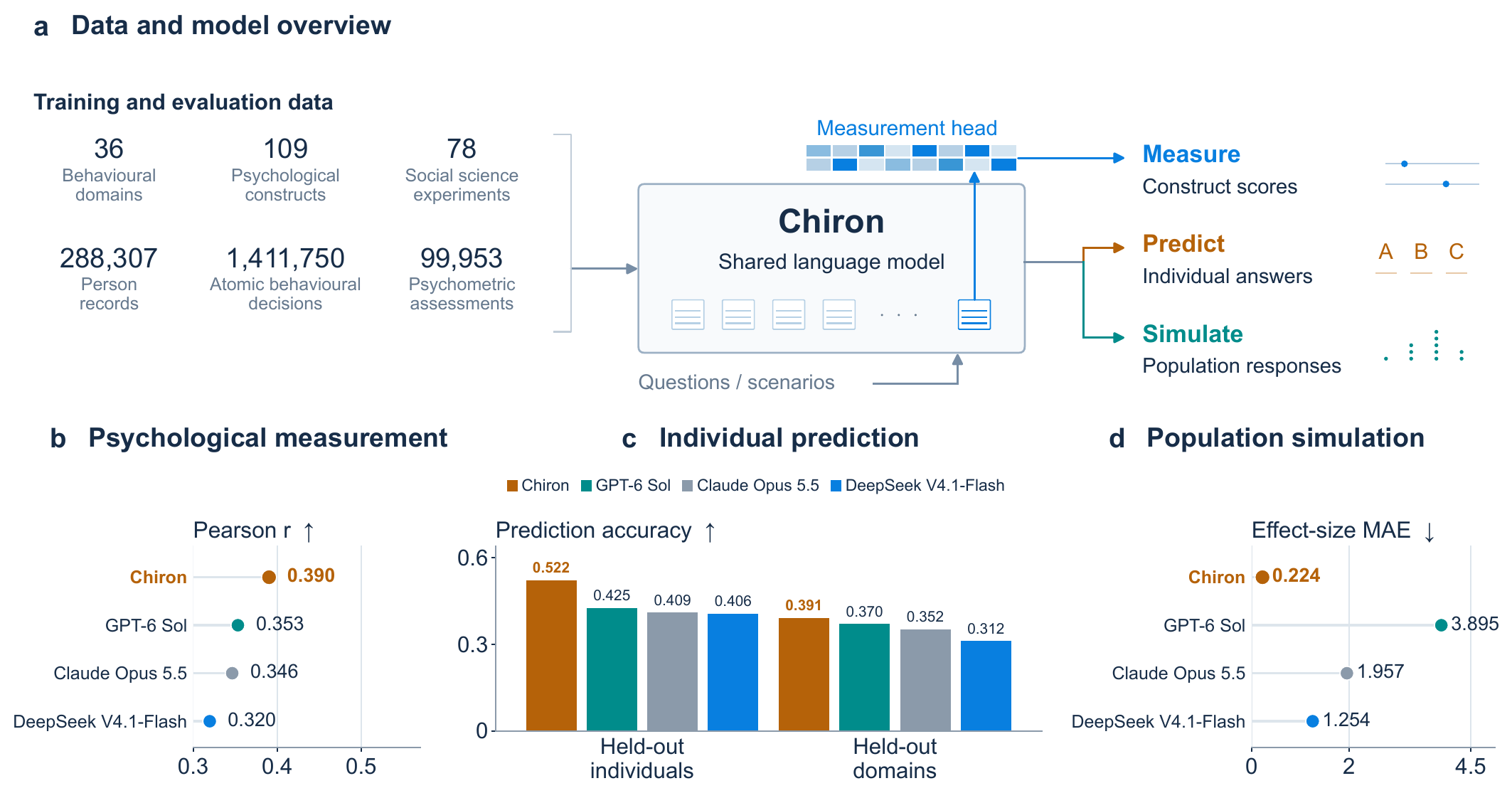
Training and evaluation coverage and main comparisons from the manuscript.
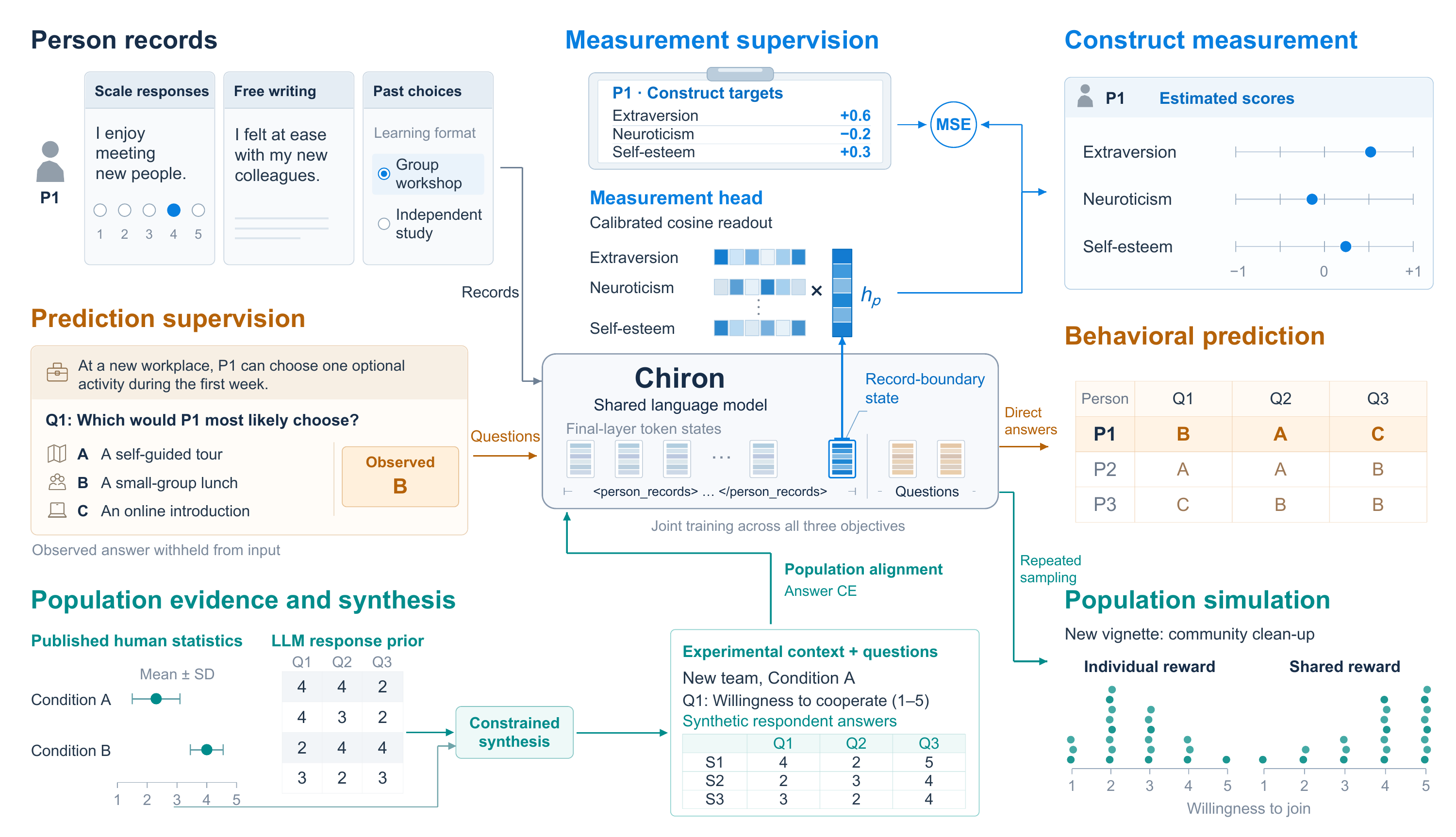
Chiron jointly learns to measure psychological attributes, predict individual behaviour and reproduce population response distributions. A shared language model represents personal evidence, while a dedicated measurement head reads construct scores from that representation.
| Task | Input | Output |
|---|---|---|
| Psychological measurement | A person's records | Scores for 109 predefined constructs |
| Behavioural prediction | Personal records and a new question | Predicted responses or choices |
| Population simulation | Experimental context and questions | Sampled respondent-level answers |
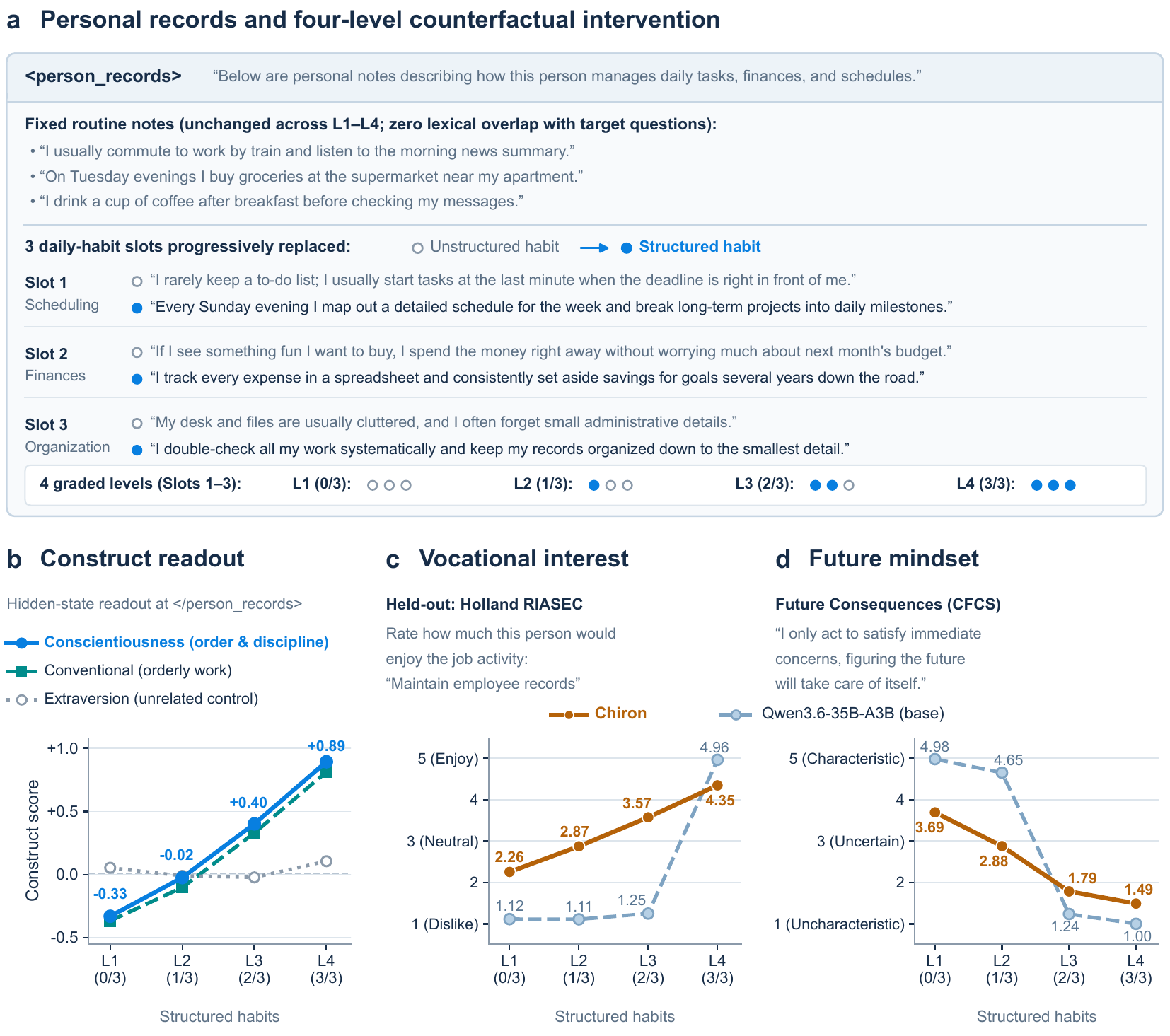
Changing the supplied daily-habit records produces coordinated changes in construct scores and predictions. This illustrative case concerns an intervention on model inputs; it does not establish a human causal mechanism or isolate the effect of measurement supervision.
Use Linux x86-64, Python 3.12 and uv 0.11 or later, with sufficient GPU memory for the 35B base model. Python is selected by .python-version; package versions and sources are recorded in uv.lock.
git clone https://github.com/ValueByte-AI/chiron.git
cd chiron
uv python install 3.12
export UV_PROJECT_ENVIRONMENT=.venv-inference
uv sync --locked --extra inference
uv sync installs Python packages, not model weights. The first Chiron.from_pretrained("chiron-group/chiron") call downloads the Chiron adapter and measurement head, then loads the base model named in the adapter configuration: Qwen/Qwen3.6-35B-A3B. Its weights and tokenizer are downloaded if they are not already cached. Subsequent calls reuse cached files for the same model revision.
If a Hugging Face repository requires access, authenticate with uv run --locked --extra inference hf auth login. Run Python scripts through uv run --locked --extra inference python.
from chiron import Chiron

model = Chiron.from_pretrained("chiron-group/chiron")
records = [
    "I make a plan before starting a project and keep track of its deadlines.",
    "When a task becomes difficult, I usually keep working until it is finished.",
]
print(model.measure(records, constructs=["conscientiousness"]))
measure returns a dictionary of construct scores. Omit constructs to return all 109; model.constructs lists their names. The head is trained against targets on −1 to 1, and its predictions can extend beyond that range.
Prediction and population sampling use the vLLM service described under Serving. After starting it, connect from the inference environment. A single-question example:
from chiron import Chiron

model = Chiron.from_server("http://127.0.0.1:8000/v1")
records = [
    "I make a plan before starting a project and keep track of its deadlines.",
    "When a task becomes difficult, I usually keep working until it is finished.",
]
record_context = "Below are records describing this person."
questions = [
    'How would this person rate "I finish tasks on time"?\n'
    "Option 1: Disagree\nOption 2: Neither agree nor disagree\nOption 3: Agree"
]
print(model.predict(
    record_context=record_context,
    observations=records,
    questions=questions,
))
predict returns generated answer text. Its fixed template presents record_context, observations and questions in that order. Generation uses temperature 0, thinking disabled and a default answer limit of 128 tokens. The service accepts up to 8,192 tokens including the answer.
Multiple questions can share a response scale, as in this shortened IPIP-FFM evaluation example:
# Shortened IPIP-FFM evaluation example: two targets sharing one response scale.
record_context = (
    "Below are self-report questionnaire responses from one respondent on the IPIP-FFM scale."
)
observations = [
    "Item: I worry about things | Response: Agree",
    "Item: I start conversations | Response: Agree",
    "Item: I don't mind being the center of attention | Response: Neutral",
    "Item: I take time out for others | Response: Agree",
]
questions = (
    "Use this response scale for every question below:\n"
    "Option 1: Disagree\nOption 2: Slightly disagree\nOption 3: Neutral\n"
    "Option 4: Slightly agree\nOption 5: Agree\n\n"
    "Rate each statement for this person:\n"
    'Q1. "I am not interested in abstract ideas"\n'
    'Q2. "I get irritated easily"'
)
print(model.predict(
    record_context=record_context,
    observations=observations,
    questions=questions,
))
The model returns one completion with answers numbered Q1, Q2, and so on, in question order. Lists receive automatic question numbering; a string preserves an already formatted question block.
Transformers/PyTorch generation is also supported: load with Chiron.from_pretrained(...) and use the same predict and simulate_population arguments.
To use existing local weights:
model = Chiron.from_pretrained(
    "models/chiron",
    base_model="models/qwen3.6-35b-a3b",
)
Run measurement locally, or run the prediction examples after starting the vLLM service:
uv run --locked --extra inference python examples/measurement.py
uv run --locked --extra inference python examples/prediction.py
examples/population.py runs the two company-hierarchy conditions from study OBHDP_10_1b, using the experimental wording, three items, seven response options, and 103 and 99 respondents used in the paper.
uv run --locked --extra inference python examples/population.py
Connect with Chiron.from_server(...). simulate_population accepts participant_context, experimental_setting, questions and n_respondents. Each question contains text and an ordered list of options. vLLM generates all respondents for a condition in one request, using temperature 1, top-p 1, top-k disabled, thinking disabled and constrained Q1: Option … responses. The default token budget is 8 * len(questions) + 16. Results contain raw_output and one-based option_ids, ordered by respondent index.
seed is the condition-level random seed. The example uses 20261154 and 20261155 for conditions A and B, matching the evaluation. The default is 20260902; the paper adds each condition's original evaluation index. Transformers uses the same prompt and sampling rules, with respondents generated sequentially. Random samples can differ between backends.
Use a separate shell and environment for training. The training profile uses CUDA 12.8 PyTorch wheels and the bundled LLaMA-Factory source. Building FlashAttention requires a CUDA 12.8 development toolkit and a C++ compiler; make nvcc available on PATH or set CUDA_HOME to the toolkit installation. uv supplies the GPU extensions' build dependencies and matches their build-time PyTorch to the training runtime.
Run commands from the repository root:
export UV_PROJECT_ENVIRONMENT=.venv-train
uv sync --locked --extra train
uv run --locked --extra train hf download chiron-group/chiron-data --repo-type dataset --local-dir chiron-data
uv run --locked --extra train hf download Qwen/Qwen3.6-35B-A3B --local-dir models/qwen3.6-35b-a3b
Prepare the source datasets following the data instructions. The complete training mixture requires locally obtained restricted sources; the distributed subset alone is insufficient. Each source retains its own licence and access requirements.
Data preparation uses the dataset repository's own requirements.txt, separately from the model environment:
uv run --no-project --python 3.12 --with-requirements chiron-data/requirements.txt \
  python chiron-data/code/prediction/build_prediction.py
uv run --no-project --python 3.12 --with-requirements chiron-data/requirements.txt \
  python chiron-data/code/measurement/build_human_gold.py
uv run --no-project --python 3.12 --with-requirements chiron-data/requirements.txt \
  python chiron-data/code/build_joint_training.py
uv run --locked --extra train torchrun --nproc_per_node=4 scripts/train_joint.py
The two-epoch recipe is in configs/train_joint.yaml; checkpoints are saved to outputs/joint/. The measurement head saves its centring mean for inference. chiron_person_mean_ema.pt also stores the update count and rate for training resumption. The customized backend is included in LLaMA-Factory/ under its Apache-2.0 licence.
The manuscript evaluates psychological measurement, prediction across 29 behavioural domains and population simulation across 15 held-out studies. The data repository provides frozen evaluation inputs, source instructions and reconstruction scripts.
Distributed evaluation files omit restricted-domain records. Their subset scores should not be compared directly with the paper's full-set aggregates. Follow the source-specific instructions to reconstruct the complete evaluation locally. Paper-specific evaluation outputs, baseline and reporting scripts are available upon request.
Use a separate shell and environment for vLLM. Its official 0.21.0 wheels target CUDA 13.0, so the serving profile selects matching PyTorch, TorchVision and TorchAudio wheels. A compatible NVIDIA driver is required. Inference and training use CUDA 12.8; serve cannot be combined with either extra.
export UV_PROJECT_ENVIRONMENT=.venv-serve
uv sync --locked --extra serve
uv run --locked --extra serve hf download Qwen/Qwen3.6-35B-A3B --local-dir models/qwen3.6-35b-a3b
uv run --locked --extra serve hf download chiron-group/chiron --local-dir models/chiron
CUDA_VISIBLE_DEVICES=0,1 uv run --locked --extra serve python scripts/serve.py
The server applies the LoRA update in FP32 while loading the base weights, then runs BF16 inference. This is the loading path used in the prediction and population experiments. --base-model, --checkpoint and --port can select existing local weights or a different port.
In a separate inference shell, connect with Chiron.from_server("http://127.0.0.1:8000/v1"). The public methods fill the fixed prompts and request settings. Measurement continues to use Chiron.from_pretrained(...).measure(...) through Transformers/PyTorch; run it separately or allocate distinct GPUs.
The tests cover both the inference package and training backend. Use the compatible training and inference extras together, with the test dependency group:
export UV_PROJECT_ENVIRONMENT=.venv-train
uv sync --locked --extra train --extra inference --group test
uv run --locked --extra train --extra inference --group test pytest -q
uv lock --check
uv build --wheel --no-sources
After changing dependencies in pyproject.toml, run uv lock and commit both files. Keep the selected extras on uv run commands so that uv synchronizes the intended profile. Model checkpoints are managed separately by Hugging Face and are not pinned by the Python lockfile.
| Path | Contents |
|---|---|
chiron/inference.py |
Model loading, fixed prompts and inference |
chiron/sitecustomize.py |
Adapter loading for the vLLM server |
examples/ |
Measurement, prediction and population examples |
scripts/train_joint.py |
Joint training entry point |
scripts/serve.py |
vLLM prediction and population server |
configs/ |
Training settings |
pyproject.toml, uv.lock, .python-version |
Environment profiles, locked dependencies and Python version |
LLaMA-Factory/ |
Customized training backend |
assets/figures/ |
Paper figures, web previews and source hashes |
If you use Chiron in your research, please cite:
@misc{ye2026foundationmodelmeasurepredict,
      title={A Foundation Model to Measure and Predict Human Behaviour},
      author={Haoran Ye and Tianrui Huo and Hangzhen Li and Xin Zhang and Guojie Song},
      year={2026},
      eprint={2611.24830},
      archivePrefix={arXiv},
      primaryClass={cs.CL},
      url={https://arxiv.org/abs/2611.24830},
}
ValueByte-AI/chiron is a public repo on GitHub by ValueByte-AI. Chiron: A foundation model to measure and predict human behaviour.
It declares no license on GitHub. Public does not mean open source: without a license, nobody is granted the right to reuse it.
Its maker has not tagged a system, so it is unknown here. Its README says what it needs.
Open "Take it" on its page: Take My Repo writes an install plan for your machine and hands it to your AI agent (Claude Code, Codex or Cursor), which asks you before each step. Take My Repo has not tested it on any machine.
Its last change on GitHub was on 2026-11-19. Take My Repo does not judge from that whether it is maintained.
Nobody has reviewed it on Take My Repo yet, which says nothing about its quality.
Turn any PDF or image document into structured data for your AI. A powerful, lightweight OCR toolkit that bridges the gap between images/PDFs and LLMs. Supports 100+ languages.
Abnormal Human Behaviors Detection/ Road Accident Detection From Surveillance Videos/ Real-World Anomaly Detection in Surveillance Videos/ C3D Feature Extraction
The agent harness performance optimization system. Skills, instincts, memory, security, and research-first development for Claude Code, Codex, Opencode, Cursor and beyond.
Transforms complex documents like PDFs and Office docs into LLM-ready markdown/JSON for your Agentic workflows.
[AAAI 2025] Measuring Human and AI Values Based on Generative Psychometrics with Large Language Models.
[ACL 2024] ValueBench: Towards Comprehensively Evaluating Value Orientations and Understanding of Large Language Models
pysche-driven behavior-modeling paper codebase...