CLR: Claim-Level Reliability Assessment for Efficient Test-Time Reasoning
📄 Paper |
🚀 Quick Start
Constructing a correct solution requires an entire reasoning path to hold. Refuting an incorrect one may require finding only a single decisive flaw.
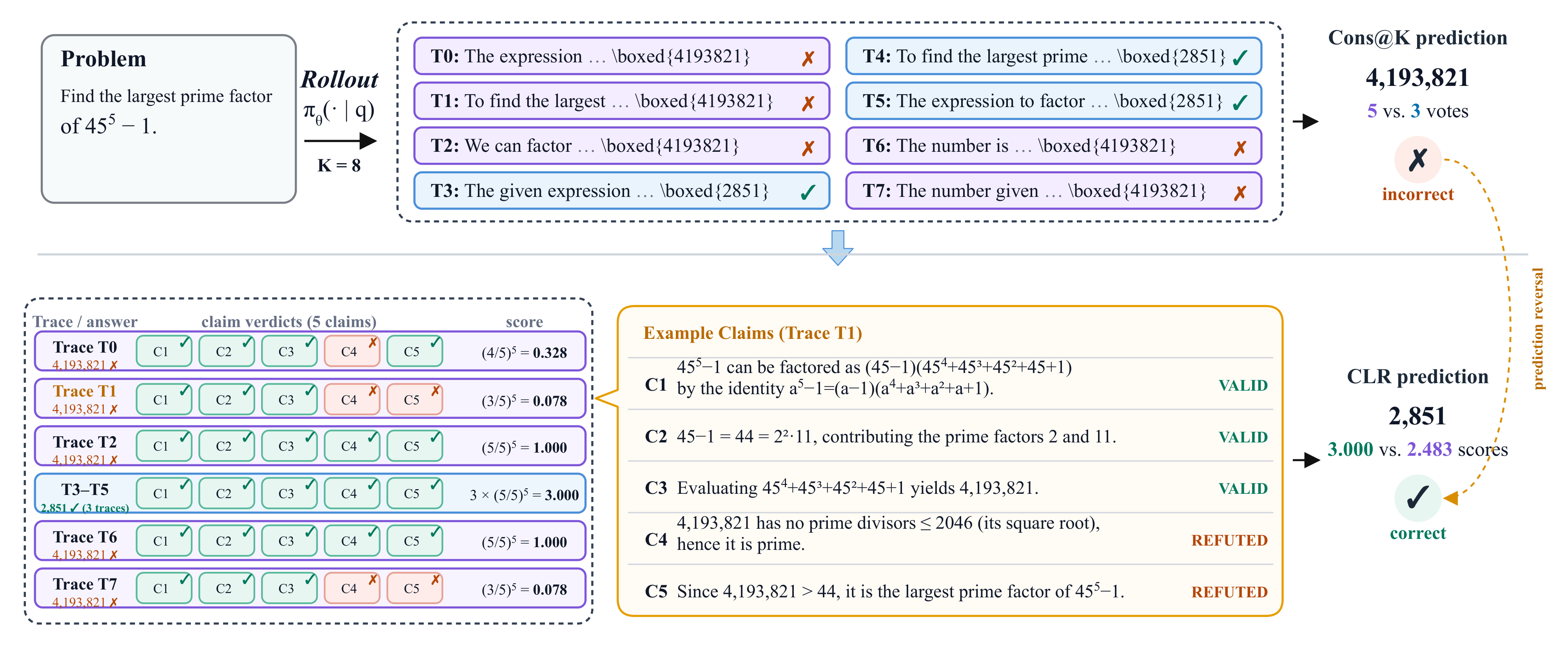
CLR (Claim-Level Reliability Assessment) is a training-free test-time scaling framework used in our VibeThinker-3B technical report, that reallocates compute from sampling more solutions to falsifying decision-critical claims. It extracts key claims from reasoning traces, tests them for potential flaws, and uses the resulting reliability signals to weight solution voting.
By suppressing unreliable traces, CLR can let a reliable minority overturn an incorrect majority, improving reasoning accuracy and token efficiency without additional training or external verifiers.
Quick Start
pip install -r requirements.txt
Basic Usage
CLR supports any OpenAI-compatible API. Launch a vLLM server with --reasoning-parser so reasoning is split from the final answer, then run demo.py:
Step 1. Launch a vLLM server (example: gpt-oss):
vllm serve /path/to/gpt-oss-20b --port 8000 --reasoning-parser openai_gptoss
Step 2. Edit BASE_URL and MODEL in demo.py, then run:
python demo.py
run() Function
run() is the central interface for CLR. It takes a list of questions + ground truths and returns metrics.
Inputs
questions / ground_truths: aligned lists of problem texts and answersbase_url / model / api_key: the running OpenAI-compatible serverworkers: max concurrent requests (thread pool size)K: number of solution traces per flow (inner rollout)N: number of independent flows per question (outer rollout)num_claims: number of verification claims extracted per tracebeta: exponent for weight (valid / num_claims) ** beta (defaults to num_claims)sampling_params: forwarded verbatim to the server — put any model-specific fields hereoutput_path: if set, dump per-question details + metrics to JSON
sampling_params supports standard fields (temperature, top_p, top_k, max_tokens) plus model-specific extensions via chat_template_kwargs (e.g. reasoning_effort, enable_thinking).
Output Format
run() returns a dict with:
- Primary metrics
pass@1: mean correctness over N flow answers per questionpass@N: fraction of questions with ≥ 1 correct flow answercons@N: majority-vote accuracy over N flow answers (ties averaged)
- Stage-1 (raw trace) baselines
s1_pass@1: mean fraction of K traces that are corrects1_pass@K: fraction of flows where ≥ 1 of K traces is corrects1_cons@K: simple majority-vote accuracy over K traces
- Metadata
K, N, num_claims: run configurationCLR_per_flow_avg_token: average output tokens per flow
Answer equivalence is decided by math_verify with an exact-string fast path.
Project Structure
.
├── demo.py              # Minimal runnable example
├── README.md
└── clr/
    ├── __init__.py      # Public API
    ├── pipeline.py      # Core two-stage pipeline + run() entry point
    ├── llm.py           # OpenAI-compatible chat client (worker-bounded concurrency)
    ├── prompt.py        # Stage-1/Stage-2 prompt assembly + response parsing
    └── evaluation.py    # math_verify equivalence, weighted/plain majority vote, metrics
Citation
@article{xu2026clr,
  title={Claim-Level Reliability Assessment for Efficient Test-Time Reasoning},
  author={Xu, Sen and Wang, Wei and Liu, Shixi and Min, Jixin and Dai, Yingwei and Yin, Zhibin and Chen, Yirong and Zhang, Junlin},
  journal={arXiv preprint arXiv:2608.11994},
  year={2026}
}