
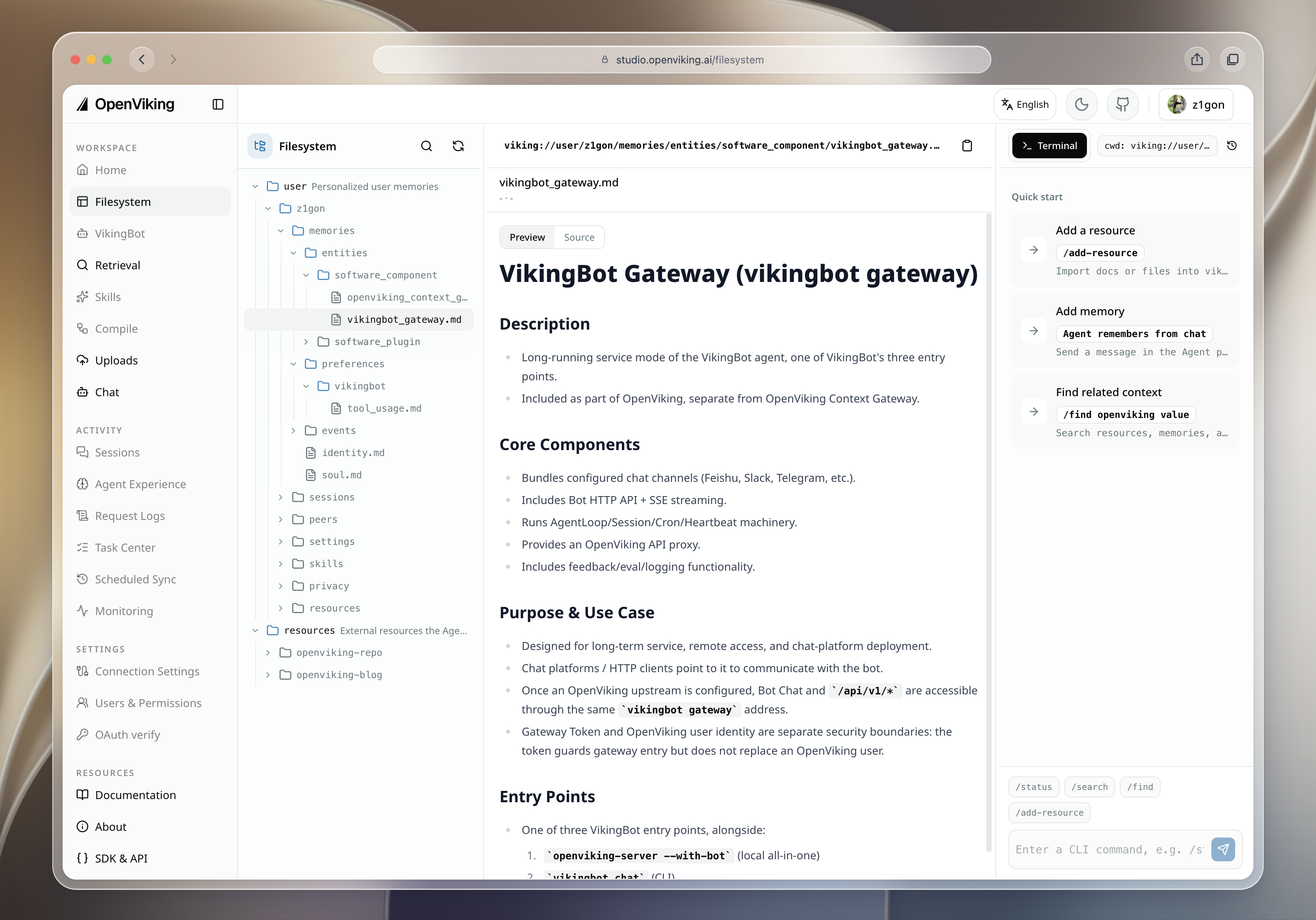
OpenViking
Self-evolving Context Database for AI Agents. Unify Agent Memory, Knowledge RAG and Skills.
- 43k
- Python
- AGPL-3.0
- 7 h ago
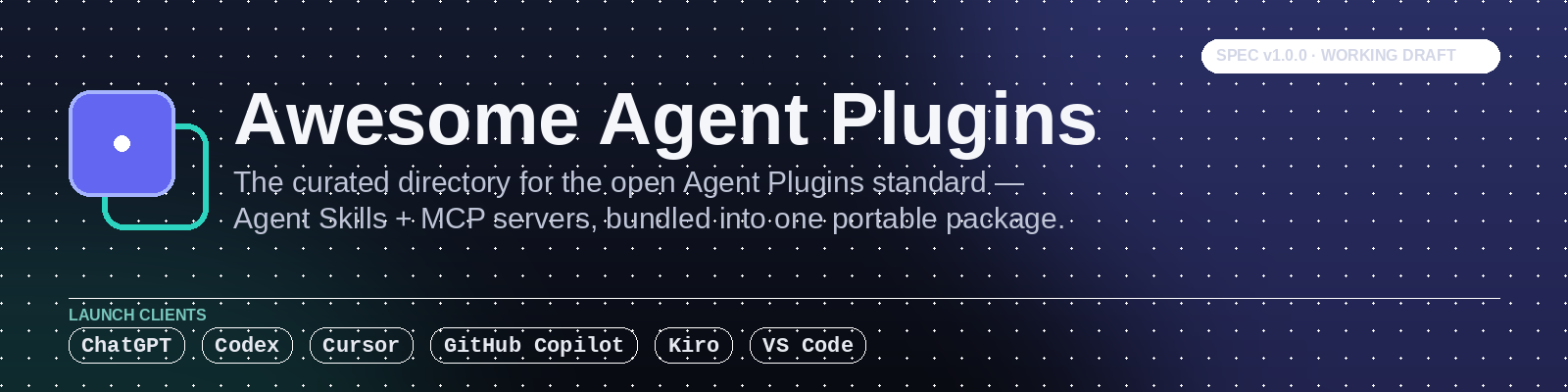
Agent Plugins directory: 40+ verified plugins for the open, vendor-neutral standard.
Repo ZeroPointRepo/awesome-agent-plugins, read from GitHub 19 h ago. ZeroPointRepo has not joined Take My Repo.
ZeroPointRepo/awesome-agent-plugins is a public repo on GitHub by ZeroPointRepo. Agent Plugins directory: 40+ verified plugins for the open, vendor-neutral standard. It declares no license on GitHub. Public does not mean open source: without a license, nobody is granted the right to reuse it. It has 8 stars and last changed on 2026-09-28. Nobody has reviewed it on Take My Repo yet, which says nothing about its quality. Read from GitHub on 2026-11-23.
Self-evolving Context Database for AI Agents. Unify Agent Memory, Knowledge RAG and Skills.
A curated, verified directory of 48 Agent Plugins. Agent Plugins is the open, vendor-neutral standard published on 2026-08-06 by Amazon, Anysphere/Cursor, GitHub, Microsoft, OpenAI and Vercel, with Google as a core maintainer. It bundles Agent Skills and MCP servers into one portable, drop-in folder that every compliant client can read.
Every entry below is checked against a live plugin.json carrying the canonical 1.0.0 $schema. No link
dumps, no dead repos, and no per-client manifests dressed up as open-standard plugins. This is an unofficial,
community-maintained list and is not affiliated with the Agent Plugins Working Group.
An Agent Plugin is a directory with a plugin.json manifest at its root. It's the packaging format the
Agent Plugins Working Group (Amazon, Cursor, GitHub, Microsoft, OpenAI, Vercel) published on 2026-08-06 to give
Agent Skills and MCP server configs one portable, install-once shape that every compliant client can
read — instead of writing a separate integration for each client.
plugin-name/
├── plugin.json               # REQUIRED — $schema + name. Optional: version, description,
│                              # license, keywords[], author, homepage, repository, extensions
├── skills/
│   └── <skill-name>/
│       ├── SKILL.md           # one skill per immediate child dir — NOT searched recursively
│       ├── scripts/
│       └── references/
├── mcp.json                   # OPTIONAL — mcpServers{}: stdio | streamable-http | sse
└── com.vendor.client/         # OPTIONAL — namespaced client-specific extensions
Minimal valid plugin.json:
{
  "$schema": "https://agent-plugins.org/schemas/1.0.0/plugin.schema.json",
  "name": "my-first-plugin"
}
What the spec deliberately does not cover — and this is the part worth being precise about, because it's
what most secondary write-ups blur: Agent Plugins is a packaging format only. It defines the manifest, the
fixed component locations, and two runtime variables (${PLUGIN_ROOT}, the package root; ${PLUGIN_DATA}, a
persistent writable directory) that clients expand in args, env values and cwd — never in command, URLs,
or header keys. It has no opinion on distribution, marketplaces, permissions, or how a client installs a
plugin — each client (VS Code, Cursor, ChatGPT/Codex, GitHub Copilot, Kiro, and Google's tooling as core
maintainer) owns that layer itself. It also enforces real security boundaries: every path a plugin ships must
resolve inside the plugin root (symlink escapes are rejected), command in mcp.json is a single executable
token that is never shell-interpolated, and there's no portable field for embedding credentials.
mkdir -p hello-plugin/skills/say-hello
cd hello-plugin

cat > plugin.json <<'EOF'
{
  "$schema": "https://agent-plugins.org/schemas/1.0.0/plugin.schema.json",
  "name": "hello-plugin",
  "version": "0.1.0",
  "description": "A minimal Agent Plugin — one skill, no MCP server.",
  "license": "MIT"
}
EOF

cat > skills/say-hello/SKILL.md <<'EOF'
---
name: say-hello
description: Greet the user by name and explain what this plugin does.
---

# Say Hello
1. Ask for the user's name if not already known.
2. Reply with a friendly greeting.
3. Mention that this plugin came from a `SKILL.md` file with zero extra config.
EOF

# Validate against the canonical schema before you ship it (see Tools below)
npx -y ajv-cli@5 validate --spec=draft2020 \
  -s https://agent-plugins.org/schemas/1.0.0/plugin.schema.json \
  -d plugin.json
Point a compliant client at the hello-plugin/ folder (in VS Code: Chat: Install Plugin From Source) and
you have a working plugin — no mcp.json required, since it's optional. Add one when you actually need an MCP
server; see upstash/context7 below for a real mcp.json in production.
Verified against each vendor's own docs/announcement as of 2026-08-12. ✅ confirmed · ❓ not yet confirmed in
public docs — please open a PR with a source if you can confirm it.
| Client | Skills | MCP servers | Client extensions (com.vendor.*) |
Install path |
|---|---|---|---|---|
| VS Code | ✅ | ✅ | ❌ ignored today (docs) | @agentPlugins in Extensions view · Chat: Install Plugin From Source · auto-appears after install via Copilot CLI. Requires chat.plugins.enabled. |
| GitHub Copilot (VS Code, CLI, app) | ✅ | ✅ | ❓ | Shared install path with VS Code above; also via Copilot CLI. |
| Codex / Codex CLI | ✅ (discovers + reads plugin skills) | ✅ (opt-in MCP 2026-07-28 protocol, paginated discovery) | ❓ | Codex CLI workspace plugin install; marketplace details unconfirmed. |
| ChatGPT | ✅ (plugins can bundle skills) | ❓ | ❓ | Install UX not independently confirmed at time of writing — see Codex Knowledge Base writeup. |
| Cursor | ✅ | ✅ | ❓ | Listed as a launch client by Vercel's announcement; specific install flow not independently confirmed — PRs welcome. |
| Kiro | ✅ | ✅ | ❓ | Via "Kiro Powers" installable packages (AWS Open Source Blog). |
Google joined as a core maintainer on launch day (not a launch client) and is integrating support starting with Agents CLI and the Data Agent Kit.
If you run one of the ❓ cells day to day, open a PR — a one-line source link is all we need to flip it to ✅.
remotion by
Remotion — at 57,211 stars this is the largest project yet to ship a manifest carrying
the canonical $schema, and it is a useful signal precisely because Remotion is not an agent company. Video
rendering is one of the few tasks where an agent cannot check its own work by reading the output, so the
skills cover the parts that go wrong silently: frame-accurate timing, audio sync, caption placement and the
3D compositing API. Install: point a compliant client at packages/codex-plugin in the repo above.
Last week's pick, sentry, remains listed under DevOps.
Rotates weekly. Nominate an entry by opening an issue with the pick-of-the-week label.
Adoption reality check — remeasured 2026-08-24. A week ago this section said adoption of the open manifest was near nil: of 34 vendor skill/MCP repositories scanned on 2026-08-17, only Sentry, Neon, Upstash's context7, Qdrant and the spec's own example carried the canonical
https://agent-plugins.org/schemas/1.0.0/plugin.schema.json$schema. That is no longer true, and this section was wrong for several days before this re-measurement caught it.A GitHub code search for that exact
$schemastring in files namedplugin.jsonnow returns 2,204 files across roughly 140 distinct repositories, includinghuggingface/diffusers,remotion-dev/remotion,aws/agent-toolkit-for-aws,apache/magpie,BuilderIO/agent-native,inkeep/open-knowledge,SalesforceCommerceCloud/b2c-developer-tooling,CrowdStrike/fusion-skills,GitGuardian/agent-skills,vuetifyjs/mcpandperplexityai/modelcontextprotocol.Two caveats that matter more than the headline. The file count is not a repository count — a handful of collections carry dozens of manifests each (
withoneai/one-agent-plugin83,github/awesome-copilot68,sickn33/agentic-awesome-skills34), so the distribution is far more concentrated than 2,204 suggests. And per-client manifests have not gone away: Vercel, Cloudflare, Stripe, Railway, MongoDB, Wix, Axiom and Chrome DevTools still ship.claude-plugin/,.cursor-plugin/,.codex-plugin/or.grok-plugin/folders rather than one portableplugin.json. What changed is that the open manifest stopped being a rounding error.Spec 1.1.0 is in Working Draft as of 2026-08-19 (
spec/1.1.0.md,schemas/1.1.0/), introducing a second canonical schema URL athttps://agent-plugins.org/schemas/1.1.0/plugin.schema.json. Adoption is early: 130 code hits against 3,760 for 1.0.0. Every entry in this catalog is verified against 1.0.0, which is what the version badge reports. It will move to 1.1.0 when the catalog does, not before.Every entry in this catalog is checked for that
$schema, which is why this list is shorter than a link dump would be. You can verify any entry yourself by opening itsplugin.json. Know one we've missed? Please open a PR.
Format: - [name](repo-url) by [author](author-url) — one-line description. **[tag]**
Tags: production (used in the wild) · beta · experimental · reference (spec/example, not meant to run standalone)
ZeroPointRepo/awesome-agent-plugins is a public repo on GitHub by ZeroPointRepo. Agent Plugins directory: 40+ verified plugins for the open, vendor-neutral standard.
It declares no license on GitHub. Public does not mean open source: without a license, nobody is granted the right to reuse it.
Its maker has not tagged a system, so it is unknown here. Its README says what it needs.
Reverse engineer anything with agents, from app behavior down to native binaries.
The agent harness performance optimization system. Skills, instincts, memory, security, and research-first development for Claude Code, Codex, Opencode, Cursor and beyond.
Master programming by recreating your favorite technologies from scratch.
410 Claude Code skills & agent skills & plugins (120+ Agents, custom commands, 410+ skills, customizable references, scripts)for Claude Code, Codex, Gemini CLI, Cursor, and 8 more coding agents — engineering, marketing, product, compliance, C-level advisory, research, business operations, commercial & finance, and your daily productivity skills.
Open "Take it" on its page: Take My Repo writes an install plan for your machine and hands it to your AI agent (Claude Code, Codex or Cursor), which asks you before each step. Take My Repo has not tested it on any machine.
Its last change on GitHub was on 2026-09-28. Take My Repo does not judge from that whether it is maintained.
Nobody has reviewed it on Take My Repo yet, which says nothing about its quality.
Take My Repo cannot say: it does not audit code and has not run awesome-agent-plugins. What is known comes from GitHub. It declares no license on GitHub. Public does not mean open source: without a license, nobody is granted the right to reuse it. Its last change was on 2026-09-28. It has 8 stars, which measure popularity, not safety. Nobody has reviewed it on Take My Repo yet, which says nothing about its quality. Read the source before you run it. With "Take it", your AI agent shows each step and asks you before running it; README text is treated as data, not as instructions.





