metabase
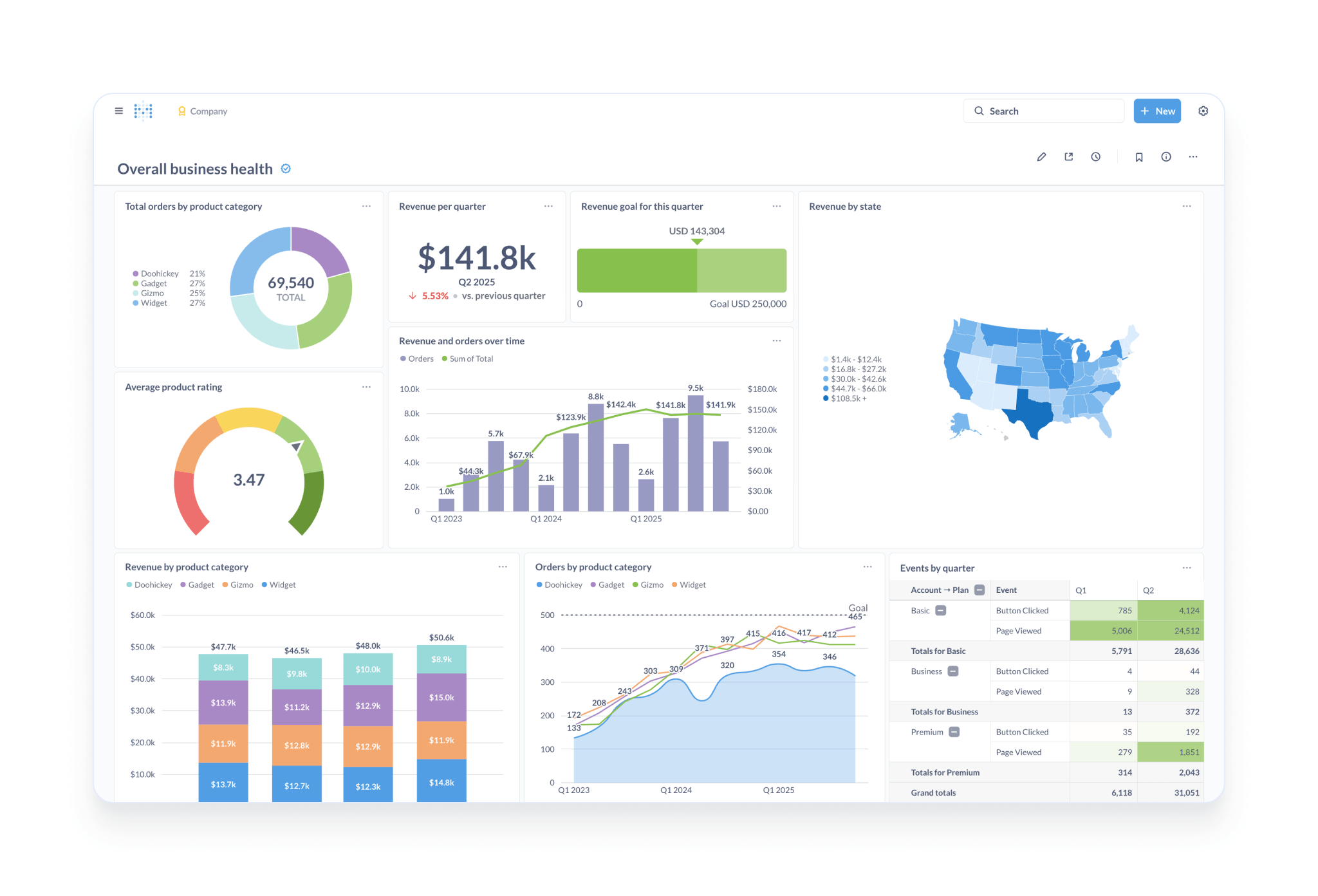
The easy-to-use open source Business Intelligence and Embedded Analytics tool that lets everyone work with data :bar_chart:
- 50k
- Clojure
- 13 h ago
A grug-brained stab at layout and tooling to conveniently develop many Clojure projects in a single source repo.
Repo adityaathalye/clojure-multiproject-example, read from GitHub 10 h ago. adityaathalye has not joined Take My Repo.
adityaathalye/clojure-multiproject-example is a public repo on GitHub by adityaathalye. A grug-brained stab at layout and tooling to conveniently develop many Clojure projects in a single source repo. It declares no license on GitHub. Public does not mean open source: without a license, nobody is granted the right to reuse it. It is written mainly in Clojure, has 20 stars and last changed on 2025-03-10. Nobody has reviewed it on Take My Repo yet, which says nothing about its quality. Read from GitHub on 2026-11-22.
NOTICE: Bespoke Software For My Use.
However, I hope others find some value in the idea(s) / trick(s) contained herein. Plus, "Learn Generously" is my credo, and I hope publishing this welcomes brain-exchange with kindred spirits.
So... MIT-licensed for great good.
Please mess about and contribute feedback / critique! No idea is sacrosanct.
deps.edn declares all source code relationshipsbuild/build.clj and bin/run_cmd.sh contain all commands to
execute against the whole or part of the multiprojectparts are functions: Mutually independent building blocks
that we configure and compose into applications. I've made my own
grugstack, but you can vendor in anything of your own.projects are objects: Purpose-built applications, having
whatever architecture they need to have, built using whatever set
of libraries and/or parts they need.:app-alias naming convention is key
(haha) to success (see MultiProject Conventions).Try from project root:
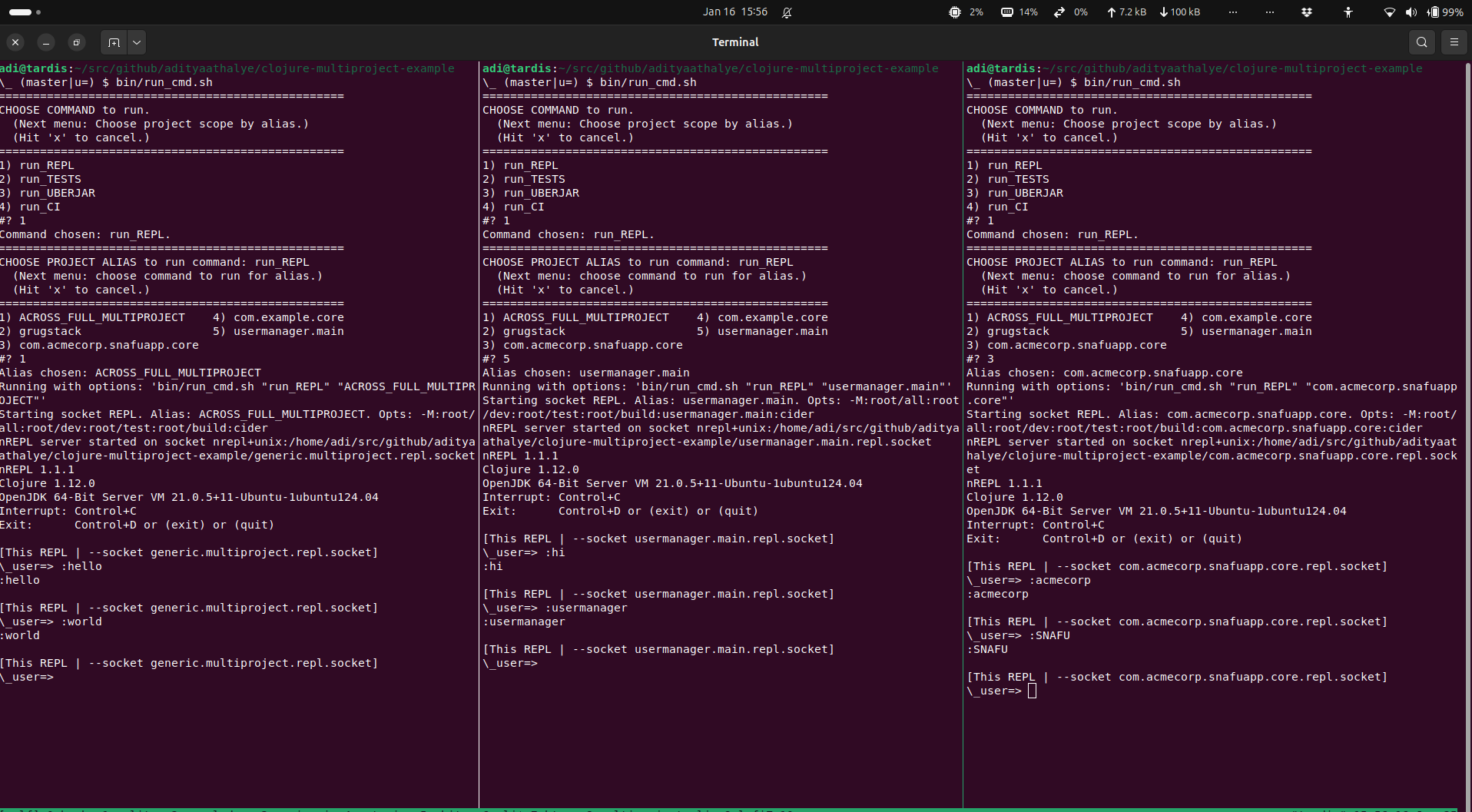
bin/run_cmd.sh Bash helper script builds and runs commands
documented in Usage. (TBD: rewrite as babashka script for
maximum portability).bin/run_cmd.sh # and follow the menu to pick COMMAND and ALIAS
# OR
bin/run_cmd.sh run_TESTS # and follow the menu to pick ALIAS
# OR, directly make it do what you mean...
bin/run_cmd.sh run_TESTS "com.acmecorp.snafuapp.core"
bin/run_cmd.sh run_UBERJAR "com.acmecorp.snafuapp.core"
As of today, "multiproject" addresses my own specific requirements; viz.
Indie and Hobby SaaS apps of my own;
RAD for outcomes-driven customers who want long-lived, stable software. I'm my own customer! And I'm available for hire!
Benefit from the Clojure ecosystem's creativity, reach, stewardship, and software stability.
Professionally, I want to be able to:
Architecturally, I want to retain optionality.
Choosing to focus on outcomes means I should retain the option to use any framework or architecture or Clojure dialect, for any type of application (web, backend, developer tool etc.).
As of this writing, I feel like this is already plausible. I don't see why any one app managed by "multiproject" cannot itself be a biff/kit/duct app, or itself follow polylith architecture, or be just a single babashka script.
Systematically, I want /system and workflow/ re-use.
In addition to stack reuse.
Just enough structure to help me manage things, while staying sane, without building hard dependence on any specific project layout, build tool, application stack etc.
More stream-of-conscious-y stuff squirreled away under sundry design notes.
A working Clojure installation (prefer the latest available Clojure).
Bash to use the bin/run_cmd.sh. I've assumed Bash 5.0+. Bash 4.0+
should be okay too.
Non-Linux users may have to fiddle about to make things work right for them. I use Ubuntu 24.04 LTS on my dev and server boxen. So I haven't paid attention to any other OS.
The root deps.edn is the lynchpin of control.
deps.edn under its project
root. The app-specific deps file must specify its own library
dependencies.Top-level alias naming convention does a lot of heavy lifting for us.
:root/
aliases, only in the root deps.edn file. This helps avoids
overlap / conflict with system-specific and user-specific
deps.edn.deps.edn. The alias data is used by commands
defined for use within the multiproject.:app-alias command line option..m2 repository may be useful for dependency
management / audit reasons, but isn't a hard requirement..gitignore under the project root (for completions,
refactoring, etc.).Use aliases from the root-level deps.edn to run everything from the root of the source repo. Here "everything" including tests, builds, CI tasks.
I prefer to start REPLs at the shell, and connect to them via my code editor. This lets me independently kill/restart/manage the REPL process and the Editor process. Sometimes one of them can go into a bad state. Live REPL state tends to collect orphan objects the longer they are live. Sometimes I want to force-invalidate some editor state, which may require killing and cold-starting it. etc...
This is the most common way to start a REPL. This works just fine for conventional single-repo single-app style projects.
clj -M:root/all:root/dev:root/test:cider
This is my preferred tactic to trivially share or isolate REPLs from each other, in a multi-project context. The trick is to name socket paths along the project directory paths structure. For example:
To imply a REPL is shared across the whole multi-project, create the UNIX domain socket at the root of the multi-project repo.
clj -M:root/all:root/dev:root/test:cider --socket "repl.socket"
To imply a REPL is specific to a project, create the socket at the root of the project directory.
clj -M:root/all:root/dev:root/test:com.example.core:cider --socket "projects/example_app/repl.socket"

clj -M:root/all:root/dev:root/test:com.acmecorp.snafuapp:cider --socket "projects/acmecorp/snafuapp/repl.socket"
This trick helps us conveniently access / share code from anywhere in the multi-project, while also being able to isolate project-specific REPL state when needed.
Example: Isolating Integrant REPL state per-project, while being able to access source code from any path in the multi-project.
user namespace. This is Clojure's standard bootstrap
behaviour.Given these guarantees...
dev/user.clj, right under the
root of the multi-project. It contains handy REPL utilities to
manipulate system state (start / stop / restart), as well as spin
up developer tools like portal.user.clj code yet REPL state is
maintained independently, in isolated process, by construction.deps.edn settings to
configure source access for each project-specific alias. With this,
we can grant access to any permutation of the multi-project
codebase.Thus, inert code can be shared, while live state is isolated.
Test all apps:
clj -X:root/all:root/test
Test only one app:
clj -X:root/all:root/test:com.acmecorp.snafuapp.core
grugstack itself.clj -X:root/all:root/test:grugstack
Run full CI sequence for individual apps.
clj -T:root/build
java -jar target/com.example.core/com.example.core-*.jar
clj -T:root/build :app-alias ':com.acmecorp.snafuapp.core'
java -jar target/com.acmecorp.snafuapp.core/com.acmecorp.snafuapp.core-*.jar

# Followed by

curl localhost:13337
Package a single app into an uberjar.
Run only "uberjar" part of the CI sequence, for app identified by
:app-alias.
clj -T:root/build uberjar :app-alias ':com.acmecorp.snafuapp.core'
Then check it as described above
Run only "test" part of the CI sequence, for apps identified by
:app-alias.
clj -T:root/build test :app-alias ':com.acmecorp.snafuapp.core'
We can just use the deps-new tool, from the root directory of the multi-project repo.
Example:
clojure -Tnew app :name com/acmecorp/fubarapp/core :target-dir projects/acmecorp/fubarapp
This produces the usual "application" project layout. We don't really need some of the files under the newly-created project, but it doesn't hurt us to let them be (README, LICENSE, build.clj, .gitignore etc.). Tomorrow, if I need to pull the app out of the multi-project, into a standalone project (say, to hand over to someone), then staying compatible with the standard app layout should make extraction easier.
$ tree -a projects/acmecorp/fubarapp/
projects/acmecorp/fubarapp/
├── build.clj
├── CHANGELOG.md
├── deps.edn
├── doc
│   └── intro.md
├── .gitignore
├── LICENSE
├── README.md
├── resources
│   └── .keep
├── src
│   └── com
│       └── acmecorp
│           └── fubarapp
│               └── core.clj
└── test
    └── com
        └── acmecorp
            └── fubarapp
                └── core_test.clj
As of this writing, cljfmt drives code formatting convention. Thank
you, yet again, weavejester.
clj -Ttools install io.github.weavejester/cljfmt '{:git/tag "0.13.0"}' :as cljfmt
cljfmt.edn (:path being the most important
for our multi-project).clj -Tcljfmt checkclj -Tcljfmt fixHere's my stream of consciousness...
The attempt is to...
grugstack),projects/example_app), or must
be neatly isolated for my customers (e.g. projects/acmecorp/snafuapp).Conceptually, it is aspirational...
Ideally, I want to get away with...
build.clj. Stare at the build.clj file and
the multi-project-level deps.edn file side-by-side to see the
main trick I've used... I figured out a permutation of (alias names
x grouping of paths x grouping of dependencies x grouping of args
that must get overridden to narrow context to the last alias).By design, I want to run tools / start REPLs etc. only at the root of the multi-project, and use explicit command-line options to broaden or narrow scope of the command / REPL to the part(s) of the multi-project that I want to target. This helps me keep a simple mental model of managing the whole or the part of the multi-project, that can show up legibly in my shell's history / project logs / docs etc. (hopefully the Usage examples will make this clear).
Lots.
As of now, I am in discussions-only mode... Ping me in the Clojurians Slack or Zulip or this thread in the official mailing list.
I've consumed way too much web-stack buildin' prior art from across the Clojure ecosystem. Clojure core, community librarians, builders, architects, teachers, book authors: the whole lot of you; thank you!
Special mentions to authors making projects and explanations for use by solo/indie web app builders: biff, duct, zodiac, caveman.
Last but not least, special mention to polylith, which lit a key
light bulb in my head... The "Expression Problem" applies to code
layout and application architecture too! Not Functions v/s Objects;
but Functions and Objects.
That said, I'm not sure I've "got it" yet. So to take it back to the top, please send design notes my way!
Copyright (c) 2025 Aditya Athalye.
Distributed under the MIT license.
adityaathalye/clojure-multiproject-example is a public repo on GitHub by adityaathalye. A grug-brained stab at layout and tooling to conveniently develop many Clojure projects in a single source repo.
It declares no license on GitHub. Public does not mean open source: without a license, nobody is granted the right to reuse it.
Its maker tagged it for macOS, Windows and Linux, or as Docker or cross-platform. That is declared by the maker; Take My Repo has not tested it.
Open "Take it" on its page: Take My Repo writes an install plan for your machine and hands it to your AI agent (Claude Code, Codex or Cursor), which asks you before each step. Take My Repo has not tested it on any machine.
The easy-to-use open source Business Intelligence and Embedded Analytics tool that lets everyone work with data :bar_chart:
Its last change on GitHub was on 2025-03-10. GitHub counts 0 open issues and pull requests. Take My Repo does not judge from that whether it is maintained.
Nobody has reviewed it on Take My Repo yet, which says nothing about its quality.
Hello world in every computer language. Thanks to everyone who contributes to this, make sure to see contributing.md for contribution instructions!
A privacy-first, open-source platform for knowledge management and collaboration. Download link: http://github.com/logseq/logseq/releases. roadmap: https://logseq.io/p/NX4mc_ggEV
Suite of tools for deploying and training deep learning models using the JVM. Highlights include model import for keras, tensorflow, and onnx/pytorch, a modular and tiny c++ library for running math code and a java based math library on top of the core c++ library. Also includes samediff: a pytorch/tensorflow like library for running deep learn...
Could be my ever-growing, ever-improving, Swiss Army Toolkit of functions-as-cmd-line-tools and useful-to-me patterns.
A "from first principles" variant of "usermanager-example", the tutorial Clojure web application by Sean Corfield.
Yet another scheme to fathom the Structure and Interpretation of Computer Programs.