
dify
Build Agentic workflows, RAG pipelines, with rich AI model and tool support on one collaborative workspace. Deploy on cloud, VPC, or self-hosted, so teams move from prototype to production without rebuilding the stack.
- 161k
- Python
- 2 h ago
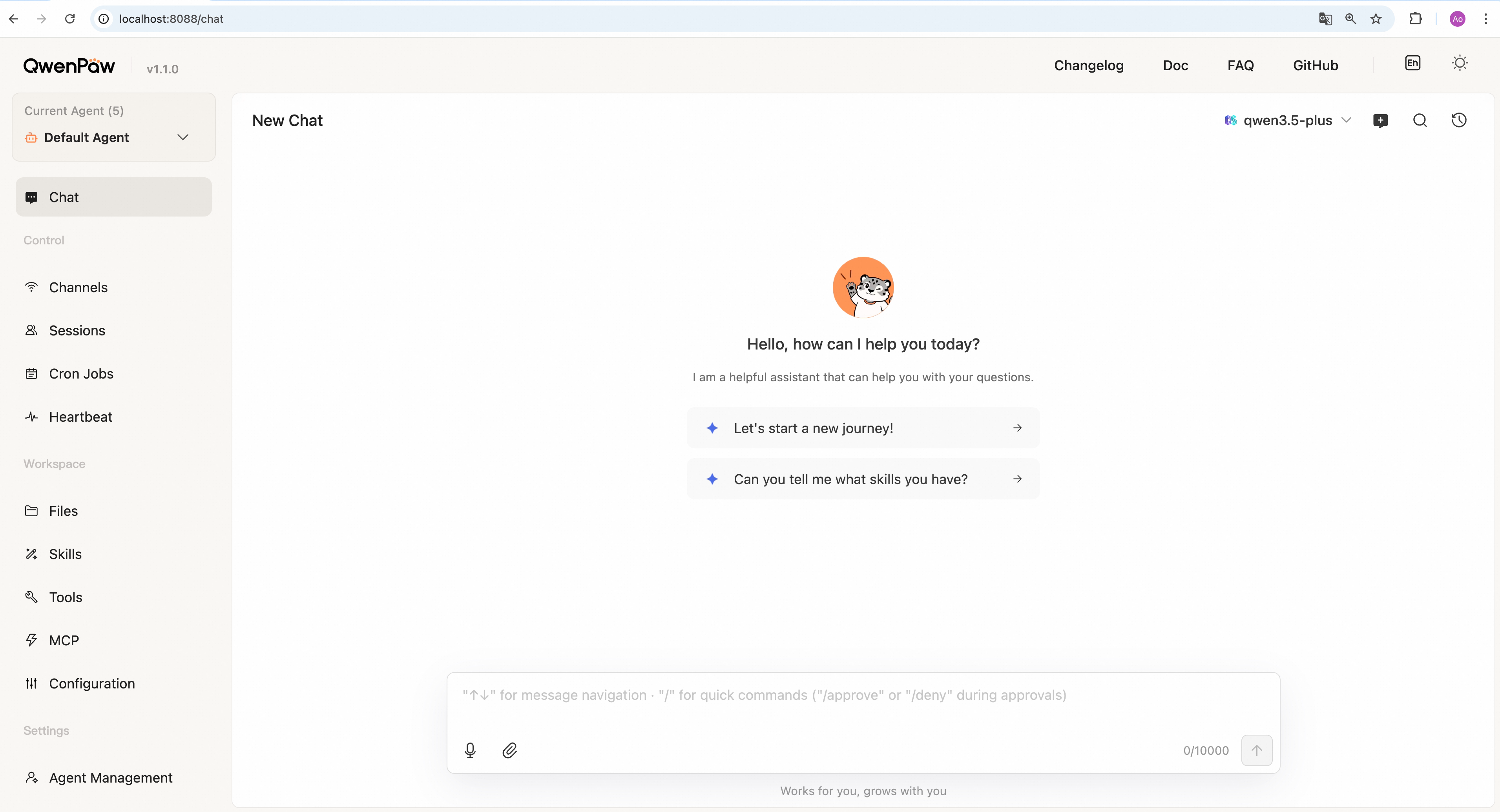
Your Personal AI Assistant; easy to install, deploy on your own machine or on the cloud; supports multiple chat apps with easily extensible capabilities.
Repo agentscope-ai/QwenPaw, read from GitHub 1 min ago. agentscope-ai has not joined Take My Repo.
agentscope-ai/QwenPaw is a public repo on GitHub by agentscope-ai. Your Personal AI Assistant; easy to install, deploy on your own machine or on the cloud; supports multiple chat apps with easily extensible capabilities. It declares the Apache-2.0 license on GitHub. It is written mainly in TypeScript, has 37,902 stars and last changed on 2026-11-18. Nobody has reviewed it on Take My Repo yet, which says nothing about its quality. Read from GitHub on 2026-11-18.
Your personal AI assistant — deploy locally or in the cloud, extend with Skills & Plugins, connect across every channel.
| Never forgets | Three-layer memory — live working context, full verbatim history, and a self-evolving personal knowledge base powered by ReMe. Conversations and resources continuously become readable, editable, searchable, and linked Markdown memory. |
| Local or cloud, runs free | QwenPaw-Flash models (2B / 4B / 9B / 35B-A3B / 27B) trained for agent tasks. Built-in QwenPaw Local runtime — no API key, no cloud dependency. Also works with Ollama, LM Studio, or 14+ cloud providers. |
| Security built in | Kernel-level Sandbox, Tool Guard, File Guard, Skill Scanner, and Access Policy. Dangerous commands are blocked before they run. |
| Multi-agent & parallel | Spawn independent agents with their own memory and skills. Sub-agents at runtime. Agent Communication Protocol (ACP) for cross-system orchestration. |
| File workspace | Unified file navigation, preview, editing, diffs, upload, and download across project and Agent files. |
| Extensible | Skills for scheduling, documents, browser, news, and more. Plugin architecture with a marketplace. MCP integration for external tools. Combine them into purpose-built workflows. |
| Reachable anywhere | DingTalk, Lark, WeChat, Discord, Telegram, iMessage, QQ — one instance, all channels. Console, TUI, and desktop app for direct access. |
| Yours, not ours | Deploy locally — data stays on your machine. No third-party hosting, no data upload. |
[2026-11-11] v2.3.0 | Piccolo local decision models, QwenPaw Community integration, Advisor Mode for collaboration between larger and smaller models, Code Mode; plugin-system refactoring, the plugin SDK, and channels as plugins; image memory, tag browsing, and Console and desktop multi-window improvements. v2.3.0 Release Notes →
[2026-10-15] v2.2.2 | Console updates, new QwenPaw-Flash models covering 9B/27B/35B-A3B, PawPort for importing Codex/Qoder data, Creator 2.0.1, and Data 0.3.0. v2.2.2 Release Notes →
[2026-09-10] v2.2.1 | Creator 1.2 blueprint workbench, per-Agent model routing, and unified environment management. v2.2.1 Release Notes →
[2026-09-03] v2.2.0 | Self-hosted multi-user QwenPaw Hub, QwenPaw Mail, native QwenPaw Data, unified model routing, Creator 1.1, a unified marketplace, and major Console, Skills, channel, and reliability improvements. v2.2.0 Release Notes →
[2026-08-13] v2.1.0 | QwenPaw OS Shell, unified Files workspace, QwenPaw Creator, Codex/Qoder Agent integration, Browser-use, Computer-use, workspace checkpoints, and long-running conversation continuity. v2.1.0 Release Notes →
If you prefer managing Python yourself (requires Python >= 3.11, < 3.14):
pip install qwenpaw
qwenpaw init --defaults
qwenpaw app
Then open the Console in your browser at http://127.0.0.1:8088/ to configure your model. To chat in DingTalk, Lark, WeChat, etc., see the Channel setup documentation.
Codex and Qoder backends are optional plugins installed separately in Settings → Plugins. The full extra excludes their SDKs; transitional codex/qoder extras only prepare dependencies. Existing users should follow the prepared migration instructions before restarting an upgraded host.
No Python setup required, one command installs everything. The script will automatically download uv (Python package manager), create a virtual environment, and install QwenPaw with all dependencies (including Node.js and frontend assets). Note: May not work in restricted network environments or corporate firewalls.
macOS / Linux:
curl -fsSL https://qwenpaw.agentscope.io/install.sh | bashWindows (CMD):
curl -fsSL https://qwenpaw.agentscope.io/install.bat -o install.bat && install.batWindows (PowerShell):
irm https://qwenpaw.agentscope.io/install.ps1 | iex
Note: The installer will automatically check the status of uv. If it is not installed, it will attempt to download and configure it automatically. If the automatic installation fails, please follow the on-screen prompts or execute
python -m pip install -U uv, then rerun the installer.
⚠️ Special Notice for Windows Enterprise LTSC Users
If you are using Windows LTSC or an enterprise environment governed by strict security policies, PowerShell may run in Constrained Language Mode, potentially causing the following issue:
If using CMD (.bat): Script executes successfully but fails to write to
PathThe script completes file installation. Due to Constrained Language Mode, it cannot automatically update environment variables. Manually configure as follows:
- Locate the installation directory:
- Check if
uvis available: Enteruv --versionin CMD. If a version number appears, only configure the QwenPaw path. If you receive the prompt'uv' is not recognized as an internal or external command, operable program or batch file,configure both paths.- uv path (choose one based on installation location; use if
uvfails): Typically%USERPROFILE%\.local\bin,%USERPROFILE%\AppData\Local\uv, or theScriptsfolder within your Python installation directory- QwenPaw path: Typically located at
%USERPROFILE%\.qwenpaw\bin.- Manually add to the system's Path environment variable:
- Press
Win + R, typesysdm.cpland press Enter to open System Properties.- Click “Advanced” -> “Environment Variables”.
- Under “System variables”, locate and select
Path, then click “Edit”.- Click “New”, enter both directory paths sequentially, then click OK to save.
If using PowerShell (.ps1): Script execution interrupted
Due to Constrained Language Mode, the script may fail to automatically download
uv.
- Manually install uv: Refer to the GitHub Release to download
uv.exeand place it in%USERPROFILE%\.local\binor%USERPROFILE%\AppData\Local\uv; or ensure Python is installed and runpython -m pip install -U uv.- Configure
uvenvironment variables: Add theuvdirectory and%USERPROFILE%\.qwenpaw\binto your system'sPathvariable.- Re-run the installation: Open a new terminal and execute the installation script again to complete the
QwenPawinstallation.- Configure the
QwenPawenvironment variable: Add%USERPROFILE%\.qwenpaw\binto your system'sPathvariable.
Once installed, open a new terminal and run:
qwenpaw init --defaults   # or: qwenpaw init (interactive)
qwenpaw appmacOS / Linux:
# Install a specific version
curl -fsSL ... | bash -s -- --version 1.1.0

# Install from source (dev/testing)
curl -fsSL ... | bash -s -- --from-source

# Upgrade — just re-run the installer
curl -fsSL ... | bash

# Uninstall
qwenpaw uninstall          # keeps config and data
qwenpaw uninstall --purge  # removes everything
Windows (PowerShell):
# Install a specific version
irm ... | iex; .\install.ps1 -Version 1.1.12

# Install from source (dev/testing)
.\install.ps1 -FromSource

# Upgrade — just re-run the installer
irm ... | iex

# Uninstall
qwenpaw uninstall          # keeps config and data
qwenpaw uninstall --purge  # removes everything
Images are on Docker Hub (agentscope/qwenpaw). Image tags: latest (stable); pre (PyPI pre-release).
docker pull agentscope/qwenpaw:latest
docker run -p 127.0.0.1:8088:8088 \
  -v qwenpaw-data:/app/working \
  -v qwenpaw-secrets:/app/working.secret \
  -v qwenpaw-backups:/app/working.backups \
  agentscope/qwenpaw:latest
Also available on Alibaba Cloud Container Registry (ACR) for users in China: agentscope-registry.ap-southeast-1.cr.aliyuncs.com/agentscope/qwenpaw (same tags).
Then open http://127.0.0.1:8088/ for the Console. Config, memory, and skills are stored in the qwenpaw-data volume; model provider settings and API keys are in the qwenpaw-secrets volume; backup archives are stored in the qwenpaw-backups volume. To pass API keys (e.g. DASHSCOPE_API_KEY), add -e VAR=value or --env-file .env to docker run.
Connecting to Ollama or other services on the host machine
Inside a Docker container,
localhostrefers to the container itself, not your host machine. If you run Ollama (or other model services) on the host and want QwenPaw in Docker to reach them, use one of these approaches:Option A — Explicit host binding (all platforms):
docker run -p 127.0.0.1:8088:8088 \
  --add-host=host.docker.internal:host-gateway \
  -v qwenpaw-data:/app/working \
  -v qwenpaw-secrets:/app/working.secret \
  -v qwenpaw-backups:/app/working.backups \
  agentscope/qwenpaw:latest
Then in QwenPaw Settings → Models, change the Base URL to
http://host.docker.internal:<port>— for example,http://host.docker.internal:11434for Ollama, orhttp://host.docker.internal:1234/v1for LM Studio.Option B — Host networking (Linux only):
docker run --network=host \
  -v qwenpaw-data:/app/working \
  -v qwenpaw-secrets:/app/working.secret \
  -v qwenpaw-backups:/app/working.backups \
  agentscope/qwenpaw:latest
No port mapping (
-p) is needed; the container shares the host network directly. Note that all container ports are exposed on the host, which may cause conflicts if the port is already in use.
The image is built from scratch. To build the image yourself, please refer to the Build Docker image section in scripts/README.md, and then push to your registry.
To run QwenPaw on Alibaba Cloud (ECS), use the one-click deployment: open the QwenPaw on Alibaba Cloud (ECS) deployment link and follow the prompts. For step-by-step instructions, see Alibaba Cloud Developer: Deploy your AI assistant in 3 minutes.
AgentScope Platform provides one-click cloud QwenPaw deployment, plugin sharing, and a Skill marketplace. Free, 7/24 online.
ModelScope Studio also supports cloud QwenPaw deployment. Note: set your Studio to non-public so others cannot control your QwenPaw.
Beta Notice: The desktop application is currently in Beta testing phase with the following known limitations:
- Incomplete compatibility testing: Not fully tested across all system versions and hardware configurations
- Potential performance issues: Startup time, memory usage, and other performance aspects may need further optimization
- Features under development: Some features may be unstable or missing
If you're not comfortable with command-line tools, you can download and use QwenPaw's desktop application without manually configuring Python environments or running commands.
Download the desktop app (Tauri build) from the official download page:
QwenPaw-Tauri-<version>-Windows-setup.exeQwenPaw-Tauri-<version>-macOS.zip (Apple Silicon recommended)Important: The first launch may take 10-60 seconds (depending on your system configuration). The application needs to initialize the Python environment and load dependencies. Please wait patiently for the window to open automatically.
When you download the QwenPaw macOS app from Releases, macOS may show: "Apple cannot verify that 'QwenPaw' contains no malicious software". This happens because the app is not notarized. You can still open it as follows:
Right-click to open (recommended) Right-click (or Control+click) the QwenPaw app → Open → in the dialog click Open again. This tells Gatekeeper you trust the app; after that you can double-click to launch as usual.
Allow in System Settings If it is still blocked, go to System Settings → Privacy & Security, scroll to the message like "QwenPaw was blocked because it is from an unidentified developer", and click Open Anyway or Allow.
Remove quarantine attribute (not recommended for most users)
In Terminal run:
xattr -cr "/Applications/QwenPaw Desktop.app"
(or use the path to the .app after unzipping). This clears the "downloaded from the internet" quarantine flag so the warning usually does not appear, but is less safe and controllable than using Right-click → Open.
For detailed usage instructions, troubleshooting, and common issues, see the Desktop Application Guide.
After installation, configure your model in Console → Settings → Models, then explore:
Prefer to stay in the terminal? Run qwenpaw to open a full-screen chat TUI that drives the same agent as the Console and the IM Channels — same memory, skills, MCP tools, and sessions — without leaving your keyboard.
qwenpaw                     # open a chat with the active agent
qwenpaw tui --resume <id>   # resume a previous session
qwenpaw .                   # start in the current repo (Coding Mode)
It supports streaming replies, slash commands (/help, /resume, /theme, plus the agent's own /model, /clear, …), pasting files/long text as attachments, and inline tool-permission prompts. See the Terminal UI guide for details.
If you use a cloud LLM API (e.g., DashScope / Qwen, OpenAI, Anthropic, Google Gemini, DeepSeek, Kimi, OpenRouter, and more), you must configure an API key before chatting. QwenPaw will not work until a valid key is set. See the official docs for details.
How to configure:
qwenpaw app, open http://127.0.0.1:8088/ → Settings → Models. Choose a provider, enter the API Key, and enable that provider and model.qwenpaw init — When you run qwenpaw init, it will guide you through configuring the LLM provider and API key. Follow the prompts to choose a provider and enter your key.DASHSCOPE_API_KEY in your shell or in a .env file in the working directory.Tools that need extra keys (e.g. TAVILY_API_KEY for web search) can be set in Console Settings → Environment variables, see Config for details.
Using local models only? If you use Local Models (QwenPaw Local / Ollama / LM Studio), you do not need any API key.
QwenPaw can run LLMs entirely on your machine — no API keys or cloud services required. See the official docs for details.
QwenPaw also provides the QwenPaw-Flash series — purpose-trained 2B / 4B / 9B / 35B-A3B / 27B models for agent scenarios, with Q4 and Q8 quantizations. Available on ModelScope and Hugging Face.
| Backend | Best for | Install |
|---|---|---|
| QwenPaw Local (llama.cpp) | Cross-platform (macOS / Linux / Windows) | Built-in; click "Download" in the web UI. Supports QwenPaw-Flash with hardware-aware recommendations. |
| Ollama | Cross-platform (requires Ollama service) | Install and start Ollama; set context length ≥ 32k. |
| LM Studio | Cross-platform (requires LM Studio) | Install and start LM Studio; enable Local Server. |
QwenPaw includes five core security layers:
ShellEvasionGuardian inspects every tool call before execution, detecting command injection, path traversal, reverse shells, and obfuscated attacks. Configurable approval levels: STRICT / SMART / AUTO / OFF.~/.qwenpaw.secret/, ~/.ssh, etc.).See Security for details.
| Topic | Description |
|---|---|
| Introduction | What QwenPaw is and how to use it |
| Quick start | Install and run (local or ModelScope Studio) |
| Console | Web UI: chat and agent configuration |
| Terminal UI (TUI) | Full-screen terminal chat, same agent as Console |
| Desktop App | Desktop application installation and usage |
| Models | Configure cloud, local, and custom providers |
| Channels | DingTalk, Lark, QQ, Discord, iMessage, and more |
| Skills | Extend and customize capabilities |
| Plugins | Plugin system and Plugin Market |
| MCP | Manage MCP clients |
| Persona | Agent personality customization (SOUL / PROFILE) |
| Memory | Self-evolving personal knowledge base built on local, editable, searchable, and linked Markdown memory, powered by ReMe |
| ReMe Documentation | Official ReMe overview and documentation |
| Memory-Evolving & Proactive | Agent memory evolution and proactive interaction |
| Context | Scroll-based context management |
| Magic commands | Control conversation state without waiting for the AI |
| Heartbeat | Scheduled check-in and digest |
| Cron / Scheduled Tasks | Scheduled tasks and automation |
| Multi-Agent | Create multiple agents and enable collaboration |
| Security | Sandbox, tool guard, file guard, skill scanner, access policy |
| Backup & Restore | Data backup and recovery |
| Config & working dir | Working directory and config file |
| REST API | HTTP API for integration and automation |
| ACP Integration | Agent Communication Protocol integration |
| CLI | Init, cron jobs, skills, clean |
| Agent Team Practice | Multi-agent team deployment guide |
| FAQ | Common questions and troubleshooting |
In Console chat, select assistant response text and click Quote to follow-up to append an editable quote to your draft. See Console.
In the Console, /clear and a successful /new leave the chat empty when you reopen it or reload the page. See Magic commands.
Full documentation: qwenpaw.agentscope.io/docs
For common questions, troubleshooting tips, and known issues, please visit the FAQ page.
| Area | Item | Status |
|---|---|---|
| Release Evaluation Rankings | Evaluate each release and update the public leaderboard. | In Progress |
| Lightweight Codebase | Split non-core components into plugins that can be installed and enabled on demand to reduce installation and runtime costs. | In Progress |
| Decision Model Integration | Integrate Jev and other decision models for collaborative decision-making. | In Progress |
| Deep UI/UX Optimization | Improve navigation, interactions, and visuals across screen sizes. | In Progress |
Status: In Progress — actively being worked on.
QwenPaw evolves through open collaboration, and we welcome all forms of contribution! Check the Roadmap above to find areas that interest you, and read CONTRIBUTING to get started. We particularly welcome:
Join GitHub Discussions to discuss ideas or pick up tasks.
git clone https://github.com/agentscope-ai/QwenPaw.git
cd QwenPaw

# Build console frontend first (required for web UI)
cd console && npm ci && npm run build
cd ..

# Copy console build output to package directory
mkdir -p src/qwenpaw/console
cp -R console/dist/. src/qwenpaw/console/

# Install Python package
pip install -e .
pip install -e ".[dev,test,full]"qwenpaw init --defaults, then qwenpaw app.Note for updates: When updating to a new major version after
git pull, please also rebuild the frontend, reinstall the package (pip install -e .), restartqwenpaw app, and clear your browser cache withCtrl+Shift+R(orCmd+Shift+Ron macOS).
QwenPaw stands for Qwen Personal Agent Workstation, and also embodies the wisdom of Qwen and the warmth of a Paw. We hope it is not a cold tool, but an intelligent and warm "little paw" always ready to help—a most intuitive partner in your digital life.
AgentScope team · AgentScope · AgentScope Runtime · ReMe
| Discord | X (Twitter) | DingTalk | RedNote |
|---|---|---|---|
Star QwenPaw on GitHub and be instantly notified of new releases.
QwenPaw collects anonymous usage data during qwenpaw init to help us understand our user base and prioritize improvements. Data is sent once per version — when you upgrade QwenPaw, telemetry is re-collected so we can track version adoption.
What we collect:
What we do NOT collect: No personal data, no files, no credentials, no IP addresses, no identifiable information.
When running qwenpaw init interactively, you will be asked whether to opt in. If you choose --defaults, telemetry is accepted automatically. The prompt appears once per version and never affects QwenPaw's functionality.
QwenPaw is released under the Apache License 2.0.
All thanks to our contributors:
agentscope-ai/QwenPaw is a public repo on GitHub by agentscope-ai. Your Personal AI Assistant; easy to install, deploy on your own machine or on the cloud; supports multiple chat apps with easily extensible capabilities.
It declares the Apache-2.0 license on GitHub.
Its maker has not tagged a system, so it is unknown here. Its README says what it needs.
Open "Take it" on its page: Take My Repo writes an install plan for your machine and hands it to your AI agent (Claude Code, Codex or Cursor), which asks you before each step. Take My Repo has not tested it on any machine.
Its last change on GitHub was on 2026-11-18. Take My Repo does not judge from that whether it is maintained.
Nobody has reviewed it on Take My Repo yet, which says nothing about its quality.
Build Agentic workflows, RAG pipelines, with rich AI model and tool support on one collaborative workspace. Deploy on cloud, VPC, or self-hosted, so teams move from prototype to production without rebuilding the stack.
RAGFlow is an agent-native database: a Retrieval-Augmented Generation (RAG) engine that grew into context infrastructure.
The agent harness performance optimization system. Skills, instincts, memory, security, and research-first development for Claude Code, Codex, Opencode, Cursor and beyond.
Reverse engineer anything with agents, from app behavior down to native binaries.
A production-ready runtime framework for agent apps with secure tool sandboxing, Agent-as-a-Service APIs, scalable deployment, full-stack observability, and broad framework compatibility.


