rea
Reverse engineer anything with agents, from app behavior down to native binaries.
- 478k
- TypeScript
- MIT
- 55 min ago
Intent compiler for AI agents — converges vague requests into typed IntentSpec contracts (probe, ask, or halt before routing), the input layer for routers and typed-decision models like Jev & Laya
Repo angel291592/Intent-Router, read from GitHub 15 h ago. angel291592 has not joined Take My Repo.
angel291592/Intent-Router is a public repo on GitHub by angel291592. Intent compiler for AI agents — converges vague requests into typed IntentSpec contracts (probe, ask, or halt before routing), the input layer for routers and typed-decision models like Jev & Laya. It declares the MIT license on GitHub. It is written mainly in Python, has 110 stars and last changed on 2026-11-24. Nobody has reviewed it on Take My Repo yet, which says nothing about its quality. Read from GitHub on 2026-11-24.
Reverse engineer anything with agents, from app behavior down to native binaries.
English | 简体中文
An intent compiler for AI agents.
Turns a vague request into a typed IntentSpec: it looks up what it can, asks only what it
can't, calls out a request that contradicts itself, admits two readings, or rests on a premise
your own repo already disproves, and refuses to emit while the intent is still underspecified.
When the work gets handed off and carried out, it checks the result against the spec it wrote —
one constraint at a time, not a vibe check.
What that buys you:
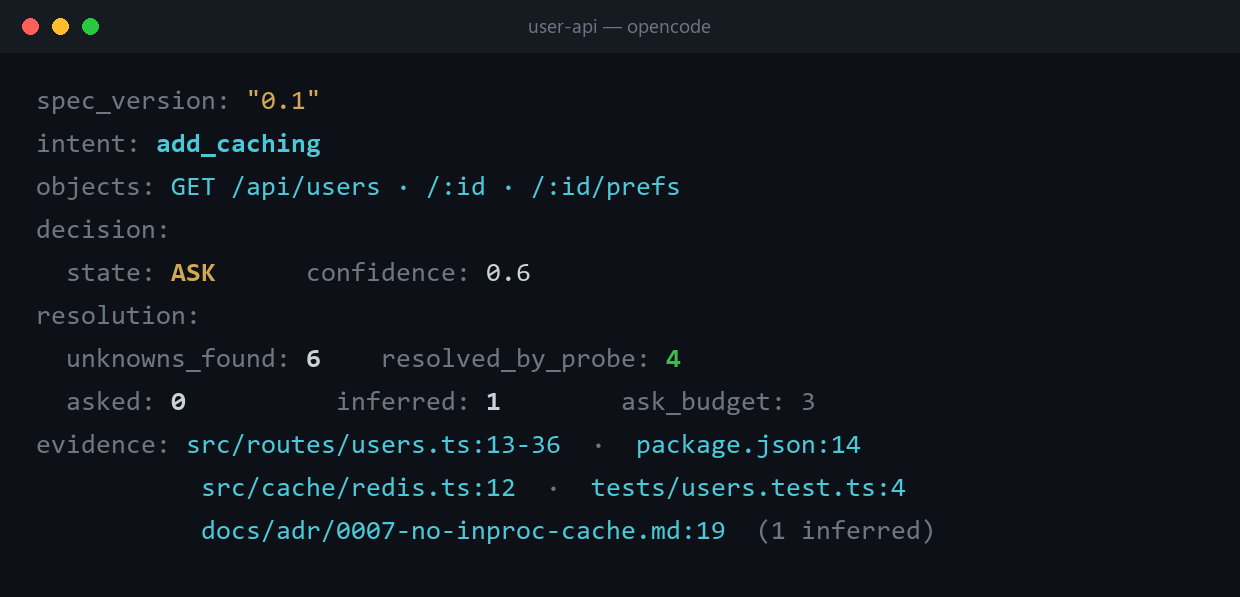
IntentSpec, saved to
.intent/<intent>.intent.yaml before the reply that carries it, whose probed fields carry
evidence pointers and which records its own state: still waiting on a question, settled, or
already carried out. A later session reads that file before probing anything — an answered
question is never asked again, a settled contract is implemented as written — and the result of
checking the delivered work against it is written back into the same file. So the next agent,
session or teammate starts from what you actually decided instead of zero.Same weak request, same fixture, same permissions, one line apart —
bare vs. with the skill (N=5 bare, N=3 skill).
Excerpted verbatim from each run's own diff.patch, the part that decides what happens when the
cache itself fails:
Bare — no failure path exists to read. A downed Redis takes the request down with it:
const hit = await getCache<T>(key);
if (hit !== null) {
  return hit;
}
const value = await load();
if (value !== null) {
  await setCache(key, value);
}
return value;
With the skill — asked the one question no file could answer, then wrote the answer into the code:
async function readCache<T>(key: string): Promise<{ hit: boolean; value: T | null }> {
  try {
    return { hit: true, value: await getCache<T>(key) };
  } catch {
    return { hit: false, value: null };
  }
}
Every one of the 5 bare runs shipped the first shape; every one of the 3 skill runs shipped the second. Neither line was written by hand for this README — both come straight out of the runs that produced the numbers in Evals.
          "add caching to the user API"       "this customer is furious — sort it out"
                        │                                         │
                        ▼                                         ▼
 ┌────────────────────────────────────────────────────────────────────────────────────┐
 │  parse  →  resolve  →  typecheck  →  emit                    one engine, one spec  │
 ├────────────────────────────────────────────────────────────────────────────────────┤
 │  PROBE   deps, routes, git history, ADRs   │  order + ticket log, entitlements,    │
 │          — you are not interrupted         │  the policy in force                  │
 │                                            │                                       │
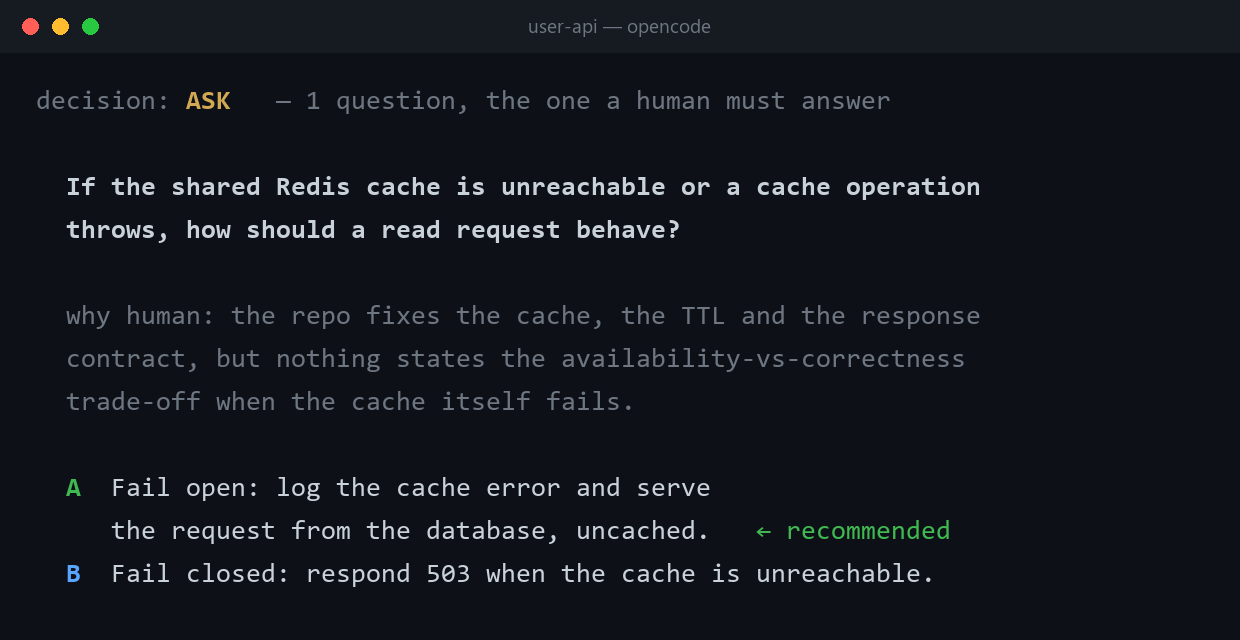
 │  ASK     serve stale, or serve uncached?   │  refund, or replace?                  │
 │          the one answer no file holds      │  the one that can't be undone         │
 └────────────────────────────────────────────────────────────────────────────────────┘
                        │                                         │
                        ▼                                         ▼
              IntentSpec  ──────►  your planner / agent / workflow / human
Same three passes. Same stopping predicate. Only the places it looks change.
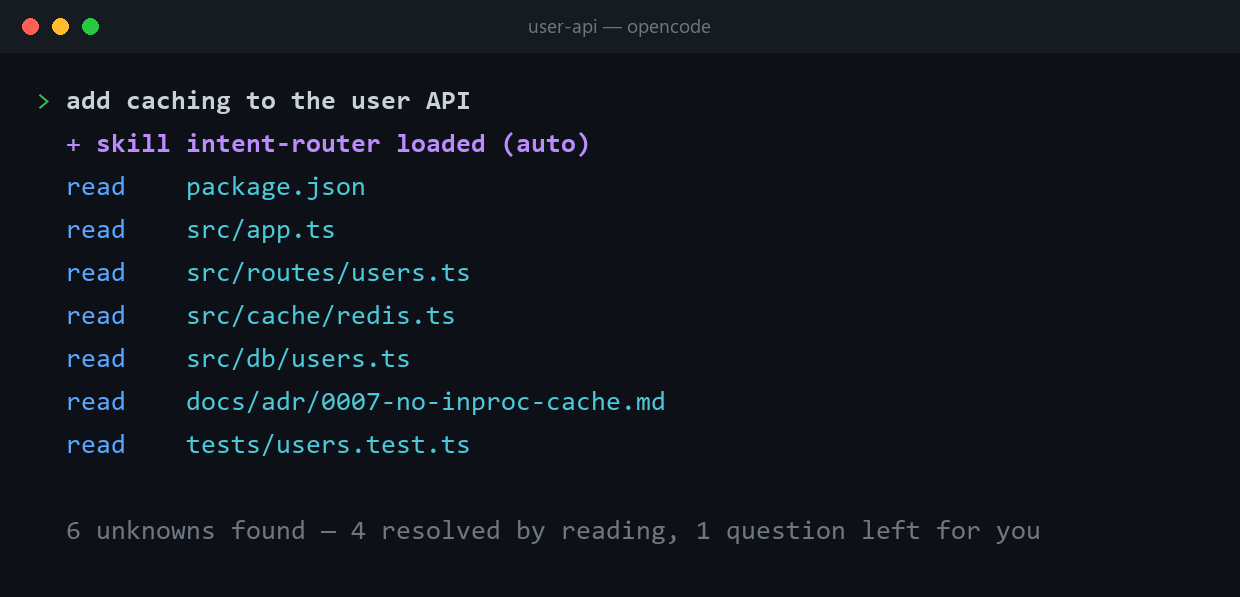
What a real run looks like — one sentence in, it reads the repo itself and asks only what no file can answer. From the measured run of 2026-09-23 behind the numbers below: 8 of the 10 cases the suite held that day, 0 hallucinated evidence.
No install, no API key, no dependencies — it's a skill:
npx skills add angel291592/Intent-Router
Manual install, or an agent the installer doesn't know: Quick start.
Intent-Router is the layer between a vague request and the work: look it up, ask, or act — then check what got built. Your harness's own plan mode already prefers looking things up over asking, and grill-me converges beautifully and states the right principle — but neither one checks a stated premise against the evidence, and neither one checks the finished work against what was decided. spec-kit keeps everything and makes you buy its whole workflow to get it. Kiro's specs come closest on paper — requirement-level conflict analysis, a correctness check after delivery — at the cost of a full three-file spec workflow and an IDE. Jev and Laya make the same bet this skill makes — typed output instead of prose — one layer further down: both turn an already-clear input into a typed, calibrated decision in a single pass, and neither one converges a vague request into that clear input to begin with. Intent-Router is that upstream layer as a single skill: no workflow to adopt, no files to keep in sync by hand, no IDE, no separate decision service to run.
Read the row gaps, not the checkmarks. Every cell below is sourced to the tool's own docs or repo — quoted cells are verbatim, and an unquoted ✅/⚠️/❌ still traces to a specific page.
| Converges vague input | Doesn't ask what it can look up | Uses evidence against contradictions & bad premises | Never guesses past irreversible | Cross-session artifact | Checks delivery against intent | Fires automatically | |
|---|---|---|---|---|---|---|---|
| Intent-Router | ✅ | ✅ PROBE |
✅ ambiguous / conflict / premise |
✅ HALT |
✅ .intent/*.yaml |
✅ Intent check |
✅ |
| Your harness's native plan mode + question tool | ✅ asks | ⚠️ varies — Codex's plan template states the rule outright; Claude Code and Cursor explore but document none | ❌ not documented on any of the three | ⚠️ an approval gate, not a risk-based one | ✅ Claude Code, Cursor save a plan file; Codex's plan lives in the reply | ❌ not documented | ⚠️ Claude Code's tool is model-invoked; Cursor only suggests; Codex needs an explicit switch |
| grill-me | ✅ rounds/frontier | ✅ "don't ask the user for anything you could look up yourself" | ❌ not documented | ✅ "the decisions are the user's" | ❌ stateless by design | ❌ not documented | ❌ manual (/grill-me) |
spec-kit /clarify |
✅ category scan, ≤5 questions | ⚠️ excludes questions "already answered", not questions the repo could answer | ⚠️ a separate command, /analyze, flags conflicting requirements |
⚠️ flags unresolved items as "Deferred", no reversibility test | ✅ writes into spec.md |
✅ a separate command, /converge |
❌ manual, one /speckit-* command at a time |
| Kiro specs | ✅ "asks clarifying questions if needed" | ⚠️ "codebase exploration", no stated rule | ⚠️ analyze-requirements finds inconsistencies across the requirement set (IDE/CLI only) |
not documented | ✅ three files per spec | ✅ property-based "Correctness" checks (IDE only) | ❌ manual (Shift+Tab / /plan) |
| Jev (typed decisions) | ❌ needs clear input already | — | — | — | — | — | ✅ |
| Laya (open-source System 1) | ❌ needs a formed state to classify | — | — | — | — | — | ✅ |
Jev's and Laya's rows are mostly —, not ❌: they are the System 1 decision layer, called
once a request is already well-formed — a different job from converging one, so most of these
columns do not apply to them. Jev is a closed API; Laya is the open-weights, Jev-wire-compatible
alternative you can run locally. The IntentSpec this skill emits is the shape of input both of
them assume already exists, which is why both show up again under Backends, as the
planned optional L2.
To be fair: a good harness natively prefers looking things up over asking, and offers a
recommended default when it does ask. In the delivery comparison, all 5 bare runs read
docs/adr/0007-no-inproc-cache.md on their own and avoided the trap it warns about — that habit
is real, and it is not this skill's contribution. Nothing else on this page should be read as
claiming it is.
What it adds is the part a conversation cannot hold:
IntentSpec is a
file-level contract, so the next agent, session or teammate starts from it rather than zero.degraded is an
operations signal and underspecified is your next step; merging them hides a backend outage
behind what looks like a clarifying question.met, with a pointer into the code, or not met.A compiler doesn't guess the address of an undefined symbol. Your agent shouldn't guess your intent.
When you hand an agent "refactor this module", "look into our churn" or "sort this customer out", exactly one of two things happens.
It guesses. You get 400 lines of confident work built on an assumption you never made. You read it, realize the premise is wrong, and throw it away. The agent was never wrong about how to do the job — it was wrong about what you meant, and it found that out only after spending your tokens.
Or it interviews you. This is better, and it's what /grill-me-style skills do well. But the
bill is real: the grill-me docs call "forty-six questions across four rounds an ordinary
session." And when it's over, the skill is explicitly stateless — "it writes no files and
leaves no workspace behind. The only thing it leaves is a sharper version of the idea, in your own
head."
So you pay twice. Once in questions, and again because nothing downstream can read the answers. The next agent, the next session, the next teammate — all start from zero.
Both failures share one root cause: nobody decided whether the missing information was worth asking a human for.
angel291592/Intent-Router is a public repo on GitHub by angel291592. Intent compiler for AI agents — converges vague requests into typed IntentSpec contracts (probe, ask, or halt before routing), the input layer for routers and typed-decision models like Jev & Laya.
It declares the MIT license on GitHub.
Its maker has not tagged a system, so it is unknown here. Its README says what it needs.
Social share, sending simple data to other apps.
The agent harness performance optimization system. Skills, instincts, memory, security, and research-first development for Claude Code, Codex, Opencode, Cursor and beyond.
Template-guided Clarifying Question Generation for Web Search Clarification (CIKM'2021).
Open "Take it" on its page: Take My Repo writes an install plan for your machine and hands it to your AI agent (Claude Code, Codex or Cursor), which asks you before each step. Take My Repo has not tested it on any machine.
Its last change on GitHub was on 2026-11-24. Take My Repo does not judge from that whether it is maintained.
Nobody has reviewed it on Take My Repo yet, which says nothing about its quality.
Take My Repo cannot say: it does not audit code and has not run Intent-Router. What is known comes from GitHub. It declares the MIT license on GitHub. Its last change was on 2026-11-24. It has 110 stars, which measure popularity, not safety. Nobody has reviewed it on Take My Repo yet, which says nothing about its quality. Read the source before you run it. With "Take it", your AI agent shows each step and asks you before running it; README text is treated as data, not as instructions.