Evolution
Interactive bio-cultural and evolutionary population simulator built with Godot, featuring an isometric hexagonal ecosystem, pixel-art aesthetic, and dual-frequency Ollama cognitive engine.
- 0
- 8 d ago
Repo arrase/Evolution, read from GitHub 1 h ago. arrase has not joined Take My Repo.
In short
arrase/Evolution is a public repo on GitHub by arrase. Interactive bio-cultural and evolutionary population simulator built with Godot, featuring an isometric hexagonal ecosystem, pixel-art aesthetic, and dual-frequency Ollama cognitive engine. It declares no license on GitHub. Public does not mean open source: without a license, nobody is granted the right to reuse it. It is written mainly in GDScript, has 0 stars and last changed on 2026-11-16. Nobody has reviewed it on Take My Repo yet, which says nothing about its quality. Read from GitHub on 2026-11-23.
Evolution
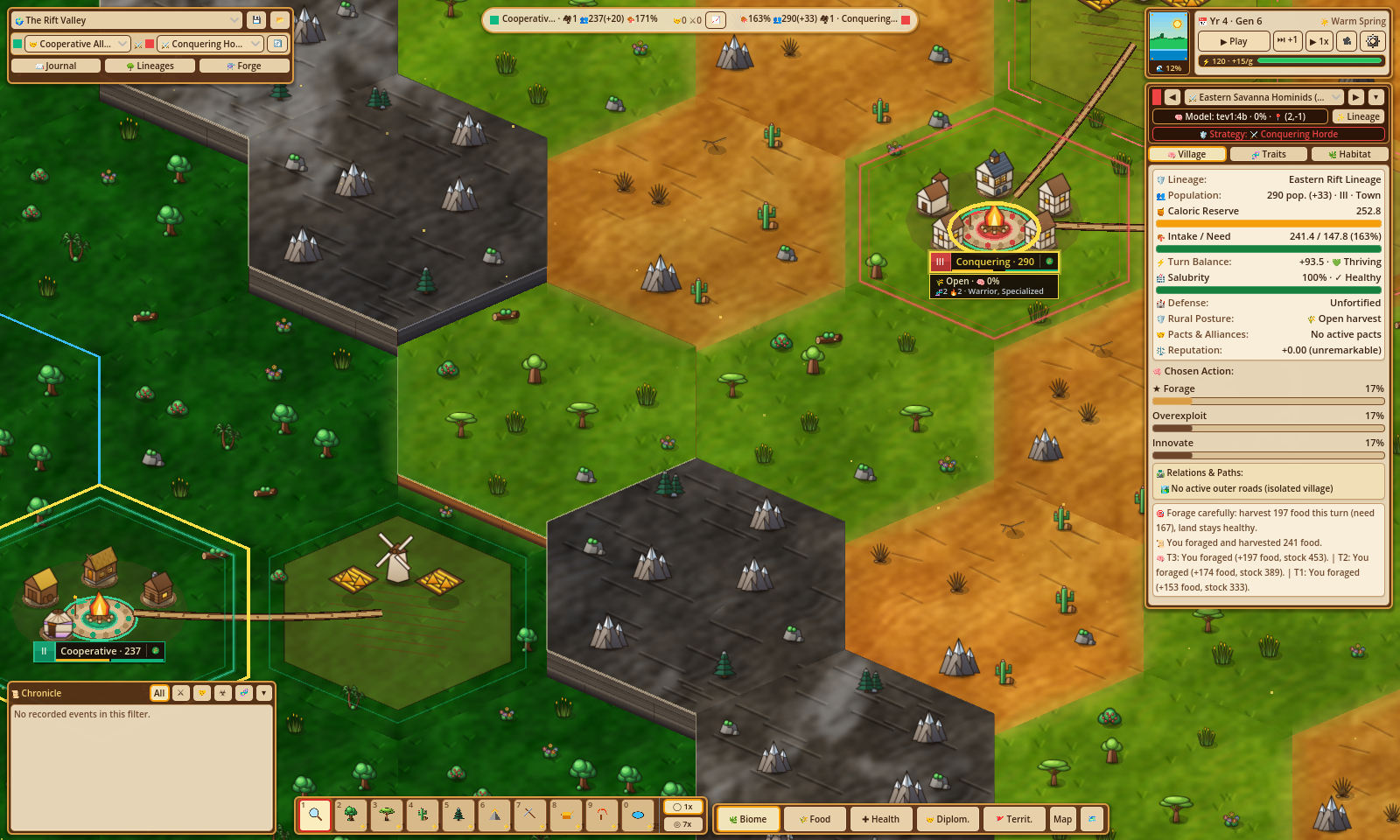
Evolution is an interactive bio-cultural and evolutionary population simulator built with Godot 4.7, featuring a high-DPI 2.5D illustrated isometric hexagonal ecosystem (169 hexes, map_radius = 7) powered by a GPU ocean wave shader (ocean_waves.gdshader) and procedural #23150c ink-outlined artwork (v4_readability).
Rather than commanding individual units directly, you act as the Selective Pressure and Evolutionary Architect—configuring 1v1 Evolutionary Strategy Duels (Strategy A ⚔️ Strategy B) before pressing Play, forging custom strategies and traits, and shaping climates, terrain altitude, sea levels, and habitat carrying capacity ($K$)—while single-deme-per-hex subpopulations (demes) autonomously choose both a rural defense posture and a concrete targeted action, cultivate adjacent rural hinterlands (crops and pasture), manage urban salubrity (salubrity), erect hex-edge perimeter fortifications, unite into multi-hex walled conurbations (urban_hex_ids, up to 3 districts), innovate, or diverge into new species.
Key Features
1. 1v1 Evolutionary Strategy Duels (Strategy A ⚔️ Strategy B)
Before launching a simulation at Generation 0, you choose which two Evolutionary Strategies (EvoTypes.StrategyDef) will face off across the 169-hex valley—or forge your own in the Evolutionary Laboratory (persisted automatically to ~/.config/Evolution/user_catalog.json). Each strategy bundles compatible biological adaptations, cultural traditions, and a natural-language Doctrine, imbuing its founding lineage and daughter settlements with a distinct emblem, color identity, faction slot (A / B), and combined 6-axis biophysical footprint:
| Strategy ID | Emblem & Name (EN / ES) | Color | Bundled Traits (bio-* + cul-*) |
Evolutionary Philosophy |
|---|---|---|---|---|
strat-cooperation |
🤝 Cooperative Alliance Alianza Cooperativa |
#10B981 |
bio-k-strategy, bio-social-instinct + cul-communal-conservation |
Fosters social cohesion, communal habitat conservation, sanitation, and formal alliance pacts. |
strat-expansion |
🧭 Expansionist Pioneers Pioneros Expansionistas |
#3B82F6 |
bio-r-strategy, bio-thermal-tolerance, bio-social-instinct + cul-fire-processing |
Fast reproduction, high mobility, and thermal tolerance to colonize new corridors and territories. |
strat-trade |
⚖️ Merchant League Liga Mercantil |
#F59E0B |
bio-k-strategy, bio-encephalization + cul-interdeme-barter |
Drives inter-village barter, commercial symbiosis, trust building, and horizontal cultural diffusion. |
strat-war |
⚔️ Conquering Horde Horda Conquistadora |
#EF4444 |
bio-r-strategy, bio-social-instinct + cul-warrior-expansion, cul-extraction-tools |
Aggressive martial expansion, border raids, tribute coercion, and intensive extraction to dominate rival territories. |
strat-innovation |
🔬 Innovator Technocrats Tecnócratas Innovadores |
#A855F7 |
bio-encephalization, bio-digestive-spec + cul-fire-processing, cul-extraction-tools |
High encephalization, thermal food processing, and specialized extraction toolkits to accelerate cultural innovation. |
2. Single-Deme-Per-Hex Ecology, 4-Tier Urbanism, Rural Postures & Salubrity
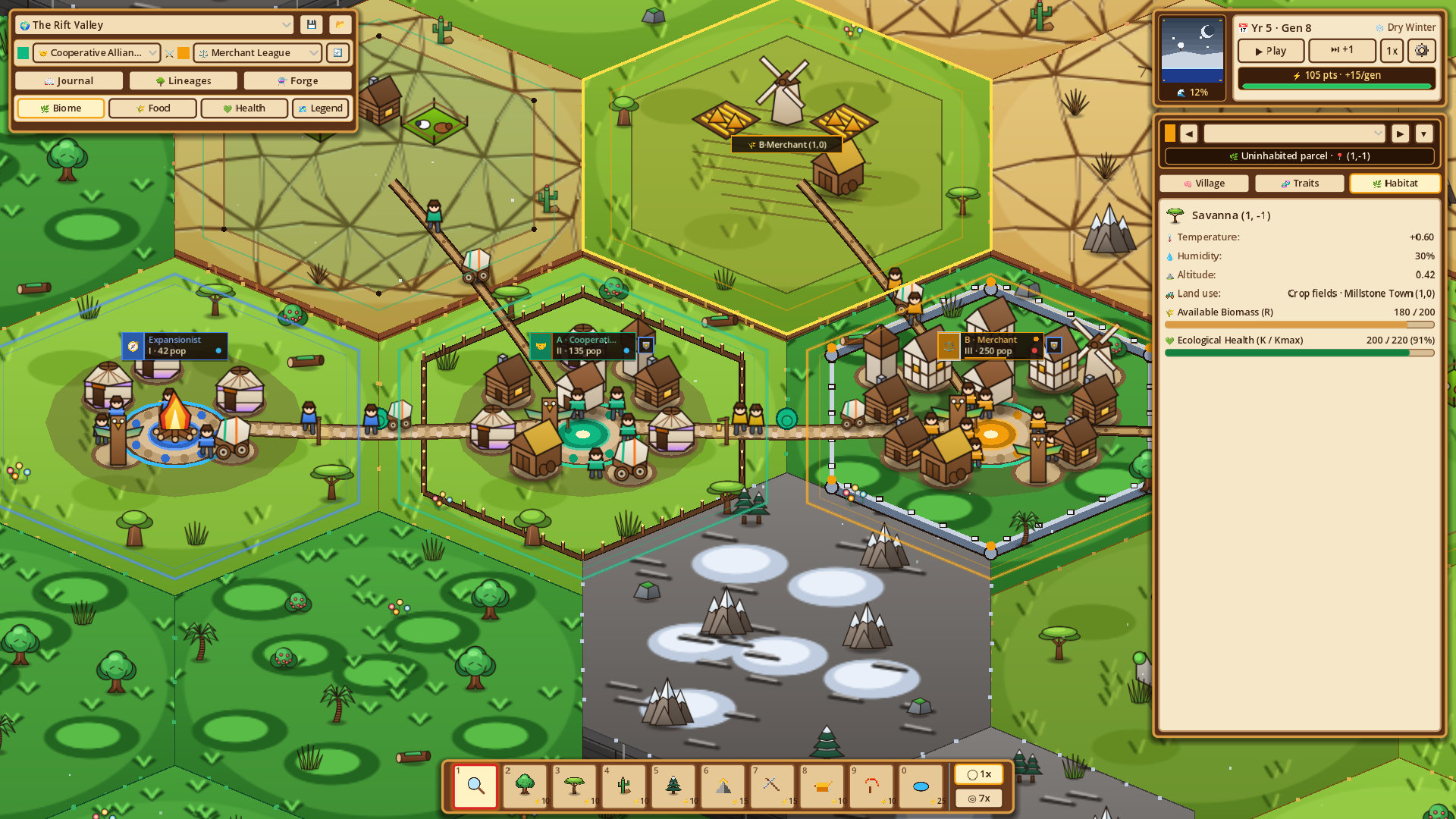
Every scenario operates on a 169-hex (map_radius = 7, HEX_SIZE = 240.0) pointy-top axial grid where each inhabited hex belongs to a single settlement (cell.deme_ids.size() <= 1), while unified cities can span up to 3 contiguous urban districts (urban_hex_ids). All trade, cooperation, raids, wars, and synoecism occur across perimeter hex edges:
- 4-Tier Urban Hierarchy (
I..IV—Deme.get_village_tier()):I · Camp / Campamento(tier == 1): Nomadic frontier camp (population < 120,defense_tier == 0) with thatched huts (hut_thatch) and central campfires (campfire); relies entirely on local hex foraging (URBAN_FORAGE_MULT = 1.0).II · Village / Aldea(tier == 2): Settled village (population >= 120ordefense_tier >= 1) with clay houses (house_clay), granaries (granary), and watchtowers (watchtower); claims up to1adjacent rural hinterland hex (URBAN_FORAGE_MULT = 0.90).III · Town / Villa(tier == 3): Urbanized town (population >= 240, or>= 170with fortifications or prior absorption) with stone houses (house_stone), temple totems (temple_totem), and windmills (windmill); local wild foraging drops (URBAN_FORAGE_MULT = 0.65) while rural capacity grows to2adjacent hinterland hexes.IV · Metropolis / Metrópolis(tier == 4): Monumental walled city (population >= 380, or>= 280withdefense_tier >= 2,merged_count >= 1, or multi-hex unionis_multi_hex()) crowned by a citadel keep (citadel_keep) and cathedral (cathedral); local wild foraging drops to0.40while the city cultivates up to4adjacent rural hinterland hexes (plus+1bonus rural slot per extra urban district).
- Rural Hinterlands (
crops&pasture), Defense Postures & 3-Turn Ruins (ruin_turns):- Tier II–IV settlements automatically claim adjacent uninhabited passable hexes, converting fertile biomes into wheat fields (
crops,crop_field,windmill) and arid/tundra biomes into livestock pastures (pasture,pasture_pen) connected by rural farm tracks with animatedcovered_wagons. - Every turn, each settlement selects a Rural Defense Posture (
DEFENSE_POSTURES) alongside its main action:open_harvest(100%harvest,25%rural militia,0%crop shield),patrol_fields(90%harvest,55%rural militia,65%crop shield, places rural watchtowers), ormobilized_garrison(78%harvest,80%rural militia,85%crop shield). - Unprotected or overwhelmed rural fields pillaged during raids lose up to
26.0biomass and are scorched into 3-turn persistent stone ruins (ruin_turns = 3,has_ruins = true) before recovering for re-cultivation.
- Tier II–IV settlements automatically claim adjacent uninhabited passable hexes, converting fertile biomes into wheat fields (
- Urban Salubrity, Epidemic Contagion & Post-Epidemic Immunity (
EvoEpidemicSalubrity):- High urban crowding (
pop / eff_K + 0.12 * max(0, tier - 2)) and warm humid climates degradesalubrity([0.05, 1.0]), whereascul-communal-conservation(+0.20) andbio-k-strategy(+0.14) bolster public health. - When
salubrity < 0.38withpopulation >= 130, an Urban Epidemic Outbreak ("epidemic") can erupt (15%initial mortality,infection_turns = 2). Infected cities suffer6%mortality per turn and spread contagion ("epidemic_spread") across active pacts and trade/raid/war contacts to susceptible neighbors (salubrity < 0.70,pop >= 40,8%mortality), before recovering with 6 turns of temporary immunity (immunity_turns = 6) and+0.25salubrity ("epidemic_recovered").
- High urban crowding (
3. Authentic Evolutionary, Geopolitical & Dual Synoecism Dynamics
The simulation cleanly separates neural agency (each settlement chooses both a defense posture and a concrete targeted action evaluated by Ollama /v1/systemone) from biophysical consequence (deterministic laws of energy conservation, carrying capacity $K$, metabolic cost, combat odds, and demography):
- $r/K$ Selection Trade-offs & The Baldwin Effect: Prolific density-dependent growth and lower settling thresholds (
bio-r-strategy, min pop65) vs. high-longevity carrying-capacity buffering, sanitation (+0.14), and20%fortification cost discounts (bio-k-strategy, min pop145; default105). Sustained non-foraging behavioral selection (baldwin_counters >= 8) consolidates into heritable biological adaptations. - Dual Inheritance & Complementary Trade (
trade): Populations with cognitive or social capacity (bio-encephalizationorbio-social-instinct) unlock cumulative cultural innovation (6emergent archetypes: Agrarian, Wayfinder, Masonry, Mercantile, Martial, Agroforestry) and horizontal cultural diffusion across trade routes—earning100%mutual or55%(75%if allied) unreciprocated trade surplus (0.18 * volume * complementarity * barter_mult, boosted up to1.6xacross distinct biomes/cultures and1.45xwithcul-interdeme-barter) while building bilateral trust. - Hex-Edge Perimeter Fortifications (
fortify,defense_tier: 0..3): Settlements invest food reserves ([20, 40, 65]) and local hex biomass ([12, 22, 32], with a20%discount forbio-k-strategyorcul-communal-conservation) to erect 2.5D hex-edge perimeter walls: Lv.1 Palisade (+50%defense /25%loot shield), Lv.2 Stone Wall (+100%defense /50%loot shield), and Lv.3 Castle (+160%defense /75%loot shield, immune to direct non-surprise city raids). - Emergent Geopolitics (
offer_pact,accept_pact,aid,demand_tribute,pay_tribute,raid,betray,conquer):- Neighboring demes forge Alliance Pacts (
+12%harvest per active pact up to1.36xand flanking defense), send Surplus Aid (+0.25trust,+0.05reputation), and issue Tribute Ultimatums (25%reserves clamped[8, 40]for a 3-turn truce, or trigger an immediate punitive raid upon refusal). - Rivals launch Plunder Raids (
45%troops)—including distance-2 border-field raids against exposed rural parcels—break treaties via Betrayal (betray,8-turn feud,-0.50global reputation,-1.00trust), repel Fortified Sieges (siege), and wage Wars of Conquest (conquer,55%troops,COMBAT_EXPONENT = 2.5). Defeated single-hex defenders retreat to an adjacent empty passable hex or are partially absorbed (1/3population), while multi-hex cities lose only the conquered district and revalidate contiguity.
- Neighboring demes forge Alliance Pacts (
- Dual Synoecism Architecture (
unite/accept_union):- Continuous Multi-Hex Walled Unions (
urban_hex_ids, up to3districts): When two established pact allies (pact_turns >= 3) both at Tier $\ge 2$ unite within the3-hex urban cap, they fuse into a single multi-hexDeme, upgrading perimeter defenses (defense_tier >= 2), culling shared internal wall edges along their adjoining border, linking plazas with a golden"merge"avenue, and combining their urban districts and rural quotas. - Asymmetric Category Absorption: When one partner is Tier I (
max(tier) >= 2) or combining would exceed3urban hexes, the lower-tier settlement is absorbed into the host city—merging population, traits, and up tostorage_capreserves, permanently enriching host $K$ by+20.0, and converting vacated adjacent hexes into cultivated"crops"or"pasture"hinterlands.
- Continuous Multi-Hex Walled Unions (
- Colonization Corridors & Allopatric Speciation: Settlements expand across 2–3 hop passable colonization corridors (
-m<gen>) and diverge via allopatric speciation after>= 10turns of geographic isolation from their lineage anchor, spawning child species inlineage_treewhile retaining their foundingstrategy_id.
4. Dual-Question System 1 Engine, Live KPI Chart, 5 Map Lenses & 2.5D Illustrated World
- Dual-Question System 1 Payoff-Forecast Agency (
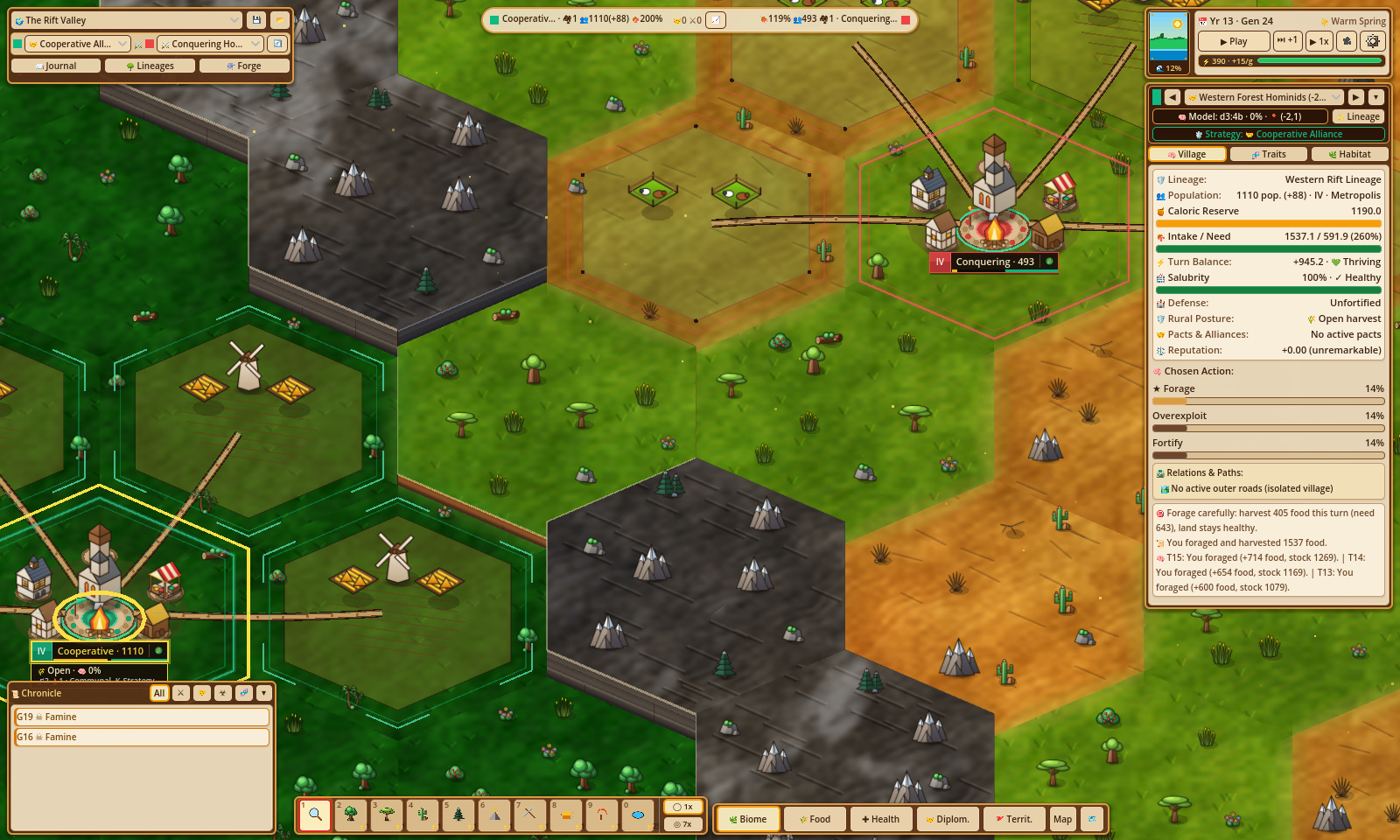
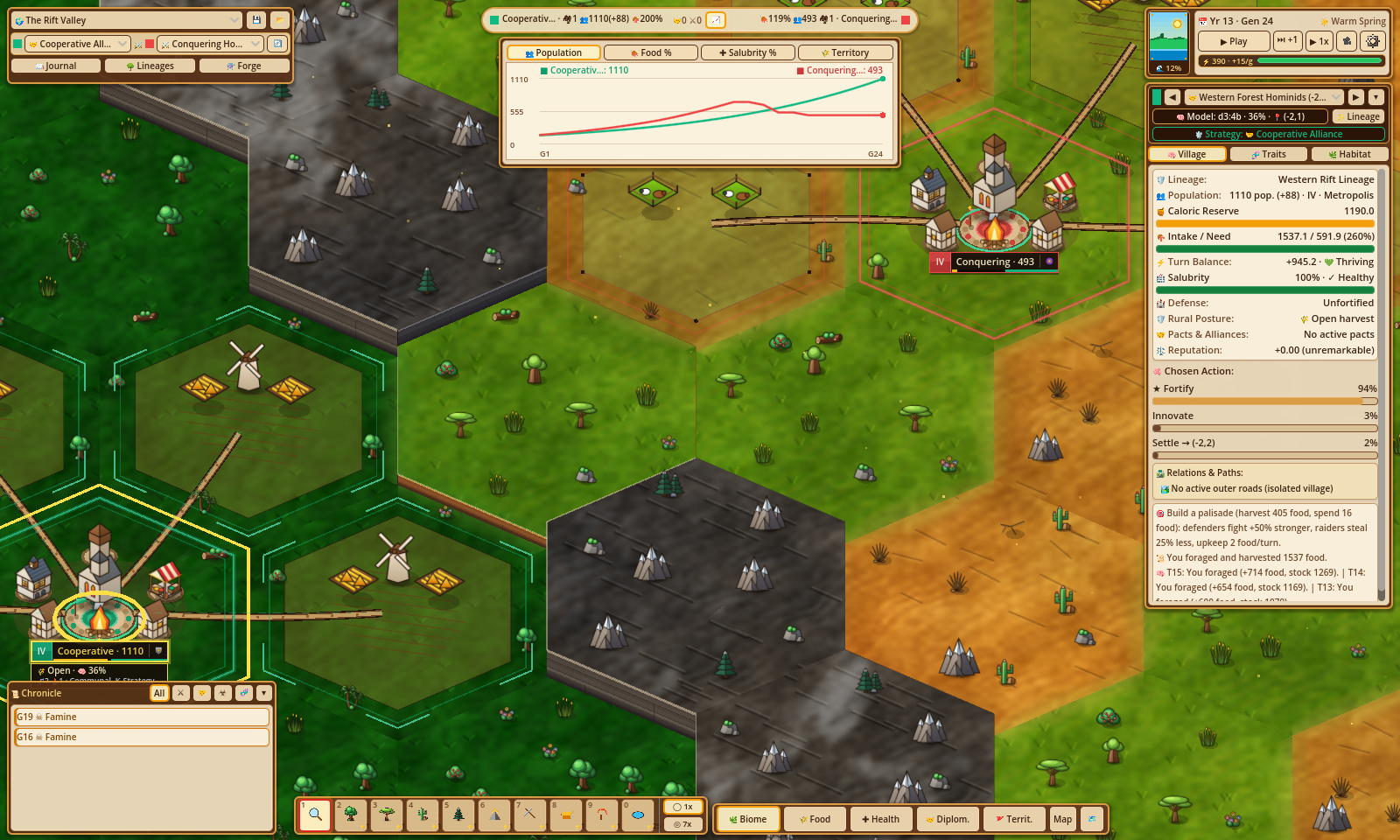
d3:4b&tev1:4bvia Ollama/v1/systemone): Every generation, each settlement builds a feasible menu of6–14concrete, target-bound actions (EvoActionMenu.build) across 16 action types (forage,intensify,fortify,innovate,settle,trade,aid,offer_pact,accept_pact,demand_tribute,pay_tribute,raid,betray,conquer,unite,accept_union). Each option'scriterionis its quantified expected outcome (EvoOutcomeForecast.describe), paired with a structured Situation Report (EvoSituationReport.build: vital/salubrity alerts, active traits, tactical horizons, neighbor threats, colonization corridors, last outcome, and 12-event episodic memory)./v1/systemoneevaluates bothquestions.posture(3 defense postures) andquestions.decision(action menu) concurrently on aWorkerThreadPool(MAX_CONCURRENT_JOBS = 4), andEvoActionPolicysamples stochastically atT = 0.45with zero heuristic blending. - 5 Analytical Map Lenses & Live Strategy KPI History Chart: Cycle across 5 lenses (
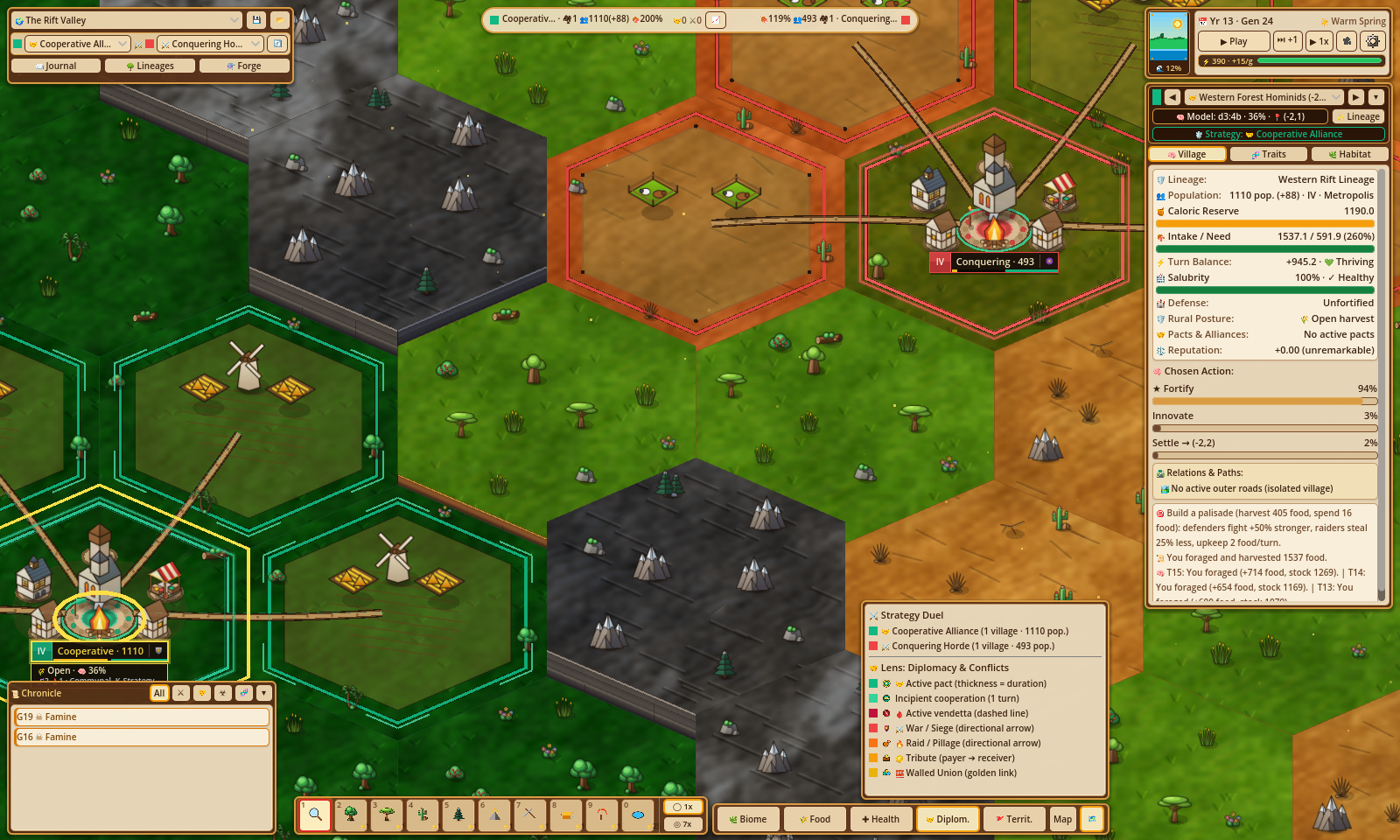
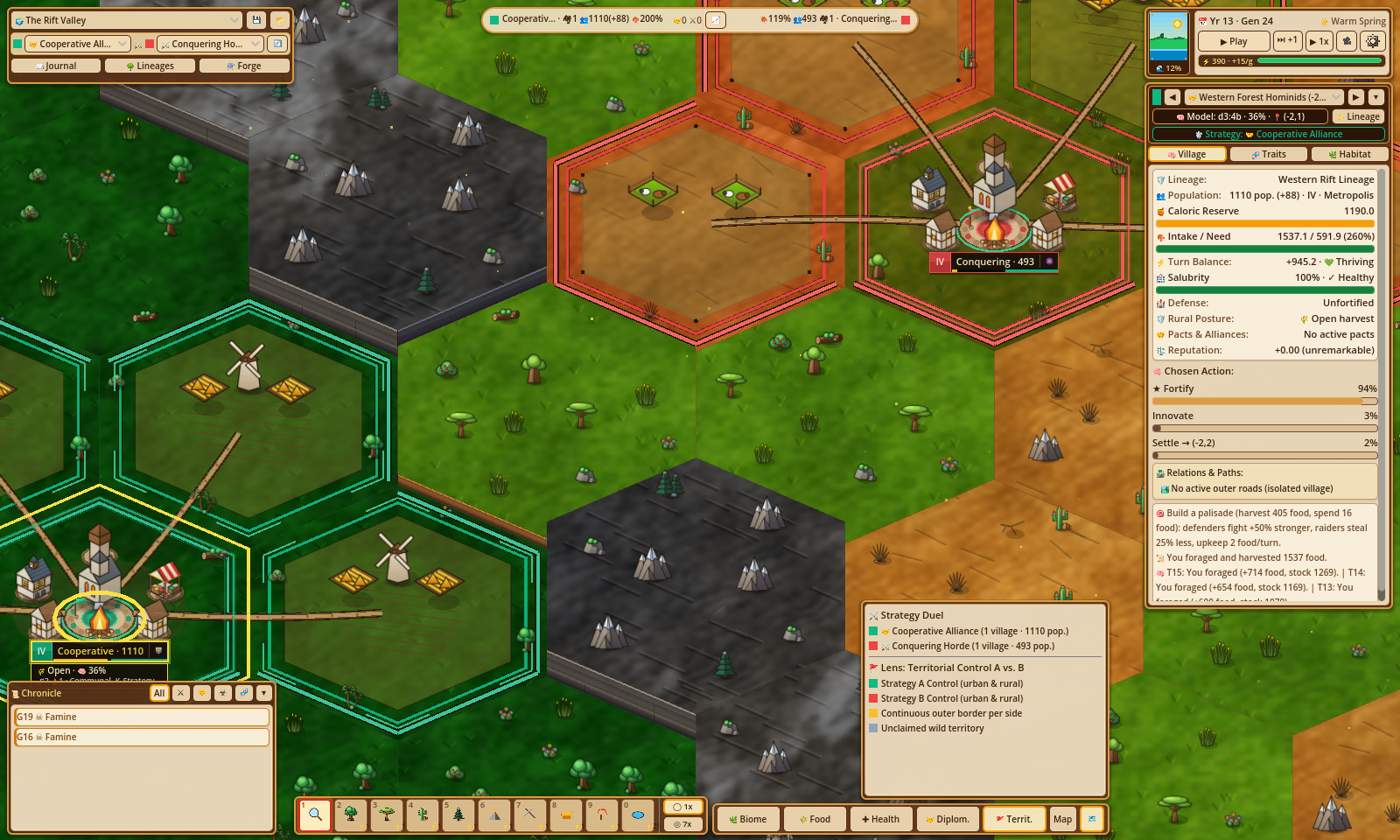
Tab):🌿 Biome,🌾 Food,✚ Health,🤝 Diplom.(Diplomacy & Conflicts), and🚩 Territ.(Territorial Control A vs. B). Track live Strategy A vs. Strategy B villages, population, food adequacy%, average salubrity%, and rural territory in the top-center Stats Strip & Collapsible History Chart (📈), alongside the bottom-left Live Chronicle Feed and animated Event Replay FX. - 2.5D High-DPI Illustrated Presentation: Renders an animated GPU ocean backdrop (
ocean_waves.gdshader), 10-tier 2.5D cliff extrusions,256×224illustrated biome hex tiles,128×128–160×160isometric buildings, flora, and fortifications with#23150cink outlines and mipmapped linear filtering (TEXTURE_FILTER_LINEAR_WITH_MIPMAPS), and a locked-yaw (0.0°) 2.5D camera (EvoCameraController).
Strategy KPI History Chart (📈) |
Diplomacy & Conflicts Lens (🤝 Diplom.) |
Territorial Control Lens (🚩 Territ.) |
|---|---|---|
 |
 |
 |
5. Standardized 6-Axis Biophysical Vector & Thermodynamic Conservation
Every biological trait, cultural tradition, and action reference maps to a bounded 6-axis vector (metabolic_cost, extraction_efficiency, ecological_impact, spatial_mobility, social_cohesion in $[-1, +1]$, and transmission_threshold in $[0, +1]$). No trait can violate thermodynamic conservation: positive advantages beyond BASE_BUDGET = 0.60 strictly require commensurate metabolic or ecological costs ($C_{\text{curr}} \ge 0.50 \cdot (A^+ - 0.60)$).
Scientific Scenarios & 1v1 World Presets (169 Hexes, map_radius = 7)
Every scenario initializes a balanced 1v1 Evolutionary Strategy Duel (Strategy A vs. Strategy B, defaulting to strat-cooperation 🤝 vs. strat-war ⚔️) across a 169-hex (map_radius = 7) world that can be customized at Generation 0 from the top HUD matchup bar:
The Rift Valley (preset-rift-savanna)
A tectonic mountain ridge (q = 0, altitude = 0.88, pierced by three savanna mountain passes at (0, -3), (0, 0), and (0, 3)) divides a lush western tropical rainforest (77 hexes) from a drying eastern savanna-steppe mosaic (77 hexes). Western Forest Hominids (deme-rift-west at (-2, 1), Strategy A, pop = 140) face off against Eastern Savanna Hominids (deme-rift-east at (2, -1), Strategy B, pop = 140).
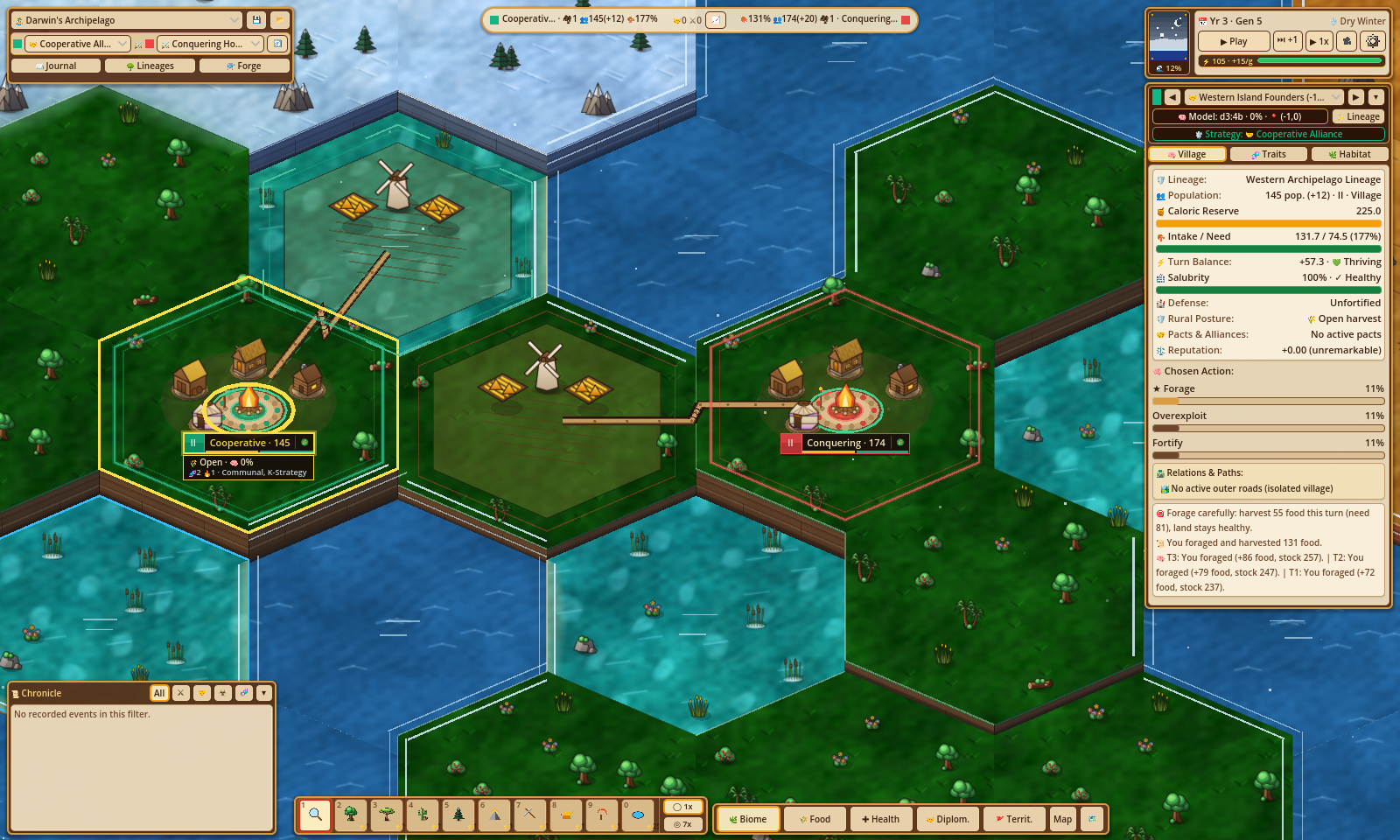
Darwin's Archipelago (preset-darwin-archipelago)
Volcanic islands linked by 7 shallow intertidal land bridges (0,-1, 0,1, 2,0, -2,1, 0,-4, 0,4, 4,-1) that periodically emerge and flood with 8-generation glacial sea-level cycles (0.12 $\leftrightarrow$ 0.25). Two rival island founders—Western Island Founders (deme-darwin-founder at (-1, 0), Strategy A, pop = 95) and Eastern Island Rivals (deme-darwin-rival at (1, 0), Strategy B, pop = 95)—race across temporary land bridges during low tides and undergo allopatric speciation when rising seas isolate colonies across northern tundra, southern rainforest, and eastern steppe islands.
The Finite Island (preset-finite-island)
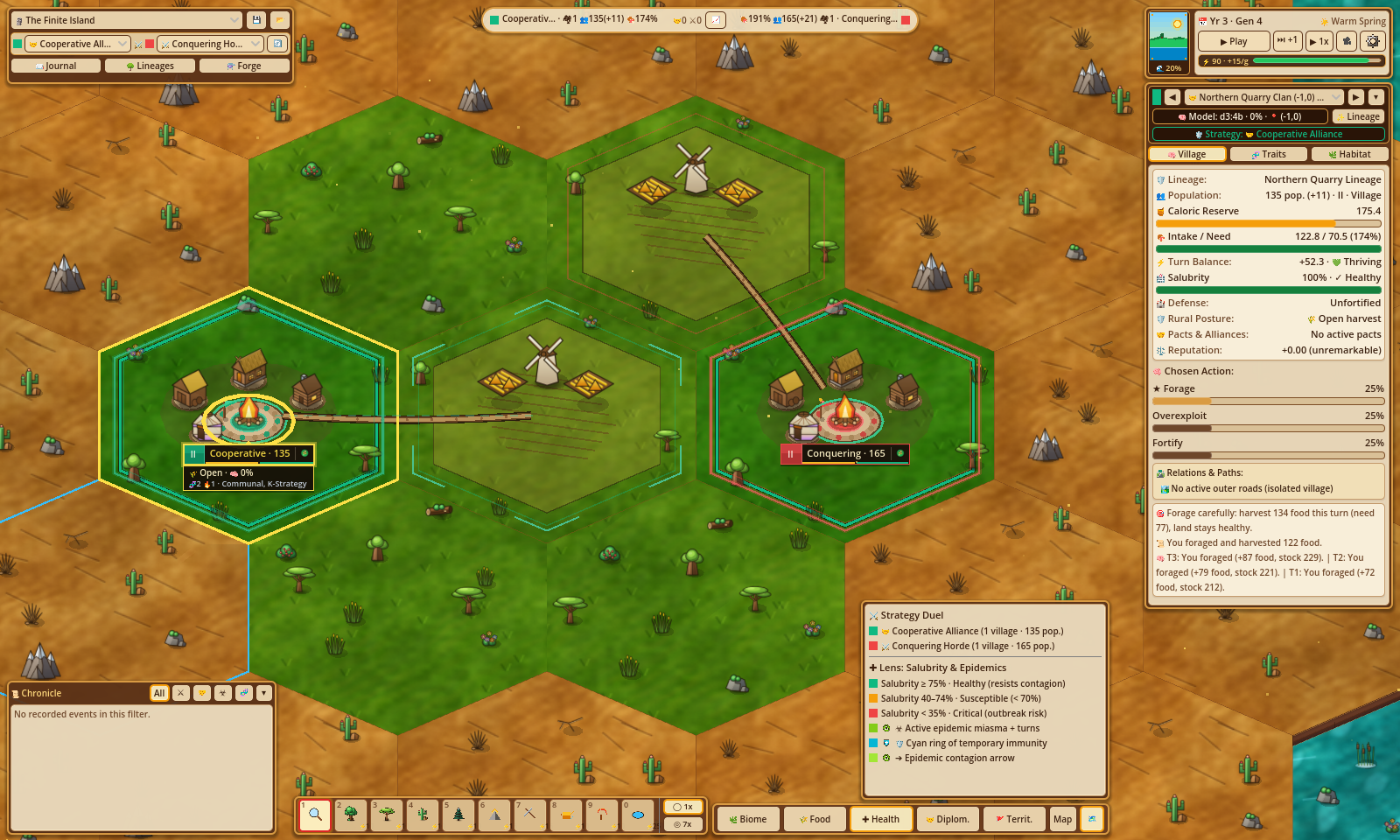
A fertile but geographically bounded island surrounded by deep ocean where two competing clans—Northern Quarry Clan (deme-island-1 at (-1, 0), Strategy A, pop = 95) and Southern Timber Clan (deme-island-2 at (1, 0), Strategy B, pop = 95)—share a fragile savanna core ($d \le 1$, $r_{\text{regen}} = 0.08$) encircled by arid steppe ($2 \le d \le 3$) and coastal shallows ($d = 4$). Without communal conservation norms and sustainable hinterland management, intensive overexploitation and conflict degrade carrying capacity $K$ below $60%$ of $K_{\max}$ and trigger the Tragedy of the Commons.
Interactive Modals & Analytical Tools
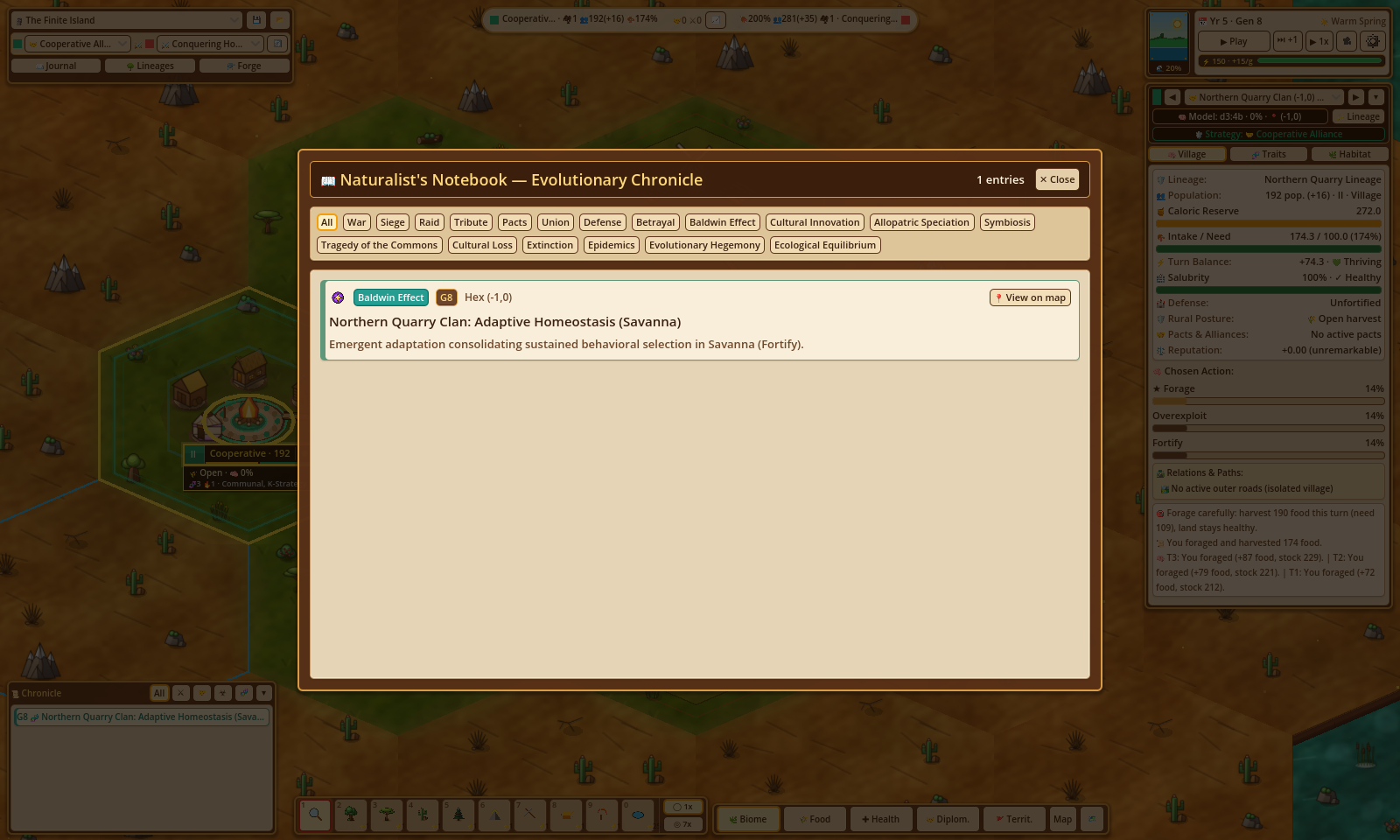
Naturalist's Notebook — Evolutionary Chronicle
Tracks every evolutionary, demographic, health, and geopolitical milestone (Wars, Sieges, Plunder Raids, Tributes, Alliance Pacts, Settlement Unifications, Fortifications, Betrayals, Baldwin Effect, Cultural Innovation, Allopatric Speciation, Symbiosis, Tragedy of the Commons, Cultural Loss, Extinction, Urban Epidemics, Evolutionary Hegemony, and Dynamic Equilibrium) across 19 category filters with one-click camera jumps to the exact hexagon where the event occurred.
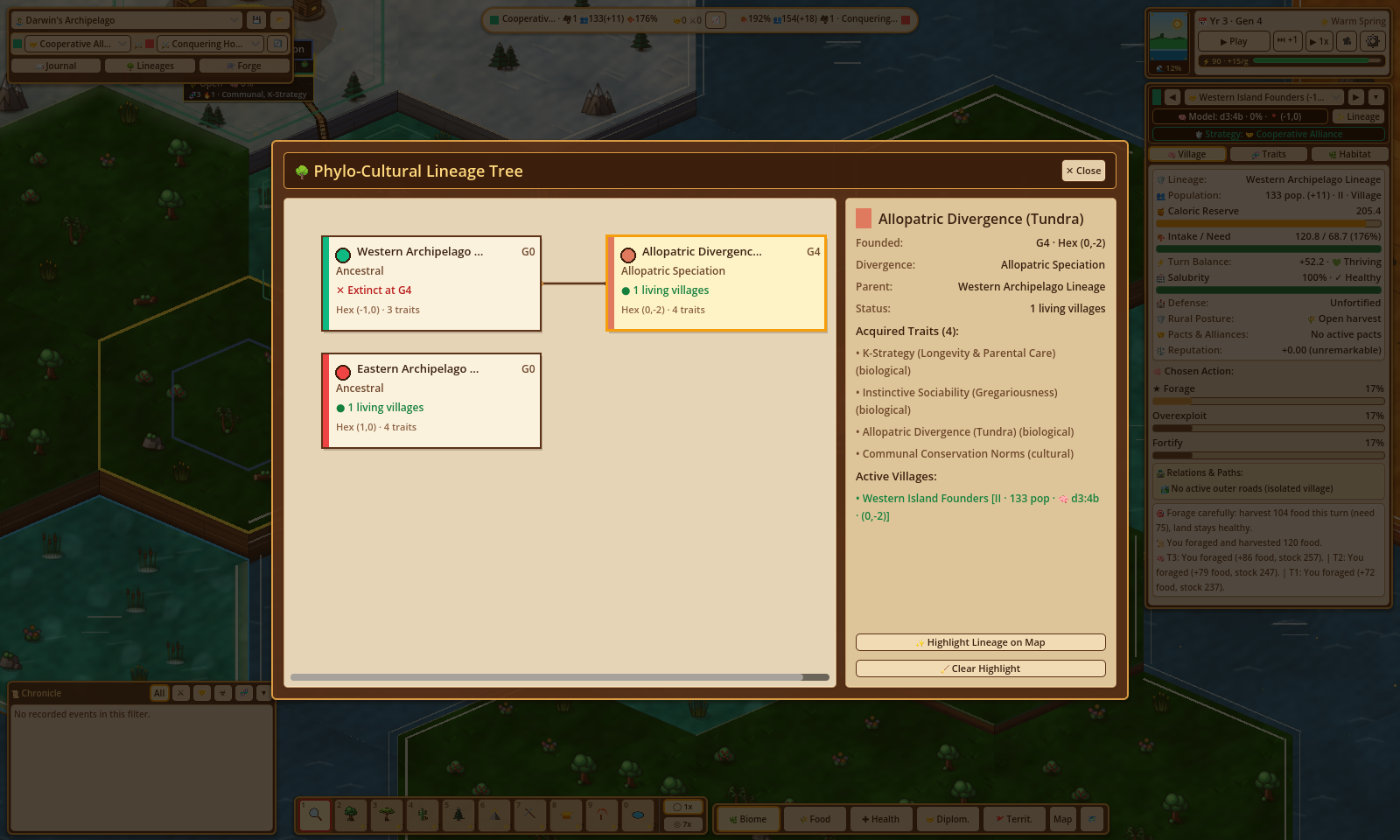
Phylo-Cultural Lineage Tree
Visualizes ancestral and diverged lineages, founding and extinction generations, inherited strategy_id, acquired biological and cultural traits, and active settlements (I–IV), with interactive map lineage highlighting.
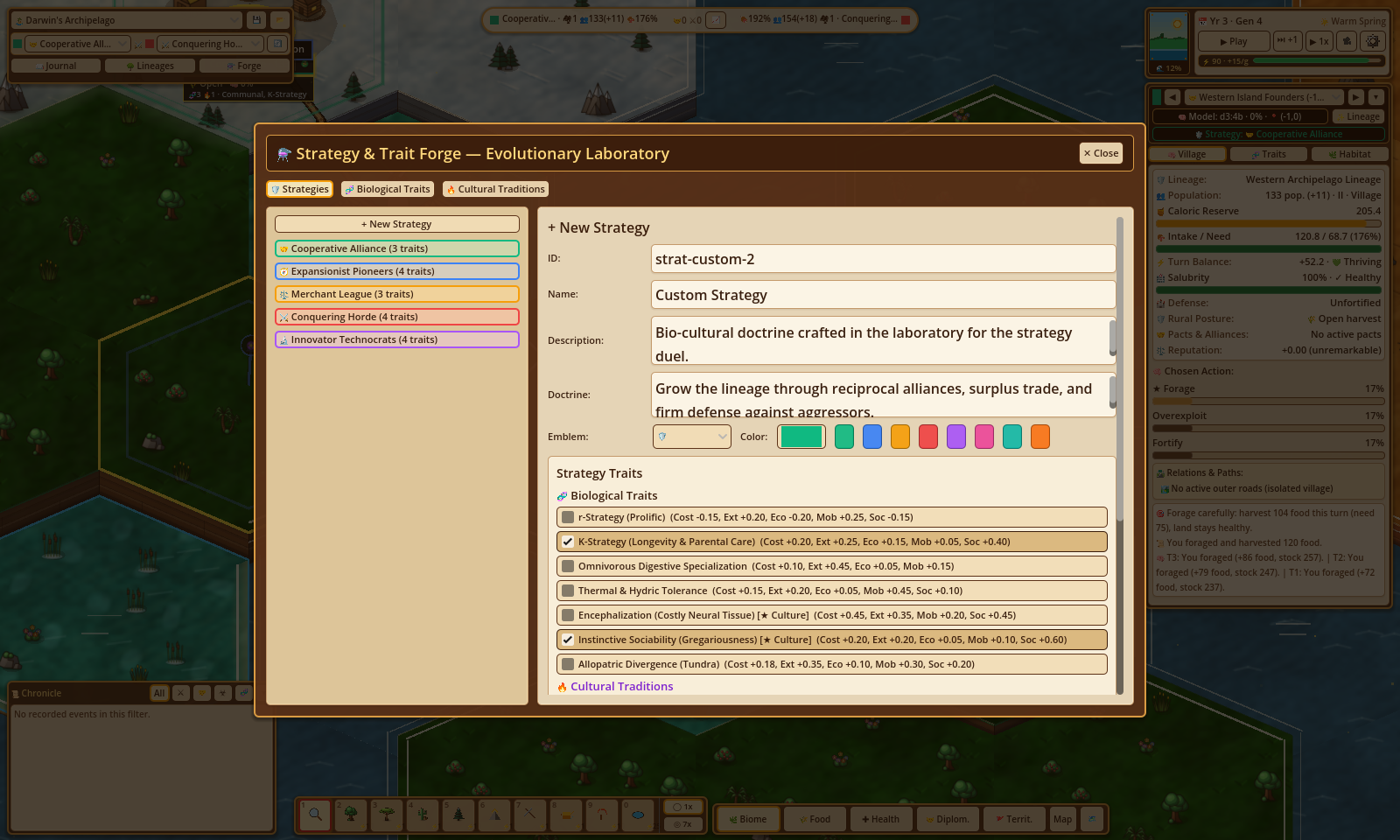
Strategy & Trait Forge — Evolutionary Laboratory
An open 3-tab catalog editor (🛡️ Strategies, 🧬 Biological Traits, and 🔥 Cultural Traditions) to inspect, tweak, or craft new traits and custom evolutionary strategies—complete with an editable natural-language Strategy Doctrine, a live Thermodynamic Balance Meter, combined 6-axis footprint preview, one-click assignment to Strategy A / Strategy B, direct trait injection into any active settlement, and automatic persistence to ~/.config/Evolution/user_catalog.json.
Controls & God-Mode Hotbar
| Input / Shortcut | Action |
|---|---|
| Left Click | Select settlement or hex (Inspect mode) / Apply active terrain or climate brush (1x or 7x radius) |
| W / A / S / D, Arrows, or Middle Drag | Pan camera across the 169-hex 2.5D valley (820 px/s; left-drag also pans in Inspect mode) |
| R or Right / Shift+Left / Alt+Left Drag | Tilt camera pitch ($28^\circ\text{–}75^\circ$, R tilts $+8^\circ$, horizontal yaw locked at $0^\circ$) |
| Mouse Wheel or + / - | Cursor-pivoted zoom (0.12x macro archipelago view to 3.00x settlement close-up) |
| F / Home | F (or 0 in camera): fit full map; Home: reset camera to default angle and zoom |
| Tab | Cycle across all 5 Map Lenses (Biome $\to$ Food $\to$ Health $\to$ Diplomacy $\to$ Territory) |
| Space | Toggle Play / Pause generational simulation (0.5x = 4.0s, 1x = 2.0s, 3x = 0.6s) |
Keys 1 – 0 |
Equip slot from the 10-slot bottom Hotbar (1: Inspect, 2–5: Biome Brushes, 6–7: Raise/Lower Altitude, 8–9: Enrich/Deplete $K$, 0: Sea Level & Tidal Bar) |
| Escape | Close active popup/modal or return to the Inspect tool |
Installation & Getting Started
Prerequisites
- Ollama (Required) running locally on
http://127.0.0.1:11434with System 1 decision models (d3:4b,tev1:4bby default, or any model reporting the"decision"capability in/api/tags). Because Evolution exclusively studies neural decision-model behavior, if Ollama is offline at startup, a blocking warning modal prevents the simulation from starting and exits when dismissed (or offers automated model download when models are missing).
Prebuilt Release Binaries
Download the latest release for your operating system from the GitHub Releases page:
Linux (x86_64)
- Download
evolution-linux-x86_64.tar.gz. - Extract the archive and run the executable:
tar -xzf evolution-linux-x86_64.tar.gz
chmod +x evolution-linux-x86_64
./evolution-linux-x86_64
Windows (x86_64)
- Download
evolution-windows-x86_64.zip. - Extract the
.ziparchive to any folder. - Double-click
evolution-windows-x86_64.exeto launch the simulator (if Windows SmartScreen appears, click More info → Run anyway).
macOS (Universal — Apple Silicon & Intel)
- Download
evolution-macos-universal.zip. - Double-click the
.zipfile to extractEvolution.app, and optionally move it to/Applications. - Because the bundle is unsigned, remove the macOS Gatekeeper quarantine attribute before launching for the first time (or Right-Click → Open):
xattr -dr com.apple.quarantine Evolution.app
open Evolution.app
Running from Source
Requires Godot Engine 4.7+ (4.7.2-stable recommended):
# Import project assets and launch the simulator
godot --path .
Running the Automated Test Suite
The repository includes a headless unit, cognitive, biophysical, and UI verification suite (4 test modules, 22 test cases, 614 assertions) covering 169-hex axial geometry, 6-axis thermodynamic conservation, /v1/systemone dual-question payloads, rural defense postures, 3-turn ruins, epidemic contagion/immunity, multi-hex walled cities (urban_hex_ids), stats history, i18n, and HUD/renderer integration:
godot --headless --path . --script res://tests/test_runner.gd
Regenerating Documentation Screenshots
To regenerate documentation screenshots in gh-pages/assets/img/:
godot --path . --script res://tests/test_visual_capture.gd
Project Structure
├── assets/                 # Themes and auto-cached high-DPI illustrated sprites (v4_readability)
├── gh-pages/               # MkDocs documentation & shared screenshots (ignored by Godot via .gdignore)
├── scenes/main.tscn        # Root scene entry point
├── src/
│   ├── main.gd             # EvoMainController: turn loop timer, async LLM polling, signal orchestration
│   ├── core/               # EvoTypes, 6-axis thermodynamics, 169-hex math, catalog, presets, i18n, settings
│   ├── engine/             # Turn engine, env/milestone phases, agency/ (action menu, forecast, report, policy), biophys/ (9 modules), cognitive/ (Ollama client)
│   ├── ui/                 # Field-journal HUD (hud/ top bar, stats strip, inspector, hotbar, live chronicle), and modals (Journal, Lineages, Forge)
│   └── world/              # 2.5D illustrated hex renderer, ocean_waves.gdshader, render/ (7 sub-renderers), sprites/ (4 generators), camera
└── tests/                  # Headless 4-suite test runner, standalone emergence probe, and visual capture script
Questions
What is Evolution?
arrase/Evolution is a public repo on GitHub by arrase. Interactive bio-cultural and evolutionary population simulator built with Godot, featuring an isometric hexagonal ecosystem, pixel-art aesthetic, and dual-frequency Ollama cognitive engine.
Is Evolution open source?
It declares no license on GitHub. Public does not mean open source: without a license, nobody is granted the right to reuse it.
Does Evolution run on macOS, Windows or Linux?
Its maker has not tagged a system, so it is unknown here. Its README says what it needs.
How do I install Evolution?
Open "Take it" on its page: Take My Repo writes an install plan for your machine and hands it to your AI agent (Claude Code, Codex or Cursor), which asks you before each step. Take My Repo has not tested it on any machine.
Is Evolution still maintained?
Its last change on GitHub was on 2026-11-16. Take My Repo does not judge from that whether it is maintained.