
PathFM
PathFM: Fast Generative Forecasting of Multivariate Trajectories
- 5
- 3 wk ago
Repo autogluon/PathFM, read from GitHub 8 h ago. autogluon has not joined Take My Repo.
In short
autogluon/PathFM is a public repo on GitHub by autogluon. PathFM: Fast Generative Forecasting of Multivariate Trajectories. It declares no license on GitHub. Public does not mean open source: without a license, nobody is granted the right to reuse it. It is written mainly in Jupyter Notebook, has 5 stars and last changed on 2026-11-01. Nobody has reviewed it on Take My Repo yet, which says nothing about its quality. Read from GitHub on 2026-11-22.
PathFM: Fast Generative Forecasting of Multivariate Trajectories
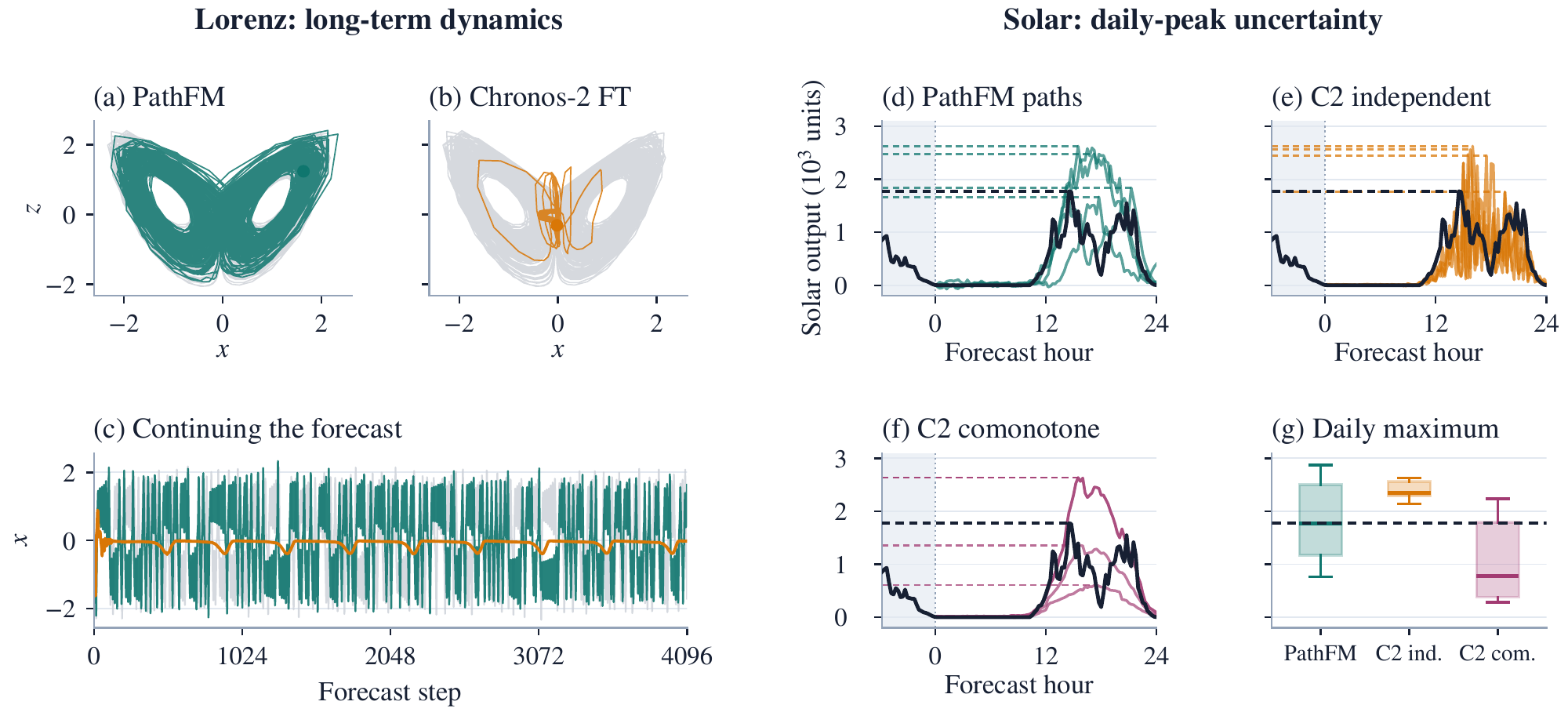
One forecast ensemble for many downstream questions. PathFM generates coherent multivariate futures that you can sample, summarize, and continue. Use the sampled paths to forecast cumulative demand, peak load, and autocorrelation, or explore the long-run behavior of a chaotic system.
Jiachen Yao, Xiyuan Zhang, Annan Yu, Boran Han, Abdul Fatir Ansari, Shuai Zhang, Michael Bohlke-Schneider, and Bernie Wang
California Institute of Technology · Amazon
Highlights
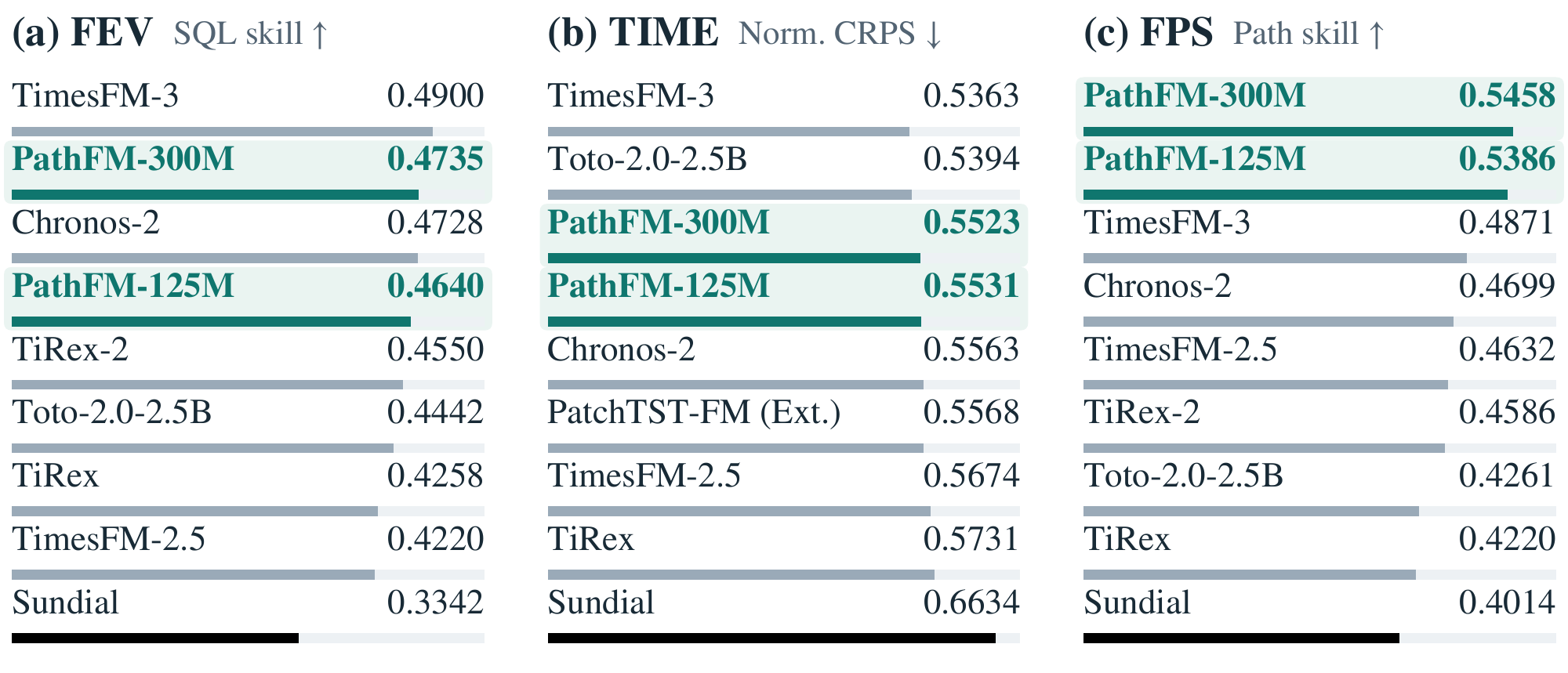
- Leading trajectory quality: the 125M and 300M general models achieve the two highest aggregate path scores on fps-bench.
- Fast ensemble generation: the 125M model generates 32 forecast paths in about 50 ms on an NVIDIA L4, using a single distilled sampling step.
- Strong marginal accuracy: PathFM-300M ranks 2nd on fev-bench and 3rd on TIME as of September 26, 2026.
- Sustained chaotic dynamics: specialized models combine accurate short-horizon predictions with long rollouts that retain variability and dynamical structure.
The Lorenz example shows a sampled PathFM rollout retaining the two-lobe structure and sustained variability. The solar example shows how temporal dependence changes the predicted daily maximum, even when marginal quantiles stay the same. Complete paths make these downstream distributions directly accessible.
Results
PathFM combines leading path quality with competitive marginal forecasting. Both general models outperform every evaluated external baseline on aggregate FPS skill.
Forecast Path Score Bench (fps-bench)
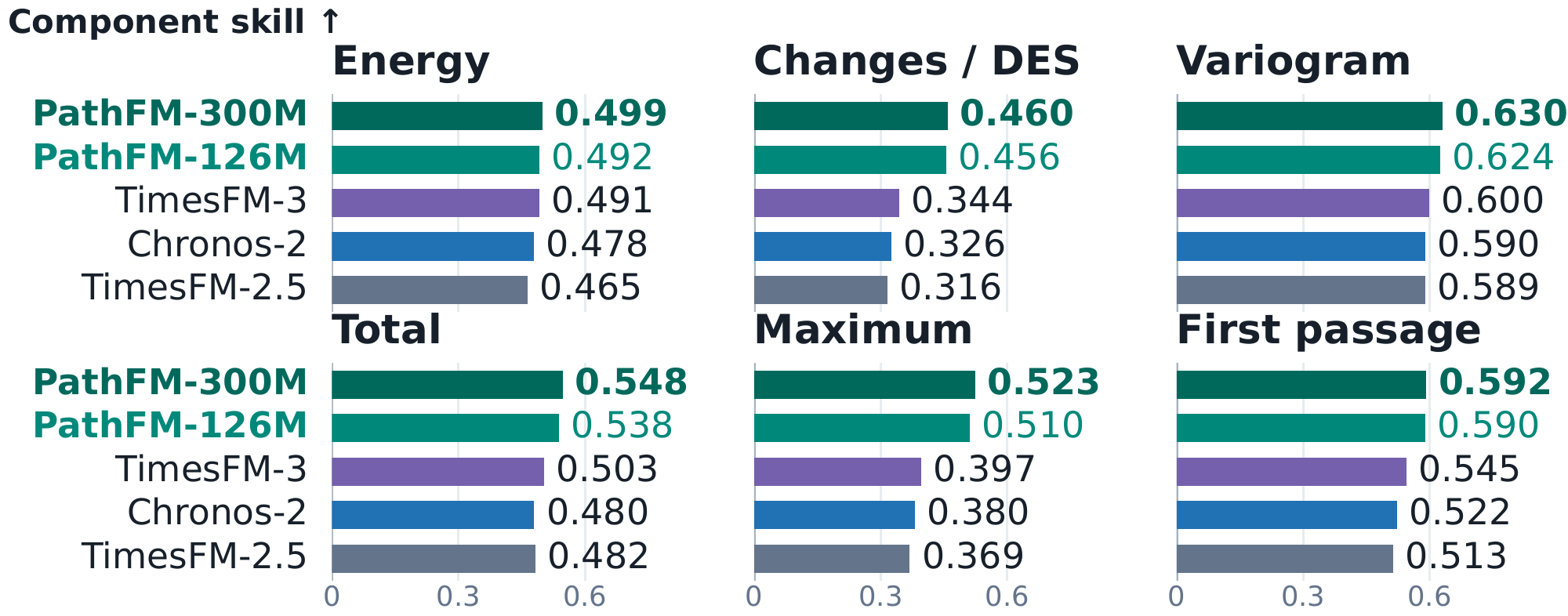
fps-bench evaluates what happens along a forecast path. It extends fev-bench with six complementary scores: energy score, differenced energy score, variogram score, and CRPS for horizon totals, maxima, and first-passage times. These scores assess temporal structure and uncertainty in quantities that matter for downstream decisions.
See the six path-score components
How it works
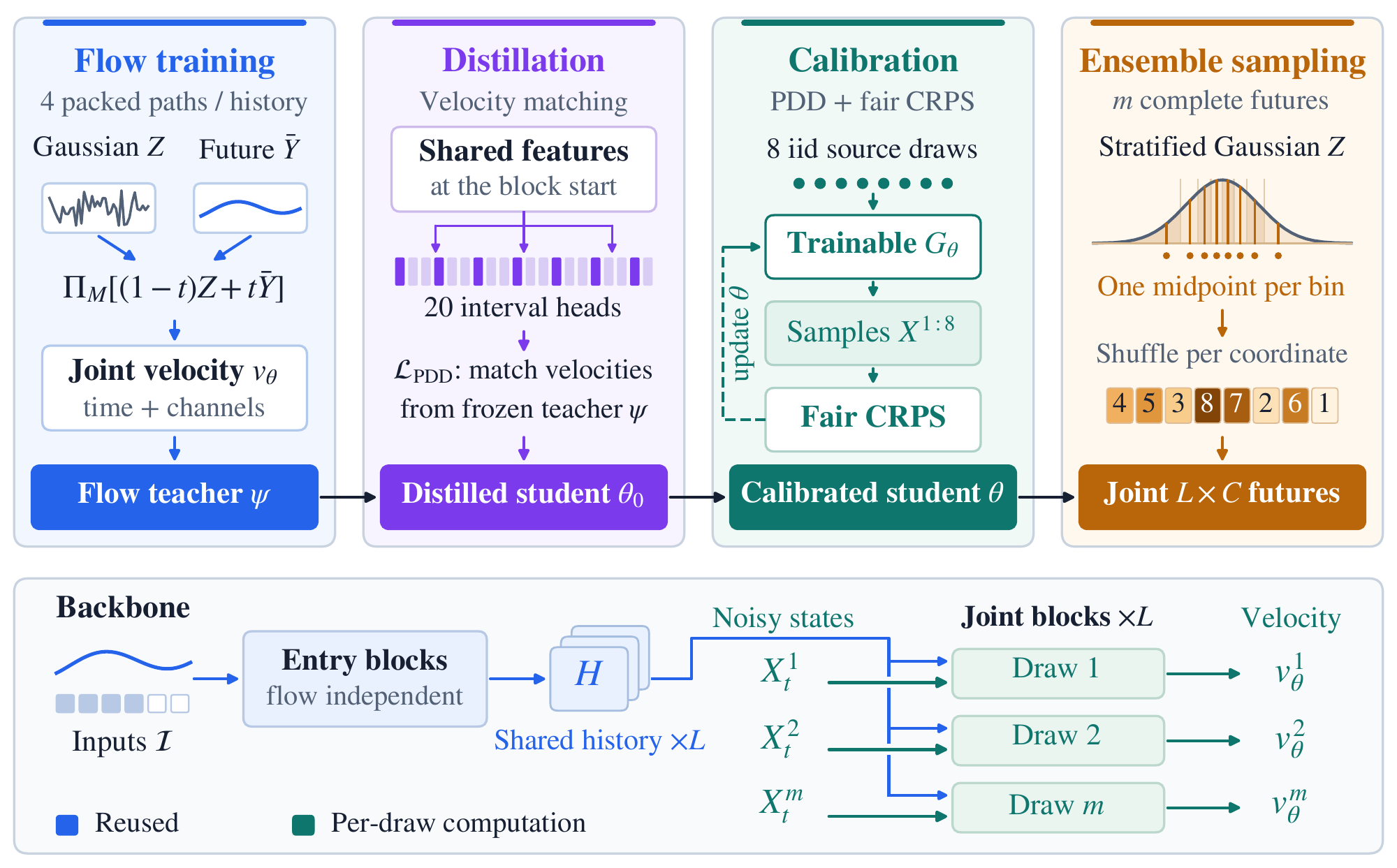
PathFM learns a conditional flow over complete future trajectories, coupling time steps and variables. We put efforts into making it fast, sample-efficient, and easy to use. Check out our paper!
Installation
Clone the repository and install with Python 3.11+:
git clone https://github.com/autogluon/PathFM.git
cd PathFM
pip install .
Models
| Model | Training context length | Native forecast | Hugging Face |
|---|---|---|---|
| PathFM-125M | Up to 8,192 steps | 480 steps | Weights |
| PathFM-300M | Up to 8,192 steps | 480 steps | Weights |
| PathFM-Chaotic-75M | 512 steps | 256 steps | Weights |
| PathFM-Chaotic-125M | 512 steps | 256 steps | Weights |
Pass a Hub model ID or a local weights folder to from_pretrained or --model.
Usage
predict_samples: sample paths up to 480 steps for general models or 256 for chaotic models.rollout: continue each sampled path independently for a longer horizon.predict_quantiles: return quantiles and point forecasts.
import torch
from pathfm import PathFMPipeline

torch.manual_seed(42)
model = PathFMPipeline.from_pretrained("autogluon/pathfm-125m", device="cuda")
context = torch.sin(torch.arange(512, dtype=torch.float32) / 10)[None, None, :]
paths = model.predict_samples(context, prediction_length=128)
quantiles, point = model.predict_quantiles(
    context, prediction_length=128, quantile_levels=[0.1, 0.5, 0.9],
)
forecast = model.rollout(context, prediction_length=960, num_samples=32, seed=42)
print(forecast.samples.shape)  # [batch, 32, channels, 960]
torch.save(forecast.samples, "trajectories.pt")
Input shape is [batch, channels, context].
Use finite observations for rollouts and device="cpu" for CPU inference.
Forecast totals and peaks
Each sampled path is a complete possible future. Apply a function to each path to obtain samples of the downstream quantity:
samples = paths[0]  # [channels, samples, horizon] for the first input item
total_samples = samples.sum(dim=-1)  # [channels, samples]
peak_samples = samples.amax(dim=-1)
peak_interval = torch.quantile(
    peak_samples.float(), torch.tensor([0.1, 0.9], device=peak_samples.device), dim=-1,
)  # [2, channels]: an 80% predictive interval for the peak
Chaotic trajectories
Explore evolving futures over thousands of steps. PathFM-Chaotic continues each sampled trajectory from its own history, preserving distinct possible futures through long rollouts. In the paper's PANDA evaluation, the 125M ten-step model achieves the lowest short-horizon sMAPE among the compared models at every reported horizon.
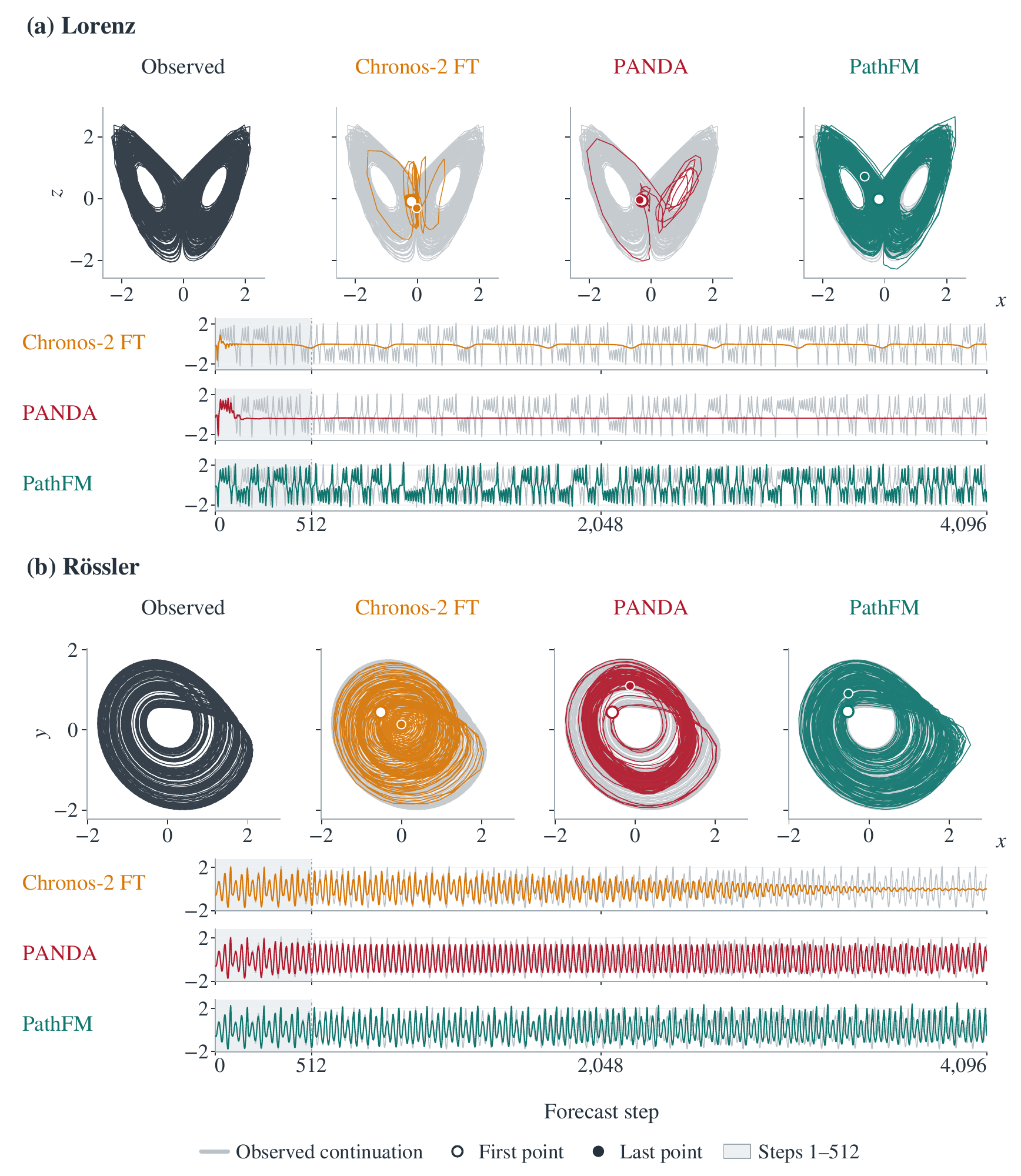
The figure shows the paper's 125M chaotic model with ten-step Euler sampling. Phase portraits and time traces cover all 4,096 forecast steps for Lorenz and Rössler. Gray curves show the observed continuations, and shading marks the first 512 forecast steps.
Explore the chaotic-model notebook for sample paths, quantiles, interactive 4,096-step rollout plots, and PANDA evaluation.
pip install ".[benchmarks,notebooks]"
jupyter lab notebooks/chaotic_forecasting.ipynb
Save observations in context.npy as [channels, context] or [batch, channels, context].
The chaotic models default to 16 paths with 10-step Euler sampling.
python examples/chaotic_rollout.py \
  --model autogluon/pathfm-chaotic-125m --context context.npy --horizon 4096 \
  --seed 42 --device cuda --output rollout.npz
Reproduce the paper
FEV / FPS / TIME / GIFT
Use a general model and a separate output directory for each model.
pip install -r requirements.txt
pip install ".[benchmarks]"
python -m pathfm.benchmarks.download fev --output datasets/fev
python -m pathfm.benchmarks.download time --output datasets/time
python -m pathfm.benchmarks.download gift --output datasets/gift

MODEL=autogluon/pathfm-125m
python -m pathfm.benchmarks.fev \
  --model "$MODEL" --data-root datasets/fev --output outputs/fev \
  --device cuda --save-samples
python -m pathfm.benchmarks.fps --fev-output outputs/fev
python -m pathfm.benchmarks.time \
  --model "$MODEL" --data-root datasets/time --output outputs/time --device cuda
python -m pathfm.benchmarks.gift \
  --model "$MODEL" --data-root datasets/gift --output outputs/gift --device cuda
FPS uses the forecast paths saved by FEV. Its energy and CRPS components score the empirical ensemble.
Short-horizon accuracy
Reproduce the chaotic models' sMAPE at 64, 128, and 256 steps on the pinned base40 and skew40 test splits.
The protocol uses 512-step contexts, six windows per trajectory, 16 stratified paths, and seed 42.
It uses each checkpoint's default 10-step Euler sampler.
Context-standardized sMAPE is averaged over windows, then trajectories within each source group, then equally across the 480 source groups.
The reported scores use bfloat16 inference; numerical results can vary slightly across GPU architectures.
pip install -r requirements.txt
pip install ".[benchmarks]"
python -m pathfm.benchmarks.download panda --output datasets/panda
python -m pathfm.benchmarks.panda \
  --model autogluon/pathfm-chaotic-125m --data-root datasets/panda \
  --output outputs/panda-125m --device cuda
Use any chaotic model ID from the table above and a separate output directory for each model.
Results are written to groups.csv and summary.json.
For a quick check, append --max-groups 1 and use a separate output directory.
To distribute evaluation across GPUs, run shards --shard-index 0 through 15, then aggregate with --score-only.
Contributing
See CONTRIBUTING.md for contribution guidelines.
Security
See CONTRIBUTING for more information.
License
Original PathFM material in this repository is licensed under the Creative Commons Attribution-NonCommercial 4.0 International license (CC BY-NC 4.0). Sharing and adaptation are permitted for noncommercial purposes with attribution, subject to the license terms.
Third-party material retains its original licenses and notices; see THIRD_PARTY_NOTICES.md. Downloaded datasets and model checkpoints are governed by the licenses provided with their respective source repositories.
Citation
If you use PathFM or fps-bench in your research, please cite:
@misc{yao2026pathfm,
  title         = {{PathFM}: Fast Generative Forecasting of Multivariate Trajectories},
  author        = {Jiachen Yao and Xiyuan Zhang and Annan Yu and Boran Han and
                   Abdul Fatir Ansari and Shuai Zhang and Michael Bohlke-Schneider and Bernie Wang},
  year          = {2026},
  eprint        = {2610.22358},
  archivePrefix = {arXiv},
  url           = {https://arxiv.org/abs/2610.22358}
}
Questions
What is PathFM?
autogluon/PathFM is a public repo on GitHub by autogluon. PathFM: Fast Generative Forecasting of Multivariate Trajectories.
Is PathFM open source?
It declares no license on GitHub. Public does not mean open source: without a license, nobody is granted the right to reuse it.
Does PathFM run on macOS, Windows or Linux?
Its maker has not tagged a system, so it is unknown here. Its README says what it needs.
How do I install PathFM?
Open "Take it" on its page: Take My Repo writes an install plan for your machine and hands it to your AI agent (Claude Code, Codex or Cursor), which asks you before each step. Take My Repo has not tested it on any machine.
Is PathFM still maintained?
Its last change on GitHub was on 2026-11-01. Take My Repo does not judge from that whether it is maintained.
What do people who ran PathFM say?
Nobody has reviewed it on Take My Repo yet, which says nothing about its quality.