Agentify
Turn a use case into a grounded agentic system design.
Quickstart site · Example gallery · Releases
Agentify is an agent skill that works like a seasoned AI solutions architect. Describe what you want to build ("an AI support agent for our customer portal", "a document assistant for our law firm"), answer a short round of clarifying questions, and receive a detailed, defensible system design document: requirements and NFRs, an explicit decision record, a justified component architecture, security and evaluation plans, cost math, a rollout plan, and interactive architecture diagrams embedded inline. Every architectural decision cites an authoritative source.
The output is a single self-contained HTML file with a dark/light theme toggle, a navigable table of contents, and embedded SVG diagrams. No dependencies, no network calls, shareable anywhere.
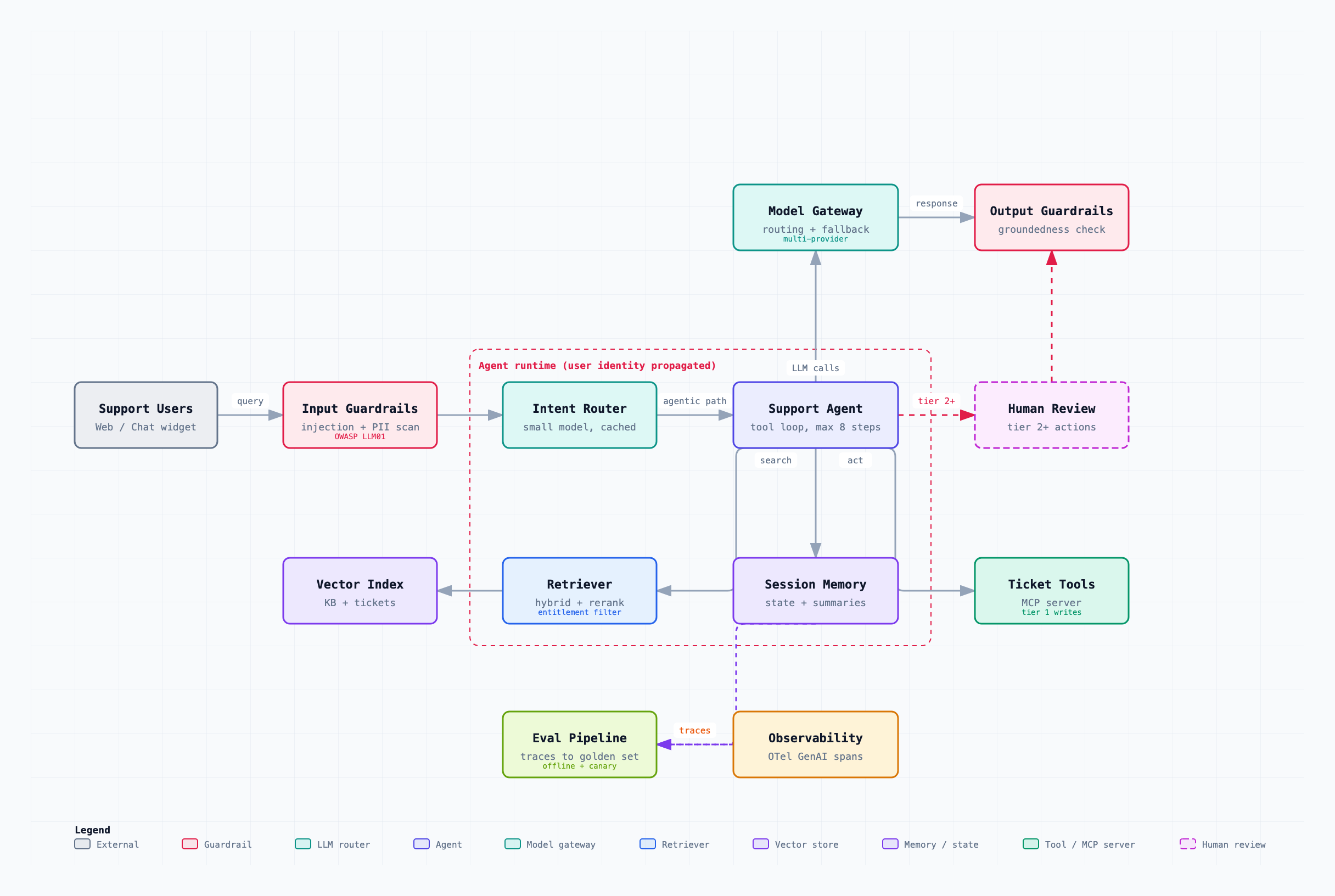
A generated architecture, drawn with agent-native components: guardrails, an intent router, the agent runtime boundary where the user identity is propagated, permission-aware retrieval, tools as an MCP server, a human-review gate, and the eval and observability loop. This is one figure from the support agent design document.
Features
- Grounded, cited reasoning. Every architectural decision cites a knowledge-base document (which carries primary-source citations) or a dated live source. No uncited claims.
- The escalation ladder. Forces the design up from deterministic code, to a single augmented LLM call, to workflow patterns, to an agent, to multi-agent, with a written justification for every climb and an anti-escalation rule that says when a simpler rung wins.
- Seven decision trees for the choices that matter: whether you need generative AI at all, RAG vs fine-tuning vs long context, single vs multi-agent, autonomy tiers with enforcement gates, and memory tiers.
- Domain-harm analysis. Asks what happens if the system is wrong or abused and scales the guardrails to that harm, not to company size.
- Right-sizing. Classifies a design lightweight or enterprise and sizes the document to match, so a small feature is not buried in tenant-isolation and DR ceremony.
- Two modes. Production (the design you should build) and interview (the same rigor framed as a system design interview answer, with per-section coaching).
- A self-contained deliverable. One HTML file with a dark and light theme toggle, a navigable table of contents, print-to-PDF, and embedded interactive diagrams. No dependencies, no network calls.
- More than one artifact. Beyond the design document, export the decisions as architecture decision records (
agentify adr), or compare two designs for the same use case as a visual diff (agentify diff) to see exactly what a changed constraint does.
- Agent-native diagrams. Architecture, sequence, data-flow, and lifecycle diagrams with a vocabulary built for agentic systems (agent, router, retriever, vector store, guardrail, eval loop, human review, tool, memory, queue, ASR, TTS).
- A broad, audited knowledge base. Vendor agent guides, cloud well-architected frameworks, peer-reviewed surveys, standards bodies (OWASP, NIST, MCP, OpenTelemetry), evaluation frameworks, and voice and multimodal design, spot-checked against primary sources.
- A reasoning eval harness. Golden cases with expected decisions guard against regressions in the design logic, run in CI.
- Install-free. Ship as a skill; the CLI and validators run with no
npm install.
Why
Asking an LLM to "design an agentic system" produces plausible-sounding but ungrounded output: components with no justification, agents where a workflow would do, security as an afterthought. Agentify forces the design through the published engineering canon instead:
- The escalation ladder: deterministic code, then a single augmented LLM call, then workflow patterns, then an agent, then multi-agent. Every climb needs written justification, and the design must say when a simpler rung wins.
- Decision trees for the choices that matter: do you need generative AI at all, RAG vs fine-tuning vs long context, single vs multi-agent topology, autonomy tiers with enforcement gates, memory tiers.
- An enterprise bar: every component carries the requirement it serves, its scaling model, its failure mode and fallback, and a concrete technology example. NFRs are numbers, not adjectives. Cost math is shown, including the 10x scenario.
What grounds it
Agentify ships with a versioned knowledge base (in agentify/knowledge/) distilled from primary sources, cited inline in every design:
| Category |
Sources |
| Agent design |
Anthropic (Building Effective Agents, context engineering, multi-agent research system), OpenAI (A Practical Guide to Building Agents), Google/Kaggle Agents whitepaper, Andrew Ng's agentic patterns |
| System design |
The customer-facing GenAI design loop (Selamy), Chip Huyen's AI Engineering, the a16z LLM application stack |
| Enterprise architecture |
AWS Well-Architected Generative AI Lens, Azure WAF AI workloads, Google Cloud Architecture Framework |
| Platform primitives |
The provider API surface designs sit on: tool-use loops, parallel calls and tool_choice, structured outputs, extended thinking, prompt caching, and agent SDKs (Anthropic, OpenAI, Google ADK, smolagents), plus the Llama Guard safety classifier |
| Research |
arXiv surveys covering RAG, agentic RAG, multi-agent collaboration and orchestration, LLM-as-judge, the tau-bench reliability benchmark, agentic multimodal models, and multimodal hallucination, plus named retrieval techniques (Contextual Retrieval, GraphRAG, late chunking, ColBERT) |
| Voice and multimodal |
Cascaded vs speech-to-speech architecture, turn-taking (VAD, endpointing, barge-in), the conversational latency budget, and audio-native evaluation, from OpenAI, LiveKit, ElevenLabs, and the voice-agent testing literature |
| Standards and defenses |
OWASP Top 10 for LLM Applications (2025) and for Agentic Applications (2026), NIST AI RMF and its GenAI Profile, the Model Context Protocol, OpenTelemetry GenAI semantic conventions, and concrete injection defenses (CaMeL, spotlighting, NeMo Guardrails, Constitutional AI, model and system cards) |
| Evaluation |
RAGAS, the TruLens RAG Triad, eval-driven development practice, and agent benchmarks by task type (SWE-bench Verified, WebArena, GAIA, Terminal-Bench) |
Facts that go stale (model choices, pricing) are never baked in: designs pull them live at generation time and stamp them with the retrieval date. Provenance for every source lives in SOURCES.md.
Two modes
- Production mode (default): the design your team should build. Concrete, opinionated, buildable.
- Interview mode: the same rigor framed as a system design interview answer. Each section adds what a strong candidate says, what interviewers probe next, and the tradeoffs to voice out loud. Useful for preparing for GenAI system design loops.
Quick start
Install
npx skills add avnath13/agentify -g
The installer detects the AI coding agents on your machine (Claude Code, Cursor, Codex, Gemini CLI, and many others) and asks which ones to install the skill into. Use Space to select and Enter to confirm. This adds the single agentify skill to the agents you pick, it does not install anything else.
To install to one agent without the prompt (for example Claude Code):
npx skills add avnath13/agentify -g --agent claude-code -y
Other options:
npx skills add avnath13/agentify           # project-local instead of global
npx skills add avnath13/agentify --list    # show the skill(s) in the repo, install nothing
npx skills remove agentify                 # uninstall
Or download agentify.zip from the latest release and add it as a skill manually. The skill is dependency-free at runtime; nothing to npm install to use it.
Use it
Describe what you want to design, in your own words:
Design an AI agent that triages our inbound sales leads: reads the inquiry, enriches it from our CRM, scores it, and drafts a response for rep approval. About 300 leads per day.
Agentify asks only the questions whose answers change the design (data permissions, latency and cost targets, autonomy limits, compliance), walks its decision trees, and writes <use-case>.design.html.
Then iterate in chat. The design is a conversation, not a one-shot:
Make it production mode and assume 99.99% availability and a 200ms p50 budget.
Re-run assuming we cannot use an external model provider, on-prem only.
The compliance team says this is now in scope for HIPAA. Update the security and data sections.
For interview practice, ask for interview mode:
In interview mode: design a customer-facing RAG assistant for a retail bank.
Example prompts
Production designs:
- "Design an AI support agent for our customer portal. It answers product questions from our docs and knowledge base, looks up order and subscription status, and files tickets. About 450 tickets per day, and it should escalate to a human when unsure."
- "We want an internal copilot that answers questions over our wiki and Slack history, with per-team permissions so nobody sees another team's private channels."
- "Design a compliance assistant over five years of contracts that answers with citations to the source clause. Strictly read-only."
- "Design a coding agent that turns a bug ticket into a tested pull request for our monorepo. It must never merge and never touch production."
- "Design an agent that drafts first-response emails for our support inbox, pulls order data, and hands off anything about refunds to a human."
Interview mode:
- "In interview mode: design a customer-facing RAG assistant for a bank."
- "In interview mode: design a multi-tenant meeting-notes summarizer with strict tenant isolation."
Refining an existing design (just keep talking):
- "Cut the cost ceiling to 0.05 USD per conversation and show me what changes."
- "Assume traffic is bursty, 10x peaks around launches. Redo the scale section."
- "Swap the vector store recommendation for something we can self-host."
What a design contains
Fifteen sections, each with a defined pass bar: executive summary, requirements and NFRs, decision record (with rejected alternatives), system architecture, data and retrieval, tools and integrations, state and memory, security and guardrails, evaluation plan, observability, scale and cost analysis, failure modes and degradation, rollout plan, a request walkthrough, and references.
In interview mode each section also carries a collapsible "interview notes" block: what a strong candidate says, the follow-ups the interviewer will probe, and the tradeoff to voice.
Diagram vocabulary
Agentify draws four diagram types, using the bundled engine, and embeds them in the design:
| Type |
Shows |
| Architecture |
Components, trust boundaries, and how requests flow between them |
| Sequence |
The primary request path, including guardrail and retrieval hops |
| Data flow |
Ingestion and retrieval pipelines, PII boundaries, freshness |
| Lifecycle |
State machines: an agent run, a ticket, an order, with retries and terminal exits |
Beyond the usual infrastructure boxes, the engine adds an agent-native component vocabulary so the picture matches the frameworks, each with its own color family:
| Component |
For |
agent |
an LLM-driven agent loop |
llm-router |
intent or model routing |
model-gateway |
provider gateways, model API front doors, fallback |
retriever |
query-time retrieval services |
vector-store |
vector or hybrid indexes |
memory-state |
conversation state, agent memory |
guardrail |
input/output guardrails, content filters |
eval-loop |
evaluators, critics, quality gates |
human-review |
human approval gates (drawn with a dashed border) |
tool |
tools, MCP servers, function endpoints |
queue |
queues and task buses between agents |
The full palette and semantics are documented in schemas/README.md.
Using the output
The design document (<use-case>.design.html) is a single self-contained file:
- Theme toggle in the top right, persisted to
localStorage, respecting your system preference. Force a theme with ?theme=light or ?theme=dark for deterministic screenshots.
- Table of contents