sample-autonomous-cloud-coding-agents
Autonomous background coding agents on AWS. Turn tasks into pull requests via isolated runtimes, with built-in orchestration, observability, and governance.
- 214
- TypeScript
- MIT-0
- 1 d ago
Hierarchical agent system for Org-wide CloudOps coverage — Health, FinOps, and network resilience in one interface.
Repo aws-samples/sample-cloudops-multi-agent-system, read from GitHub 4 d ago. aws-samples has not joined Take My Repo.
aws-samples/sample-cloudops-multi-agent-system is a public repo on GitHub by aws-samples. Hierarchical agent system for Org-wide CloudOps coverage — Health, FinOps, and network resilience in one interface. It declares the MIT-0 license on GitHub. It is written mainly in Python, has 15 stars and last changed on 2026-11-19. Nobody has reviewed it on Take My Repo yet, which says nothing about its quality. Read from GitHub on 2026-11-19.
Important: This project is intended for educational and demonstration purposes only. It is not intended for use in production environments without additional hardening. See Security Hardening for Production below and the AWS Solutions Guidance Disclaimer.
A hierarchical multi-agent system for AWS cloud operations, built on Amazon Bedrock AgentCore with Strands Agents SDK and an AG-UI streaming Next.js frontend.
Ask it things like "What were my AWS costs last month?", "Are any critical AWS Health events open?", "How resilient is my Direct Connect topology?" — and get structured answers, interactive visualisations, and downloadable reports.
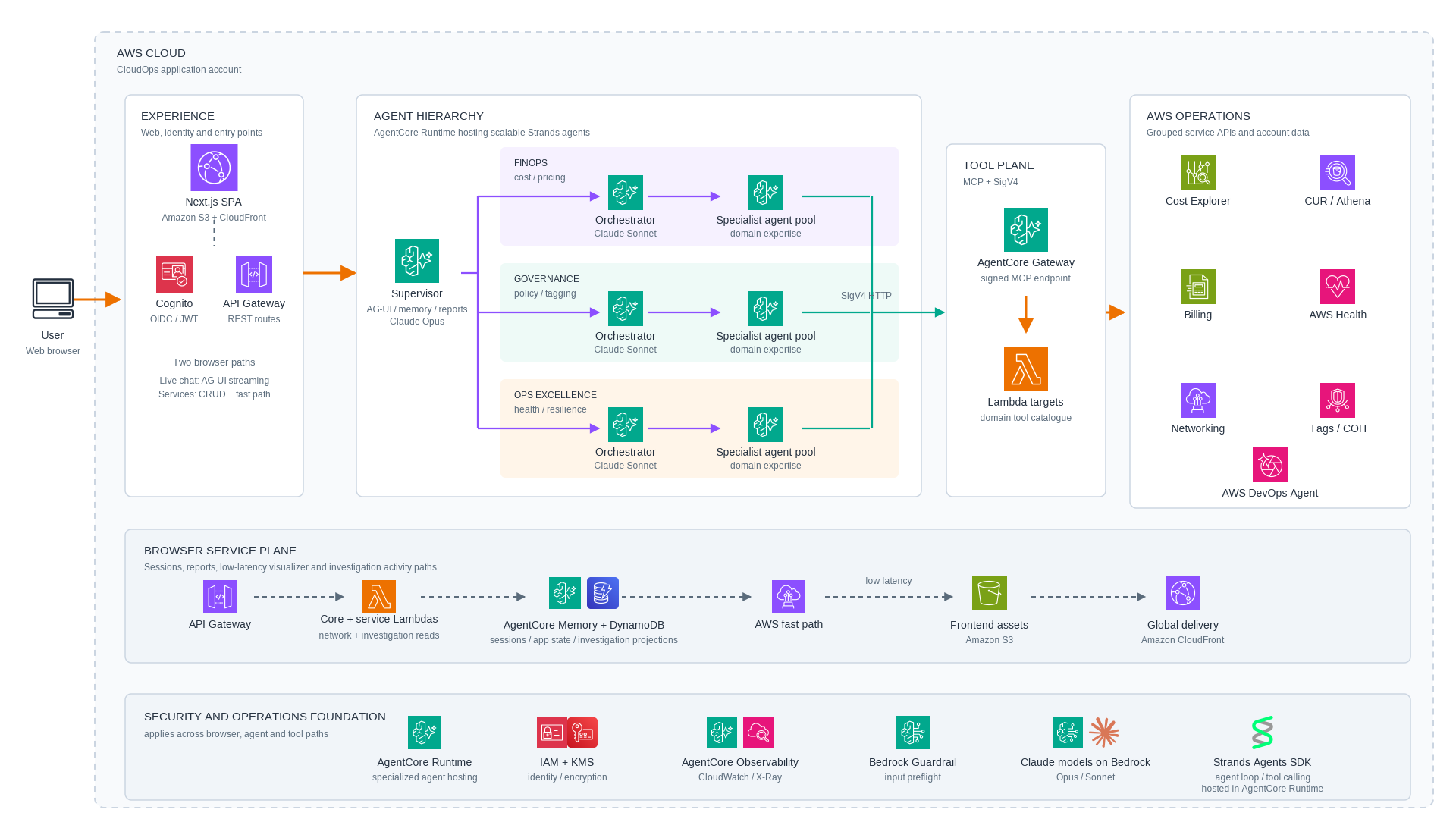
Three layers:
All agents run on AgentCore Runtime containers. Inter-agent
communication is SigV4-signed HTTP; the supervisor speaks AG-UI to the
browser. All agent behaviour is defined in a single config file —
src/agents/hierarchy.json — so adding or changing agents is a JSON
edit, not a code change.
For system internals (memory, tool tracing, build hashing, gateway sync), see docs/architecture.md.
The type field in hierarchy.json determines which code path an agent
uses. Any agent can be "type": "frontend" to become the user-facing
entry point.
Single leaf agent standalone
hierarchy.json: cost-operations-agent.type = "frontend"
DEPLOY_AGENTS=cost-operations-agent

Frontend → cost-operations-agent (AG-UI) → Gateway MCP tools
Mid-level agent with children
hierarchy.json: finops-agent.type = "frontend"
DEPLOY_AGENTS=finops-agent,cost-operations-agent,pricing-agent

Frontend → finops-agent (AG-UI) → cost-operations-agent (HTTP) → Gateway
                                → pricing-agent (HTTP) → Gateway
Full hierarchy (default)
Frontend → supervisor (AG-UI) → finops-agent (HTTP)      → cost-ops (HTTP)        → Gateway
                                                          → pricing (HTTP)         → Gateway
                              → governance-agent (HTTP)   → tag-governance (HTTP)  → Gateway
                              → ops-excellence (HTTP)     → health-events (HTTP)   → Gateway
                                                          → network-resiliency (HTTP) → Gateway
                                                          → lambda-upgrade (HTTP) → Gateway
To switch topologies: change the type field in hierarchy.json, set
DEPLOY_AGENTS, redeploy.
finch vm start      # Start container runtime (needed for agent images)
make quickstart     # Setup → configure → deploy (~15 min first time)
make deploy-auto    # Re-deploy changes (1-2 min for prompt edits, ~5 min for code changes)
make run-local      # Local frontend dev server (hot reload, talks to deployed backend)
make plan           # Terraform plan without applying
make destroy        # Tear down infrastructure
make destroy-all    # Nuclear: infra + ECR + memory + state backend
Local dev & the Cognito allow-list.
make run-localtemporarily addshttp://localhost:3000/to the Cognito app client's callback/logout URLs on start and removes it on a clean exit (seescripts/run-local.sh). If the process is terminated uncleanly (SIGKILL, closed terminal, crash), that localhost entry can linger in the allow-list. It's harmless to the deployed site — production auth uses the CloudFront callback, not localhost — but it's good hygiene to keep alocalhostredirect out of a long-lived app client. Remove a stale entry by re-runningmake run-localand exiting it cleanly (Ctrl-C), or delete it from the Cognito console. Never commitlocalhostas a permanent Terraform-managed callback URL.
Pass DEPLOY_MODE as a command-line override (e.g. DEPLOY_MODE=gateway-only make deploy-auto) to control scope — it's a shared key, so a value in .env is ignored (see Development Guide → Deploy Modes):
| Mode | Agents | Gateway | Tools | Frontend | Cognito | Use case |
|---|---|---|---|---|---|---|
full (default) |
✅ | ✅ | ✅ | ✅ | ✅ | Production / first deploy |
agents-only |
✅ | ✅ | ✅ | ❌ | ✅ | Backend-only changes |
gateway-only |
❌ | ✅ | ✅ | ❌ | If OAuth | Standalone MCP server for external clients |
tools-only |
❌ | ❌ | ✅ | ❌ | ❌ | Lambda tool iteration |
DEPLOY_AGENTS=finops-agent          # Only this agent + its parent chain
DEPLOY_TOOLS=cost-explorer,billing  # Only these Lambda tools
GATEWAY_AUTH=oauth                  # Add Cognito JWT auth on the gateway
One-off overrides:
DEPLOY_TOOLS=health-events make deploy-auto
The health-events collector ingests AWS Health events (scheduled maintenance, service issues, AWS investigations) for the deploy account by default. For multi-account orgs it can aggregate across all members via AWS Health Organizational View — one central EventBridge rule, no per-member plumbing.
See docs/agents/health-events.md for the four deploy
modes (single-account, org-mgmt, org-delegated, cross-account), the
AWS Support plan matrix (EventBridge is free; backfill needs
Business+ Support), and the make backfill-health command.
make reconfigure-shared # Re-run the interactive config with a diff + APPLY CHANGES gate
make test-unit         # 475+ unit tests (moto, pytest) — reports, memory, tracing, prompts,
                       # health-events collector (risk rules + LLM enrichment paths)
make test-integration  # End-to-end against a deployed stack (requires Cognito creds in scripts/.env)
Integration tests need COGNITO_USERNAME and COGNITO_PASSWORD in
scripts/.env.
make destroy         # terraform destroy only
make destroy-all     # Full teardown: infra + ECR + memory + state backend + log groups
src/
  agents/                       # Strands agents — config-driven
    hierarchy.json              # Single source of truth (prompts, models, type, children)
    frontend/ orchestrator/ worker/
    shared/                     # memory, tracing, reports, gateway, registry, cross_account
  lambda/
    mcp/                        # One folder per AWS API surface (9 tools)
    frontend/                   # Browser-facing REST Lambdas (JWT-authorised)
    collectors/                 # Background collectors (EventBridge → SQS → Lambda → DDB)
  frontend/                     # Next.js static export SPA + visualiser / reports / tours

terraform/
  modules/core/                 # system modules (runtime, gateway, memory, cognito, etc.)
  modules/custom/               # Optional modules (health-events, network-resilience)

scripts/
  deploy.sh + lib/              # Deploy orchestrator + sub-scripts
  backfill_health.py            # Health events backfill (opt-in)
  debug/                        # Log tailer, gateway fixer, CLI invoke, NR health check

docs/
  architecture.md               # system internals
  agents/                       # Per-leaf-agent references (deploy modes, data model, gotchas)
    README.md                   # When to add a file + section template
    cost-operations.md          # Cost Explorer / CUR / COH reference
    pricing.md                  # Pricing catalog / anomalies / budgets
    health-events.md            # Health events feature reference
    network-resiliency.md       # Direct Connect topology + resilience rules
    tag-governance.md           # Tag governance feature reference
    lambda-upgrade.md           # Lambda runtime upgrade discovery + migration
  skills/                       # Per-skill references (method, API surface, portability)
    discounted-commitments.md   # SP/RI risk-adjusted sizing + commitments MCP tool
  observability-tuning.md       # X-Ray + Transaction Search knobs

skills/                         # Portable agent skills (invocable as /skill-name)
  developer-guide/SKILL.md      # Adding agents / tools / collectors (interactive)
  discounted-commitments/       # SP/RI sizing — 3 markdown files, no code

tests/unit/                     # pytest + moto
make setup                Identity setup (.env) + install deps
make configure            First-run shared config (SSM + JSON)
make reconfigure-shared   Change shared config (diff + APPLY CHANGES gate)

make deploy-auto          Deploy everything non-interactively
make deploy               Interactive deployment
make plan                 Terraform plan only
make package              Package Lambda tools (hash-based, parallel)
make build-agents         Build container images only

make backfill-health DAYS=30 [ORG=1] [ROLE_ARN=...]   See docs/agents/health-events.md

make run-local            Frontend with Cognito auth
make run-local-bypass     Frontend without auth (dev only)

make test                 Unit tests
make test-integration     Integration tests (requires deployed stack)

make destroy              terraform destroy
make destroy-all          Full teardown including state backend
make clean                Remove build artifacts

make help                 Show all targets
Two-tier: per-developer identity lives in .env (AWS_PROFILE,
PROJECT_PREFIX, ENVIRONMENT). Shared project config (region,
IdP, cross-account roles, CUR settings, deploy flags) lives in SSM
Parameter Store under /$PROJECT_PREFIX/$ENVIRONMENT/config/*,
managed by terraform/modules/core/shared-config/.
On every deploy, precedence is (highest wins):
AWS_REGION=eu-west-1 make deploy-autoterraform/config.auto.tfvars.json (written by make configure)See .env.example for the canonical identity-only .env template and
scripts/shared-keys.txt for the full list of shared keys.
/developer-guide).commitments MCP tool, and
how the portable skill and the deployed Lambda stay in agreement.Skills provide the system's analytical capabilities as portable workflows that work across any MCP-compatible environment. They auto-detect the best execution path: MCP tools (if gateway is connected) → AWS CLI (if available) → delegate to coding agent.
| Skill | Invoke with | What it does |
|---|---|---|
/developer-guide |
"how do I add an agent?" | Interactive guide for extending the system |
/resilience-report |
"generate a DX resilience report" | Self-contained HTML with topology + assessment |
/finops-analysis |
"what are my top costs?" | Cost breakdown, trends, forecasts, savings |
/health-events-digest |
"any critical health events?" | Health event digest with risk scoring |
/tag-governance-assessment |
"how's my tag compliance?" | Tag compliance scoring + remediation links |
/lambda-runtime-upgrade |
"find deprecated lambda functions" | Multi-region deprecated-runtime discovery + migration report |
/discounted-commitments |
"what savings plans should we buy?" | Risk-adjusted SP/RI sizing — achievable vs AWS best case (docs) |
Skills are invoked by typing /skill-name in Claude Code or Kiro. Each skill auto-detects the best execution path:
| Path | When | What you need |
|---|---|---|
| MCP tools (fastest) | Gateway is connected to your IDE | DEPLOY_MODE=gateway-only deployed + gateway endpoint in MCP config |
| AWS CLI | Working locally with credentials | AWS CLI v2 + active credentials (aws sts get-caller-identity works) |
| Delegate | Sandboxed environment | Coding agent (Kiro) enabled in host capabilities |
For the MCP tool path (recommended — handles cross-account, pre-enriched data):
# 1. Deploy the gateway + Lambda tools only (no agents, no frontend)
DEPLOY_MODE=gateway-only make deploy-auto

# 2. Get the gateway endpoint
terraform -chdir=terraform output gateway_endpoint

# 3. Add to your IDE's MCP config
#    Claude Code: .mcp.json at project root
#    Kiro: Settings → MCP Servers
Once connected, skills detect the tools automatically and skip the CLI/delegate paths.
This sample includes foundational security controls (SigV4 inter-agent auth, Cognito JWT, IAM least-privilege, tenant isolation, output redaction, Bedrock Guardrails). For production deployments, consider the following additional hardening:
| Area | Recommendation |
|---|---|
| Network isolation | Place Lambda functions in a VPC with VPC endpoints for DynamoDB, Bedrock, SSM, and STS. Remove public internet paths for data-plane traffic. |
| Web Application Firewall | Enable AWS WAF on the CloudFront distribution with managed rule groups (AWSManagedRulesCommonRuleSet, AWSManagedRulesKnownBadInputsRuleSet) and rate-limiting rules. |
| Container scanning | Enable ECR scan-on-push and integrate vulnerability findings into the build pipeline. Block deployment of images with Critical/High CVEs. |
| Threat detection | Enable Amazon GuardDuty for runtime threat detection on IAM credential abuse, container anomalies, and DNS exfiltration. |
| Key management | Rotate KMS customer-managed keys annually. Use separate keys per data classification tier. |
| Rate limiting | Add per-user throttling at API Gateway (token bucket) and Bedrock inference quota management. |
| Audit logging | Enable CloudTrail Data Events for DynamoDB and S3 to capture item-level access. Retain audit logs for 365 days minimum. |
| Incident response | Develop IR playbooks for AI-specific incidents (prompt injection, memory poisoning, model abuse). |
| Output redaction | Genuine secrets (access keys, external IDs, role-session names) are always scrubbed from persisted memory and saved reports. AWS account IDs and ARNs are shown by default — they are the substance of a cloud-ops report (e.g. "top accounts by spend", over-permissioned-role findings), so blanking them makes the output meaningless. If you persist or share transcripts and want identifiers scrubbed too, set redact_identifiers = true (Terraform variable, wired to the supervisor runtime as REDACT_IDENTIFIERS). |
This project is licensed under the MIT-0 License. See the LICENSE file.
aws-samples/sample-cloudops-multi-agent-system is a public repo on GitHub by aws-samples. Hierarchical agent system for Org-wide CloudOps coverage — Health, FinOps, and network resilience in one interface.
It declares the MIT-0 license on GitHub.
Its maker tagged it for macOS, Windows and Linux, or as Docker or cross-platform. That is declared by the maker; Take My Repo has not tested it.
Open "Take it" on its page: Take My Repo writes an install plan for your machine and hands it to your AI agent (Claude Code, Codex or Cursor), which asks you before each step. Take My Repo has not tested it on any machine.
Autonomous background coding agents on AWS. Turn tasks into pull requests via isolated runtimes, with built-in orchestration, observability, and governance.
Its last change on GitHub was on 2026-11-19. GitHub counts 11 open issues and pull requests. Take My Repo does not judge from that whether it is maintained.
Nobody has reviewed it on Take My Repo yet, which says nothing about its quality.
Open-source agentic ops platform for cloud, SRE, DevOps, support and FinOps teams. AI agents investigate incidents, cut cloud and Kubernetes waste and run approval-gated runbooks across Kubernetes, AWS, Azure, GCP and your databases. Self-hosted, bring your own models.
Universal Agent Evaluation Framework (UAEF) is a framework-agnostic evaluation system for AI agents. Invoke any agent and score it on multiple metrics spanning tool calling, response quality, safety, performance, and reasoning. Track experiments against baselines, catch regressions automatically, and get LLM-generated insights.
Scalable, Composable Reinforcement Learning for Real-World Agents with Bedrock AgentCore.
Machine Learning University: Accelerated Natural Language Processing Class
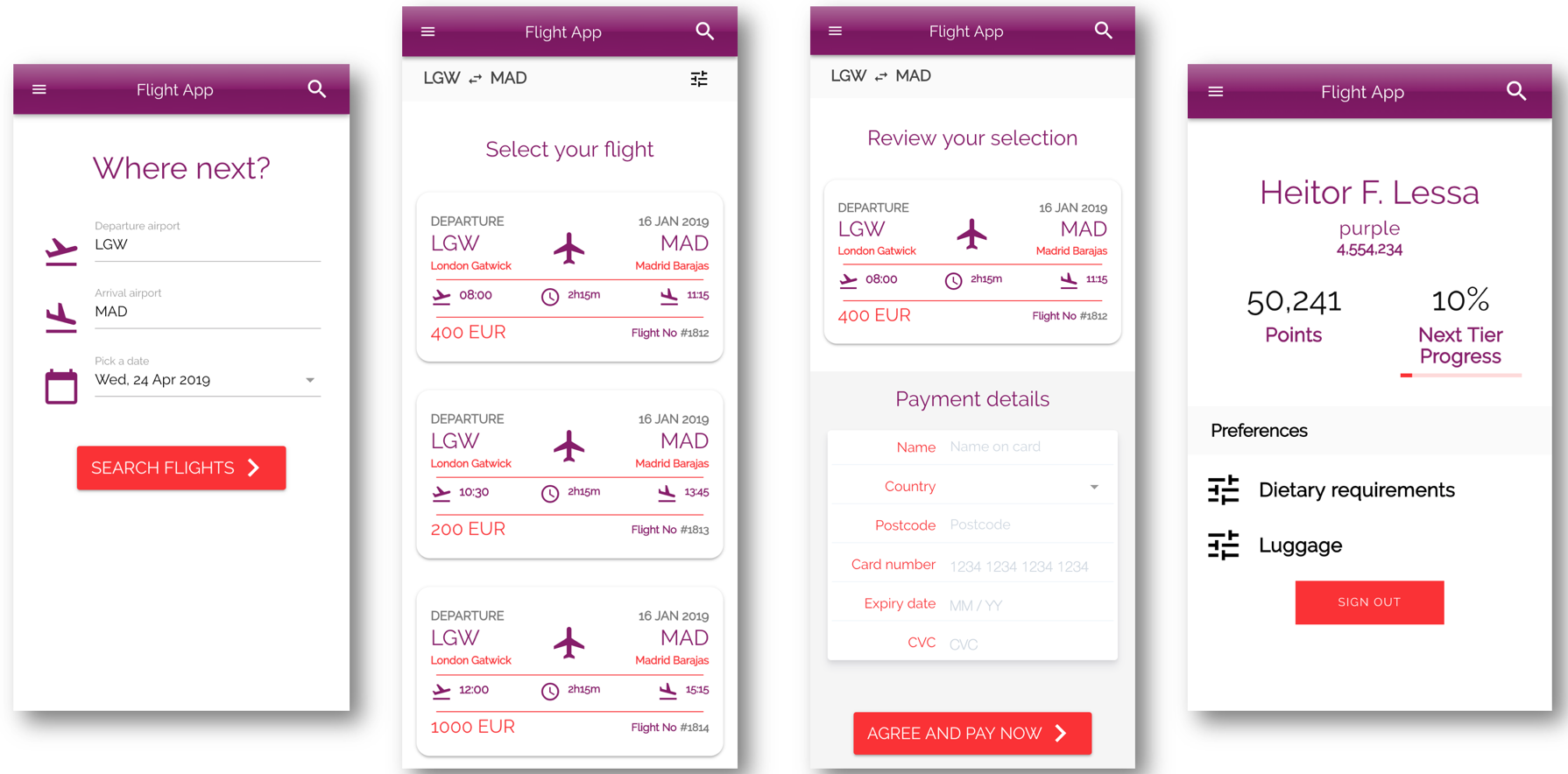
Airline Booking is a sample web application that provides Flight Search, Flight Payment, Flight Booking and Loyalty points including end-to-end testing, GraphQL and CI/CD. This web application was the theme of Build on Serverless Season 2 on AWS Twitch running from April 24th until end of August in 2019.
This is a workshop designed for Amazon Bedrock a foundational model service.
Serverless patterns. Learn more at the website: https://serverlessland.com/patterns.
Machine Learning University: Accelerated Computer Vision Class