
rtk
CLI proxy that reduces LLM token consumption by 60-90% on common dev commands. Single Rust binary, zero dependencies
- 88k
- Rust
- Apache-2.0
- 4 h ago
Plan-then-build AI coding for Claude Code & Codex CLI — you approve the plan before the model writes a line of code. SPEC → PLAN → TEST → CODE → REVIEW → LEARN
Repo azalio/map-framework, read from GitHub 2 h ago. azalio has not joined Take My Repo.
azalio/map-framework is a public repo on GitHub by azalio. Plan-then-build AI coding for Claude Code & Codex CLI — you approve the plan before the model writes a line of code. SPEC → PLAN → TEST → CODE → REVIEW → LEARN. It declares the MIT license on GitHub. It is written mainly in Python, has 143 stars and last changed on 2026-11-24. Nobody has reviewed it on Take My Repo yet, which says nothing about its quality. Read from GitHub on 2026-11-24.
CLI proxy that reduces LLM token consumption by 60-90% on common dev commands. Single Rust binary, zero dependencies
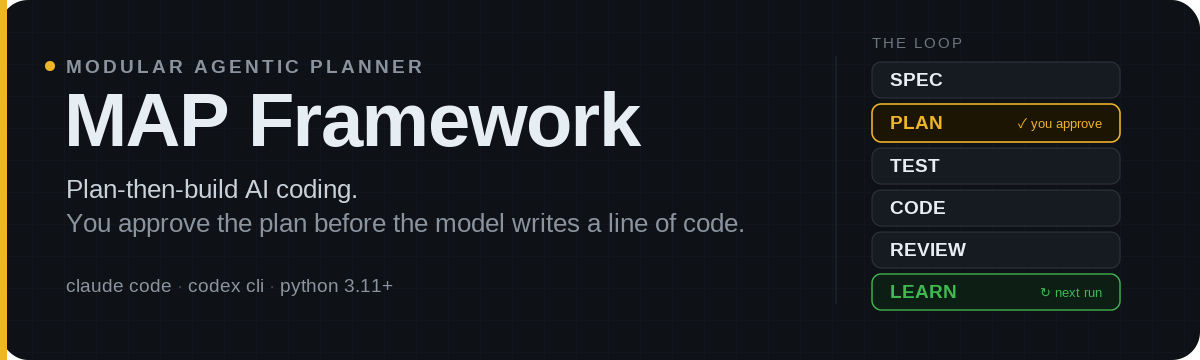
After mapify upgrade, Claude can invoke any MAP skill through the Skill tool on your behalf except /map-release, which remains manual-only. Workflow confirmation gates still apply; /map-upgrade requires explicit consent for a major version.
Most AI agents rush straight to code — fast wrong answers, silent rework.
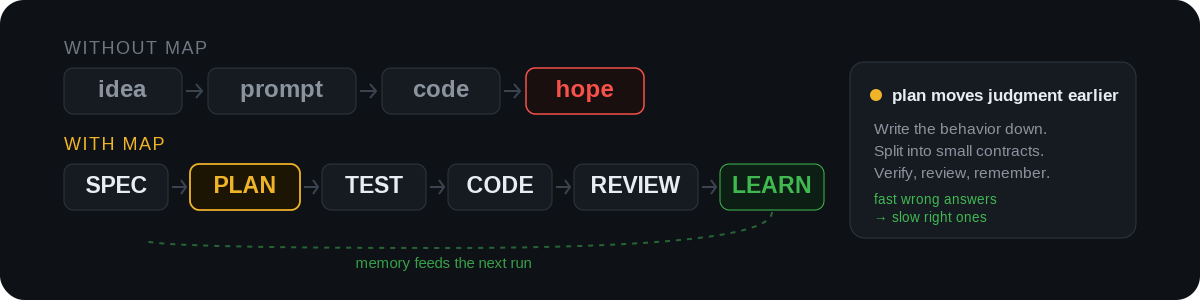
Common failure modes MAP eliminates:
MAP moves engineering judgment earlier: write down the behavior, split the work into small contracts, verify each stage, review against the spec, and save lessons for the next run.
Skill maintainers can use mapify skill-eval optimize <skill> --provider claude|codex --apply
to update only the selected provider's description in the shared template source;
the opposite provider stays unchanged (details).

1. Install
uv tool install mapify-cli

# or with pip
pip install mapify-cli
Requires Python 3.11+, and python3 on your PATH must be that interpreter — the
installed hooks and .map/scripts/ runners execute through a #!/usr/bin/env python3 shebang, not through the interpreter that ran mapify. mapify init
checks it up front and tells you what to fix (details).
For Go projects requiring build tags, set checks.go.tags: integration,netgo in
.map/config.yaml for the Stop hook's build check (configuration).
2. Initialize your project
Claude Code is the default provider. Cross-AI review compares explicit host and
reviewer adapter vendors; same-vendor or unknown provenance is not labeled
independent (details).
An offline historical review corpus
provides pinned introducing diffs, adjudicator-only labels and audited controls.
It starts no reviewers and makes no evaluation or policy-promotion claims.
An opt-in bounded subscription pilot
adds offline preparation/reporting and a separately acknowledged, at-most-six-call
Claude CLI runner. Its v2 inputs are complete allowlisted -U30 diffs; prompts
estimated above 60,000 tokens are excluded, never truncated. Results require
manual adjudication; historical v1 runs cannot be resumed.
A paired offline evaluator measures precision/recall before
and after verification, including real defects lost when dismissing findings.
Claude Code:
cd your-project
mapify init
claude
Codex CLI:
cd your-project
mapify init . --provider codex
codex
The generated .codex/config.toml enables hooks. On first use, review and trust
the project hook configuration when Codex prompts you; /hooks shows the eight
installed lifecycle event groups.
3. Run the loop
Claude Code:
/map-plan → /map-efficient → /map-check → /map-review → /map-learn
Codex CLI:
$map-plan → $map-efficient → $map-check → $map-review → $map-learn
That's the whole golden path.
Need to reorder unstarted work in an active run? Use the audited
resequence_pending command
without resetting the current step, retries, results or baselines.
/map-plan for anything non-trivial — it clarifies behavior and splits the work into contract-sized subtasks./map-prd-review directly, or accept /map-plan's optional readiness preflight. A non-ready result shows the gaps and asks whether to revise or continue planning anyway./map-efficient./map-plan off-ramps you to a direct edit or /map-fast instead of forcing full planning./map-wayfind resolves open design decisions on a durable map. Evidence-first research is on by default: factual lookups stay light; uncertain decisions get independent investigations and targeted checks, with no default attempt cap for authorized read-only work. Opt in at task start with configure_research --budget-limit N; existing caps remain binding and extensions require scoped user approval. Consequential or genuinely expensive actions still need separate consent. Stale open-ticket evidence can be explicitly refreshed without erasing history or resetting that budget. Research handoffs are checked before /map-plan; historical decisions retain explicit legacy provenance./map-auto routes and drives the chain autonomously; hard-stops only on dangerous_action/safety_guardrail holds.Codex CLI ships the same 23 MAP skill entry points and invokes them with
$:$map-plan,$map-efficient,$map-check, and so on. See the Usage Guide.
Framework updates. Automatic stable updates are enabled by default. Normal MAP skills check at most once per project every 24 hours, apply eligible patch and minor releases, and ask before a major release after showing its official feature highlights. Rejecting a major offer is remembered per project for that exact version, so it is not offered again; any different patch, minor, or major version is offered normally. Use these project controls and provider-specific manual skills when needed:
mapify init . --no-auto-update   # persist updates.auto: false
mapify init . --auto-update      # re-enable automatic checks
/map-upgrade                     # Claude manual check/upgrade
$map-upgrade                     # Codex manual check/upgrade
Automatic failures stay silent so they do not block the requested workflow;
manual checks report errors explicitly. The public mapify upgrade command is
separate and unchanged: it upgrades only the CLI and does not refresh project
files. See Automatic and manual framework updates.
If a legacy map-debug skill cannot load its ../../references/ documents, refresh
the project after upgrading the CLI:
mapify init . --force --no-git --provider codex --refresh-existing
(use --provider claude for Claude). This restores missing managed references;
upgrading the CLI alone does not.
The DevOpsConf 2026 case study applies this process to a production Kubernetes Project Operator:
SPEC → PLAN → TEST → CODE → REVIEW → LEARN| Good fits | Poor fits |
|---|---|
| Complex backend features | Typos and tiny edits |
| Kubernetes controllers and operators | Small one-off scripts |
| Internal platform tooling | Product ideas where behavior is still unknown |
| API, CRD, or domain-model changes with invariants | Broad rewrites without clear boundaries |
| Refactoring with a meaningful test harness | Tasks cheaper to do directly than to plan |
| Command | Use For |
|---|---|
/map-auto |
Single-entry autonomous autopilot: routes a task through existing MAP workflows and drives the chain to a committed branch |
/map-plan |
Start here for non-trivial work; clarify behavior and decompose tasks |
/map-prd-review |
Review a PRD with a 0-10 readiness score, strengths, risks, and uncovered edge cases |
/map-wayfind |
Too foggy to plan? Resolve design decisions on a durable map before /map-plan; cite HTTP(S) docs, repo sources or hashed ticket-local observations |
/map-efficient |
Implement an approved plan or already-scoped task |
/map-fast |
Small, low-risk changes where full planning is overhead |
/map-check |
Quality gates, verification, and artifact checks; --docs reports docs-vs-code drift |
/map-review |
Pre-commit semantic review against the plan, tests, and diff |
/map-learn |
Capture project memory and reusable lessons |
/map-understand |
Interactive teaching and quiz mode for code, diffs, and workflow results |
/map-debug |
Bug fixes and debugging |
/map-task |
Execute a single subtask from an existing plan |
/map-tdd |
Test-first implementation workflow |
/map-release |
Package release workflow; Codex $map-release shares the same commit-bound CI gates |
/map-resume |
Resume interrupted workflows |
For stacked PRs, use /map-review --base-ref runtime (Codex: $map-review --base-ref runtime) to review only the child branch's changes against its parent's merge-base, including dirty work. Trusted review policy still comes from the default branch.
/map-review requires coverage of changed paths against the selected base, including local edits. Unchanged repository files remain optional, snapshot-bound dependency context. Codex $map-review uses a runner-owned app-server connection to deliver evidence directly to independent readers; the parent no longer copies every chunk. Codex reviewers ask for the next part or request a file and line range. The runner handles pagination and reconnects to interrupted threads automatically. Compatible updates to the local transport preserve completed checks and reviewer reports in the same round. If Codex loses a thread, a fresh reader reviews the same portion of the diff. Runtime host probes, intact delivery acknowledgments and post-delivery finalization tokens are required before a Codex review can complete; the legacy native reader remains unverified.
A guessed dependency path outside the admitted review inventory returns a recoverable diagnostic with bounded, permitted path suggestions. Retry a suggested path through the same runner; this neither expands access nor permits live repository discovery. Actual access restrictions and stale snapshots still fail closed.
Reviewer output validation requires registered role names; unknown agent kinds are rejected rather than checked without a schema.
Implementation completion does not imply review completion: edit reminders preserve pending admitted review rounds rather than suggesting a new run.
Sharded reviews judge denied access against the reporting shard's required scope; optional cross-shard denials remain visible without falsely blocking completeness.
/map-plan and /map-efficient require per-subtask size, concern, and constraint metadata, then validate blueprint.json before implementation, so oversized or mixed-concern plans fail early./map-check and /map-review validate against the spec, tests, and diff instead of asking whether code "looks fine"./map-review auto-bundles available spec, plan, tests, verification, and coverage evidence into a single durable input (.map/<branch>/review-bundle.json); standalone external-PR review needs no Actor blueprint. --detachedazalio/map-framework is a public repo on GitHub by azalio. Plan-then-build AI coding for Claude Code & Codex CLI — you approve the plan before the model writes a line of code. SPEC → PLAN → TEST → CODE → REVIEW → LEARN.
It declares the MIT license on GitHub.
Its maker has not tagged a system, so it is unknown here. Its README says what it needs.
Open "Take it" on its page: Take My Repo writes an install plan for your machine and hands it to your AI agent (Claude Code, Codex or Cursor), which asks you before each step. Take My Repo has not tested it on any machine.
🌍 AppWorld: A Controllable World of Apps and People for Benchmarking Function Calling and Interactive Coding Agent, ACL'24 Best Resource Paper.
Reverse engineer anything with agents, from app behavior down to native binaries.
Secure, fast, efficient, battle-tested at Alibaba's scale. Hybrid architecture code review tool: deterministic pipelines + LLM Agent, precise line-level comments, built-in multi-language ruleset (NPE, thread-safety, XSS, SQL injection), OpenAI & Anthropic compatible.
The agent harness performance optimization system. Skills, instincts, memory, security, and research-first development for Claude Code, Codex, Opencode, Cursor and beyond.
3,000+ reusable AI agent skills for Claude Code, Codex, Cursor and Gemini CLI. AAS Core adds local catalog discovery, agent-owned selection and plan preview. CLI, MCP and plugins.
Its last change on GitHub was on 2026-11-24. Take My Repo does not judge from that whether it is maintained.
Nobody has reviewed it on Take My Repo yet, which says nothing about its quality.
Take My Repo cannot say: it does not audit code and has not run map-framework. What is known comes from GitHub. It declares the MIT license on GitHub. Its last change was on 2026-11-24. It has 143 stars, which measure popularity, not safety. Nobody has reviewed it on Take My Repo yet, which says nothing about its quality. Read the source before you run it. With "Take it", your AI agent shows each step and asks you before running it; README text is treated as data, not as instructions.