
FastAPI-boilerplate
An extendable async API using FastAPI, Pydantic V2, SQLAlchemy 2.0, PostgreSQL and Redis.
- 2.1k
- MIT
- 5 d ago
Repo benavlabs/FastAPI-boilerplate, read from GitHub 14 h ago. benavlabs has not joined Take My Repo.
In short
benavlabs/FastAPI-boilerplate is a public repo on GitHub by benavlabs. An extendable async API using FastAPI, Pydantic V2, SQLAlchemy 2.0, PostgreSQL and Redis. It declares the MIT license on GitHub. It is written mainly in Python, has 2,116 stars and last changed on 2026-11-18. Nobody has reviewed it on Take My Repo yet, which says nothing about its quality. Read from GitHub on 2026-11-23.
Similar repos

Fastro · The Benav Labs FastAPI Boilerplate
Batteries-included FastAPI starter - vertical-slice modules, swappable infrastructure, plugin-ready CLI.
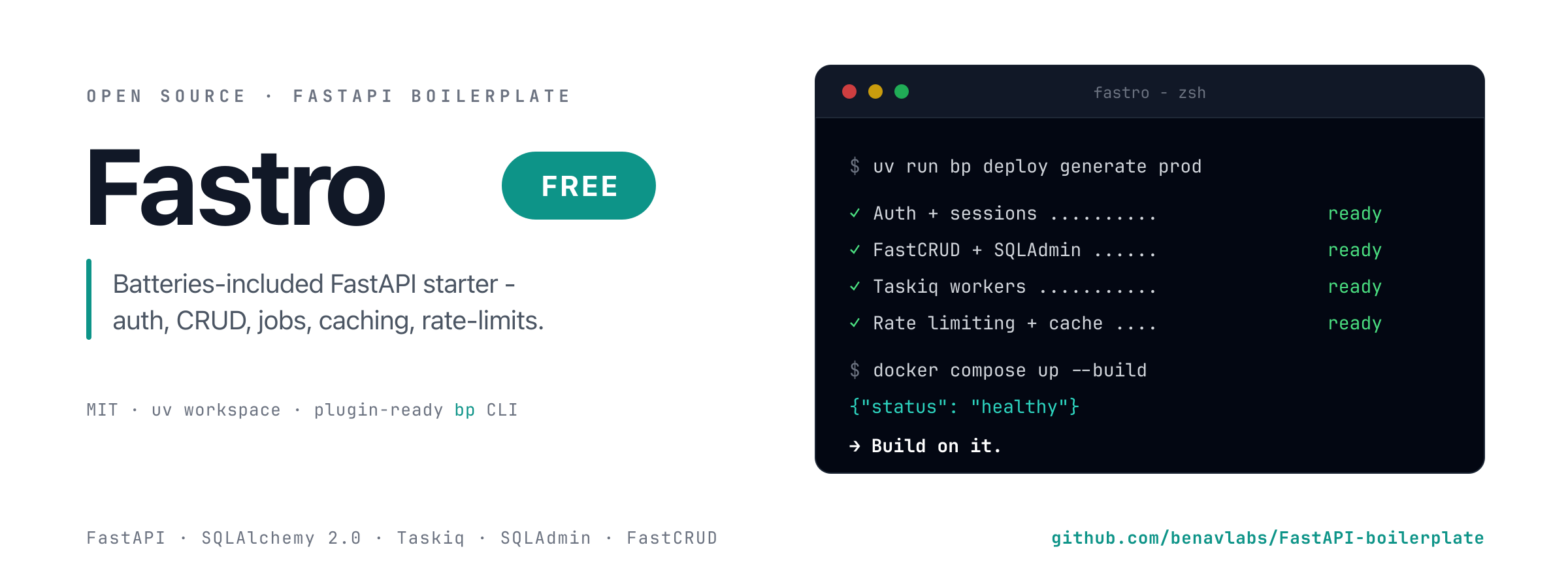
The free, open-source FastAPI foundation. Building a SaaS - AI or not? FastroAI adds payments, entitlements, email & a frontend (plus AI) on top - compare ↓
Features
- Nine removable features - accounts, rbac, tiers, tier_limits, ratelimit, api_keys, admin, cache and taskiq, each leaving with its routes, models, settings, admin views, seeders and tests (guide)
- Fully async FastAPI + SQLAlchemy 2.0
- Pydantic v2 models & validation
- Server-side sessions + CSRF via crudauth; OAuth (Google and GitHub wired); API keys
- Annotated type aliases for all FastAPI dependencies
- Rate limiter with per-tier, per-path rules
- FastCRUD for efficient CRUD & pagination
- SQLAdmin-based admin panel (optional, env-toggled)
- Taskiq workers (Redis or RabbitMQ broker)
- Redis or Memcached caching (
@cachedecorator + provider API) - Plugin-ready
bpCLI - generate compose files, audit env, mount third-party command/feature plugins - Docker Compose for local / prod / nginx-fronted (generated by the CLI)
- Runs on any Postgres - the bundled container, or serverless via Neon (guide)
Why and When to use it
Perfect if you want:
- A pragmatic starter with auth, CRUD, jobs, caching and rate-limits
- Sensible defaults with the freedom to opt-out of modules
- A foundation that grows - vertical-slice modules + a plugin-aware CLI for code generators
- Docs over boilerplate in this README - depth lives on the docs site
Not a fit if you need a monorepo microservices scaffold - see the docs for pointers.
What you get:
- App: FastAPI app factory, env-aware docs exposure
- Auth: server-side sessions, CSRF, OAuth, API keys
- DB: Postgres + SQLAlchemy 2.0, Alembic migrations with prod-confirm gate - local container or serverless (Neon)
- CRUD: FastCRUD generics
- Caching: decorator + provider API (Redis or Memcached)
- Queues: Taskiq workers (Redis or RabbitMQ)
- Rate limits: per-tier + per-path rules
- Admin: SQLAdmin views (optional, env-toggled)
- CLI:
bptool for compose scaffolding, env audits, and plugin extensions
Fastro vs FastroAI
This boilerplate - Fastro - is the free, open-source foundation: everything you need for a production FastAPI backend. FastroAI is the paid template built on the same foundation for shipping a complete SaaS - Stripe billing (subscriptions, credits, discounts), entitlements, transactional email, and a frontend, all wired together. Building an AI product? The PydanticAI agent layer is included too - but every paid feature fits a regular SaaS just as well.
| Fastro (this repo · free) | FastroAI (paid) | |
|---|---|---|
| FastAPI + SQLAlchemy 2.0, Pydantic v2 | ✓ | ✓ |
| Auth - sessions, OAuth, API keys | ✓ | ✓ + JWT |
| FastCRUD · SQLAdmin · Alembic | ✓ | ✓ |
| Caching · rate limiting · Taskiq jobs | ✓ | ✓ |
| Docker (local / prod / nginx) | ✓ | ✓ |
bp CLI - scaffolding, env audit, plugins |
✓ | |
| Payments - Stripe: subscriptions, credits, discounts, webhooks | ✓ | |
| Entitlements - feature gating by plan/tier | ✓ | |
| Transactional email & notifications | ✓ | |
| Frontend - Astro landing / marketing site | ✓ | |
| Observability - Logfire tracing & metrics | ✓ | |
| AI agents - PydanticAI: memory, tools, usage tracking | ✓ | |
| Support | Community · Discord | Priority · lifetime updates |
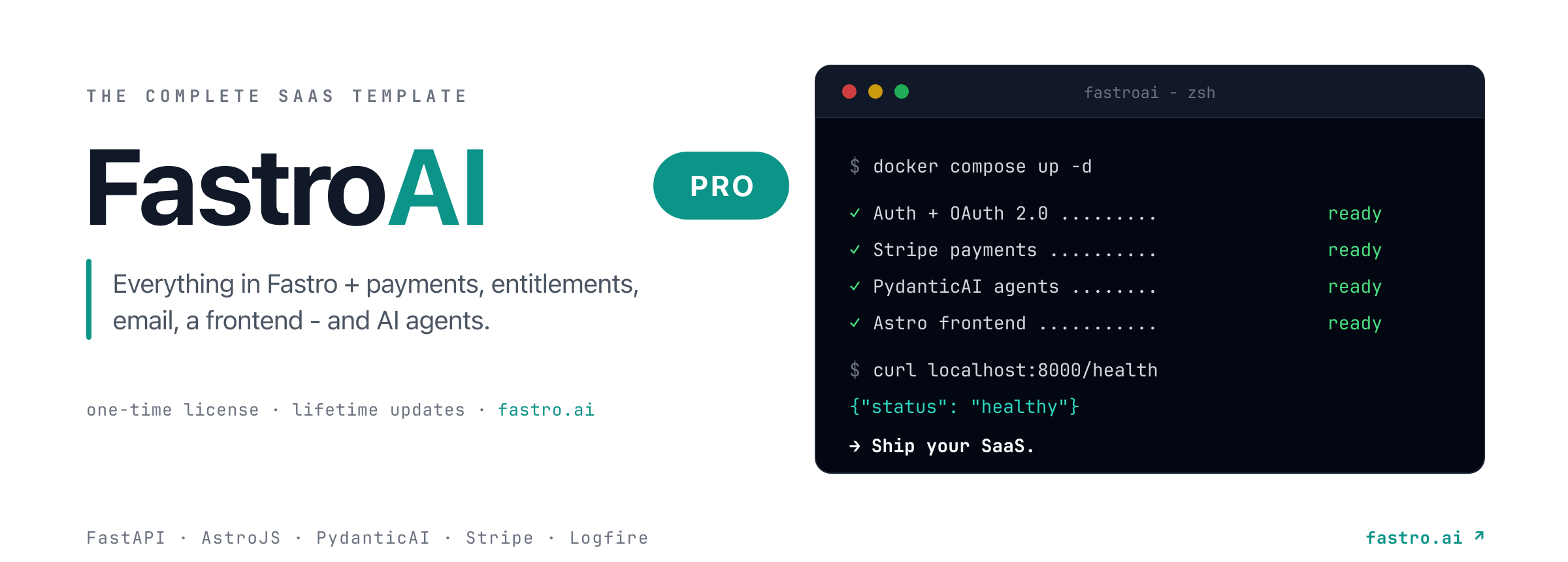
Stick with Fastro if you want a clean, hackable FastAPI backend to build on. Get FastroAI → if you're shipping a SaaS - AI or not - and want billing, entitlements, email, auth, and a frontend ready out of the box.
Repo Layout
This is a uv workspace with two members. One venv at the root covers both.
fastapi-boilerplate/
├── pyproject.toml          # workspace root (uv workspace metadata)
├── backend/                # the deployable application
│   ├── src/                # interfaces/, infrastructure/, modules/
│   ├── pyproject.toml
│   └── Dockerfile          # multi-stage: dev / migrate / prod
└── cli/                    # `bp` - developer/operator tool (never ships in prod)
    └── src/cli/
Quickstart
git clone https://github.com/<you>/FastAPI-boilerplate
cd FastAPI-boilerplate
uv sync --all-packages --all-extras           # one venv at the root, both members installed
Generate a compose file for the deployment shape you want:
uv run --no-sync bp deploy generate local               # hot-reload dev stack
# or: uv run --no-sync bp deploy generate prod          # production single-host
# or: uv run --no-sync bp deploy generate nginx         # production behind nginx
Configure your env (the CLI helps with secrets and validation):
cp backend/.env.example backend/.env
uv run --no-sync bp env gen-secret                      # print a fresh SECRET_KEY
uv run --no-sync bp env validate                        # audit .env against the production validator
Bring it up:
docker compose up --build
# → http://127.0.0.1:8000  (Swagger at /docs)
Without Docker (Postgres + Redis required locally - or skip local Postgres with Neon):
cd backend
uv run --no-sync alembic upgrade head
uv run --no-sync python -m scripts.setup_initial_data   # creates the first admin user + default tier
uv run --no-sync fastapi dev src/interfaces/main.py     # API
uv run --no-sync taskiq worker src.infrastructure.taskiq.worker:default_broker  # in a second terminal
Full setup, env-var reference, and per-environment deployment guides live in the docs.
Common tasks
# generate a fresh production-ready compose file
uv run --no-sync bp deploy generate prod --workers 8

# audit your .env against the production security validator
uv run --no-sync bp env validate

# run Alembic migrations
cd backend && uv run --no-sync alembic revision --autogenerate -m "<msg>" && uv run --no-sync alembic upgrade head

# run tests
cd backend && uv run --no-sync pytest

# install bp as a global tool (optional)
uv tool install --editable ./cli
More examples (superuser creation, tiers, rate limits, admin usage, plugin authoring) in the docs.
Sponsors
Neon supports this project with database credits for our open-source infrastructure - thank you. Neon is serverless Postgres: compute scales to zero when idle, and you can branch a database like you branch code (handy for per-PR preview environments).
It's also a drop-in option for your own build, and free to start - the free plan is permanent rather than a trial (no credit card), with enough storage and compute for dev, staging, and small production workloads. Point DATABASE_URL at a Neon project and the local Postgres container becomes optional - no code changes:
DATABASE_URL=postgresql+asyncpg://user:password@ep-xxx-pooler.region.aws.neon.tech/neondb?ssl=require
→ Full Neon guide (connection-string conversion, pooled vs. direct endpoints, scale-to-zero pool settings). Any other managed Postgres works the same way.
Contributing
Read contributing.
References
This project was inspired by a few projects, it's based on them with things changed to the way I like (and pydantic, sqlalchemy updated)
Full Stack FastAPI and PostgreSQLby @tiangolo himselfFastAPI Microservicesby @kludex which heavily inspired this boilerplateAsync Web API with FastAPI + SQLAlchemy 2.0for sqlalchemy 2.0 ORM examplesFastAPI Rocket Boilerplatefor docker compose
License
Contact
Benav Labs – benav.io, discord server
Questions
What is FastAPI-boilerplate?
benavlabs/FastAPI-boilerplate is a public repo on GitHub by benavlabs. An extendable async API using FastAPI, Pydantic V2, SQLAlchemy 2.0, PostgreSQL and Redis.
Is FastAPI-boilerplate open source?
It declares the MIT license on GitHub.
Does FastAPI-boilerplate run on macOS, Windows or Linux?
Its maker tagged it for macOS, Windows and Linux, or as Docker or cross-platform. That is declared by the maker; Take My Repo has not tested it.


