gkd
基于无障碍,高级选择器,订阅规则的自定义屏幕点击安卓应用 | An Android APP with custom screen tapping based on Accessibility, Advanced Selectors, and Subscription Rules
- 45k
- Kotlin
- GPL-3.0
- 13 d ago
Compose Desktop for native target using SDL3
Repo bitsycore/compose-desktop-native, read from GitHub 1 min ago. bitsycore has not joined Take My Repo.
bitsycore/compose-desktop-native is a public repo on GitHub by bitsycore. Compose Desktop for native target using SDL3. It declares the MIT license on GitHub. It is written mainly in Kotlin, has 139 stars and last changed on 2026-11-23. Nobody has reviewed it on Take My Repo yet, which says nothing about its quality. Read from GitHub on 2026-11-25.
基于无障碍,高级选择器,订阅规则的自定义屏幕点击安卓应用 | An Android APP with custom screen tapping based on Accessibility, Advanced Selectors, and Subscription Rules
Run Compose Multiplatform as a native binary, with no JVM. Compose Desktop Native compiles to a single executable for macOS (arm64), Linux (x64/arm64), and Windows (mingwX64), using SDL3 for windowing and input.
org.jetbrains.compose.runtime klibs from Maven, never
reimplemented.androidx.compose.ui, foundation,
animation, and material3 are copied from Compose Multiplatform verbatim
wherever they compile as is, with project code filling in only the native glue.
The same treatment extends to ecosystem libraries that stop short of
Kotlin/Native desktop - Koin, Coil 3 and Pulse MVI are vendored and rebuilt for
these targets, and you still declare their official coordinates.skiko-windows-x64.dll.data.kres
resource bundle; on Windows it also ships skiko-windows-x64.dll next to the
exe (auto-provisioned by the bridge plugin).| Platform | Gradle target | Renderer |
|---|---|---|
| macOS arm64 | macosArm64 |
Skia (Metal) - official Skiko |
| Linux x64 / arm64 | linuxX64 / linuxArm64 |
Skia (OpenGL) - official Skiko |
| Windows | mingwX64 |
Skia - bitsycore Skiko fork |
import androidx.compose.material3.Text
import com.compose.sdl.nativeComposeWindow

fun main() = nativeComposeWindow(title = "Hello") {
    Text("Hello from Compose Desktop Native")
}
The content lambda runs with a ComposeWindowScope receiver that exposes
window: ComposeNativeWindow (setTitle, setSize, minimize, maximize,
setFullscreen, close). The same handle is reachable from any nested
composable via LocalComposeNativeWindow.current.
For multiple windows, wrap them in nativeComposeApp, where the set of
Window(...) calls is state driven (Compose Desktop style):
fun main() = nativeComposeApp {
    Window(title = "Main", onCloseRequest = ::exitApplication) { /* ... */ }
    if (showInspector) {
        Window(title = "Inspector", onCloseRequest = { showInspector = false }) { /* ... */ }
    }
}
Each window gets its own Lifecycle, ViewModelStore, and SavedStateRegistry
owners, driven by real SDL focus and visibility events, so ViewModels and
saved state behave as they do on Android.
Window() takes the same attributes as Compose Desktop's - undecorated,
transparent, resizable, enabled, focusable, alwaysOnTop,
onPreviewKeyEvent and onKeyEvent - and re-applies them when they change.
(transparent is the one exception: SDL needs it at window-creation time, so it
is fixed for the window's life.)
When the Compose-level API doesn't reach far enough, drop to SDL directly:
val handles = window.rawSdlHandles()   // SDL_Window* / SDL_Renderer* / GL / Metal
handles.window?.let { sdl3.SDL_FlashWindow(it.reinterpret(), SDL_FLASH_BRIEFLY) }
The pointers are a snapshot valid only while the window lives, and which ones
are non-null depends on the resolved renderer (glContext for Skia OpenGL,
metalView for Metal, renderer for CPU raster).
commonMain.dependencies {
    implementation(project(":compose:desktop:native:desktop-native-window")) // window shell + main loop
    implementation(project(":compose:material3:material3"))   // Material 3 widgets
    implementation(project(":utils:material-symbols"))        // icon-font composables (in-repo utility, not published)
}
The klibs publish to maven.bitsycore.com
(no auth) and GitHub Packages (authenticated fallback) under per-area coordinates that mirror
upstream - com.bitsycore.compose.ui:ui, com.bitsycore.compose.foundation:foundation,
… (the com.bitsycore fork of each org.jetbrains.compose.*). Apply
the bridge Gradle plugin once, declare the official Compose Multiplatform
coordinates, and the plugin swaps in the port's klibs on native desktop targets
while android, jvm, iOS, and wasm keep resolving the official artifacts.
// build.gradle.kts, official coordinates everywhere
plugins {
    kotlin("multiplatform")
    id("org.jetbrains.compose")
    id("com.bitsycore.compose-desktop-native.bridge") version "<release>"
}

commonMain.dependencies {
    // The plugin exposes the exact Compose versions the port tracks, so you
    // never hand-match them (material3 and material3-adaptive each ride their
    // own release train upstream).
    implementation("org.jetbrains.compose.runtime:runtime:${composeDesktopNative.composeRuntime}")
    implementation("org.jetbrains.compose.ui:ui:${composeDesktopNative.compose}")
    implementation("org.jetbrains.compose.foundation:foundation:${composeDesktopNative.compose}")
    implementation("org.jetbrains.compose.material3:material3:${composeDesktopNative.composeMaterial3}")

    // material3-adaptive, which upstream publishes for apple targets only.
    // Note adaptive api-exposes androidx.window:window-core - declare it
    // DIRECTLY if your commonMain touches WindowSizeClass, since substituted
    // modules hide their transitives from the common metadata classpath.
    val vAdaptive = composeDesktopNative.composeMaterial3Adaptive
    implementation("org.jetbrains.compose.material3.adaptive:adaptive:$vAdaptive")
    implementation("org.jetbrains.compose.material3.adaptive:adaptive-layout:$vAdaptive")
    implementation("androidx.window:window-core:1.5.1")
}
One repository, no credentials. https://maven.bitsycore.com/releases
carries both the port's artifacts and the bitsycore skiko fork
(com.bitsycore.skiko), which the Windows (mingwX64) target renders through;
macOS/Linux pull the official skiko from Maven Central instead. The exact
repositories {} snippet and version pinning:
gradle-plugin/compose-desktop-native-bridge/README.md.
For a complete project that applies the bridge and builds one shared UI for Android, JVM, and native desktop, see the example repo: bitsycore/compose-desktop-native-bridge-example.
Both live in commonMain and also build for stock JVM Compose Desktop, which
serves as the visual and behavioural reference: any difference against the
native build is a porting bug.
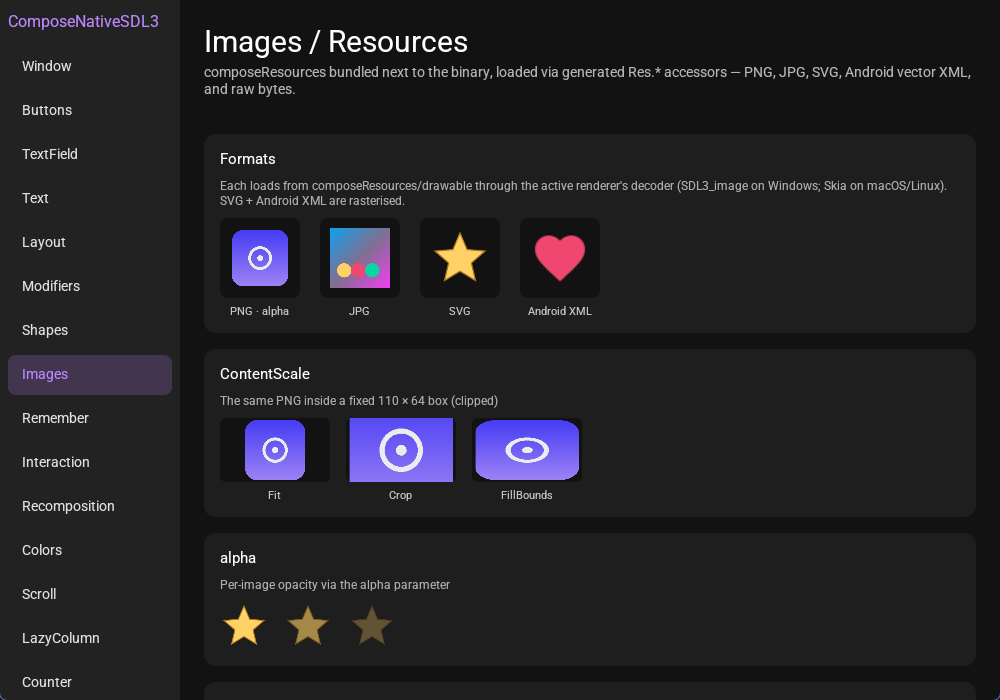
:demo is a tour of the re-implemented Compose and Material 3 surface,
30-plus screens covering text, layout, shapes, images, state, lazy lists,
dialogs, canvas, graphics layers, animation, and gestures.
./gradlew :demo:runDebugExecutableMacosArm64   # macOS (Skia / Metal)
./gradlew :demo:runDebugExecutableLinuxX64     # Linux (Skia / OpenGL)
gradlew.bat :demo:runDebugExecutableMingwX64   # Windows (Skia / Skiko fork)
./gradlew :demo:run                            # JVM Compose Desktop (reference)
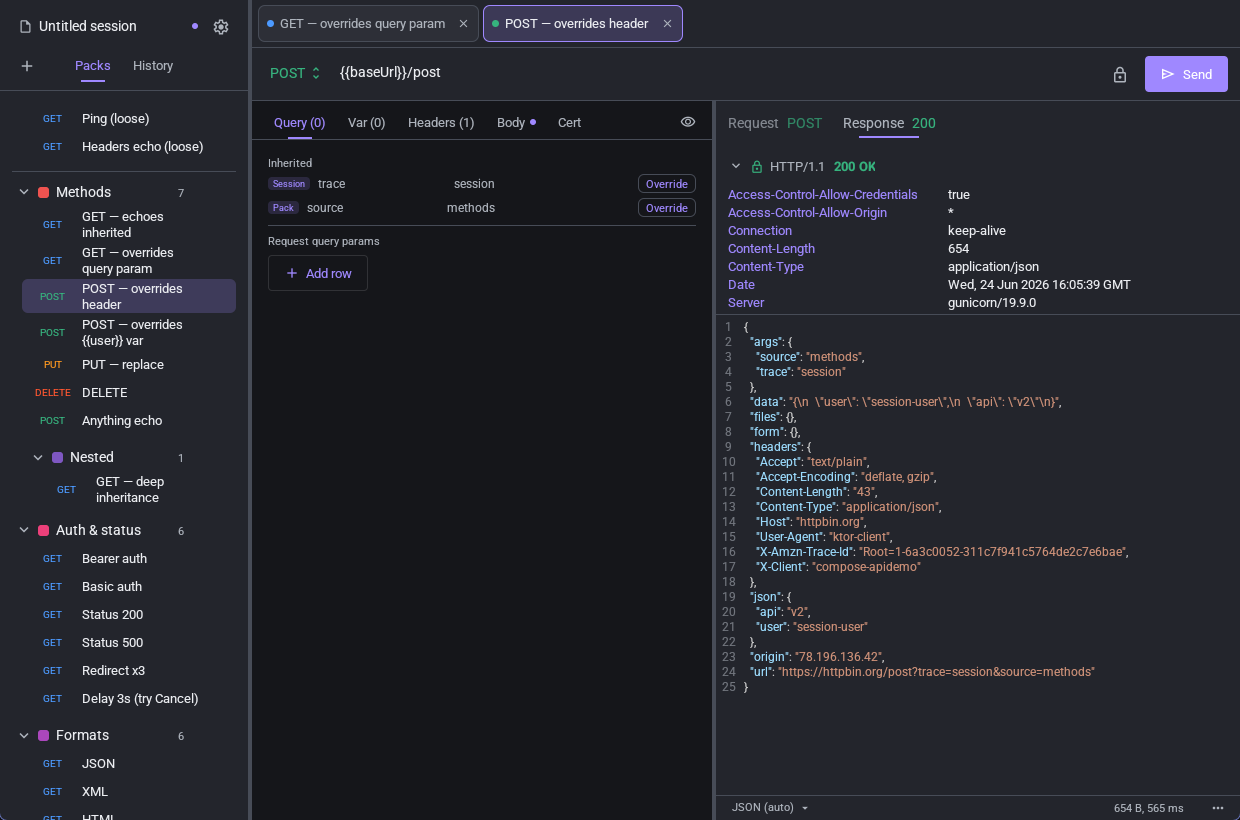
:apidemo is a Postman-style REST client built entirely on the library:
request collections, a session inheritance ladder, syntax-highlighted body
editors, a response viewer with timing and TLS-chain inspection, and mTLS
client certificates.
./gradlew :apidemo:runDebugExecutableMacosArm64
./gradlew :apidemo:run                         # JVM Compose Desktop (reference)
One Gradle module per upstream artifact, and the Gradle path mirrors the
directory (:compose:ui:ui, :compose:foundation:foundation, …). The renderer
lives in :compose:ui:ui and the sdl3 cinterop in :sdl:sdl-core;
:compose:desktop:native:desktop-native-window is the SDL integration layer.
Most of the androidx architecture stack (lifecycle, viewmodel, navigation3, savedstate, navigationevent) ships real Kotlin/Native desktop klibs and runs on the port unmodified. Where an ecosystem library stops short of Kotlin/Native desktop, this repo vendors it verbatim from upstream and rebuilds it for these targets, so you keep writing against the official coordinates:
| Vendored | Why | Published as |
|---|---|---|
Compose ui / foundation / animation / material3 |
the port itself | com.bitsycore.compose.* |
components-resources, navigation3-ui |
no mingwX64 / linux klibs | com.bitsycore.compose.components, com.bitsycore.navigation3 |
| Koin viewmodel + compose modules | apple + android only upstream (koin-core itself is fine) |
com.bitsycore.koin |
| Coil 3 (whole stack) | no mingwX64 anywhere; no desktop native at all for its compose layer | com.bitsycore.coil3 |
| Pulse MVI | no desktop-native artifact upstream | com.bitsycore.compose.desktop.native.pulse |
| material3-adaptive (all four) | ios + macosArm64 only upstream - no linux, no mingw | com.bitsycore.compose.material3.adaptive |
The bridge plugin substitutes each of these on native desktop configurations, so
app code declares io.insert-koin:koin-compose, io.coil-kt.coil3:coil-compose
and so on exactly as it would anywhere else. The full module map, dependency
graph, and the list of compatible artifacts are in CLAUDE.md.
Everything below is pinned in exactly two files -
gradle/libs.versions.toml (Maven coordinates) and
scripts/compose-fork/compose.properties
(the upstream git refs the vendored sources are copied from) - plus
scripts/build-sdl/build-sdl.properties
for SDL3. A release tracks one Compose Multiplatform version; the table is the
contract.
Version policy. Anything Compose Multiplatform integrates is pinned to what
CMP ships - for the androidx mirrors, the Jetpack version CMP's release notes
map its org.jetbrains.androidx.* artifact to, since this port consumes the
google coordinates. Anything CMP does not integrate is pinned to the latest
release. Deliberate exceptions are commented in the catalog; there is currently
one (savedstate, below).
| Version | Notes | |
|---|---|---|
| Kotlin | 2.4.21 | Newer than the 2.3.20 CMP 1.12.2 is built with. Kotlin/Native consumes older klibs fine, and the whole port builds clean on 2.4.21 with no klib API diff, so there is no reason to hold back. |
| Compose Multiplatform | 1.12.2 | The vendored sources are the v1.12.2 tag of both upstream repos, and the JVM parity leg forces the same version - no dev-build skew. 1.12.2 moves skiko to 0.150.2, so the mingwX64 fork was rebased onto skiko v0.150.2 and republished to keep the same Skia base. |
| SDL3 | release-3.4.20 | Built from source as a static lib per host (scripts/build-sdl/build-all.py), linked into the executable. |
| Skiko | 0.150.2 | macOS / Linux use the official org.jetbrains.skiko. |
| Skiko (Windows fork) | 0.150.2-mingw.1 | com.bitsycore.skiko:skiko - Skiko + Skia in skiko-windows-x64.dll. Same Skia base as the official build. Public repo, no auth. |
The port republishes each vendored artifact under a com.bitsycore group that
mirrors the upstream one, so the fork of any given coordinate is obvious. Apply
the bridge plugin and you keep declaring the official coordinate.
| Library | Official coordinate | Port coordinate |
|---|---|---|
| Runtime | org.jetbrains.compose.runtime:runtime*:1.12.2 |
not forked - the official klibs serve every target |
| UI | org.jetbrains.compose.ui:ui*:1.12.2 |
com.bitsycore.compose.ui:ui* |
| Foundation | org.jetbrains.compose.foundation:foundation*:1.12.2 |
com.bitsycore.compose.foundation:foundation* |
bitsycore/compose-desktop-native is a public repo on GitHub by bitsycore. Compose Desktop for native target using SDL3.
It declares the MIT license on GitHub.
Its maker has not tagged a system, so it is unknown here. Its README says what it needs.
Open "Take it" on its page: Take My Repo writes an install plan for your machine and hands it to your AI agent (Claude Code, Codex or Cursor), which asks you before each step. Take My Repo has not tested it on any machine.
:books: 免费的计算机编程类中文书籍,欢迎投稿
Kotlin Multiplatform sample with SwiftUI, Jetpack Compose, Compose for Wear, Compose for Desktop, and Compose for Web clients along with Ktor backend.
🩵 A free, open-source app store for developers' releases on GitHub, Codeberg & Forgejo — browse, discover, and install apps with one click. Formerly GitHub Store.
A library for reading and writing data that lives in network, disk, and memory.
Its last change on GitHub was on 2026-11-23. Take My Repo does not judge from that whether it is maintained.
Nobody has reviewed it on Take My Repo yet, which says nothing about its quality.
Take My Repo cannot say: it does not audit code and has not run compose-desktop-native. What is known comes from GitHub. It declares the MIT license on GitHub. Its last change was on 2026-11-23. It has 139 stars, which measure popularity, not safety. Nobody has reviewed it on Take My Repo yet, which says nothing about its quality. Read the source before you run it. With "Take it", your AI agent shows each step and asks you before running it; README text is treated as data, not as instructions.