VoiceStudio
VoiceStudio is the open-source, fully-local ElevenLabs alternative — voice cloning, voice design, video dubbing, dictation, transcription & audiobook creation in 646 languages.
- 117k
- Python
- AGPL-3.0
- 8 h ago
Fast open-source (MIT) LLM engine in C++/CUDA for RTX 3090-class GPUs. Five models in one OpenAI/Anthropic-compatible server: Qwen3.8-Flash-Next, Qwen3.8-27B, DeepSeek-V4.1-Flash, GLM-5.3-Flash, gpt-oss-120B. On 3x RTX 3090: up to 1,061 tok/s total output, 524 tok/s single stream, 13,280 tok/s prefill, up to 1M context.
Repo bpx03/QEngine, read from GitHub 2 h ago. bpx03 has not joined Take My Repo.
bpx03/QEngine is a public repo on GitHub by bpx03. Fast open-source (MIT) LLM engine in C++/CUDA for RTX 3090-class GPUs. Five models in one OpenAI/Anthropic-compatible server: Qwen3.8-Flash-Next, Qwen3.8-27B, DeepSeek-V4.1-Flash, GLM-5.3-Flash, gpt-oss-120B. On 3x RTX 3090: up to 1,061 tok/s total output, 524 tok/s single stream, 13,280 tok/s prefill, up to 1M context. It declares the MIT license on GitHub. It is written mainly in Cuda, has 85 stars and last changed on 2026-11-22. Nobody has reviewed it on Take My Repo yet, which says nothing about its quality. Read from GitHub on 2026-11-24.
VoiceStudio is the open-source, fully-local ElevenLabs alternative — voice cloning, voice design, video dubbing, dictation, transcription & audiobook creation in 646 languages.

Built and tested on one home machine. If QEngine helps you, a coffee keeps it going.
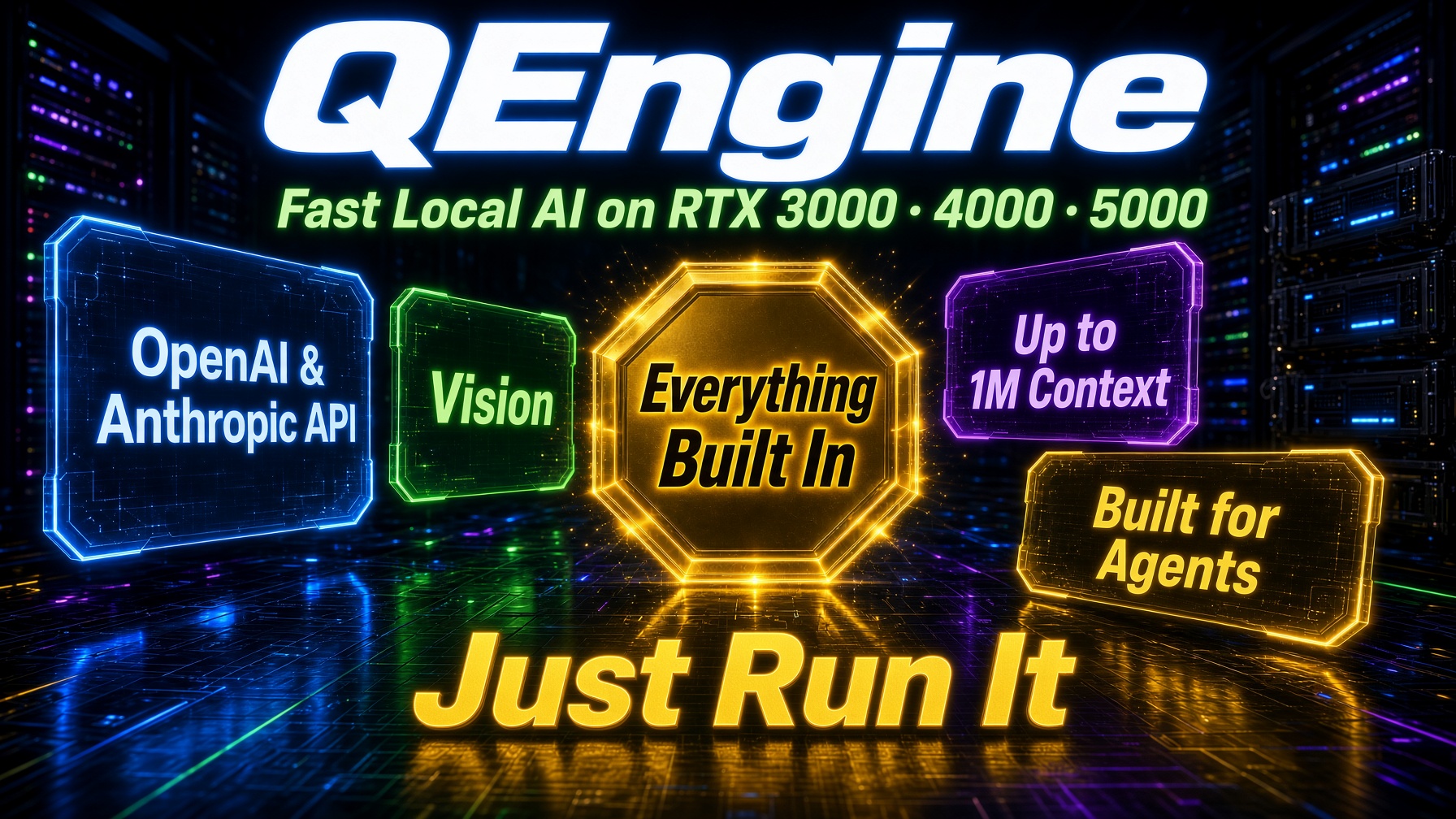
QEngine is an open-source (MIT) inference engine for five models on NVIDIA RTX 3000, 4000 and 5000 series cards, with nothing extra to install or set for any of them (tuned on the RTX 3090):
One server serves any of them through an OpenAI-compatible and an Anthropic-compatible API (it works with agent clients such as Claude Code). The C++/CUDA engines are built as shared libraries; the Python server loads them and handles the API, tool calls, structured output, scheduling and caching.
Measured on my machine (3× RTX 3090, 24 GB, PCIe 4.0 x16, GPU P2P on), QEngine 1.5.0 with its default settings and the club-3090 benchmark tools (November 19, 2026):
| output tok/s unless noted | Qwen3.8-27B | Qwen3.8-Flash-Next | DeepSeek-V4.1-Flash | GLM-5.3-Flash | gpt-oss-120B |
|---|---|---|---|---|---|
| single-stream decode, narrative / code | 275 / 524 | 310 / 452 | 88 / 120 | 110 / 92 | 301 / 301 |
| prefill, 10K-token prompt: tok/s, time to first token | 6,188, 1.60 s | 8,254, 1.23 s | 4,217, 2.35 s | 2,920, 3.42 s | 13,280, 0.74 s |
| prefill, 90K-token prompt: tok/s, time to first token | 4,994, 18.0 s | 8,390, 10.5 s | 4,895, 17.8 s | 3,572, 25.4 s | 5,055, 17.6 s |
| total output, 1 / 4 / 8 / 16 streams at once | 312 / 575 / 848 / 999 | 300 / 642 / 880 / 1,061 | 70 / 73 / 78 / 78 | 72 / 55 / 50 / 44 | 306 / 594 / 731 / 835 |
| model | weights | quality against a reference |
|---|---|---|
| Qwen3.8-27B | INT4 W4A16, group 128 (RedHatAI) plus its MTP head | next-token KL 0.0154 against BF16, top-1 agreement 95.3 % |
| Qwen3.8-Flash-Next | routed experts INT4 (Intel's AutoRound, repacked bit-exact); shared expert and dense parts INT8 or calibrated INT4; DeltaNet projections INT8 | next-token KL 0.114 against BF16, top-1 agreement 89.6 % |
| DeepSeek-V4.1-Flash | the Maya-S GGUF files as they are: experts IQ2_XXS / IQ2_S / IQ3_XXS / IQ3_S, dense Q8_0, Engram Q6_K | negative log-likelihood 1.635 on my test texts (no full-precision reference fits on this machine) |
| GLM-5.3-Flash | my INT4 quant: routed experts and KDA layers INT4 (details) | next-token KL 0.59 against the official FP8 model (three prompts: 0.45-0.77) |
| gpt-oss-120B | OpenAI's checkpoint as it is: MXFP4 experts, bf16 dense weights | next-token KL 0.118 against an fp32 reference of the model, top-1 agreement 86.9 % |
(Single-stream decode: club-3090 bench.sh with each model's own sampling; streams: its concurrency-probe.sh,
greedy, 256-token prompts and replies, total output of all streams; each number is the mean of 2 to 6 runs. The two
Qwen servers ran with thinking on at effort low and vision on. For 16 streams the servers that hold 8 conversations
by default were started with 16: GLM_CONVS=16, DeepSeek-V4.1-Flash --max-active 16, GPTOSS_SLOTS=16.
DeepSeek-V4.1-Flash and GLM-5.3-Flash decode one conversation at a time and give the streams turns, so their total
output stays at about one stream's. gpt-oss-120B at 90K: prompts of 86,786 and 89,998 tokens. Quality: the same
builds; the 8-pack results are below.)
Flash-Next quality, in more detail: next-token KL divergence against the official BF16 model on the public set
jyohukuchan/qwen38-flash-next-bf16-logits,
scored with its own compare.py: mean KL 0.114, top-1 agreement 89.6 %, WikiText-2 KL 0.125 (0.126 when
the context went through batched prefill). 1.5.0 build, November 19, 2026, the same as 1.3.6 to every digit; details
and the command under Quality.
What is new in 1.5.1 (stable, latest; it also holds everything from 1.5.0 below): two Flash-Next fixes.
FLASH_CKPT=0 no longer crashes the server (SIGFPE) when a checkpoint is planned at the point where two prompts
diverge (#41), and after a pinned prefix is dropped (pin budget or
host-memory pressure) the archive goes back under its budget at once (#40).
The other models are unchanged. Checked with the same greedy output and speed as 1.5.0; the release checks and the
numbers on this page are from 1.5.0 (release notes).
What is new in 1.5.0:
Three new models, as previews, in the same server, API and Docker image as the two Qwen models (what each one supports: Feature matrix):
27B: the first token comes much sooner with many agents at once. The 27B used to keep half of the GPU time for
running replies however many requests waited for their prompt. Now the time split follows the queue: short prompts
are prefilled back to back with one decode step between passes, long ones share the time by head count, and running
replies keep at least 10 % of it (--prefill-share-min, --prefill-short; --prefill-share-min 0.5 gives the old
split). It counts a running reply at admission by its max_tokens, and no longer copies a whole conversation to the
host archive when the next turn only replaces the last reply. On my 2 cards, in an agent replay with short tool
results, the median time to the first token at 16 agents in flight went from 4.5 s to 0.86 s, with 7 % more total
output; single-stream speed is unchanged (numbers). Beyond its 16 decode seats a request is
prefilled on one of two seats kept for prompts, gets its first token, and its reply waits parked in host memory (KV
and state, resumed exactly where it stopped) until a decode seat frees (--park, --park-reserve; --park 0
waits for a seat first, as before). Archived conversations keep two recurrent-state checkpoints instead of four
(QE_ARCH_SUBS), so the host archive holds about 1.5 times as many agents. At 32 and 64 agents in flight with the
defaults on 2 cards (release build): median first token 1.0 / 0.48 / 1.0 s at 16 / 32 / 64 agents in flight, with
243 / 359 / 285 tok/s total output and no agent's prompt computed again. QE_MAX_SEQS=32 (opt-in) seats 32 conversations on 2 and 3 cards: at 32 agents in flight
on 2 cards the median first token went from 25 s to 0.48 s with 106 % more total output, at the cost of a smaller
KV pool (2 cards: 417,792 tokens instead of 623,616, so two very long conversations no longer fit at once).
Flash-Next: the first token comes much sooner with several agents at once. Every prompt now keeps the state at
its own end, so an agent's next turn resumes there even when the client sends back another text for the reply or
drops its reasoning; before, a turn shorter than 4,096 tokens was recomputed on the next turn (about a third of
all prefill work in an agent replay). A conversation keeps three recurrent states instead of six (its system end,
its latest prompt end and the newest other one; FLASH_CKPT_KEEP=6 as before), so the host archive holds 64
agents. On 3 cards the time split follows the queue as on the 27B: while short prompts are next, running replies
get 10 % of the time after every prefill pass instead of half (--prefill-share-min; 2 cards and mode B keep the
fixed split). In an agent replay with short tool results the median time to the first token went from 0.16 / 0.44
/ 1.91 / 3.93 s to 0.13 / 0.25 / 0.37 / 2.83 s at 1 / 4 / 16 / 32 agents in flight, with 15 / 14 / 16 / 10 % more
total output (numbers). Beyond the 16 decode seats Flash-Next now parks as the 27B does
(--park, on 3 cards in tp mode): a reply gets its first token from one of 4 seats kept for prompts, waits in
host memory and resumes exactly where it stopped when a seat frees. At 32 / 64 agents the median time to the
first token went from 2.83 / 8.0 s to 0.26 / 0.75 s, with 5 / 9 % more total output.
Flash-Next: no more stops at a slot hand-off when the host is short of memory
(#32, #25). The
engine's log lines go through a writer thread, so a slow log reader can no longer hold up a GPU step
(QE_LOG_ASYNC); the archive's memory is pinned in the background only while the engine is idle, 1 GB at a time,
and pinning pauses (and backs off) when a registration is slow, which is a sign of host memory pressure. Thanks to
cristianflorett, dgaglioni and gbinka for the reports and measurements behind the Flash-Next hand-off fix (#32, #25).
Both Qwen models give memory back when other programs squeeze the host while they serve. A background thread
watches the kernel's memory-pressure and swap-in counters next to MemAvailable; under pressure the engine stops
growing, frees archive memory, shrinks the archive, drops pinned prompts and, last (Flash-Next), moves the n-gram
table to the page cache, one logged stage at a time, and it returns slowly once the host stays calm (QE_MEMP=0
turns it off; details). With 179 GB taken by another program on my machine,
Flash-Next went down to the last stage and served every request, with the same greedy text.
bpx03/QEngine is a public repo on GitHub by bpx03. Fast open-source (MIT) LLM engine in C++/CUDA for RTX 3090-class GPUs. Five models in one OpenAI/Anthropic-compatible server: Qwen3.8-Flash-Next, Qwen3.8-27B, DeepSeek-V4.1-Flash, GLM-5.3-Flash, gpt-oss-120B. On 3x RTX 3090: up to 1,061 tok/s total output, 524 tok/s single stream, 13,280 tok/s prefill, up to 1M context.
It declares the MIT license on GitHub.
Its maker has not tagged a system, so it is unknown here. Its README says what it needs.
A high-throughput and memory-efficient inference and serving engine for LLMs
The agent harness performance optimization system. Skills, instincts, memory, security, and research-first development for Claude Code, Codex, Opencode, Cursor and beyond.
Ultralytics YOLOv5 in PyTorch for object detection, instance segmentation, classification, training, and export.
Open "Take it" on its page: Take My Repo writes an install plan for your machine and hands it to your AI agent (Claude Code, Codex or Cursor), which asks you before each step. Take My Repo has not tested it on any machine.
Its last change on GitHub was on 2026-11-22. Take My Repo does not judge from that whether it is maintained.
Nobody has reviewed it on Take My Repo yet, which says nothing about its quality.
Take My Repo cannot say: it does not audit code and has not run QEngine. What is known comes from GitHub. It declares the MIT license on GitHub. Its last change was on 2026-11-22. It has 85 stars, which measure popularity, not safety. Nobody has reviewed it on Take My Repo yet, which says nothing about its quality. Read the source before you run it. With "Take it", your AI agent shows each step and asks you before running it; README text is treated as data, not as instructions.