fastapi
FastAPI framework, high performance, easy to learn, fast to code, ready for production
- 105k
- Python
- MIT
- 5 d ago
High-performance priority JSON streaming. SIMD parsing, zero-cost GAT async, skeleton-first rendering. Rust + WebAssembly.
Repo bug-ops/pjs, read from GitHub 8 h ago. bug-ops has not joined Take My Repo.
bug-ops/pjs is a public repo on GitHub by bug-ops. High-performance priority JSON streaming. SIMD parsing, zero-cost GAT async, skeleton-first rendering. Rust + WebAssembly. It declares the MIT license on GitHub. It is written mainly in Rust, has 2 stars and last changed on 2026-11-23. Nobody has reviewed it on Take My Repo yet, which says nothing about its quality. Read from GitHub on 2026-11-23.
Send the JSON your UI needs first. Stream the rest.
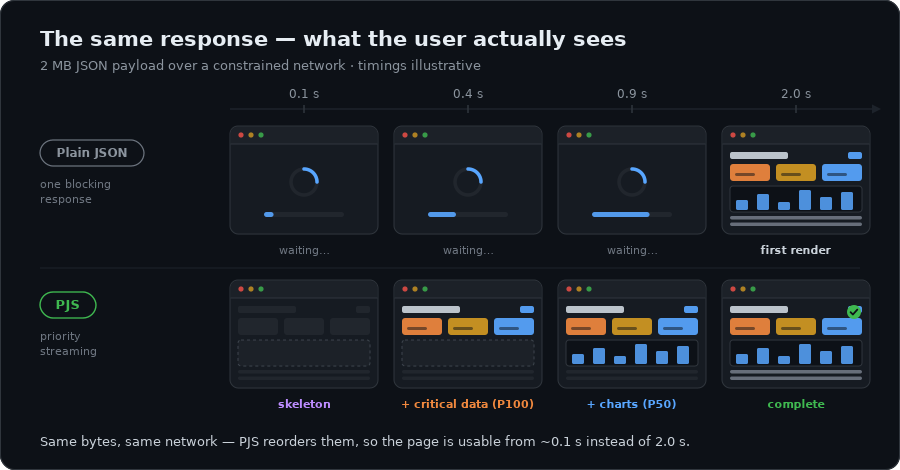
A large JSON response is all-or-nothing: the client renders only after the last byte arrives. PJS splits one document into a skeleton plus prioritized patches, so the UI shows meaningful content after the first frames while the heavy tail streams in the background.
It is the same breadth-first idea behind the React Server Components wire format and GraphQL's @defer/@stream — packaged as a small, framework-agnostic protocol: plain-JSON frames, path-addressed patches, HTTP and WebSocket transports. Rust core, WebAssembly client (~70 KB gzipped).
The server derives a skeleton (full structure, empty values), assigns each subtree a priority (0–255), and splits the document into frames.
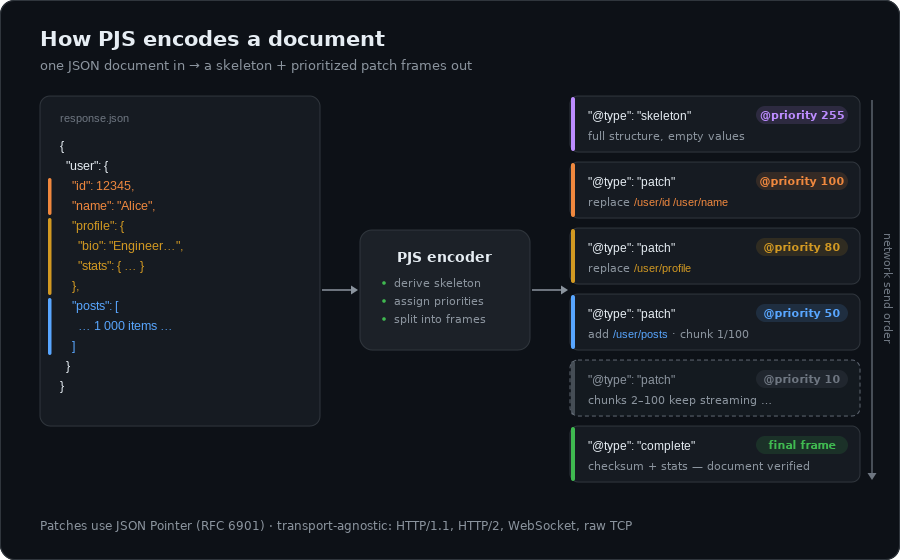
Frames go out in priority order over HTTP (SSE or NDJSON) or WebSocket. Every frame is plain JSON. On the WebSocket transport, a patch frame carries [op, path, argument] triples, where path is an array of segments and op is one of set, merge, append or append_str:
{
  "type": "StreamPatch",
  "data": {
    "session_id": "00000000-0000-4000-8000-000000000001",
    "frame_id": 1,
    "priority": 100,
    "patches": [
      ["set", ["user", "id"], 12345],
      ["set", ["user", "name"], "Alice"]
    ],
    "is_complete": false
  }
}
Large arrays are chunked and streamed at low priority so they never block critical data.
The client applies each patch to its local tree and re-renders immediately. Apply, render, repeat — no custom parser required on the consuming side.
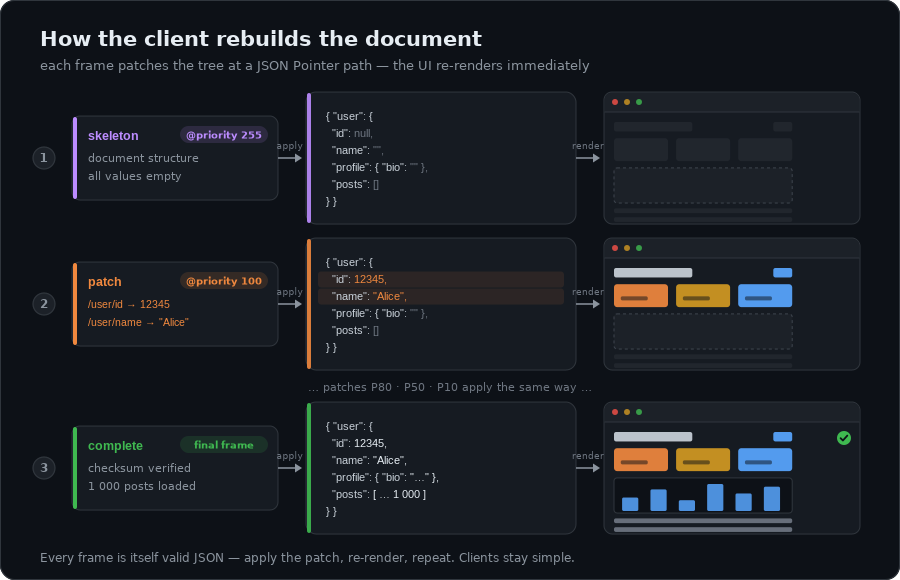
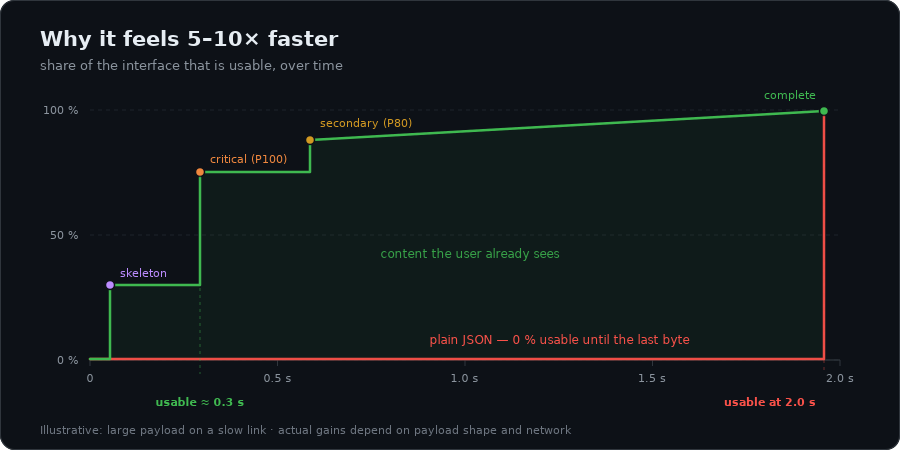
Same bytes, same bandwidth — only the order changes. Layout appears with the skeleton, critical fields right after, heavy tails last. On slow links that is the difference between staring at a spinner and using the page. The protocol's design target is a 5–10× reduction in perceived latency for large payloads (see the specification); bytes-on-wire stay roughly the same.
[dependencies]
pjson-rs = "0.8"
use pjson_rs::infrastructure::http::axum_adapter::create_pjs_router;

#[tokio::main]
async fn main() -> anyhow::Result<()> {
    let app = create_pjs_router().with_state(app_state);
    let listener = tokio::net::TcpListener::bind("127.0.0.1:3000").await?;
    axum::serve(listener, app).await?;
    Ok(())
}
npm install @pjson/wasm
import init, { PriorityStream } from '@pjson/wasm';

await init();
const stream = new PriorityStream();

stream.onFrame((frame) => {
  if (frame.priority >= 80) {
    updateUI(JSON.parse(frame.payload)); // critical data — render now
  }
});
stream.onComplete((stats) => console.log(`${stats.totalFrames} frames in ${stats.durationMs} ms`));

stream.start(json);
[!TIP] See it side by side:
cargo run --example simple_priority_demo, or the browser demo with transport switching and live metrics. Node.js usage and building WASM from source are covered incrates/pjs-wasm.
Good fit
Skip it
@defer/@stream — you get this at the framework layer.| PJS | RSC wire format | GraphQL @defer/@stream |
NDJSON / SSE | |
|---|---|---|---|---|
| Stack | any | React | GraphQL | any |
| Transport | HTTP (SSE, NDJSON), WS | HTTP | HTTP multipart | HTTP |
| Unit of delivery | path-addressed patches | component props | fragments / list items | independent lines |
| Explicit priorities | ✅ 0–255 per subtree |
implicit (Suspense) |
per directive | — |
| Falls back to plain JSON | ✅ content negotiation | — | — | n/a |
Two different questions, two different numbers:
sonic-rs, runtime dispatch to AVX-512/AVX2/SSE4.2/NEON) and GAT-based static dispatch, measured at 1.82× faster than async_trait virtual calls. Reproduce: cargo bench -p pjs-bench.Streaming parsers are a DoS surface, so limits are on by default: max document size and nesting depth, bounded array/object cardinality, checked arithmetic, and 4-layer decompression-bomb protection. All limits are configurable per stream.
| Limit | Default |
|---|---|
| Max JSON size | 10 MB |
| Max nesting depth | 64 |
| Max array elements / object keys | 10 000 |
| Max RLE run | 100 000 items |
| Max delta-array size | 1 000 000 elements |
| Max decompressed size | 10 MB |
const security = new SecurityConfig().setMaxJsonSize(5 * 1024 * 1024).setMaxDepth(32);
stream.setSecurityConfig(security);
Defaults cover the common server + browser path; everything else is opt-in.
| Feature | Description | Default |
|---|---|---|
simd-auto |
sonic-rs SIMD backend, runtime CPU dispatch | ✅ |
simd-avx512 |
x86_64 only; needs -C target-cpu=native |
— |
schema-validation |
Schema validation engine | ✅ |
compression |
zlib/gzip/brotli/zstd with per-session dictionaries | ✅ |
partial-parse |
Streaming partial JSON parsing (jiter) |
— |
http-server |
Axum server with the /pjs/* REST routes |
✅ |
http-auth-jwt |
JWT middleware | — |
websocket-server / websocket-client |
WebSocket transport | ✅ |
mimalloc |
mimalloc as global allocator | — |
metrics |
Prometheus /metrics endpoint (requires nightly once_cell_try) |
— |
float-roundtrip |
Exact f64 round-trip in serde_json parsing (about 2x cost on float tokens; unifies across the whole build) |
— |
[!NOTE] Without
float-roundtrip,serde_jsonmay decode a float 1 ULP away from the exact value (for example inWsMessagepayloads); enable the feature when bit-exact floats matter.
[!NOTE] The
jemallocfeature was removed in v0.6.0 — switch tomimallocor the system allocator.
0.8.x — the core protocol works end to end (Rust server, WASM browser client, Node.js), CI on Linux/macOS/Windows.
[!IMPORTANT]
pjson-rscurrently requires nightly Rust (impl_trait_in_assoc_type, plusonce_cell_trywith themetricsfeature);rust-toolchain.tomlpins a dated nightly.pjson-rs-domainandpjs-wasmbuild on stable Rust 1.89+ (MSRV, checked in CI). Supporting stable is a priority on the road to1.0— if this blocks you, say so in Discussions: it directly affects how we prioritize.
[!NOTE] Pre-
1.0: the wire format may still change. The specification is a draft whose@type/@patchesframe notation predates the shipped WebSocketWsMessageprotocol shown above. Feedback on the frame format is the most valuable contribution right now.
Workspace crates, one line each: pjs-domain (pure protocol logic, WASM-compatible) · pjs-core (Rust implementation, HTTP/WebSocket) · pjs-wasm (browser/Node bindings) · pjs-js-client (TypeScript client) · pjs-demo (interactive demo servers) · pjs-bench (benchmarks). Details in docs/architecture.
# rust-toolchain.toml selects the pinned nightly automatically
cargo +nightly fmt --check
cargo clippy --workspace --all-targets --all-features -- -D warnings
cargo nextest run --workspace --all-features --lib --bins
See CONTRIBUTING.md.
Dual-licensed under Apache-2.0 or MIT, at your option.
bug-ops/pjs is a public repo on GitHub by bug-ops. High-performance priority JSON streaming. SIMD parsing, zero-cost GAT async, skeleton-first rendering. Rust + WebAssembly.
It declares the MIT license on GitHub.
Its maker tagged it for macOS, Windows and Linux, or as Docker or cross-platform. That is declared by the maker; Take My Repo has not tested it.
Open "Take it" on its page: Take My Repo writes an install plan for your machine and hands it to your AI agent (Claude Code, Codex or Cursor), which asks you before each step. Take My Repo has not tested it on any machine.
SRS is a simple, high-performance, AI-driven real-time media server supporting RTMP, WebRTC, HLS, HTTP-FLV, HTTP-TS, SRT, MPEG-DASH, and GB28181, with codec support for H.264, H.265, AV1, VP9, AAC, Opus, and G.711.
High performance self-hosted photo and video management solution.
For developers, who are building real-time data-driven applications, Redis is the preferred, fastest, and most feature-rich cache, data structure server, and document and vector query engine.
Its last change on GitHub was on 2026-11-23. GitHub counts 23 open issues and pull requests. Take My Repo does not judge from that whether it is maintained.
Nobody has reviewed it on Take My Repo yet, which says nothing about its quality.
Take My Repo cannot say: it does not audit code and has not run pjs. What is known comes from GitHub. It declares the MIT license on GitHub. Its last change was on 2026-11-23. It has 2 stars, which measure popularity, not safety. Nobody has reviewed it on Take My Repo yet, which says nothing about its quality. Read the source before you run it. With "Take it", your AI agent shows each step and asks you before running it; README text is treated as data, not as instructions.