ECC
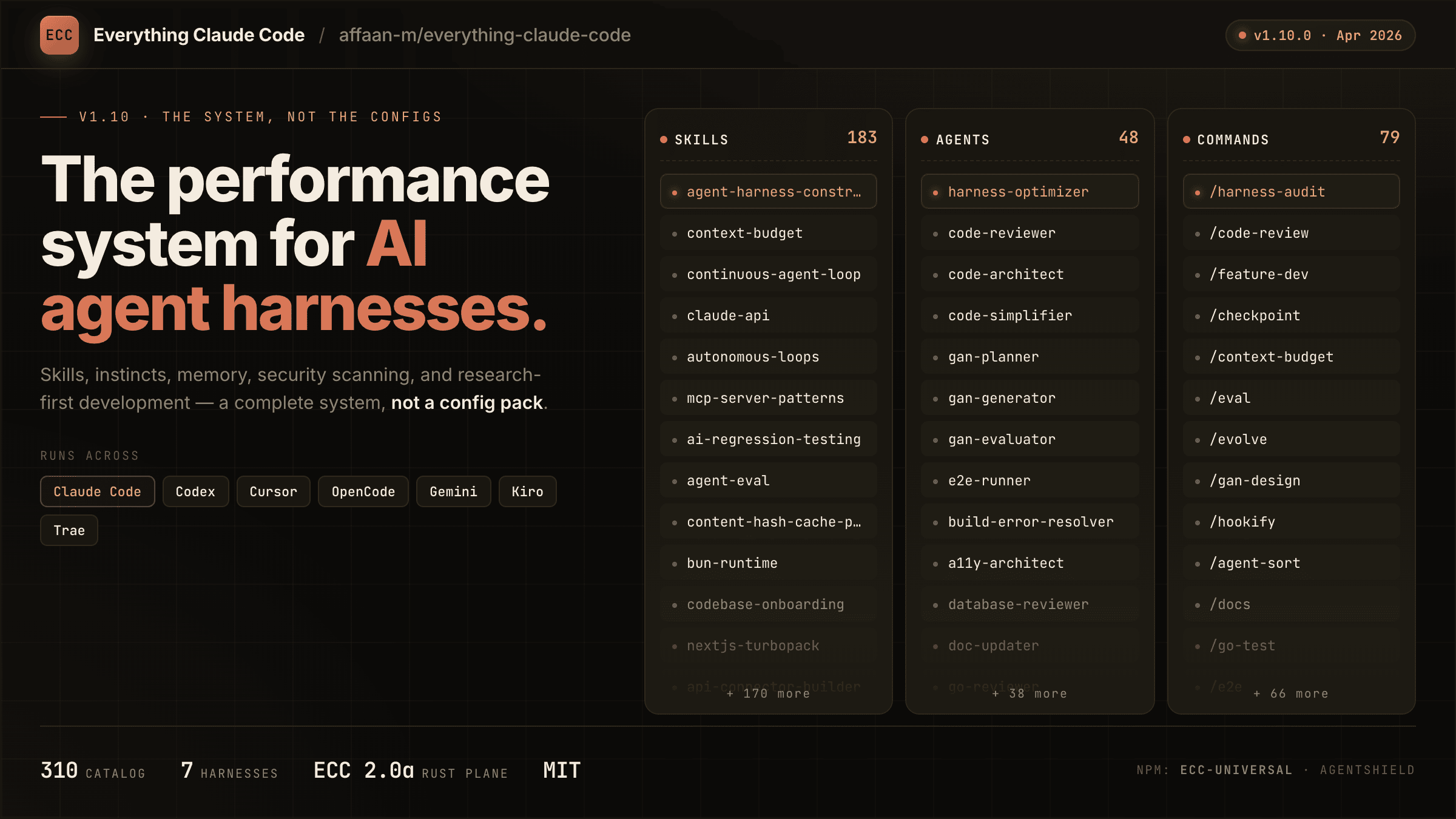
The agent harness performance optimization system. Skills, instincts, memory, security, and research-first development for Claude Code, Codex, Opencode, Cursor and beyond.
- 309k
- JavaScript
- MIT
- 3 d ago
Per-window model switcher, subagent router, and automatic 429 failover for Claude Code — switch any window with /provider, delegate subagents across models, and keep Remote Control & statuslines working.
Repo cablate/model-relay, read from GitHub 2 d ago. cablate has not joined Take My Repo.
cablate/model-relay is a public repo on GitHub by cablate. Per-window model switcher, subagent router, and automatic 429 failover for Claude Code — switch any window with /provider, delegate subagents across models, and keep Remote Control & statuslines working. It declares the MIT license on GitHub. It is written mainly in JavaScript, has 112 stars and last changed on 2026-10-24. Nobody has reviewed it on Take My Repo yet, which says nothing about its quality. Read from GitHub on 2026-11-20.
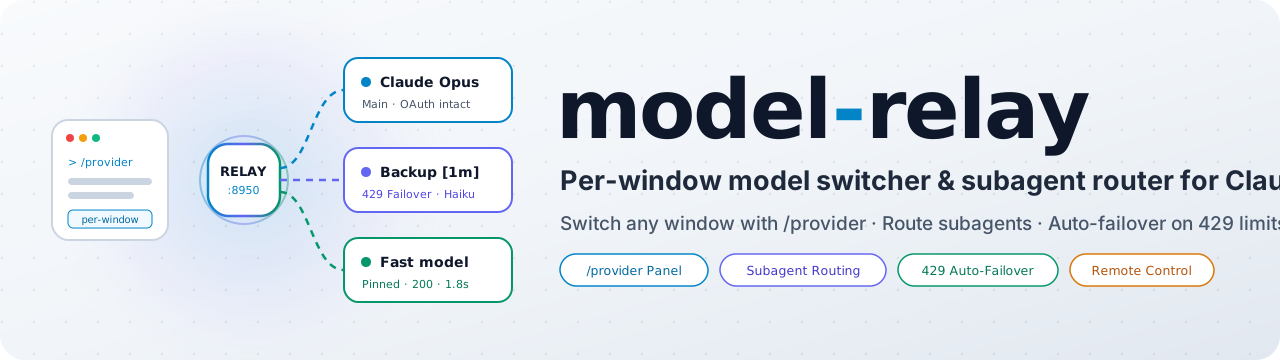
Switch any Claude Code window to another model from an interactive panel, route subagents to any provider,
and automatically fail over when Claude hits a usage limit—all on localhost, with Remote Control and statuslines intact.
English · 繁體中文 · Install · Features · Configuration · Changelog
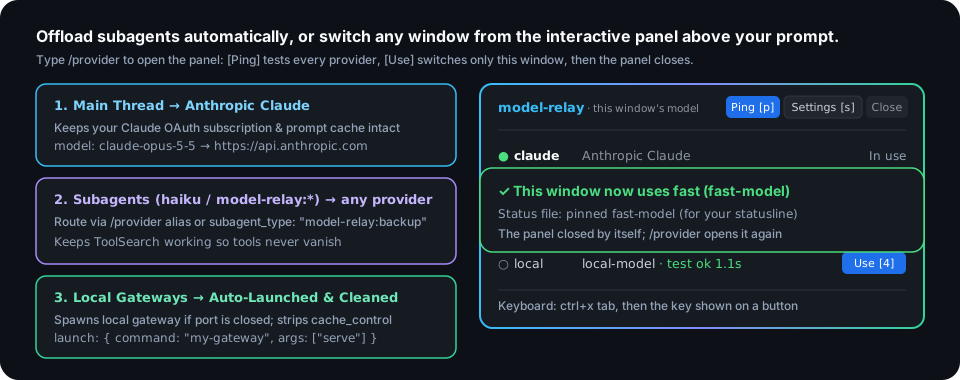
Claude Code binds model settings globally across every terminal window. model-relay runs a lightweight router on localhost (127.0.0.1:8950) so each window and subagent can use the model you want—with zero external cloud proxies.
| When… | Without model-relay |
With model-relay |
|---|---|---|
| You want to switch just one window to another model | Editing settings.json switches every open terminal at once |
Type /provider to switch only the current window from the panel above your prompt (and write its active model to model-relay-status/<session id> for your statusline) |
You want haiku or a specific subagent on another model |
Changing global env vars forces your main Opus/Sonnet chat onto that endpoint too | /provider alias haiku <name> offloads haiku globally, or model-relay:<name> spawns a one-off subagent on that provider with all tools intact |
| Claude hits a 5-hour usage limit (HTTP 429) or a provider hiccups | Your turn fails mid-task until quota resets | Automatic retries and failover.chain hand the request to your backup provider and pin only that window while new windows return to Claude after cooldown |
You use Remote Control (claude.ai/code) from your phone or browser |
Custom ANTHROPIC_BASE_URL blocks Remote Control from connecting |
Local HTTPS proxy mode (/provider rc on) keeps Remote Control working while routing each window independently |
Third-party gateways lose history/tools or reject ToolSearch / cache_control |
message-threads deltas cause mid-chat amnesia, and ToolSearch hides tools or triggers HTTP 400 |
Automatically sends full conversations keeps ToolSearch working, and cleans cache_control per provider on the fly |
model-relay is built for Claude Code users who combine a Claude subscription with backup or specialized endpoints (z.ai, DeepSeek, Kimi, MiniMax, OpenRouter, or a gateway on your own machine). Each provider has to accept Anthropic's /v1/messages format; a service that only speaks OpenAI Chat Completions needs a local translator (see Limitations). If you need a multi-tenant cloud proxy for an entire organization, use LiteLLM instead—model-relay is a single-user localhost daemon.
Requires Node.js 20+ and Claude Code 2.1.287 or later (tested on Node.js 22.23.2 and Claude Code 2.1.306).
⚠️ Upgrading from 0.6 or earlier? Updating the plugin alone is not enough. Version 0.7+ reads only
"format": 2in~/.claude/model-relay.json. Until you migrate your config and restart the router, an old 0.6 router still running in the background keeps running 0.6 code (without 0.7's conversation/tool loss fix or localhost security check), and once that process stops, the plugin will not start a new router until you migrate. Run/provider setup upgrade my model-relay configand Claude does it with you, or follow UPGRADING.md by hand (node tools/setup.mjs migrate, thenmigrate --go, then/provider restart).
claude plugin marketplace add cablate/model-relay
claude plugin install model-relay@model-relay
Set your provider's API key before starting Claude Code. The relay reads it from the environment of Claude Code, so a variable set in a shell that is already running Claude Code is not seen. Make it permanent, for example export BACKUP_API_KEY="your-api-key" in ~/.zshrc (macOS/Linux) or setx BACKUP_API_KEY "your-api-key" (Windows), then open a new terminal.
Open Claude Code and let it set things up with you. Run /reload-plugins first if Claude Code was already open.
/provider setup
Claude runs the setup tool for you, never asks you to paste a key into the chat, and asks before it changes ~/.claude/settings.json. Add what you want, such as /provider setup use deepseek for haiku.
Check that it works.
/provider doctor --ping
You should see Config OK, your provider under Providers, and a ✓ for it under Upstream ping:
Config OK (~/.claude/model-relay.json)
  Port: 8950
  Providers: backup -> your-model-id
  Failover: backup (back to Claude after 10 min)    Retry: on
  Aliases:  none (run "node tools/setup.mjs alias haiku <provider>" to route haiku)
  Claude settings: ✓ settings.json ANTHROPIC_BASE_URL=http://127.0.0.1:8950
  Router health: ✓ up on 127.0.0.1:8950 (pid 38780, <version>, pinned sessions: 0, 429 failover: idle, proxy off (0 routed / 0 tunnelled))
  Upstream ping:
    ✓ backup     (your-model-id) -> answers, first byte after 640 ms
Anything doctor finds is listed with a ⚠ and what fixes it; /provider setup can run those fixes with you. doctor only reports and changes nothing; add --fix (/provider doctor --fix) to let it apply the repairs it can make itself, such as pointing ANTHROPIC_BASE_URL in ~/.claude/settings.json at the relay. doctor --json prints the same findings for an assistant or a script, each with the setup.mjs arguments that fix it (fix) and whether that command changes something you should agree to first (needsConsent).
Nothing goes to a provider unless you say so. A new config keeps haiku and every other request on Claude; the first provider you add becomes the one that takes over on a 429 (failover.chain). To send Claude Code's haiku calls (subagents, WebFetch summaries, internal helpers) to a provider, run node tools/setup.mjs alias haiku <name>.
Setting it up by hand: run /provider init (creates ~/.claude/model-relay.json with no provider yet, so every request still goes to Claude, and points ANTHROPIC_BASE_URL in ~/.claude/settings.json at the relay). Add a provider with node tools/setup.mjs add <name> --preset <preset> --model <model id> --token env:<VAR> (presets lists the built-in ones; --url takes any other Anthropic-compatible address), restart Claude Code, then run /provider doctor --ping.
Where node tools/setup.mjs runs: the node tools/setup.mjs ... commands later in this README are the same tool. They run from the plugin's install directory, which is ~/.claude/plugins/cache/model-relay/model-relay/<version>/ ($CLAUDE_CONFIG_DIR/plugins/cache/model-relay/model-relay/<version>/ when you set CLAUDE_CONFIG_DIR; ls that folder for your version). Elsewhere, use the full path to tools/setup.mjs inside it. The command acts on the config directory in $CLAUDE_CONFIG_DIR, or ~/.claude if unset. /provider setup runs them for you from anywhere.
A key exported later is not seen: env:VAR tokens are read from the router process's own environment, which it inherits from whichever Claude Code session (or setup command) started it. A variable exported after the router started is not seen until the router restarts: stop the router process (doctor prints its pid) and start a new Claude Code session. doctor reads your shell, so it can report the key as set while the router cannot see it.
Updating: run claude plugin update model-relay@model-relay. The plugin then restarts the relay by itself once no request is in flight through it; a relay from 0.6 or earlier cannot report that, so a notice asks you to run /provider restart when no Claude Code window has a reply in progress.
AbovePrompt control panel and provider testType /provider to open a panel right above your prompt input box. It does one thing: pick which model this window uses, one button per row. Once a switch takes, the panel closes and a notice names the model now in use. Click a button, or press ctrl+x tab and then the key shown on it (1–9 to switch, p to test every provider, and r to try Claude again while a 429 cooldown runs). Switching a pinned window back to Claude takes a second press to confirm. The switches every window shares stay folded under Settings [s]: press it to show 429 failover, retry and Remote Control (f / t / x) and the model aliases. They turn on or off without editing JSON: failover and retry apply from the next request, while Remote Control asks first because it rewrites settings.json: turning it on reaches new sessions only, and turning it off disconnects sessions already running in proxy mode until they are restarted.
Each provider row shows two things apart: the last real request (last 200 · 45.0s) and the last test (test ok 640ms). The test sends one 1-token request and stops at the first byte (15 seconds at most), so a long reply never reads as a slow provider, and a failure says what is wrong in words: the key was refused, the model name is wrong, the quota is used up, the local gateway is not running, or there was no answer in time. The router keeps the provider's key out of anything it shows. When the router skips a provider (its env: variable is unset for the router), the panel says so.
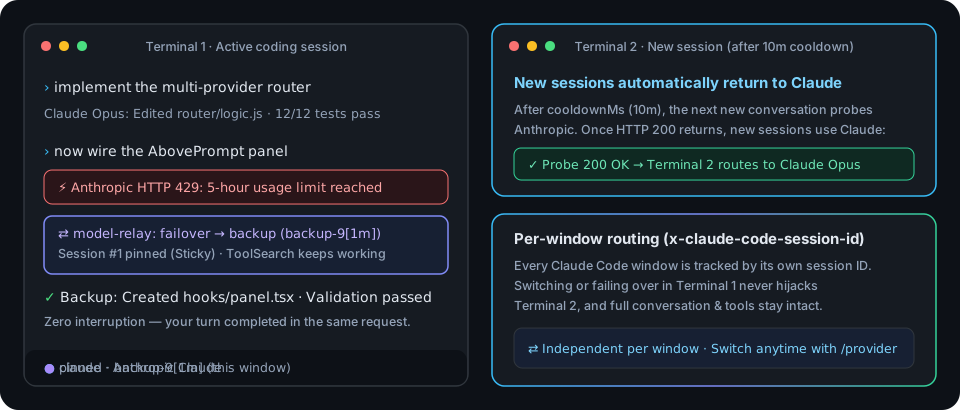
When Anthropic returns a 429 usage-limit response, the router immediately forwards the request to the first provider in failover.chain and pins that session ID for 7 days. After failover.cooldownMs (default 10 minutes), new sessions probe Claude again while existing pinned sessions stay on their backup provider. failover.enabled switches the whole thing off.
A provider answering 429 or 5xx is retried on the SAME provider with exponential backoff (retry.attempts/delayMs/backoff), capped by retry.maxDelayMs; a longer Retry-After keeps polling at that cap. Set retry.attempts: 0 to retry forever (keep hammering until it succeeds — the client connection is watched, so retries stop once the caller disconnects). Claude Code never sees the intermediate failures. retry.enabled turns retrying off everywhere in one go. Turn on retry.failover and a request that still fails once its retries run out is handed to the next provider in failover.chain (or to that provider's own fallback list), never back to one it already tried.
Built-in presets (zai, deepseek, kimi, minimax, openrouter) fill in a service's address and the compatibility switches it needs. You always choose the model, because model IDs go out of date, and give the token (or "env:VAR_NAME"). node tools/setup.mjs presets lists them. For local gateways on 127.0.0.1, set launch: { command, args } and the router will automatically spawn the gateway process whenever its port is closed.
haiku / sonnet / opus at a provider)model-relay separates three routing layers so they never get mixed up:
matchModels + ANTHROPIC_DEFAULT_*_MODEL): Routes only requests whose model matches (such as haiku subagents or WebFetch summaries) without pinning the main conversation./provider <name>): Pins only the current conversation ID (x-claude-code-session-id) for 7 days; other windows stay on Claude.failover.chain): Takes over only when Anthropic returns a 429 usage-limit error.Pointing a Claude tier like haiku at a provider (for example backup, with model your-model-id[1m]) coordinates two places at once:
~/.claude/settings.json → env.ANTHROPIC_DEFAULT_HAIKU_MODEL = "your-model-id[1m]" so Claude Code itself resolves the haiku alias to that model (including the [1m] context window) and sends "model": "your-model-id".~/.claude/model-relay.json → providers.backup.matchModels gains "haiku", so the router also catches internal Claude Code calls that hardcode "claude-haiku-*", rewriting the wire model field to "your-model-id". A request for a provider's own model always reaches that provider. node tools/setup.mjs alias haiku claude undoes both.How a request finds its provider: a request whose model is some provider's own model goes to that provider first, whatever the order in the config. Only then are the matchModels patterns tried, in config order, and the first match wins. A request caught by a pattern keeps the model name it came with, except a Claude name (claude-*, haiku, sonnet, opus), which is replaced by the provider's model. So a pattern should match the real model ID the upstream knows, not the provider's name in this file: ^backup would catch requests named after the provider and pass on a name the upstream has never heard of.
Use setup.mjs alias (or /provider alias) to inspect or set both files in one step:
node tools/setup.mjs alias                       # inspect haiku / sonnet / opus / subagent default
node tools/setup.mjs alias haiku backup          # point haiku at backup in both settings.json and model-relay.json
node tools/setup.mjs alias haiku claude          # reset haiku back to Anthropic Claude
node tools/setup.mjs alias subagent sonnet       # set CLAUDE_CODE_SUBAGENT_MODEL=sonnet in settings.json
For per-call subagent routing, model-relay also dynamically registers a full-capability Agent type model-relay:<name> for each provider the router serves (such as model-relay:backup) via $.agent.register with all parent tools and model set to that provider's model ID, and locks that model in on('agent.spawn')—so you can spawn subagent_type: "model-relay:backup" on the fly without creating .claude/agents/*.md files or restarting the session.
Each provider can shape its agent with an agent object in ~/.claude/model-relay.json. The fields are the ones an agent file's frontmatter takes, used as written; name and model always stay the provider's. description is the line Claude reads in its list of agent types when it decides which one to spawn, so say when to pick this agent:
"providers": {
  "backup": {
    "model": "your-model-id",
    "agent": {
      "description": "Use for routine, well-scoped tasks: code search, summaries, small edits.",
      "effort": "medium",
      "maxTurns": 40
    }
  }
}
A change to agent applies from your next message, without restarting Claude Code. Tested on Claude Code 2.1.308: permissionMode cannot loosen or tighten a parent running in bypassPermissions; initialPrompt is not applied to subagents started by the Agent tool (it is for claude --agent); memory had no effect, the same as in an ordinary .claude/agents/*.md file.
Claude Code can still run such a subagent on another model without saying so (a model missing from availableModels is swapped, with a line only in its debug log). The plugin checks twice: when the subagent starts, against the model Claude Code reports it started on, and when it finishes, against the models the router actually received. Either mismatch shows a notice that points to /provider doctor.
add, set, providers, remove and migrate change the file without hand-editing JSON. Every edit keeps a .model-relay-backup copy next to the file, tokens are never printed, and the running router picks the change up on its next request. On an older config (see format under Configuration), add, set, providers, remove, alias, init, restart, rc and proxy enable refuse and tell you to run migrate first; migrate is the only command that understands it. doctor also warns about an older config, a failover name that matches no provider, two providers that name the same model (the first one in the file gets it), an availableModels list in ~/.claude/settings.json that leaves a provider's model out, and a running router older than the plugin.
node tools/setup.mjs providers
node tools/setup.mjs add local --url http://127.0.0.1:4000 --model your-local-model-id --token env:LOCAL_GATEWAY_TOKEN
node tools/setup.mjs set failover.chain backup,local
node tools/setup.mjs set providers.local.fallback none
node tools/setup.mjs migrate --go
remove <name> takes the provider out of failover.chain and out of other providers' fallback lists, but it does not touch the ANTHROPIC_DEFAULT_*_MODEL aliases in ~/.claude/settings.json. If haiku, sonnet or opus pointed at the removed provider's model, Claude Code keeps sending that model name and, with no provider left to claim it, the request goes to Claude. Reset each of those aliases yourself with node tools/setup.mjs alias haiku claude (or alias haiku <name> to give it to another provider; likewise for sonnet and opus). doctor warns about an alias that no provider matches.
Remote Control only starts when Claude Code talks to api.anthropic.com, which a base URL pointing at the relay breaks. HTTPS proxy mode keeps that address and makes the relay the proxy instead: Claude Code connects through HTTPS_PROXY, the relay answers for api.anthropic.com with a certificate that Claude Code trusts through NODE_EXTRA_CA_CERTS, and model calls are routed exactly as before (providers, sticky failover, retries). Everything else, token refresh and Remote Control traffic included, passes to Anthropic unchanged.
node tools/setup.mjs proxy enable --go
node tools/setup.mjs rc
api.anthropic.com (a critical name constraint), its private key is discarded right after signing, and only Claude Code processes that carry NODE_EXTRA_CA_CERTS load it. The system certificate store is never touched.api.anthropic.com untouched, so Claude Code keeps working, just unrouted. A stopped router is different: the plugin's automatic direct fallback only works in ANTHROPIC_BASE_URL mode, so in proxy mode Claude Code cannot connect until the router is restarted (node tools/setup.mjs rc).proxy disable --go restores ANTHROPIC_BASE_URL, and the previous settings.json is kept as settings.json.model-relay-backup. Sessions already running in proxy mode lose their connection until you restart them.HTTPS_PROXY lives in settings.json env, so it also applies to commands Claude Code runs (git, curl, gh): they go through the relay as blind tunnels, and fail while the router is down.
Configuration lives in ~/.claude/model-relay.json. The directory defaults to $CLAUDE_CONFIG_DIR when set, falling back to $USERPROFILE/.claude or $HOME/.claude. model-relay.example.json shows a provider from a preset and a local gateway.
| Field | Default | Meaning |
|---|---|---|
format |
(none) | 2 for a config in the current format (init, add and migrate --go set it), the only format the router reads. A file without it, or one named custom-agent.json, is an older config: until migrate --go rewrites it, the plugin starts and replaces no router for it, so a 0.6 router still running keeps using it, and with none answering the session talks to Claude directly. The plugin says so in a notice, the panel and, with statusBar on, the status line; see UPGRADING.md |
port |
8950 |
Localhost port for the relay HTTP server (1025–65535). Change it with node tools/setup.mjs set port <n>, which also updates settings.json; the router already running keeps the old port until you stop it (the command prints its pid), and it refuses a port that already answers |
statusBar |
false |
Also show the relay state in Claude Code's plugin status line, the yellow line above the input. Off by default: each window's state is written to a status file for your own statusline instead (see below). Notices about upgrades and outages still appear as toasts |
claudeUrl |
"https://api.anthropic.com" |
Upstream Anthropic API base URL |
idleTimeoutMs |
300000 |
How long an upstream may send nothing before the request counts as failed and follows the retry and failover rules (1000–3600000); a streaming answer that keeps sending data is never cut |
proxy.enabled |
false |
Accept HTTPS-proxy connections for Remote Control. Off by default. When on, a CONNECT to any host other than api.anthropic.com is a blind tunnel that any local process can use; node tools/setup.mjs proxy enable --go turns it on and proxy disable --go off |
failover.enabled |
true |
Automatically switch to the failover chain on Claude 429 usage limits |
failover.chain |
[] |
Ordered providers that take over when Claude is out of quota or a provider keeps failing; unknown names are skipped. Empty means a 429 from Claude is passed back as it is (add puts the first provider of a new config here) |
failover.cooldownMs |
600000 |
Milliseconds before probing Claude again for new sessions (10 minutes). Kept between 60000 (1 minute) and 7200000 (2 hours): a value outside that range is moved to the nearest limit |
retry.enabled |
true |
Master switch for retrying a failing provider; false keeps the other retry settings for later |
retry.attempts |
3 |
Times the SAME provider is retried with backoff when it answers 429/5xx; 0 means retry forever. Any other value is capped at 30 |
retry.delayMs |
2000 |
First retry delay; multiplied by retry.backoff each attempt. Capped at 60000 (60 seconds), or 300000 (300 seconds) when set in a provider's own retry |
retry.backoff |
2 |
Multiplier between retries (2s → 4s → …), capped by retry.maxDelayMs. Kept between 1 and 4 |
retry.maxDelayMs |
10000 |
Longest single wait; a longer Retry-After keeps polling at this interval. Capped at 300000 (300 seconds) |
retry.failover |
false |
Opt-in: after retries are exhausted, forward the original request to the next provider in the chain instead of returning the error |
providers.<name>.retry |
true |
Per-provider switch: false never retries this provider (failure returns at once); true follows the global retry; or a partial object like { "attempts": 5 } overrides just those fields, within the limits listed above |
providers.<name>.fallback |
the chain | Who takes over from this provider: false for nobody, or a list like ["backup"] |
providers.<name>.preset |
<name> |
Optional preset (zai, deepseek, kimi, minimax, openrouter): the address and compatibility switches, never a model |
providers.<name>.baseUrl |
(from preset) | Anthropic-compatible upstream URL for this provider |
providers.<name>.token |
(required) | Literal token or "env:ENV_VAR_NAME". The variable is read from the router process's environment (inherited from the Claude Code session or setup command that started it), so one exported later is not seen until the router restarts |
providers.<name>.model |
(required) | Target model ID when rewriting requests (suffixes like [1m] are stripped on wire) |
providers.<name>.matchModels |
(from preset, else the model's first word) | Regex patterns matched against the incoming request model, in config order; the first match wins. A request for a provider's own model goes to that provider before any pattern is tried. A pattern match sends the model name on unchanged (a Claude name is replaced by the provider's model), so match the real model ID the upstream knows (see Model alias routing) |
providers.<name>.stripCacheControl |
false |
Recursively remove cache_control fields before forwarding |
providers.<name>.authHeader |
(from preset, else "bearer") |
How to send credentials: "bearer", "x-api-key", or "both". Of the built-in presets only zai uses "both"; the others use "bearer" |
providers.<name>.launch |
null |
{ "command": "...", "args": [...] } to auto-spawn if localhost port is closed |
providers.<name>.agent |
null |
Fields for this provider's model-relay:<name> subagent, as in an agent file: description, prompt, tools, disallowedTools, skills, effort, permissionMode, maxTurns, autoCompactWindow, initialPrompt, memory, isolation, background, omitClaudeMd, mcpServers, hooks. A field of the wrong shape is ignored; if Claude Code refuses the whole set, the subagent keeps the defaults and a notice says so |
Each window writes its relay state to ~/.claude/model-relay-status/<session id> (the same config directory as above) whenever it changes, as one line kind<TAB>label. The session id is the session_id Claude Code passes to a statusLine command, so a statusline reads its own window's file directly. The router deletes files untouched for a week.
kind |
label |
Meaning |
|---|---|---|
claude |
claude |
This window goes to Claude through the relay |
pinned |
the provider's model | Pinned with /provider, or by a failover |
failover |
the provider's model | Claude's limit is reached; the next request goes there |
limit |
claude |
Claude's limit is reached and the failover chain has nobody to hand over to |
offline |
offline |
No relay of this config directory answers (it is restarted when it can be; an older config is not, see format) |
direct |
claude |
No relay answers, so this window talks to Claude directly |
coralline's relay segment reads this file.
This feature is experimental: it may change or go away, and it is left out of /provider help and the tables above. Add avatars and the plugin draws the picture of the model this window is talking to in a side pane, swapping it when you switch with /provider <name>, when a Claude limit hands the window to a provider, and when it goes back to Claude. It is drawn with colored block characters (eighths and quarters of a cell), picked per cell to follow the picture's shapes, so it also works in terminals without an image protocol, such as Windows Terminal. It needs ffmpeg on PATH.
"avatars": {
  "claude": { "image": "model-relay-avatars/claude.webp", "head": [471, 200, 340] },
  "backup": "model-relay-avatars/backup.webp"
}
claude or a provider's name. A value is an image path, relative to the config directory unless it starts from a root, or { "image", "head" }. head is the square that holds the head: [centerX, centerY, size] in the image's own pixels.head set, the pane shows the head, cropped to the pane's own shape around that square (narrowing to no less than three quarters of its side) so it fills the pane; without it the whole picture is fitted into the pane. Switching back to a model this window showed lately draws its picture at once. A persona with no entry shows its name and the key to add./provider avatar on turns it on for every window (the avatarPane key): it then opens at the start of a session when the terminal is wide enough, and /provider avatar off closes it everywhere. /provider avatar alone opens or closes it in this window only, at any width, and changes no setting. It asks for a dock 80 columns wide, which Claude Code keeps to 45% of the terminal; the wider it is, the finer the picture. Close and reopen it after you change an image file.model-relay-avatars/.cache/<session id>.rgba in the config directory and empties the file when it is done; the folder is safe to delete.| Command | Description |
|---|---|
/provider |
Open the panel above the prompt to pick this window's model |
/provider <name> · /provider claude |
Switch this window without the panel, answered in one line (e.g. /provider backup); back to Claude, the next turn rebuilds the prompt cache |
/provider status |
The status as text: where this window goes, the switches every window shares, and anything to fix |
/provider help |
Every command, grouped by what it reaches: this window, every window, setup and checks |
/provider setup [goal] |
Let Claude walk you through setup with the setup tool; keys stay out of the chat |
/provider init · /provider doctor [--ping] [--fix] |
First-run setup and health check; doctor only reports unless you add --fix, which applies the repairs it can make itself. Work from any folder, with or without a config file |
/provider restart |
Restart the relay so it runs the installed plugin's code. After claude plugin update the plugin does this by itself once the relay answers no request; a relay left by an older plugin cannot report that, so a notice asks you to run it when no window has a reply in progress |
/provider ping |
Test every provider: does it answer, how soon does the answer start, and what is wrong if it does not |
/provider probe |
Reset the 429 cooldown timer so the next new session tries Claude immediately |
/provider alias [haiku|sonnet|opus] [<name>|claude] |
Inspect or point a Claude model alias at a provider (updates both settings.json and matchModels) |
/provider failover [on|off|<a,b>] |
Turn 429 failover on/off or update failover.chain |
/provider retry [on|off] |
Turn automatic provider retries on or off |
/provider rc [on|off] |
Turn Remote Control HTTPS proxy mode on or off. On reaches new sessions only; off disconnects sessions already running in proxy mode until you restart them |
127.0.0.1:<port>. Requests go strictly to claudeUrl (https://api.anthropic.com) or the baseUrl endpoints you configure. /provider ping sends a max_tokens: 1 request to each configured provider when you trigger it. No telemetry or analytics exist.~/.claude/model-relay.json and writes session sticky state to ~/.claude/model-relay-state.json plus local logs (model-relay.log and model-relay-requests.log, each emptied once it passes 5 MB). The old file names (custom-agent.json, custom-agent-state.json, custom-agent-router.log, custom-agent-requests.log) are no longer read; migrate --go renames them.~/.claude/model-relay-pki/ holds a public CA file and one leaf certificate with its key (restricted to your user). The CA is limited to api.anthropic.com and trusted only through NODE_EXTRA_CA_CERTS; delete the folder or run proxy disable --go to stop using it.claude plugin validate /path/to/model-relay.| Environment | Status |
|---|---|
| Windows 11 + Node.js 22 + Git Bash / PowerShell | Tested |
macOS / Linux + Node.js 20+ (sh + curl) |
Per official Node.js & POSIX specs. CI runs only node tools/check.mjs on Node.js 22 (Ubuntu, Windows, macOS); Node.js 20, the plugin hooks and the Claude Code integration are not tested there |
/v1/messages endpoint: Providers that only speak OpenAI Chat Completions require a local translation proxy (and can be supervised via providers.<name>.launch)./provider claude on a long conversation will resend the full conversation history to Anthropic.Start with /provider doctor --ping: it lists each problem with a ⚠ and the command that fixes it, and /provider setup can run those fixes with you.
| Symptom | What to check |
|---|---|
/provider says config is missing or invalid |
Run /provider doctor (or node tools/setup.mjs doctor from the install directory) to verify JSON syntax and check if any env:VAR variables are unset in your shell |
The status line (with statusBar on) shows Relay offline: connected directly to Claude, or the status file says direct |
In ANTHROPIC_BASE_URL mode the plugin bypassed a stopped router so your chat keeps working. In proxy mode there is no such bypass: Claude Code cannot connect until the router is restarted. Run /provider doctor or check ~/.claude/model-relay.log (a router that finds its port taken by another process or another config directory logs that there and exits) |
Remote Control says it is only available via api.anthropic.com |
Claude Code still uses the relay as its API address; run node tools/setup.mjs proxy enable --go and start a new session |
proxy enable refuses because NODE_EXTRA_CA_CERTS is already set |
Something you use (often a company network that inspects TLS) already relies on that certificate, and Claude Code accepts only one file there, so proxy mode would make it stop trusting yours. Remote Control through the relay cannot be combined with it yet; nothing was changed |
| Claude Code cannot connect after enabling proxy mode | The router is probably down: run node tools/setup.mjs proxy status, start it with node tools/setup.mjs rc, or go back with node tools/setup.mjs proxy disable --go |
| Tools are missing on a third-party provider | The router now renames ToolSearch before it reaches the provider and keeps tools it has loaded callable. Run node tools/setup.mjs restart so a running router picks up the change |
A model-relay:<name> subagent runs on Claude instead of the provider |
The plugin shows a notice when this happens. Usually an availableModels list does not include the provider's model, so Claude Code runs the subagent on CLAUDE_CODE_SUBAGENT_MODEL or the parent's model; add the model ID exactly as configured. node tools/setup.mjs doctor checks the list in ~/.claude/settings.json only |
A notice says the config is from an older version, and doctor says it is outdated |
The file is named custom-agent.json or has no "format": 2, so this version's router does not read it. node tools/setup.mjs migrate shows what it would write, and migrate --go writes it, with the router then routing as the older version did (it refuses if the result would route differently); then run /provider restart when no Claude Code window has a reply in progress. See UPGRADING.md |
/provider doctor and note the router's pid (on the Router health line; Router status: offline means nothing is running, so skip stopping it). Do this before uninstalling, because the tool that prints it lives in the plugin's folder.claude plugin uninstall model-relay@model-relay and remove ANTHROPIC_BASE_URL from ~/.claude/settings.json (in proxy mode remove HTTPS_PROXY, NODE_EXTRA_CA_CERTS and NO_PROXY instead; running node tools/setup.mjs proxy disable --go first does that and puts ANTHROPIC_BASE_URL back, which you then remove).kill <pid> (macOS/Linux) or taskkill /PID <pid> /F (Windows). It keeps running after the plugin is removed. A gateway the router started from a provider's launch also keeps running on its own, so stop it after the router, which restarts a closed one within about 30 seconds. Find its process by the port in that provider's baseUrl (lsof -i :<port> on macOS/Linux, netstat -ano | findstr :<port> on Windows) and stop it the same way.~/.claude/model-relay.json, ~/.claude/model-relay-state.json, ~/.claude/model-relay-status/, ~/.claude/model-relay-pki/, ~/.claude/model-relay.log, ~/.claude/model-relay-requests.log, and any *.model-relay-backup copies).node tools/check.mjs
claude plugin validate .
claude plugin test .
node tools/smoke.mjs # one real Claude Code request through this checkout's router; add --provider <name> for a provider
tools/smoke.mjs needs a logged-in claude, so CI does not run it. Run it before a release and after a Claude Code update. node tools/check.mjs also runs the TypeScript hook tests, which need Node.js 22.6 or later; only running the plugin gets by on 20+.
See CONTRIBUTING.md for architecture and release steps.
cablate/model-relay is a public repo on GitHub by cablate. Per-window model switcher, subagent router, and automatic 429 failover for Claude Code — switch any window with /provider, delegate subagents across models, and keep Remote Control & statuslines working.
It declares the MIT license on GitHub.
Its maker tagged it for macOS, Windows and Linux, or as Docker or cross-platform. That is declared by the maker; Take My Repo has not tested it.
Open "Take it" on its page: Take My Repo writes an install plan for your machine and hands it to your AI agent (Claude Code, Codex or Cursor), which asks you before each step. Take My Repo has not tested it on any machine.
Its last change on GitHub was on 2026-10-24. GitHub counts 3 open issues and pull requests. Take My Repo does not judge from that whether it is maintained.
The agent harness performance optimization system. Skills, instincts, memory, security, and research-first development for Claude Code, Codex, Opencode, Cursor and beyond.
Nobody has reviewed it on Take My Repo yet, which says nothing about its quality.
Reverse engineer anything with agents, from app behavior down to native binaries.
Get up and running with Kimi, GLM, MiniMax, DeepSeek, gpt-oss, Qwen, Gemma and other models.
Open-source, high-performance AI gateway that works as your LLM gateway, MCP gateway and agent gateway. One OpenAI-compatible API for 10,000+ models, with failover, load balancing, semantic caching, virtual keys, budgets and MCP Code Mode. Works with any SDK or agent and adds under 200µs of overhead at 5k RPS.
🤗 Transformers: the model-definition framework for state-of-the-art machine learning models in text, vision, audio, and multimodal models, for both inference and training.
18 Google Maps tools and 3 Agent Skills for place search, routes, travel planning, and local SEO—via MCP or standalone CLI.
巴逆逆(8zz)反指標追蹤器 — Facebook 抓取 + 影片轉錄 + AI 分析 + 多平台推送(Telegram / Discord / LINE)
Independent research on Claude Code internals, Claude Agent SDK, and related tooling.
An extension of Karpathy's LLM Wiki pattern: atom layer, topic-branches, two-layer Lint. Distilled from running the pattern end-to-end.
Claude Code mod: hands off to a fresh conversation when context fills up, keeps the cache warm while you're away, and turns what you teach Claude into project notes