ML-For-Beginners
12 weeks, 26 lessons, 52 quizzes, classic Machine Learning for all
- 92k
- Jupyter Notebook
- MIT
- 3 wk ago
Data Science Cheat Sheet
Repo cheat-sheets/data-science-cheat-sheet, read from GitHub 12 h ago. cheat-sheets has not joined Take My Repo.
cheat-sheets/data-science-cheat-sheet is a public repo on GitHub by cheat-sheets. Data Science Cheat Sheet. It declares the MIT license on GitHub. It is written mainly in Python, has 25 stars and last changed on 2022-06-22. Nobody has reviewed it on Take My Repo yet, which says nothing about its quality. Read from GitHub on 2026-11-24.
12 weeks, 26 lessons, 52 quizzes, classic Machine Learning for all
Data science is a concept to unify statistics, data analysis, machine learning, domain knowledge and their related methods in order to understand and analyze actual phenomena with data.
TODO
https://www.youtube.com/watch?v=xxpc-HPKN28
Individuals vs characteristics
Population (census) vs sample
Parameters vs samples
Descriptive vs inferential
Normal distribution and empirical rule (68-95-99.7)
z-score
Inference: Estimation, Testing, Regression
Central limit theorem:
p-value - the probability of getting a certain result given the null-hypothesis.
DNN implementations:
It is better to find a single optimization metric, this way it will be easier to choose a better model. When it's not possible to choose a single optimization metric, you can add satisfying metrics. For example, error rate is an optimization metric and the time it takes to run the classification on an object is a satisfying metric.
Bayes error rate is the lowest possible error rate for any classifier of a random outcome (into, for example, one of two categories) and is analogous to the irreducible error.
If your algorithm is performing worse than a human, then to improve your algorithm you can:
When to focus on bias and when on variance:
Problems where ML significantly surpasses human-level performance:
All of the above are ML on structured data as opposed to natural perception.
Advice from Andrej Karpathy for learning ML: try implementing a NN from scratch, without relying on any libraries like TensorFlow. This will help you learn how deep learning works under the hood.
Error Analysis: focus on what contributes most to the algorithm error. For example, if 90% of errors are due to blurry images and 10% are due to misclassified as a dog instead of a cat, then focus on blurry images to reduce the error.
Incorrectly labeled data:
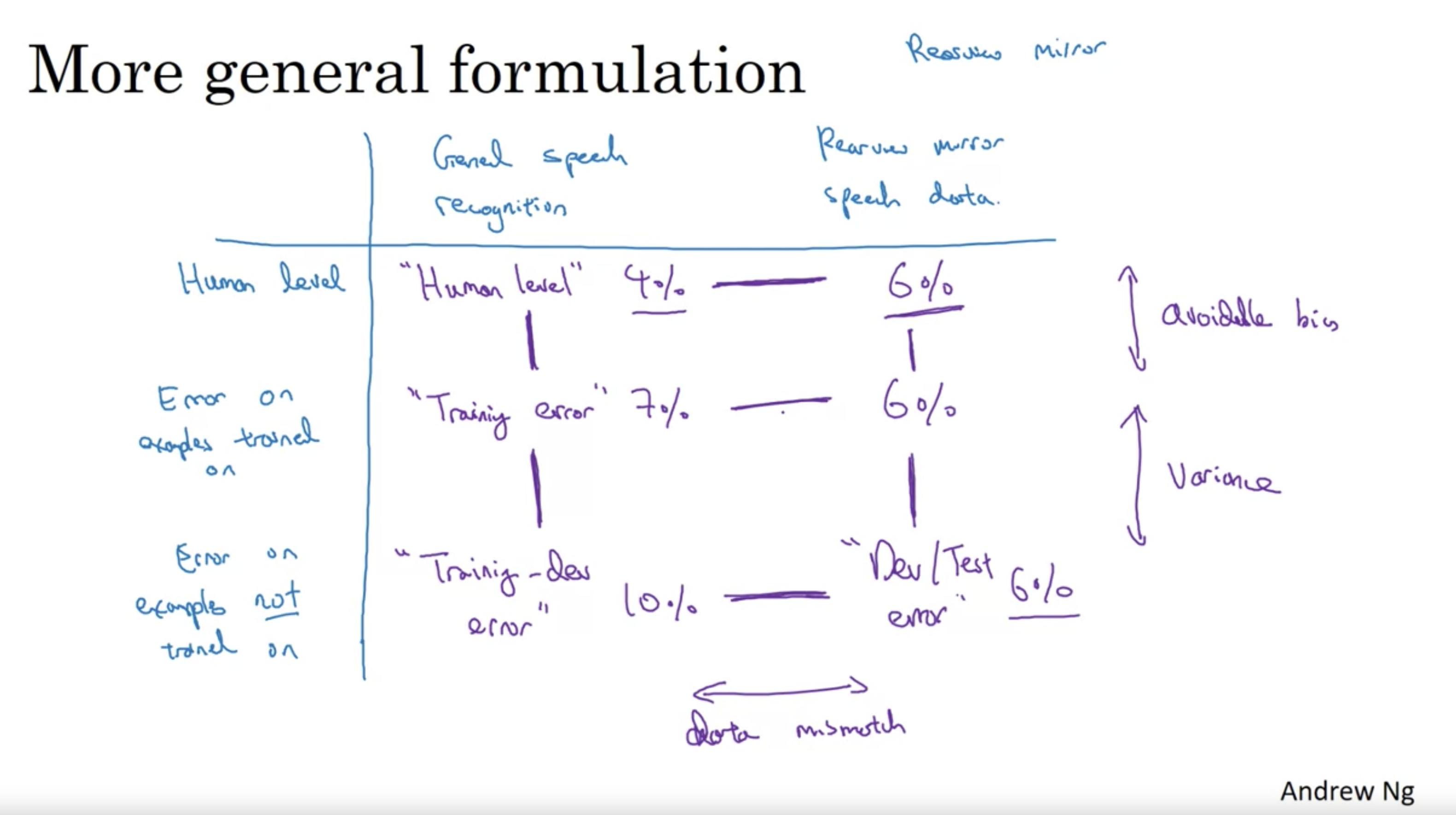
It's important to make your dev and test datasets as close to real-world data, even if it results in train and dev/test datasets be drawn from different distributions. This way you optimise to the right target. In this case to perform bias/variance analysis introduce train-dev dataset, to measure the variance contribution to error.
Transfer Learning - using intermediate NN layers, that were pre-trained on some problem A, for a different problem B. For example problem A can be classifying cats and dogs, problem B can be classifying lung desease in radiology images. It makes sense when:
Multi-task Learning - training a NN for a classification problem where an input can be assigned multiple classes, for example an image which can contain cars, pedestrians, stop signs, traffic lights, or any combination of those. It can give better results than training a separate NN for each class, because the intermediate layers are reused.
End-to-end ML - solving a problem using just an ML algorithm without any hand-designed components as part of the whole system. For example, for a speech recognition task an end-to-end ML approach is to use audio as an input for an ML algorithm and the transcript as the output, as opposed to manually extracting features from the audio first, then phonemes, the words, and then generating a transcript.
Colab Notebooks:
Why convolutions:
Computer Vision Networks:
Face Recognition:
Neural Style Transfer:
DeepFake Colab:
YOLO (You Only Look Once) algorithm:
TODO: Add more details
AI for Medicine Specialization, Coursera
AI for Diagnosis:
AI for Prognosis:
cheat-sheets/data-science-cheat-sheet is a public repo on GitHub by cheat-sheets. Data Science Cheat Sheet.
It declares the MIT license on GitHub.
Its maker has not tagged a system, so it is unknown here. Its README says what it needs.
Open "Take it" on its page: Take My Repo writes an install plan for your machine and hands it to your AI agent (Claude Code, Codex or Cursor), which asks you before each step. Take My Repo has not tested it on any machine.
An Open Source Machine Learning Framework for Everyone
Bring data to life with SVG, Canvas and HTML. :bar_chart::chart_with_upwards_trend::tada:
The 30 Days of Python programming challenge is a step-by-step guide to learn the Python programming language in 30 days. This challenge may take more than 100 days. Follow your own pace. These videos may help too: https://www.youtube.com/channel/UC7PNRuno1rzYPb1xLa4yktw
f.k.a. Awesome ChatGPT Prompts. Share, discover, and collect prompts from the community. Free and open source — self-host for your organization with complete privacy.
Its last change on GitHub was on 2022-06-22. Take My Repo does not judge from that whether it is maintained.
Nobody has reviewed it on Take My Repo yet, which says nothing about its quality.
Take My Repo cannot say: it does not audit code and has not run data-science-cheat-sheet. What is known comes from GitHub. It declares the MIT license on GitHub. Its last change was on 2022-06-22. It has 25 stars, which measure popularity, not safety. Nobody has reviewed it on Take My Repo yet, which says nothing about its quality. Read the source before you run it. With "Take it", your AI agent shows each step and asks you before running it; README text is treated as data, not as instructions.