
founding-cheat-sheet
Avoiding the pitfalls that can sink a startup
- 8
- 6 y ago
Repo cheat-sheets/founding-cheat-sheet, read from GitHub 12 h ago. cheat-sheets has not joined Take My Repo.
In short
cheat-sheets/founding-cheat-sheet is a public repo on GitHub by cheat-sheets. Avoiding the pitfalls that can sink a startup. It declares no license on GitHub. Public does not mean open source: without a license, nobody is granted the right to reuse it. It has 8 stars and last changed on 2020-10-26. Nobody has reviewed it on Take My Repo yet, which says nothing about its quality. Read from GitHub on 2026-11-24.
Founding Cheat Sheet
Table of Contents
Introduction
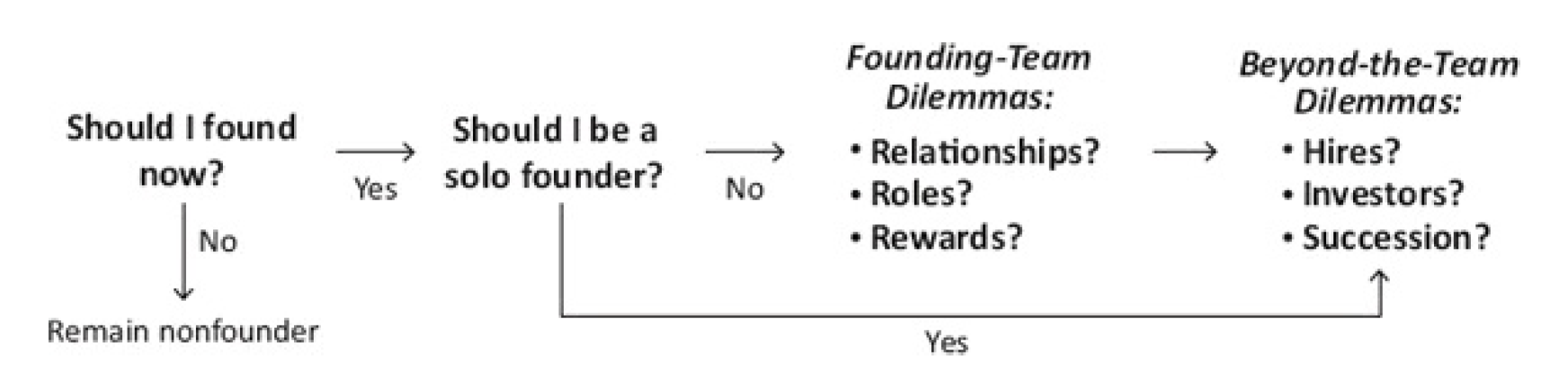
Founding dilemmas:
- Pre-founding: Career Dilemmas - when in my career should I launch a startup?
- Have I accumulated the right career experiences?
- Is the market receptive to my idea?
- Is my personal situation favorable?
- Founding Team Dilemmas - dilemmas regarding the startup's founders.
- The Solo-versus-Team Dilemma - should I launch the business myself or try to attract cofounders?
- Relationship Dilemmas - whom should I try to attract as cofounders: Friends? Family? Acquaintances? Strangers? Prior coworkers?
- Role Dilemmas — what positions should each of us take within the startup? Which decisions can we make alone, and which should we make as a team? How should we make those decisions?
- Reward Dilemmas — how should we divide equity and other financial rewards among the founding team?
- Beyond the Founding Team - dilemmas regarding the hires and investors.
- Hiring Dilemmas:
- what types of people should I hire at different stages of growth?
- what challenges will my early hires face as the startup grows?
- Should I compensate early hires differently from later hires?
- Investor Dilemmas:
- what types of investors should I target at different stages of growth?
- What challenges will these investors introduce?
- Founder-CEO Succession:
- why and how are founders replaced as CEOs of the startups they founded?
- how can founders exert more control over the process?
- what happens to the founder and to the startup after he or she is replaced by a hired "professional CEO"?
- Hiring Dilemmas:
- Exit Dilemmas - which way out?
- Acquisition
- IPO
- Bankruptcy
Pre-founding Dilemmas
Top motivations for starting a company:
- Making a difference in the world.
- Financial gain.
- Power and influence.
- Autonomy.
- Recognition.
Best time to start a company:
- Favorable Career Circumstances:
- Broad and deep work experience (managerial experience, functional background, industry knowledge, working in small vs big companies, nontraditional experiences, social capital)
- Low opportunity costs
- Change in golden handcuffs (the social status of an impressive title or well-known employer, and golden handcuffs, such as a high salary or a vesting schedule that requires one to keep working in order to earn stock awards)
- Favorable Personal Circumstances:
- Entrepreneurial motivations
- Supportive family situation
- Cash cushion
- Positive role models (most powerful influences may come from the early messages sent by the words and actions of older relatives or by the culture in which a person grew up)
- Favorable Market Circumstances:
- Big opportunity
- Favorable context - are many companies competing for scarce resources?
- Customer willingness to pay - how big is the market? Is it growing?
- Ticking clock - is the window of opportunity about to close? Ticking-clock industries include
- those in which products and services are quickly derived from and just as quickly outdated by technological or scientific advances,
- those with strong "network effects" - that is, the value of the product increases as more people use it
- those with significant economies of scale.
Founding Team Dilemmas
The Solo-versus-Team Dilemma
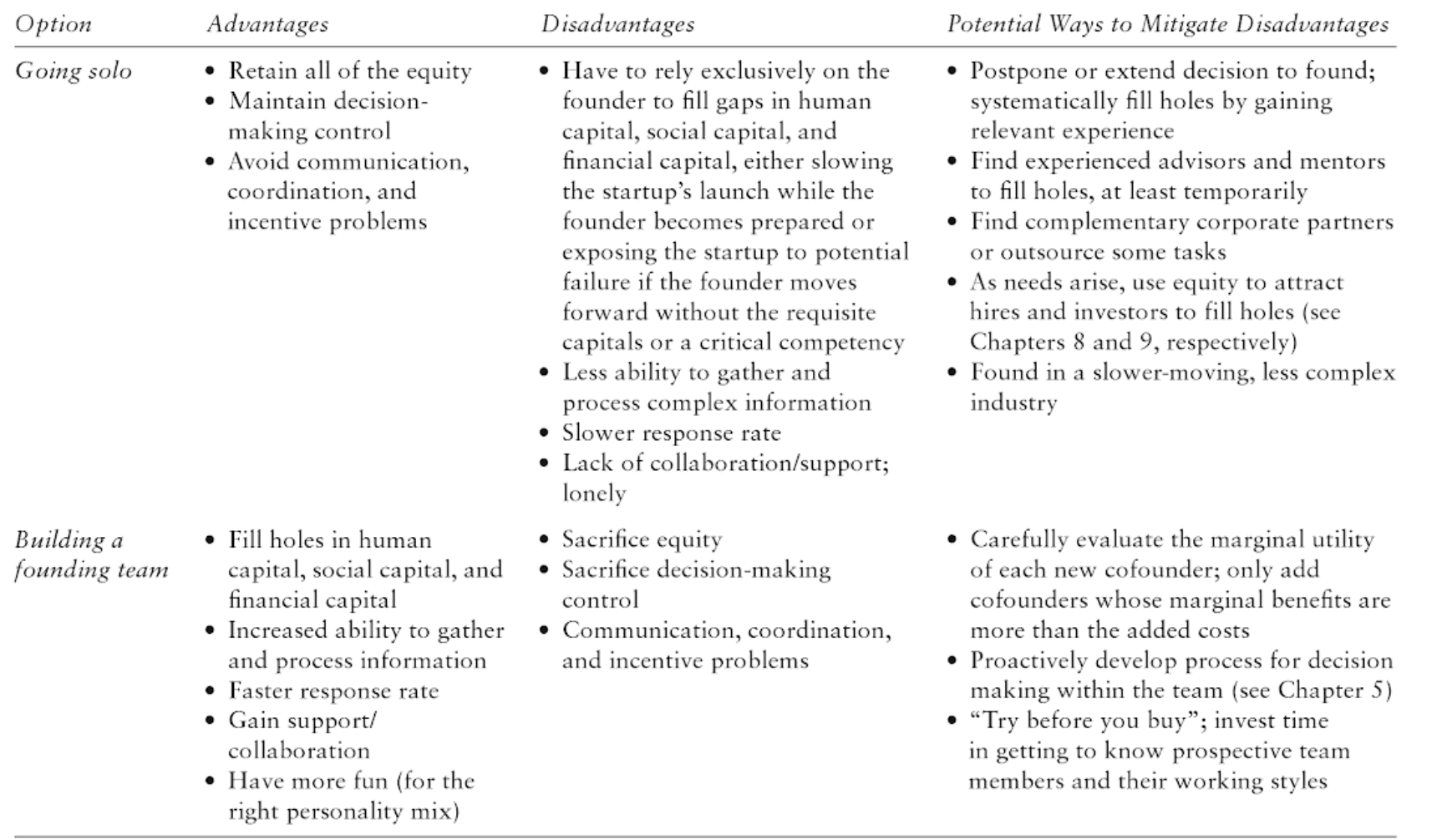
Only look for cofounders when you are missing important human, social or financial capital at time of founding:
- Human capital: Human capital includes the explicit knowledge derived from formal education and the tacit skills derived from prior experience.
- Social capital: Social capital refers to the benefits derived from one's place in information and communication networks. New startups need to reach out to recruit employees, establish relationships with potential partners, meet potential investors, and gain access to many other outside resources. The startup will benefit from cofounders' contacts and social capital.
- Financial capital: Financial capital refers to the money or other tangible resources that can be used in the founding process.
Other options may include:
- Outsourcing
- Finding advisors
- Partnering with complementary companies
Pros and cons of going solo versus building a founding team:
The Three Rs
- Relationships
- Friends/family vs acquaintances vs past coworkers
- Homogeneous vs heterogeneous teams
- Roles
- Overlapping roles vs division of labor
- Egalitarian vs hierarchical decision making
- Rewards
- Equal vs unequal equity splits
- Static vs dynamic agreements
Relationship Dilemmas
Founding team Homogeneity vs Diversity
- Tangible Factors:
- Human capital: cofounders with similar human capital can communicate more easily but the team may be missing critical skills.
- Social capital: mutual obligations are more enforceable but the divercity of information received by the team is reduced.
- Intangible factors:
- Decision-making style (hierarchical vs consensus): cofounders with similar styles make decisions more quickly. But there is no counterbalance.
- Risk tolerance (risk-seeking vs risk-averse): cofounders with similar risk tolerances may be more stable partners. But there is no counterbalance.
- Commitment level: cofounders with similar levels will be more likely to appreciate each other's efforts. But there is no counterbalance.
- Value system: cofounders with similar values will be more aligned regarding their priorities and preferences. But there is no counterbalance.
Strangers (no prior relationship) -> Past co-workers (prior professional relationship) -> Friends and Family (prior social relationship)
- the likelihood of discussing "Elephants in the room" is the lesser the closer prior relationships between cofounders. People tend to worry that raising thorny issues between friends / family would signal distrust of that friend / relative. If a business decision makes business sense but might damage the social relationship, founders naturally try to avoid making the business decision in the hope that the problem will pass.
- the risk of destroying prior relationship is the greater the closer prior relationships between cofounders.
Founders who decide to mix business and social relationships despite these dangers should at least take proactive steps to protect themselves and the startup:
- Compartmentalize relationships: If the team's size allows, avoid having cofounders report to their relative or close friend. Instead, have the cofounder report to another senior executive, keeping the private and professional relationships separate.
- Envision negative scenarios: Think about the obstacles — such as family issues, medical crises, and legal problems — that could affect a cofounder's ability to work on the startup. Resist the natural inclination of many founders to "stay positive", focusing on only desirable scenarios.
- Create a disaster plan: Put in writing a plan of action for the worst-case scenarios, such as an irresolvable business conflict or a breakup in the social relationship. Also, make it clear who has the final say in an impasse. Sign an exit contract that will apply if a worst-case scenario develops.
- Force sensitive discussions: Make a long-term policy of being open and honest about every personal issue that arises in the process of working together. Increasing the likelihood of discussing sensitive issues — by establishing a mechanism for it — can reduce the Playing-with-Fire Gap. Resist the natural inclination to put off or avoid discussions of difficult issues in the hope that they will solve themselves.
- Involve a referee: In order to prevent a professional disagreement from getting personal, write up a memo on the issue at hand and copy the entire executive team. This forces others to get involved and puts the emphasis on the issue itself rather than on the people advancing the issue. Or, use a mutual mentor or impartial advisor to mediate.
Role Dilemmas
Role Assignment
Overlapping roles
- Pros:
- Offers flexibility appropriate to early-stage startups
- Team members can pitch in wherever needed
- Taps collective knowledge of all team members
- Cons:
- Diffused responsibility weaken incentives
- May increase tension as founders step on each other's toes
Division of labor
- Pros:
- Enables assignment of titles, tasks and responsibility
- Provides better accountability
- Cons:
- Hard to collaborate on cross-cutting tasks
Decision-Making Approaches
- Egalitarian (or consensus) approach - the members of the team make decisions collectively by coming to a
complete consensus, and act as peers rather than superiors and subordinates.
- Higher quality of decisions
- Slower decision making
- Hierarchical (or autocratic) approach - the team has a formal process for making decisions and a clear hierarchy,
with a single person responsible for final decisions.
- Lower quality of decisions
- Faster decision making
- Composite - first, the team attempts to reach a full consensus. If consensus is not forthcoming, the CEO and relevant functional VP make their decision, but only after getting input from everybody in a public forum.
Pitfalls
- Don't crown multiple decision makers just to avoid a confrontation. While ducking the original conflict may seem to have saved the startup from an early implosion, it actually causes longer-term conflict, endangering the startup's future.
- Don't underestimate "Title Inertia" - the CEO has considerable symbolic and substantive power. He has to be chosen carefully as most CEOs are reluctant to relinquish their status and power, even when it's obvious they are not the best fit for the role.
- Don't inflate titles - the dangers of inertia likewise apply to non-CEO founders who take C-level titles. Once the startup has grown much bigger, many of those founders will not be the best people to fill those senior positions. Yet, demoting or replacing "overtitled" founders can be quite disruptive.
- Don't ignore incompatible motivations - if two founders are strongly control-motivated, both are likely to want to be decision makers. This can result in conflicts. In contract, when both founders are wealth-motivated, or one of them is control-motivated and the other is wealth-motivated, the team tend to be more stable.
Reward Dilemmas
Factors for determining equity splits:
- Past Contributions: How much has the founder contributed to building the value of the startup so far?
- Idea Premium: Founders who contribute the original idea on which the startup is based have made a unique contribution to the venture.
- Capital Contribution: Founders who have made larger contributions to the startup's seed capital should see a proportionate increase in their equity ownership.
- Opportunity Cost: What are the founders sacrificing in order to pursue the startup?
- Future Contributions: Most of the work required for the startup to be successful will come
in the future, but these contributions can be hard to anticipate. How much can each founder
be expected to contribute to the value of the startup down the road?
- Serial Founders: Members of the founding team who have previously led a startup to a successful exit can be expected to contribute more human and social capital down the road.
- Level of Commitment: Founders who are committed full-time to the venture can be expected to contribute more value.
- Titles: The official positions of the members of the founding team have been shown to influence equity splits, with CEOs receiving a substantial equity premium.
- Founder Motivations and Preferences
- Wealth Motivations should lead founders to prioritize larger equity stakes.
- Risk Aversion and Optimism will affect how much priority a founder places on gaining equity versus cash compensation.
- Tolerance for Conflict will affect a founder’s willingness to engage in negotiations.
- Prior Relationships can affect expectations about equity splits.
Consider dynamic splits - adjust the split as circumstances change. If the contribution of one of the founder changes, his equity split should change accordingly.
Vesting
Questions
What is founding-cheat-sheet?
cheat-sheets/founding-cheat-sheet is a public repo on GitHub by cheat-sheets. Avoiding the pitfalls that can sink a startup.
Is founding-cheat-sheet open source?
It declares no license on GitHub. Public does not mean open source: without a license, nobody is granted the right to reuse it.
Does founding-cheat-sheet run on macOS, Windows or Linux?
Its maker has not tagged a system, so it is unknown here. Its README says what it needs.