
n8n
Fair-code workflow automation platform with native AI capabilities. Combine visual building with custom code, self-host or cloud, 400+ integrations.
- 212k
- TypeScript
- 6 min ago
Mouse-first shortcuts for Windows — tap rhythms to run commands without moving the pointer.
Repo chnjames/PulseMouse, read from GitHub 1 d ago. chnjames has not joined Take My Repo.
chnjames/PulseMouse is a public repo on GitHub by chnjames. Mouse-first shortcuts for Windows — tap rhythms to run commands without moving the pointer. It declares the MIT license on GitHub. It is written mainly in C#, has 1 stars and last changed on 2026-11-11. Nobody has reviewed it on Take My Repo yet, which says nothing about its quality. Read from GitHub on 2026-11-23.

Mouse-first rhythm shortcuts for Windows.
Hold, tap a short dot/dash rhythm, and release—without moving the pointer or opening a menu.
Download v0.9.0 · 简体中文 · Development · Architecture
Windows x64 portable ZIP · SHA-256
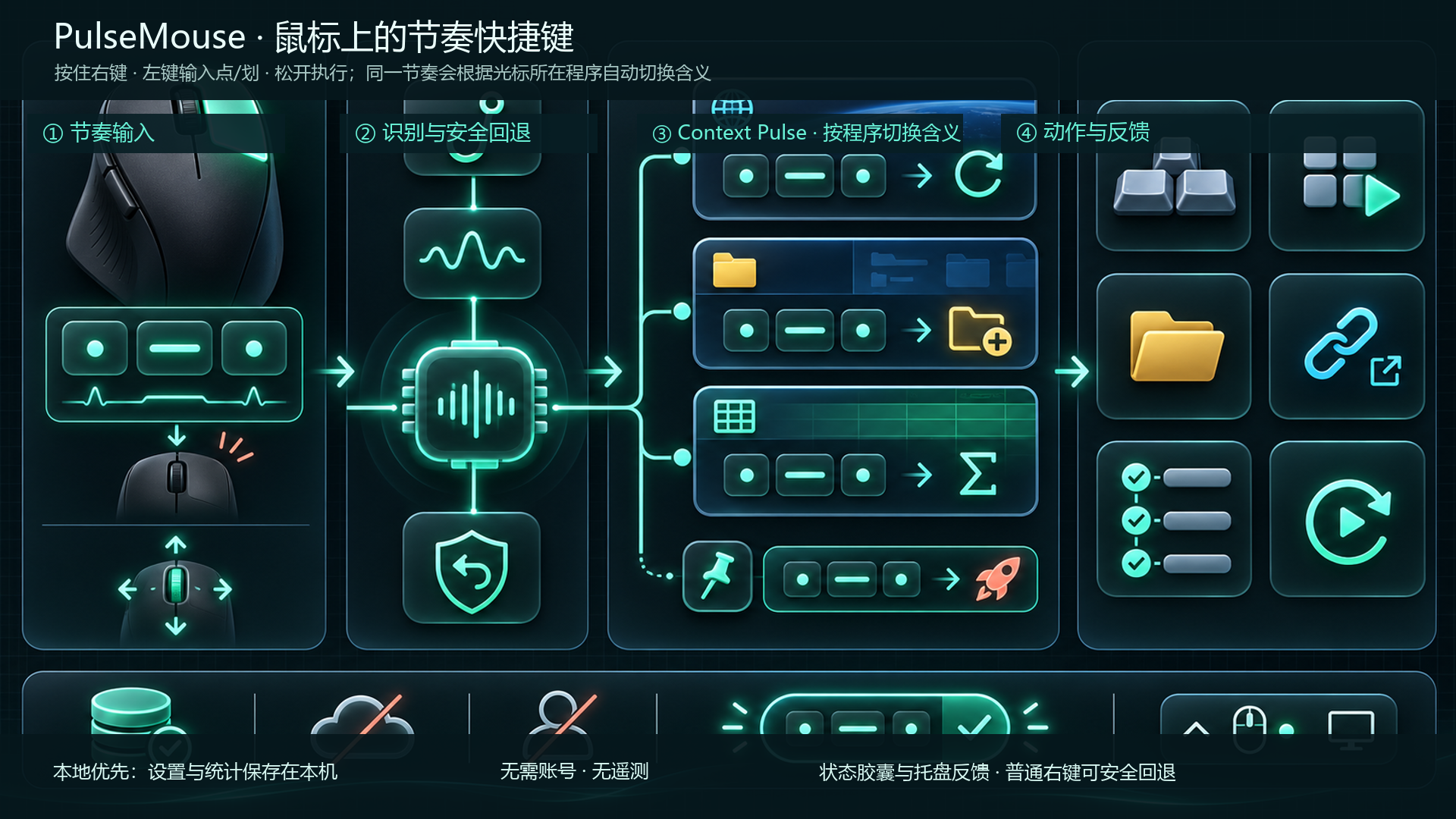
Pre-release notice. v0.9.0 ships as a portable Windows x64 build. It has no installer, code signature, or automatic updater yet. Core smoke tests pass; global-hook, injected-input, target-window, and display-scaling behavior still require the manual checks in the release checklist.
Launchers help you find an action. PulseMouse is for the small set of actions you already know by heart—copy, screenshot, switch window, open a tool, or send a shortcut. It makes those actions available through a compact rhythm while your cursor and attention stay on the current task.
| 1. Hold the trigger | 2. Tap a rhythm | 3. Release to act |
|---|---|---|
| In automatic mode, PulseMouse uses a detected side button or falls back to right-click + left-click. | A quick left press is a . dot; a 500–1600 ms hold is a - dash. |
PulseMouse resolves the rhythm for the window under the pointer, then executes the matching action. |
The same rhythm can mean different things in a browser, File Explorer, or a spreadsheet. Pinned global mappings always win; ordinary right-clicks and right-dragging return to their native behavior when no rhythm is completed.
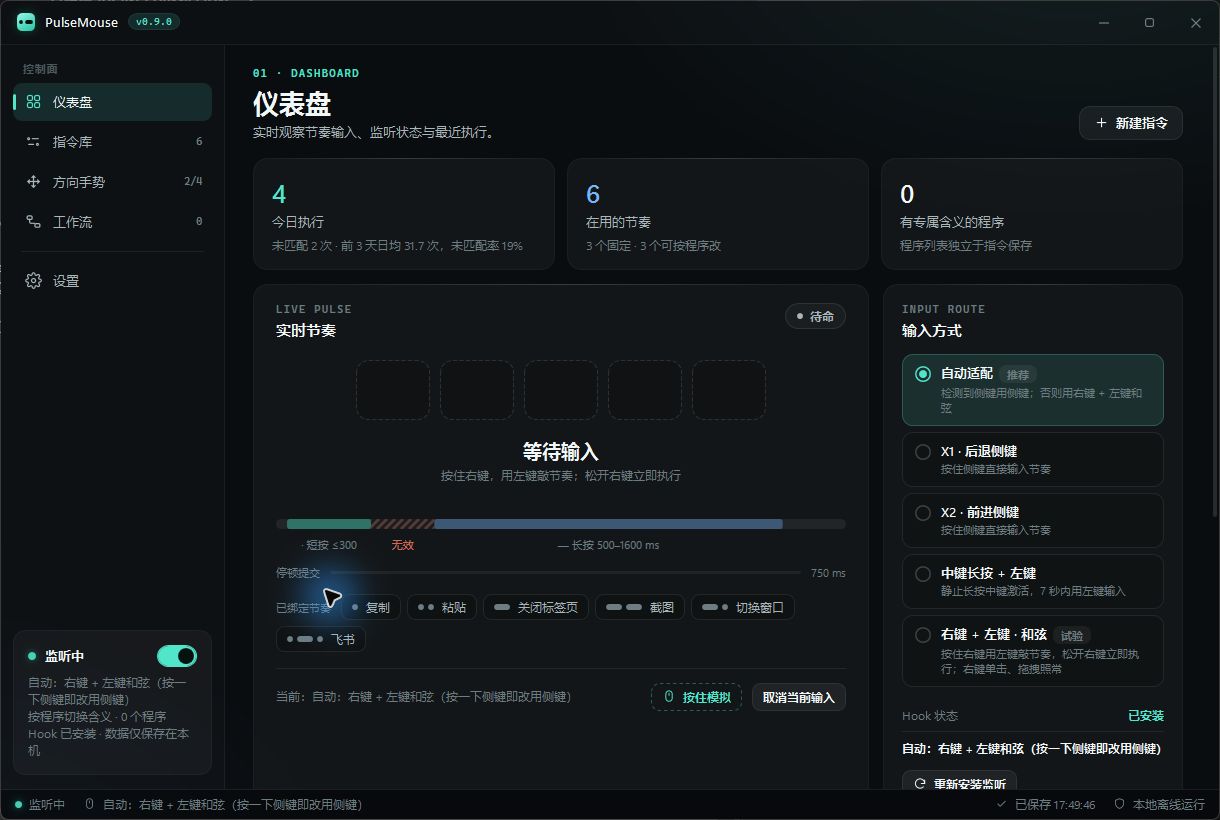
| Command library | Direction gestures |
|---|---|
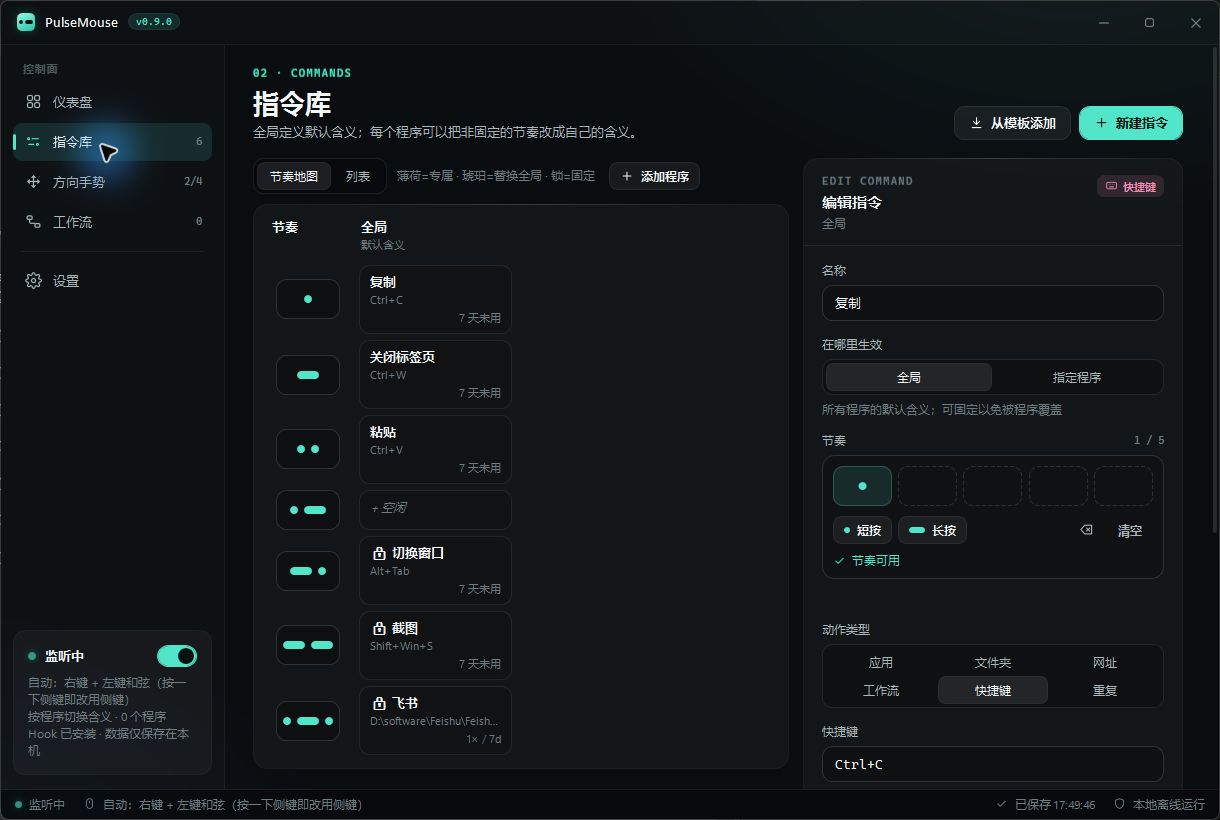 |
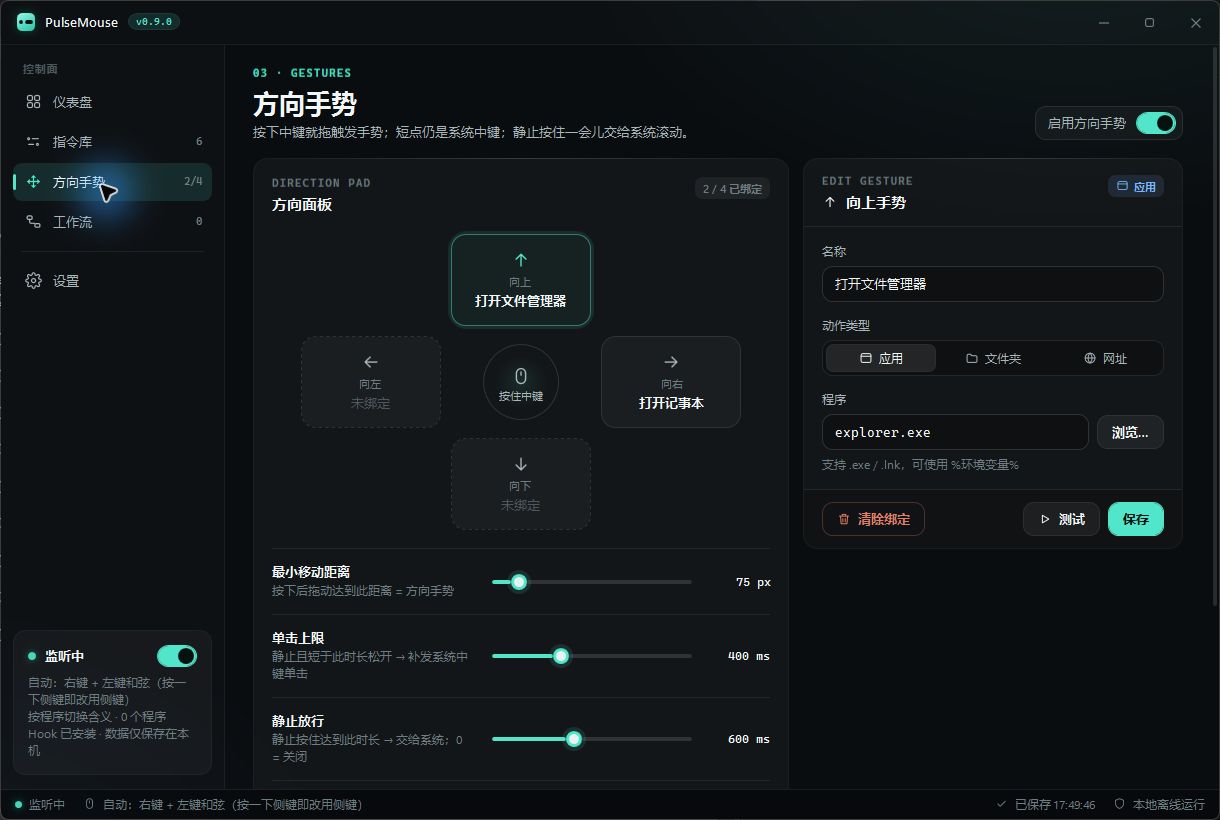 |
| Workflow builder | Settings and safety controls |
|---|---|
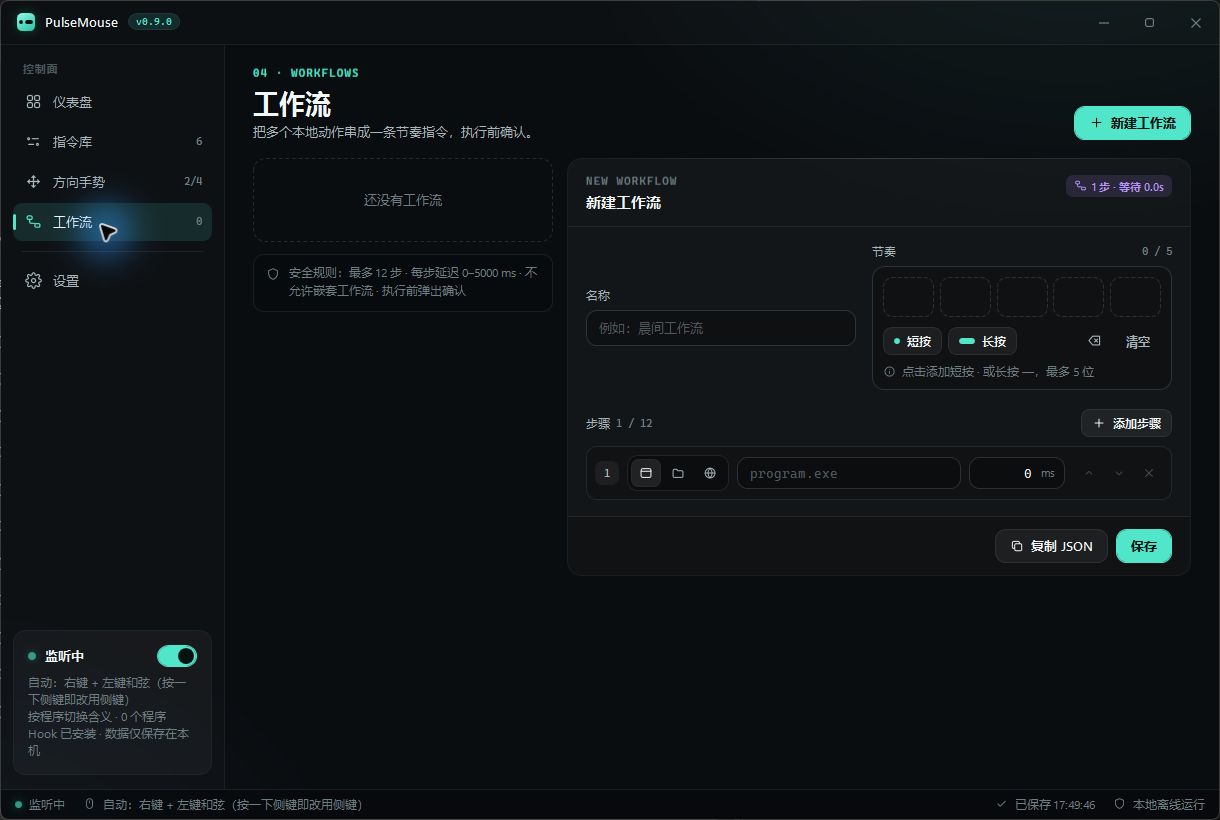 |
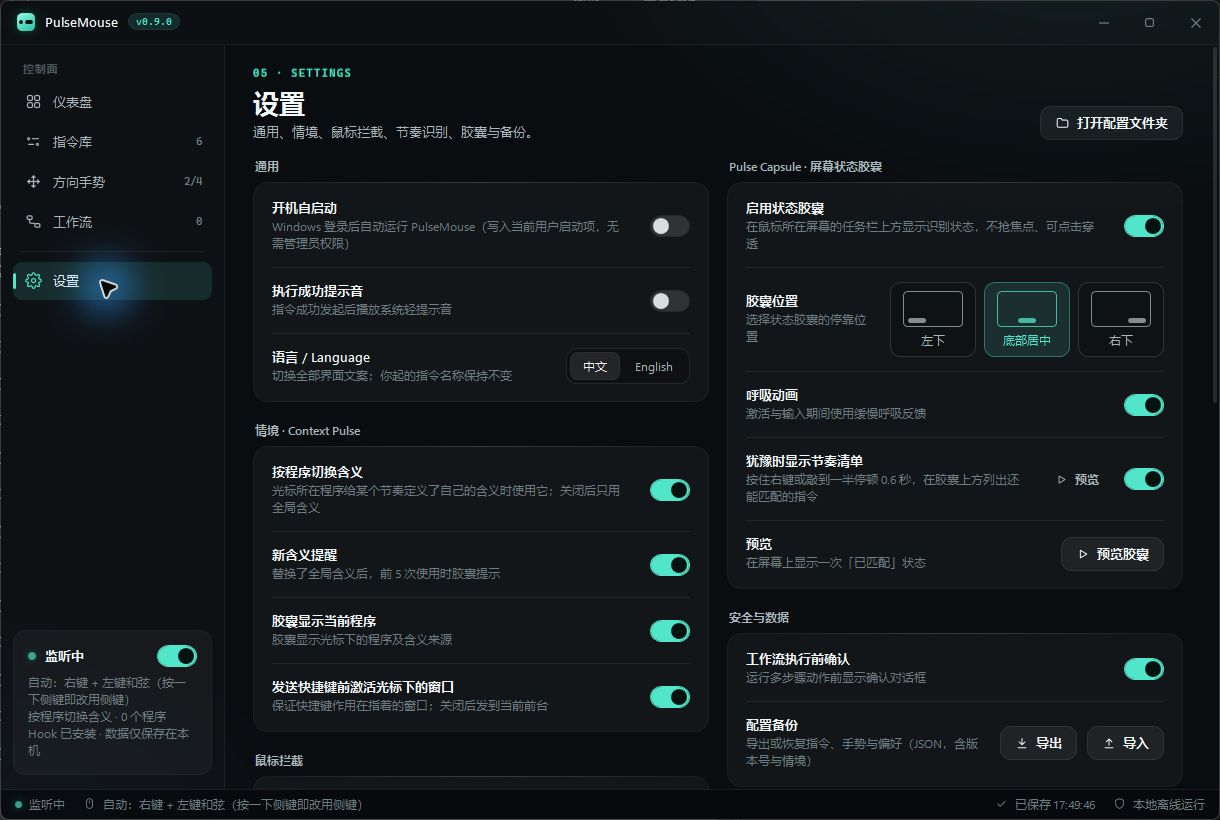 |
All interface captures above are from the running v0.9.0 application. The feature-and-architecture overview is an explanatory visual, not a UI screenshot.
| Capability | What it gives you | |
|---|---|---|
| ◌—◌ | Fast rhythm input | Enter up to five dot/dash pulses and release to run a mapping immediately. |
| ⌁ | Context Pulse | Reuse one rhythm with a different meaning in Chrome, Explorer, Excel, or another app. |
| ↗ | Useful actions | Launch an app or folder, open an HTTPS URL, send a shortcut, run a confirmed workflow, or repeat the last successful action. |
| ✥ | Direction gestures | Hold middle-click and drag up, down, left, or right to invoke a separate action layer. |
| ◉ | Feedback without focus theft | Use an on-screen capsule, reachable-rhythm hints, tray state, diagnostics, and local statistics. |
| ⌂ | Local by design | Keep settings and statistics in %LOCALAPPDATA%\PulseMouse\settings.json; no account or telemetry. |
For Windows 10/11 x64. This is a portable pre-release build.
PulseMouse.exe.The ZIP includes required WPF native files alongside the executable. Verify it with the published SHA-256 file if needed. Because the build is unsigned, Windows may show a SmartScreen warning.
| Input | Meaning |
|---|---|
| Quick press, up to 300 ms | . dot |
| Hold, 500–1600 ms | - dash |
| 300–500 ms, below 35 ms, or over 1600 ms | rejected |
Right-click chords commit on release. Side-button and classic middle-button modes commit after a 750 ms pause.
PulseMouse records the window under the pointer when the trigger starts. Resolution is deterministic:
| Action | Notes |
|---|---|
| Application | .exe, .lnk, or a command name; environment variables are expanded. |
| Folder | Opens an existing folder. |
| URL | HTTP and HTTPS only. |
| Shortcut | Examples: Ctrl+C, Alt+Tab, Shift+Win+S. |
| Workflow | 1–12 application, folder, or URL steps; confirmation is on by default. |
| Repeat last action | Replays the most recent successful non-workflow action. |
| Direction gesture | Middle-click drag: up, down, left, or right. |
The desktop and taskbar intentionally use global mappings only. Shortcut actions can activate the captured target window before sending input; if the target is gone or cannot be activated, the shortcut is not sent.
SendInput; do not use it with games or anti-cheat-protected software.Read SECURITY.md for responsible disclosure and docs/RELEASE_CHECKLIST.md for the manual validation gate.
Requirements: Windows 10/11 and the .NET 10 SDK.
dotnet restore PulseMouse.slnx
dotnet build PulseMouse.slnx -c Release --no-restore
dotnet run --project tests/PulseMouse.Core.SmokeTests -c Release --no-build
Run ./build-windows.ps1 for a self-contained x64 publish at publish/win-x64/.
Issues and pull requests are welcome. Read CONTRIBUTING.md before proposing a change. PulseMouse is released under the MIT License.
chnjames/PulseMouse is a public repo on GitHub by chnjames. Mouse-first shortcuts for Windows — tap rhythms to run commands without moving the pointer.
It declares the MIT license on GitHub.
Its maker tagged it for Windows. That is declared by the maker; Take My Repo has not tested it.
Open "Take it" on its page: Take My Repo writes an install plan for your machine and hands it to your AI agent (Claude Code, Codex or Cursor), which asks you before each step. Take My Repo has not tested it on any machine.
This project is dedicated to collecting high-quality macOS software and organizing them systematically by different categories for easy search and use.
Build Agentic workflows, RAG pipelines, with rich AI model and tool support on one collaborative workspace. Deploy on cloud, VPC, or self-hosted, so teams move from prototype to production without rebuilding the stack.
Its last change on GitHub was on 2026-11-11. Take My Repo does not judge from that whether it is maintained.
Nobody has reviewed it on Take My Repo yet, which says nothing about its quality.
Take My Repo cannot say: it does not audit code and has not run PulseMouse. What is known comes from GitHub. It declares the MIT license on GitHub. Its last change was on 2026-11-11. It has 1 stars, which measure popularity, not safety. Nobody has reviewed it on Take My Repo yet, which says nothing about its quality. Read the source before you run it. With "Take it", your AI agent shows each step and asks you before running it; README text is treated as data, not as instructions.


