
OpenProperty
Open-source property management software — a self-hosted alternative to TenantCloud, AppFolio, Buildium, and Propertyware. Rental property management with units, tenants, leases, rent collection, and maintenance work orders.
- 38
- MIT
- 6 d ago
Repo clawnify/OpenProperty, read from GitHub 3 h ago. clawnify has not joined Take My Repo.
In short
clawnify/OpenProperty is a public repo on GitHub by clawnify. Open-source property management software — a self-hosted alternative to TenantCloud, AppFolio, Buildium, and Propertyware. Rental property management with units, tenants, leases, rent collection, and maintenance work orders. It declares the MIT license on GitHub. It is written mainly in TypeScript, has 38 stars and last changed on 2026-11-17. Nobody has reviewed it on Take My Repo yet, which says nothing about its quality. Read from GitHub on 2026-11-22.
OpenProperty
Property management for landlords and small property managers: properties and units, tenants and leases, a monthly rent ledger matched from your bank statement, late-rent reminders, and maintenance work orders with your vendors.
An open-source app template provided by Clawnify.com.
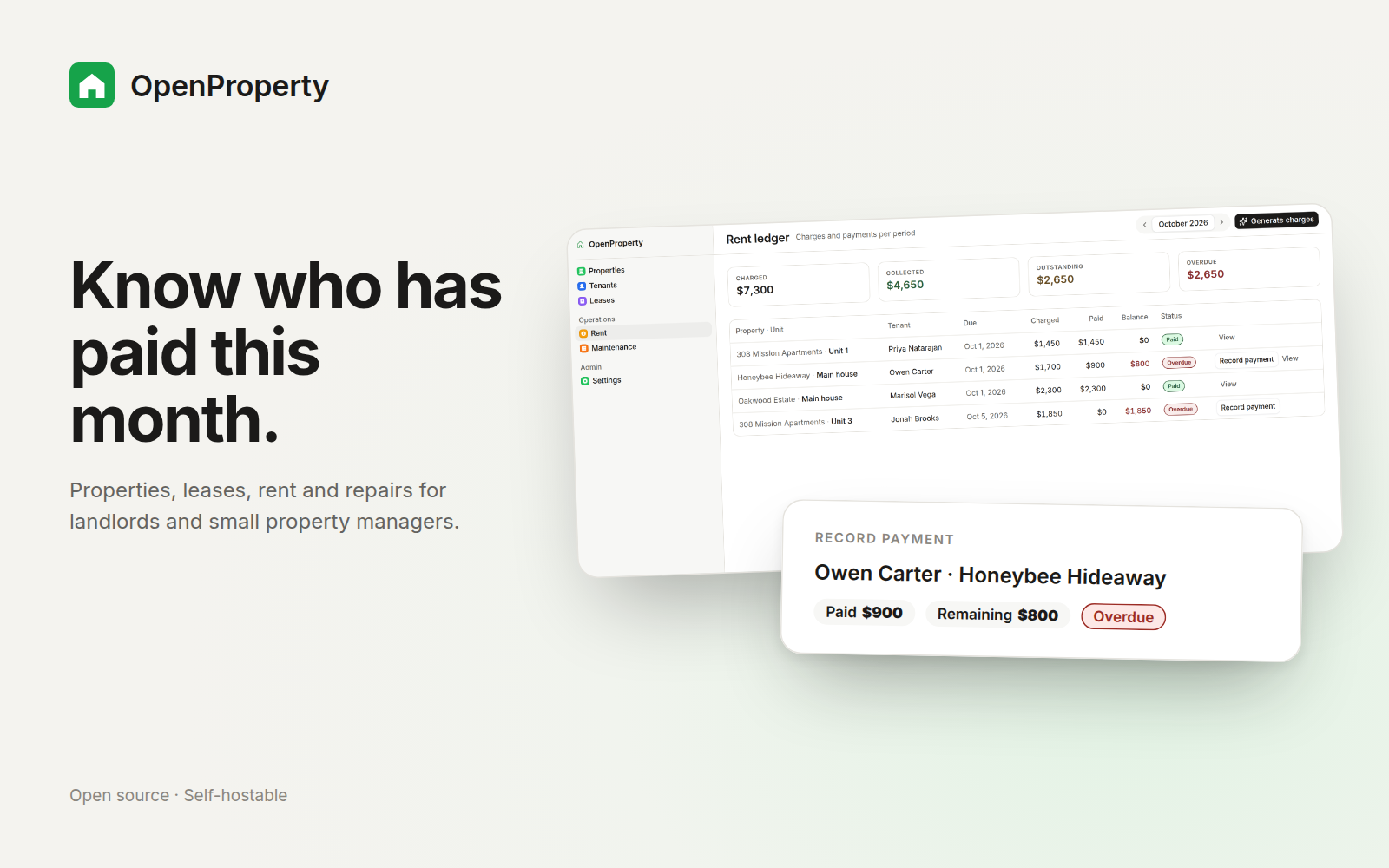
Know who has paid this month. Every active lease gets one charge per month, generated with one click and never twice. Payments are recorded against the charge, and its status follows from the money: open, partial, paid or overdue. Who still owes rent is one filter away.

See it in action
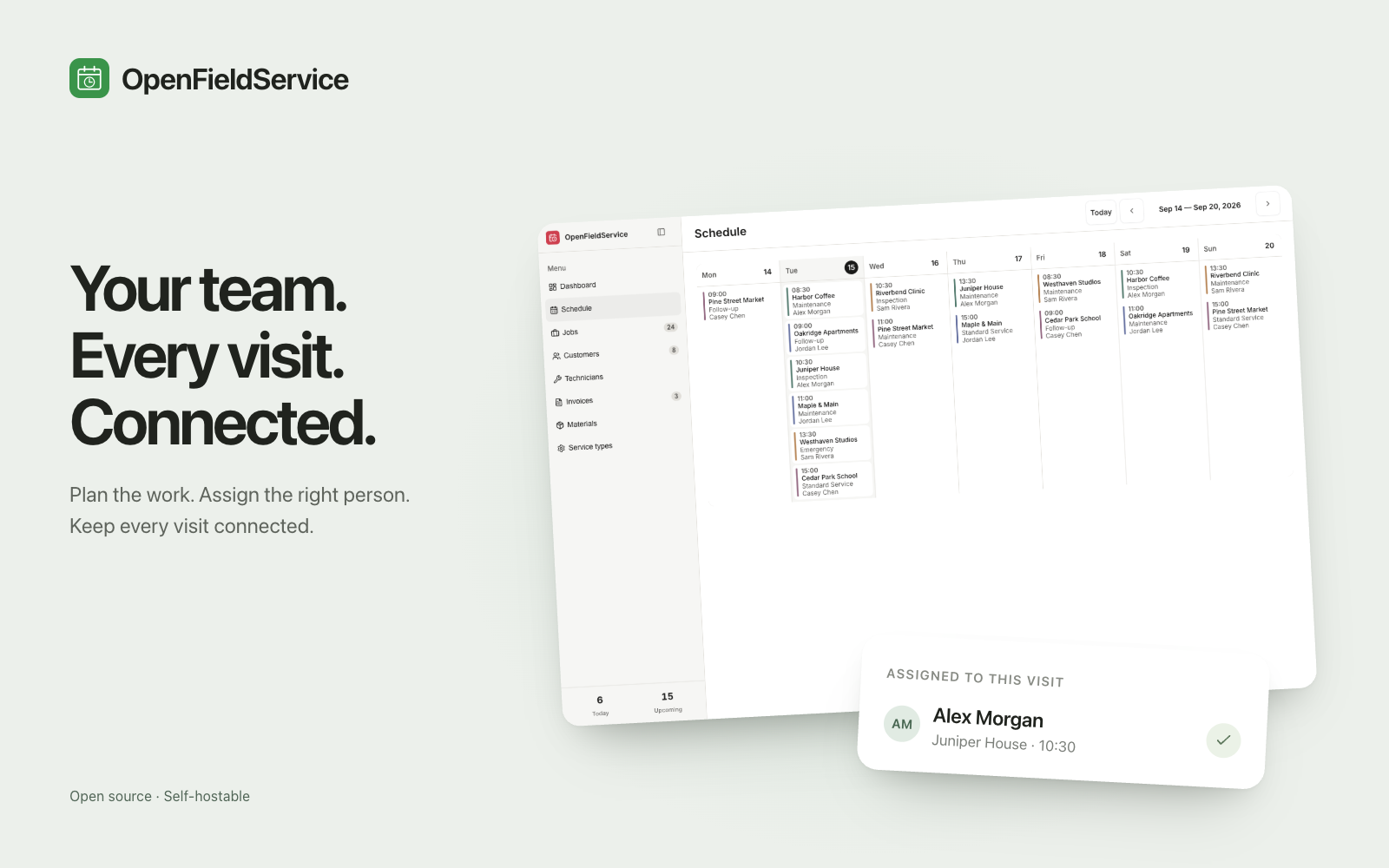
Conceptual UI illustrations of the app's main capabilities, with fictional example data. Open an image to see the details.
| Rent ledger | Payments |
|---|---|
 |
 |
| Maintenance | Dashboard |
 |
 |
What it does
- Dashboard. Occupancy, active leases, rent collected and outstanding this month, overdue totals, open and urgent work orders, and the leases ending soon.
- Properties and units. Each property shows its type, address, occupancy and its open work orders. A unit tracks bedrooms, bathrooms, size, market rent and status: vacant, occupied, turnover or unavailable.
- Tenants. A searchable list showing each tenant's current unit, and a detail page with contact details, employer, income, emergency contact and lease history.
- Leases. Term, monthly rent, deposit, due day, late fee and status (upcoming, active, ended, cancelled). A lease can have more than one tenant.
- Rent ledger. Step through months, generate the month's charges, record payments by amount, method, date and reference, and see what was charged, collected, outstanding and overdue. Generating again adds only the leases that were missing.
- Bank matching. Import a statement from your bank: a CSV from any bank (the columns, date order and decimal mark are recognised, and you confirm them before anything is saved) or a CAMT.053 file from a European bank. Each payment in is matched to the rent it pays by who sent it, not by its reference, which tenants' banking apps fill with anything. Confirm a payer once and their next payment of exactly what they owe is recorded on import. A partial payment, a new payer or two leases owing the same amount wait for you with a suggestion and the reason for it. Two months in one transfer pay the oldest month first, or the month the reference names. A line already imported from an overlapping statement is skipped, and every match can be undone.
- Late-rent reminders. On the day a reminder falls due, it is listed with the email already written: the balance, the due date, the days late and the lease's late fee. By default that is a late notice the day after the grace period and a final notice at 14 days, and both the timing and the wording are yours to change. Open it in your own email, send it, mark it sent. If you come back after three weeks you get one final notice, not every step you missed. Once the rent is matched, nothing more is offered, and a tenant whose payment may be waiting in bank matching is flagged before you write to them.
- Maintenance. Work orders with priority and status, linked to a property,
unit, tenant and vendor, with a scheduled date and a cost.
Each has a reference such as
WO-42for phone calls and follow-ups. Search by reference, title, description, property, unit, tenant or vendor; choose All to include completed and cancelled jobs. References identify records within your install and do not grant public access. - Vendors and policy. A vendor directory by trade, plus the defaults new leases start from: rent due day, late fee, grace days and currency.
A first run seeds three sample properties, five units and three vendors, so the app is usable before you add anything. Deleted sample data does not come back on a redeploy.
What it deliberately doesn't do
- Take payments. There is no card or bank processing. The ledger records money that arrived some other way.
- Screen applicants. Applications are records you keep. There is no credit or background check.
- Send messages for you. Reminders are drafted here and sent from your own email. The app sends nothing to tenants, by email, SMS or otherwise.
- Publish anything. No listing syndication, and no public tenant or owner portal.
Each of these can be built on top once you have your own copy.
Running it locally
pnpm install
pnpm dev          # UI on :5173, API on :8787, schema applied to a local database
pnpm typecheck
pnpm test
pnpm build
Stack
React 19, Vite and TypeScript on the client, with Tailwind CSS v4 and shadcn/ui. A Hono API on the server, and a SQLite database. The same code runs locally and in production.
Data
One SQLite database per install. The schema is src/server/schema.sql. The app
writes the defaults and sample data on first run.
| Table | Holds |
|---|---|
properties |
buildings, with type, address and a colour tag |
units |
rentable spaces inside a property, with rent and status |
tenants |
people, with contact, employment and emergency details |
leases |
a unit, its primary tenant, term, rent, deposit and late fee |
lease_tenants |
the other tenants on a lease |
rent_charges |
one charge per lease per month, with what has been paid |
payments |
money recorded against a charge |
vendors |
contractors by trade |
work_orders |
maintenance jobs, with priority, status, vendor and cost |
applications |
applicants and where they are in the decision |
settings |
rent policy defaults and currency |
Project layout
src/
  server/
    index.ts        API routes for every entity, first-run data
    db.ts           database adapter (query / get / run)
    schema.sql      tables and indexes
  client/
    app.tsx         shell and routing
    components/     dashboard, properties, tenants, leases, rent,
                    maintenance, settings, and shadcn/ui primitives
    hooks/          router and app state
    lib/utils.ts    colours, dates, money and period helpers
Licence
MIT. See LICENSE.
Questions
What is OpenProperty?
clawnify/OpenProperty is a public repo on GitHub by clawnify. Open-source property management software — a self-hosted alternative to TenantCloud, AppFolio, Buildium, and Propertyware. Rental property management with units, tenants, leases, rent collection, and maintenance work orders.
Is OpenProperty open source?
It declares the MIT license on GitHub.
Does OpenProperty run on macOS, Windows or Linux?
Its maker has not tagged a system, so it is unknown here. Its README says what it needs.
How do I install OpenProperty?
Open "Take it" on its page: Take My Repo writes an install plan for your machine and hands it to your AI agent (Claude Code, Codex or Cursor), which asks you before each step. Take My Repo has not tested it on any machine.
Is OpenProperty still maintained?
Its last change on GitHub was on 2026-11-17. Take My Repo does not judge from that whether it is maintained.