
forformat
Fortran indenter and formatter, including spacing and case consistency
- 5
- BSD-3-Clause
- 4 wk ago
Repo cmbant/forformat, read from GitHub 1 d ago. cmbant has not joined Take My Repo.
In short
cmbant/forformat is a public repo on GitHub by cmbant. Fortran indenter and formatter, including spacing and case consistency. It declares the BSD-3-Clause license on GitHub. It is written mainly in Rust, has 5 stars and last changed on 2026-11-01. Nobody has reviewed it on Take My Repo yet, which says nothing about its quality. Read from GitHub on 2026-11-24.
forformat
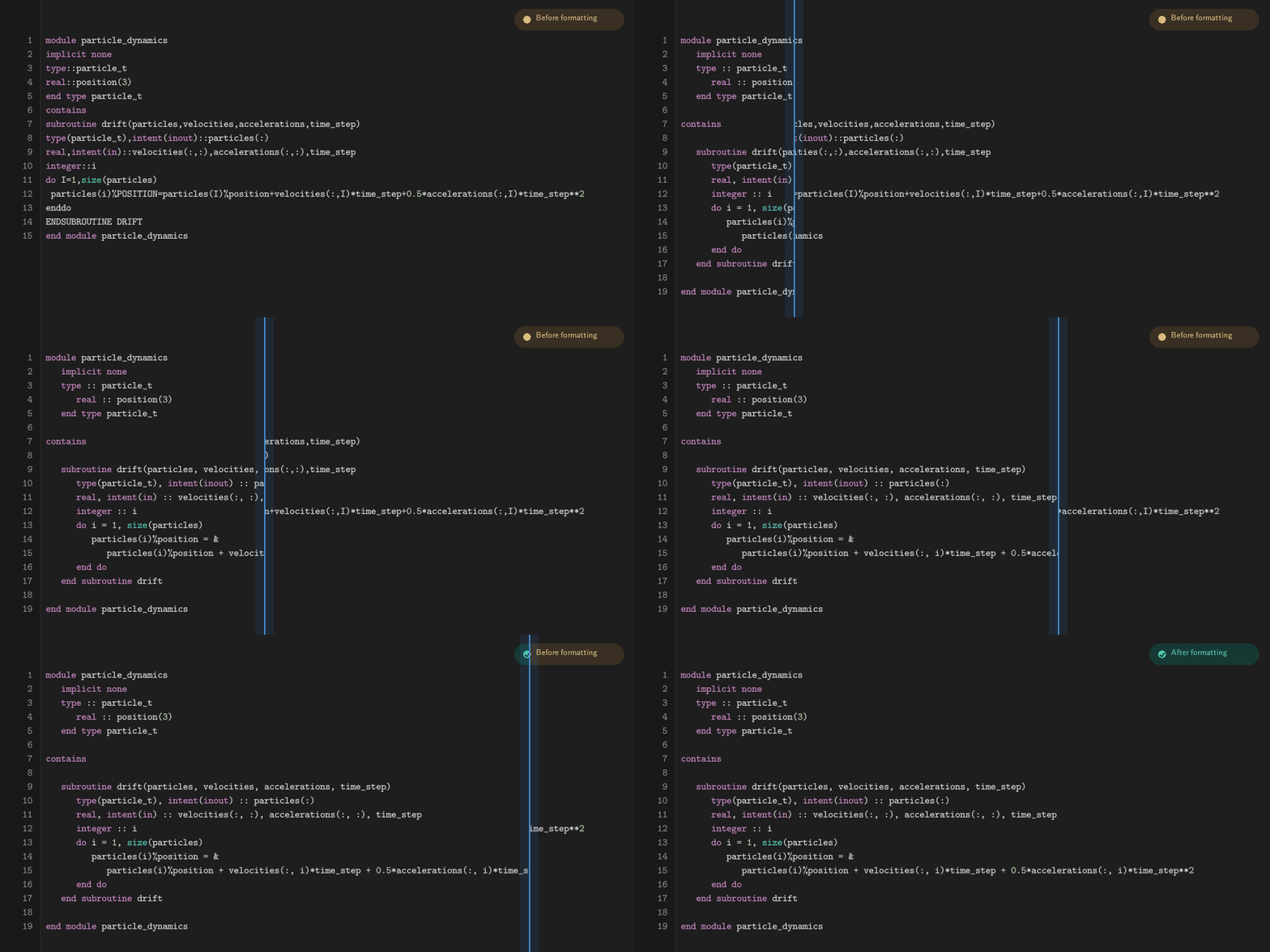
forformat is a standalone formatter for free-form Fortran. It combines findent-compatible
indentation with lexical normalization, project-aware identifier casing, and statement wrapping.
The formatter is implemented in Rust and designed for fast whole-project formatting. Python wheels
bundle forformat, so normal installation does not require Rust or a Fortran compiler.
Automatic fixed/free input detection is enabled by default. Sources detected as fixed form are left
unchanged; use -ifree or --input-format=free to force free-form handling. Fixed-form output is
not supported.
Install
From PyPI:
python -m pip install forformat
forformat --version
The package requires Python 3.9 or newer.
For pre-commit, use the separate hook repository:
repos:
  - repo: https://github.com/cmbant/forformat-pre-commit
    rev: v0.1.7
    hooks:
      - id: forformat
      # - id: forformat-check  # check only; do not rewrite
To build from source, install Rust 1.85 or newer:
cargo build --locked --release
"${CARGO_TARGET_DIR:-target}/release/forformat" --version
Tagged release workflows also build static Linux archives for x86_64 and arm64. Checksums and GitHub provenance attestations are included with release artifacts for users who want to verify downloads; they are not required for normal PyPI or pre-commit installation.
Quick start
Format files in place:
forformat src/module.f90
forformat src/*.f90
forformat src/
Explicit paths use declarations from the surrounding project for identifier case resolution; add
--isolated for standalone formatting.
Check formatting without changing files, or print a diff:
forformat --check src/*.f90
forformat --diff src/*.f90
Format every tracked free-form source in the current checkout:
forformat --all-files
Use stdin/stdout in a pipeline:
forformat --stdin < src/module.f90 > /tmp/module.f90
forformat --stdout src/module.f90 > /tmp/module.f90
For an editor buffer, give stdin the filename it represents:
forformat --stdin-filename=src/module.f90 < src/module.f90
The filename supplies configuration and Git-project discovery, source-form detection, relative
INCLUDE resolution, and diagnostics. If the file is tracked, the stdin bytes shadow its stale
on-disk contents during project analysis; the filename may also name a new file whose parent
already exists. Use --project-context=/path/to/other/checkout to override only the Git project
used for semantic context without changing the stdin filename or its configuration origin.
Formatting modes
Full formatting is the default. The other modes are useful when you want a narrower transformation:
--full— normalization, wrapping, and findent-compatible layout.--indent-only— findent-compatible indentation and trailing-whitespace handling only.--normalize-only— normalization without structural layout or wrapping.--canonicalize-only— canonical transformations without whitespace or layout normalization.--canonicalize-and-indent— canonical transformations followed by findent-compatible indentation, without wrapping or full-mode post-layout alignment.
Normalizing modes target Fortran 2003 output by default. Use --target-standard=f95 (or
target_standard = "f95" in configuration) to prevent the formatter from introducing syntax newer
than Fortran 95. The target constrains formatter-generated syntax; it does not validate or downgrade
syntax already present in the input.
Common examples:
forformat --indent=4 --indent-module=0 --indent-procedure=0 src/module.f90
forformat --keyword-case=upper --line-length=100 src/module.f90
forformat --canonicalize-and-indent src/module.f90
See CLI and configuration options for the full option reference, defaults,
configuration keys, and examples. Legacy findent spellings that are only useful for compatibility
are documented separately in migration and
compatibility. forformat --help is the compact terminal summary.
Project configuration
Project settings can live in a top-level .forformat.toml, the compatibility spelling
.findent.toml, or [tool.forformat] in pyproject.toml:
[tool.forformat]
mode = "full"
target_standard = "f2003"
indent = 4
line_length = 100
keyword_case = "lower"
context_paths = ["src", "modules"]
exclude = ["vendor/"]
extend_exclude = ["**/generated-*.f90"]
Hyphens and underscores are equivalent in configuration keys. Command-line scalar options override
project settings. --exclude replaces the configured exclusion set; --extend-exclude adds to it.
Workflow choices such as --all-files, --check, --diff, --stdin, and --stdout remain
command-line-only. See the options reference for discovery,
precedence, and the full list of command-line-only settings.
Python API
Python callers can format text or bytes using the same formatter shipped with the package:
from forformat import format_source

formatted = format_source(
    source,
    filename="/path/to/checkout/src/module.f90",
    options=("--config=/absolute/path/to/.forformat.toml",),
)
The return type matches the input type. filename gives an in-memory buffer the same file identity
as --stdin-filename; repo_context_path can optionally override its project with a directory.
Automatic configuration discovery is disabled for this API unless options explicitly supplies
--config.
Documentation
- CLI and configuration options — primary user-facing option reference.
- File and project workflow — tracked-file selection, project context, exclusions, submodules, stdin identity, and fixed/free detection.
- VS Code setup — configure the Fortran extension to use
forformat. - Full-mode guide — normalization, wrapping, layout, invariants, and code map.
- Compatibility — the findent compatibility boundary and reviewed divergences.
- Migrating from findent — legacy option mapping and unsupported features.
Development
The implementation is under src/; tests and golden fixtures are under tests/. Run:
./tools/check_local.sh
For dependency-policy changes, CI also runs cargo deny check bans licenses sources; RustSec
advisories are reported separately so a newly published advisory does not unexpectedly block an
otherwise unrelated pull request.
For changes to full-mode normalization, wrapping, or layout, also run
./tools/check_fuzz_regression.sh and the relevant focused properties. See AGENTS.md
for the full repository verification bar.
Relationship to findent
--indent-only implements the findent-compatible indentation contract for findent 4.3.8;
full mode intentionally adds behavior beyond that contract. See
compatibility for the reviewed differences and
migration for legacy option mapping.
The project is BSD-3-Clause licensed. Third-party attribution and license terms are in
LICENSE-THIRD-PARTY.
Questions
What is forformat?
cmbant/forformat is a public repo on GitHub by cmbant. Fortran indenter and formatter, including spacing and case consistency.
Is forformat open source?
It declares the BSD-3-Clause license on GitHub.
Does forformat run on macOS, Windows or Linux?
Its maker has not tagged a system, so it is unknown here. Its README says what it needs.
How do I install forformat?
Open "Take it" on its page: Take My Repo writes an install plan for your machine and hands it to your AI agent (Claude Code, Codex or Cursor), which asks you before each step. Take My Repo has not tested it on any machine.