
Catch2
A modern, C++-native, test framework for unit-tests, TDD and BDD - using C++14, C++17 and later (C++11 support is in v2.x branch, and C++03 on the Catch1.x branch)
- 22k
- C++
- BSL-1.0
- 9 d ago
The Theater Of Evolutionary Architecture
Repo codefinity/oeuvre, read from GitHub 10 h ago. codefinity has not joined Take My Repo.
codefinity/oeuvre is a public repo on GitHub by codefinity. The Theater Of Evolutionary Architecture. It declares the MIT license on GitHub. It is written mainly in JavaScript, has 10 stars and last changed on 2022-12-08. Nobody has reviewed it on Take My Repo yet, which says nothing about its quality. Read from GitHub on 2026-11-23.
/ˈəːvr(ə)/
Pronounced as: uh·vruh | noun: oeuvre; plural noun: oeuvres
Meaning: The body of work of a painter, composer, or author. A work of art, music, or literature.
This project is in design and analysis phase. Please feel free to go through the code and documentation and if you have any Questions or Suggestions, you can use the Issues tab.
The Documentation is in progress. The author is working in write-now-and-edit-later mode, therefore please expect grammatical errors, spelling mistakes, and typos. In case of any factual errors, please report them using the Issues section.
Programmers who can contribute to the project.
TOC is Incomplete - Plesase scroll down for more topics
3. Stratergy and Technology Must Go Hand-In-Hand
5. A Need for a Project Like Oeuvre
6. How Real World Evolution Works
7. Lessons Worth Learning From Real World Evolution
8. How To Make Principles Of Evolution Work for Architecture
10. Dangers of Overuse of Concepts
11. Reasons for Selection of Domain Driven Design Architecture
12. The Hexagonal Architecture
Oeuvre is not a demonstration, it is Software Evolution in motion.
Oeuvre is a social article publishing portal that enables users to write and publish and share their articles. At some level Oeuvre is an Experimental Test-Bed for Evolutionary Architecture. This project will show how quickly and efficiently DDD aligns to the changes in business.
The technology stack used is .Net, but the concept can be applied to all the programming language that supports OOPS.
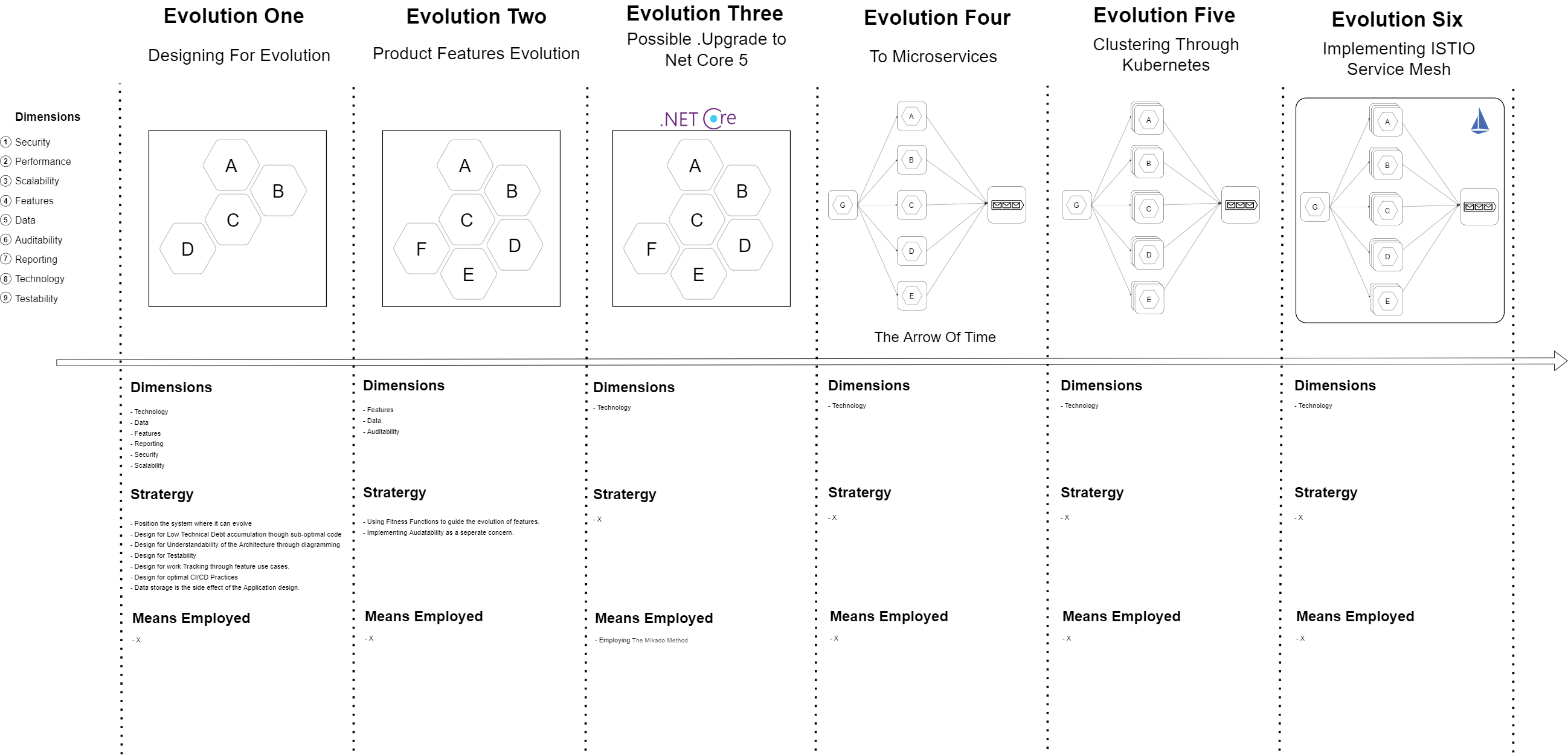
1. Dividing the application into most conducive Architectural Quanta
The Architectural Quantas that we will be employing are discussed the section Evolution In Action.
2. Restricting the Business Logic at the Core
We will be employing design philosophies like Hexagonal - Prots and Adapters in combination with Domain Driven Design to make Business Logic the core of the Architecture from where everything else originates.
3. Modularity through Application Boundaries
The application will be designed using the modular monolith approach and each module will be isolated from each other and allowed to exchange information through integration services and in-memory messaging. This approach will help the application to evolve later to Microservices.
4. Modularity at the Database Level
Even though the application will use the same database, the tables of each modules will be isolated. This will help the application to scale to the microservices level.
5. Diagramming the Application
The section No Silver Bullet explains why diagrams give a sense of orientation to the design and is needed for software because is abstract and does not by nature have a geometry.
Oeuvre will be guided by duagrams from the very begining and evolutionary stratergies will be deviced first at the digrammatic level.
The process flow of the application will be discovered and guided by Event Storming
6. Well defined use cases as the Unit of Feature Evolution
The feature evoltion of Oeuvre will be guided by BDD and the use cases defined by gherkin will reflect in the tests at various levels.
7. Evolution will be guided by Fitness Function
The section How To Make Principles Of Evolution Work for Architecture explains the usefulness of Fitness functions for guiding through incremental evolution. The Guided Evolution describes the stratergy for applying fitness functions at right places in the architecture.
8. Communication through Messaging
The The Reactive Manifesto encourages the systems to communicate through messaging. Even though our modules are in close promixity to each other, we wouldbe using messaging to pass messages and receive messages between them. Messages will also be used to create reports and audit trail.
Using messages will make it easier to later separate these modules when the application evolves to microservices. The in-memory message bus will be replaced my a message queue.
9. Continuous Monitoring
According to The 12 Factor Apps the logs generated by the App can be routed to a file, and also streamed to an analysis system so that it provides the following benifits:
Each module will log errors to its own file. Which analysis engine to be used will be decided later. (Probably - ELK in combination with Spark)
Software does not exist in isolation. It is built to solve a acclerate proccessess or solve problem in the market. Business Stratergy must gives direction to technology. If technology is the muscle, stratergy is the mind.
Business itself exists in the market to server a purpose. It has has its stratergies for growth, and many times does its course corrections. The IT stratergy must align itself to the Business stratergy to provide the business its maneuverability. In the end the Technology must be aligned what the business needs and grow with it hand in hand. If they are not tuned to each other then an imbalance is likely to occur.
There is no exact science to drive the technology with the Business Stratergy. It mostly depends on the current position of the business and the Architects knowledge and skill. For instance, an extablished company just wanting to digitize their services might need a different stratergy than a stratup launching a product. A manufacturing company wanting to upgrade their legacy system to cloud might need a different stratergy than a a company wanting their products to be opened to a different market with different laws.
Technology can be the core of the business but it must be driven by Business.

Business Stratergy for Oeuvre
For Oeuvre we assume that it's being launched by a startup which is optimistic about its growth, and at the same time wants to experiment with its product in the market and needs the application to adjut to changes in short amount of time. At the same time the company wants to keep upgrading to latest technologies as better technologies come to the market.
When the load increases on the application down the line, the company wants the product to evolve without the need for re-enginering.
SetUp instructions for this project can be found here.
It is a well known fact, often inconvenient, that in the long run the many of the projects become unmaintainable. New requirements come in, new capabilities are demanded due to changes in the market, the technology landscape becomes better, and the softwares is expected to accommodate these things without software rewrites.
Oeuvre is a quest to find answers to whether the software can be constructed in such a way that it evolves with new requirements over time.
There is no intentional design in the real world evolution. Organized compexities are built out of primeval simplicity. Structure and the functions of system emerge bit by bit without resort to a goal of any kind. The process is mindless.
In this playground of evolution, the force that induces the design is our environment. The species design themselves through random mutations to increase their chances for survival. Random mutations that favor the survival of species in that environment get propogated to the next generation, continuouing the same process again.
Environmental changes also affect.
The change happens at a single level, that is the genetic level and then manifests itself into the physical features of the species. The Genetic Code determines the external features of the species.
It is through these trial and errors, eligant designs emerge.

“A complex system that works is invariably found to have evolved from a simple system that worked. The inverse proposition also appears to be true: A complex system designed from scratch never works and cannot be made to work. You have to start over, beginning with a working simple system.” ~Galls Law
1. Iteration cannot be avoided to arrive at the design
It's difficult to to arrive at a optimal design without indulging in a bit or trial on error. It's cheaper to do trial and errors on the drawing board first before inplementing them. Afer implementing, some more iterations might be required.
2. Business logic is the genetic code and should be at the core
The business logic must influence the design. It must be at a single place so that it can be comprehended as a whole and in a logical manner. The change must happen at one fundemental level and then transform the outer layers. There needs to be a Unit of Evolution and the business logic is a good Unit.
3. Requirements are the environment that influences the design
Design depends on and is guided by the environment, hence there is a very close link between the design and the requirement. The business logic must change to meet the requirements. Environmental changes influnce design.
4. Persistance Design is Not the Unit of Application Design
Real world entities do not have a persistance database. In the real world the Entity itself is information, hence database design should be a side effect of the application design.
Software entities require a persistance mechanism because there is a need for them to be reconstuted at system reboot. Real world entities cannot be rebooted or switched off. They themselves are persistence.
5. Single Responsibility is the Universal Rule
Evolution has created system with system within systems, with one fundemental property - each system or the unit of the system does one thing and one thing perfectly. This allows the parts of the system evolve independently.
6. Evolution has a trejectory
The next stages of design will depend upon the current stage of the design.
7. Paradoxical nature of designs cannot be avoided
There will always be times when you get one part of the design right, the other part somehow does not fit. Sometimes compromises have to be made till the designs are perfected over time.
8. Framework and Application structure must allow for experimentation
As menitoned, design is an iterative process, a rigid application structure will not allow for rearranging and experementation. This will hurt the evolution of the Architecture.
9. Incremental Design is the way
Successful designs evolve from designs that were already successfully working. It becomes an imperative that you must get the design right before the next step of the evolution.
10. Designs tend towards perfection but can still not be perfect
Design is something that is always happening, therefore the attitude of perfectionism must be avoided, at the same time the process of evolution must continue.
11. The relation between the environment and the species is causal
Environment influences the species and sometimes the Species incluences the environment it lives in.
"Even in the world of make-believe there have to be rules. The parts have to be consistent and belong together." ~ Daniel Keyes, Flowers for Algernon
codefinity/oeuvre is a public repo on GitHub by codefinity. The Theater Of Evolutionary Architecture.
It declares the MIT license on GitHub.
Its maker has not tagged a system, so it is unknown here. Its README says what it needs.
Open "Take it" on its page: Take My Repo writes an install plan for your machine and hands it to your AI agent (Claude Code, Codex or Cursor), which asks you before each step. Take My Repo has not tested it on any machine.
Its last change on GitHub was on 2022-12-08. GitHub counts 4 open issues and pull requests. Take My Repo does not judge from that whether it is maintained.
Nobody has reviewed it on Take My Repo yet, which says nothing about its quality.
Take My Repo cannot say: it does not audit code and has not run oeuvre. What is known comes from GitHub. It declares the MIT license on GitHub. Its last change was on 2022-12-08. It has 10 stars, which measure popularity, not safety. Nobody has reviewed it on Take My Repo yet, which says nothing about its quality. Read the source before you run it. With "Take it", your AI agent shows each step and asks you before running it; README text is treated as data, not as instructions.


