mojo http

mojo-http
Realtime from a plain sync Django or Flask view: hold an SSE stream or WebSocket with two response headers. A WSGI/ASGI server written in Mojo — pip install m0serve. On one machine: no Channels, no Redis, no daphne. Across machines: Postgres NOTIFY.
- 6
- MIT
- 4 d ago
Repo codetalcott/mojo-http, read from GitHub 3 d ago. codetalcott has not joined Take My Repo.
In short
codetalcott/mojo-http is a public repo on GitHub by codetalcott. Realtime from a plain sync Django or Flask view: hold an SSE stream or WebSocket with two response headers. A WSGI/ASGI server written in Mojo — pip install m0serve. On one machine: no Channels, no Redis, no daphne. Across machines: Postgres NOTIFY. It declares the MIT license on GitHub. It is written mainly in Mojo, has 6 stars and last changed on 2026-11-19. Nobody has reviewed it on Take My Repo yet, which says nothing about its quality. Read from GitHub on 2026-11-20.
In the maintainer's words. Shown from GitHub; Take My Repo does not keep a copy.
mojo-http
Realtime from a synchronous Python app, with no added infrastructure.
(New here? The documentation site is m0serve.dev:
the quickstart, the operations guide and the capability matrix, with
docs/README.md as the map; for an agent, llms.txt
at the site's root indexes every page, each also served as Markdown with
.md in place of its trailing slash. For where the project stands, run
uv run poe milestones: it computes the milestone conditions from the spec
and the roadmap, and whether they still hold.)
A plain sync Django or Flask view can hold a Server-Sent Events stream or a
WebSocket by answering with two response headers, and reach every subscriber
on every worker with one function call. On one machine it needs none of
Channels, Redis, daphne, Pushpin or a second process. Across machines,
Postgres NOTIFY is the bus (--pg-listen).
from m0serve import m0pub


def events(request):                    # an ordinary synchronous view
    r = HttpResponse(": connected\n\n", content_type="text/event-stream")
    r["M0-Hold"] = "stream"             # m0serve holds the connection open
    r["M0-Channel"] = "news"            # ...subscribed to this channel
    return r                            # Django's part in it ends here


def announce(request):                  # any view, command, or cron job
    m0pub.publish("news", "deploy finished")
    return HttpResponse("ok")
pip install m0serve
m0serve myproject.wsgi --realtime
The view runs first, with sessions and permissions in hand, so your auth
stays in your app. Under gunicorn the two headers mean nothing (they are
passed through to the client) and the same view degrades to a short plain
response, so adopting it is not a fork of your codebase. The Flask version is
the same four views with one extra flag: the socket route is declared
websocket=True, because Werkzeug's router refuses an upgrade request on an
ordinary rule before any view runs;
After the quickstart has it.
QUICKSTART.md is ten minutes from pip install to live
multi-tab sync, and CI runs every command in it on every pull request.
What else it does
- **Several
applications in one process, each in its native mode.**
m0serve --mount /=shop.wsgi --mount /app=live.asgiruns sync Django on handler threads and async FastHTML on an asyncio executor, behind one listener with one shutdown. With four blocking 2-second sync views holding every pool thread, the async mount still answers at p99 2.8 ms. - It runs the app you already have. WSGI or ASGI, detected from the
object. Django, Flask, FastAPI and FastHTML each have their own smoke
test in CI (FastAPI and FastHTML are Starlette-based; FastHTML is the
flagship ASGI row), alongside
bare WSGI and ASGI apps that pin the specs clause by clause. PEP 3333
conformance is validated by
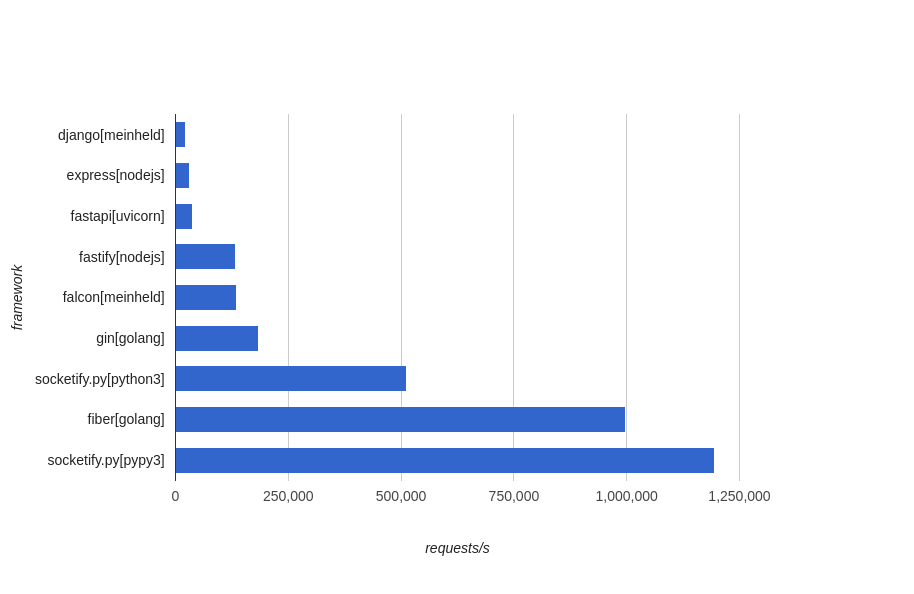
wsgiref, ASGI by a validator written from the spec. - Where it stands on throughput, from docs/BENCHMARKS.md:
level with the fast servers, not ahead. Per core,0.98x uvicorn with uvloop on bare ASGI at 16
connections; 1.63x in requests per second
(2.28x
uvicorn --loop asyncio) on 1.6 measured cores where uvicorn has one; the fast-request tail under mixed load ahead of uvicorn in every recorded run; and 1.00x Granian on bare WSGI at one worker and one handler thread each (1.02x per measured core). Every figure is rendered from a dated artifact, and CI refuses one more than a minor version old.
What it is not
- No TLS and no HTTP/2. Terminate at a proxy — gunicorn's answer, and the same one applies here.
- The served contract is stable from 1.0 — flags and environment
variables, the
M0-Hold/M0-Channelheaders, andm0pub.publish(). A minor release does not break them. Everything else, such as the Mojo APIs, the package layout and the fork's internals, may still change. A minor leaves every other Thursday (Releases). - macOS arm64 and Linux x86_64/aarch64 only. Not supported: Intel Mac (Modular ships no toolchain for it), Windows, musl.
Underneath, mojo-http is an HTTP/1.1 server and a small web framework for
Mojo: routing, content negotiation, ETags,
Server-Sent Events and WebSockets, with a Datastar
adapter for hypermedia UIs and SQLite and PostgreSQL bindings. The Python
server above is one package in it (m0-wsgi).
The server itself, the package m0_server, is a hard fork of
lightbug_http, taken from
v26.1.2 and maintained here since upstream was archived on 2026-05-12. It adds
hardening against request smuggling, slowloris, and integer overflow in
request parsing, connection timeouts, an SSE- and WebSocket-aware event loop,
and a fix for epoll struct layout on non-x86_64. See NOTICE for
the full record.
Install
To serve a Python application, no Mojo toolchain is needed — install the server binary from PyPI and point it at your app:
pip install m0serve
m0serve myproject.wsgi:application
Install it into the same virtual environment as your application, the way you would gunicorn or uvicorn. The protocol is detected from the object, so the same command serves WSGI and ASGI. Then: QUICKSTART.md, and docs/RUNNING.md for every flag, mode, limit and exit code.
One wheel per platform covers every supported CPython, 3.10 through 3.14
including free-threaded 3.14t. m0serve does not link libpython: Mojo
dlopens the interpreter at run time, so the wheel has no CPython ABI to
match and no CPython to redistribute. It has no Python dependencies and
fetches nothing at install time.
| platform | status |
|---|---|
| macOS arm64 (Apple Silicon), macOS 13+ | supported |
| Linux x86_64, glibc | supported |
| Linux aarch64 (Graviton, Ampere, arm64 Docker) | supported |
| macOS x86_64 (Intel) | not possible: Modular ships no Intel Mac toolchain |
| musl / Alpine, Windows | not supported |
The exact floors live in the wheel filename, measured from the built
binary, so pip declines a system too old to run it. The Linux floor is the
Mojo runtime's (the measurement).
To write an application in Mojo (preview), the m0 package writes the
project and installs the toolchain into it:
uvx m0 new shop
cd shop && uv sync
uv run m0 build && bin/server --port 8080
packaging/m0/QUICKSTART.md is that path to a served page, tests, rebuild on save and a deploy image, executed by CI like the one above; docs/MOJO.md is the index of its pages.
To develop against the Mojo packages in this repository, clone it:
uv sync                     # installs the Mojo toolchain
uv run poe serve-hello      # http://localhost:8080
curl localhost:8080/health  # {"status":"ok"}
The whole server
apps/hello/server.mojo, in full:
from m0_server import Server, HTTPService, HTTPRequest, HTTPResponse, OK
from m0_http import AppConfig, install_shutdown_signals


@fieldwise_init
struct HelloHandler(HTTPService):
    def func(mut self, req: HTTPRequest) raises -> HTTPResponse:
        if req.uri.request_uri == "/health":
            return OK('{"status":"ok"}', "application/json")
        return OK("hello from m0", "text/plain")

def main() raises:
    # Reads M0_PORT and M0_ACCESS_LOG. This is the app `scripts/bench_hello.sh`
    # drives, and being able to move its port and toggle access logging without
    # a rebuild is worth the two lines.
    var config = AppConfig()
    print("Starting hello server on " + config.address())
    var server = Server(config.server_config())
    var handler = HelloHandler()
    # The non-blocking loop multiplexes keep-alive connections instead of
    # serving one at a time — measurably better tail latency under
    # concurrent clients, and the same one-liner to call.
    # SIGTERM (docker stop) and SIGINT (Ctrl-C) now reach the loop's graceful
    # drain instead of severing every open connection. -1 back means signal
    # shutdown could not be armed, which is also the server's "no shutdown
    # pipe" sentinel, so there is nothing to branch on here.
    var shutdown_fd = install_shutdown_signals()
    server.listen_and_serve_nonblocking(
        config.address(), handler, shutdown_read_fd=shutdown_fd
    )
func is the one method a handler must write. The streaming hooks (sse_*, shared by SSE and WebSocket slots), the tick timer and ws_message all have default bodies, so a handler declares only the hooks it uses.
What's in the box
| Package | Description | Tests |
|---|---|---|
m0-core |
wyhash64, SHA-256 and HMAC-SHA256, SIMD JSON escape, HTML escape, JSON field parser, a C-ABI export | 85 |
m0-http |
Router, content negotiation, ETag, SSE, WebSockets, CORS, config, health, logging, multi-worker supervisor, cross-worker broadcast bus, accept sharing, the Mojo host, request-parsing hardening, view table, HTML builder and fragment, fragment-or-page, url_for and Query, form bodies, signed session cookies, CSRF and a one-user login | 1228 |
m0-datastar |
Datastar v1.0.4 wire format, DatastarStream fan-out with Last-Event-ID replay or the newest state at open and cross-worker broadcast, read_signals, a Fragment[Datastar] inside a frame, checked against the SDK's own conformance cases |
100 |
m0-wsgi |
WSGI/ASGI gateway — run Django, Flask, FastHTML, or any WSGI/ASGI app on this server | 229 |
m0-sqlite |
SQLite bindings, libsqlite3 opened with dlopen rather than linked — connections, statements, typed columns, transactions, bulk read-out, array virtual table, scalar functions written in Mojo, stamps that say which rows changed |
169 |
m0-postgres |
PostgreSQL bindings over libpq, opened with dlopen rather than linked — connections, bound parameters, text and binary results, SQLSTATE, LISTEN/NOTIFY |
84 |
| Total | 1895 |
Modules are named m0_* — mojo-http is the repository, m0 is the import prefix. Every capability, with the gate that proves it, is a row of docs/SPEC.md.
Strict layering, no upward imports: m0-core has zero dependencies, and m0-http imports from it, never the reverse. m0-datastar splits in two — consts and sse are the pure wire format with no dependencies at all, while stream and signals are the server glue and are the only parts that pull in m0-http. m0-wsgi is the only package that embeds CPython, so it is a package of its own: a Python import elsewhere would put libpython on every build's link line. m0-core also builds the C-ABI library m0pub numbers its events through; it ships inside the m0serve wheel and is not an artifact of its own (docs/FFI_DISTRIBUTION.md).
apps/notes_api/ composes most of the HTTP
layer in one small app: CRUD with :id routes and a real 405 with
Allow, one note negotiated as JSON or HTML by the Accept header,
ETag/304, static files, RFC 9457 problem+json on every error, and
CORS from a single after_response hook. uv run poe serve-notes runs it;
poe smoke-notes asserts each feature end to end.
apps/fragment_notes/ is the same
resource as a server-rendered htmx app, and the reference for the
application layer: views a URL table names, fragments that name themselves,
page-or-fragment decided from the request's headers, comptime routes
reversed by url_for, and a signed-cookie login with CSRF from
m0_http.login. docs/MOJO_VIEWS.md is that layer's
page; poe smoke-fragment-notes pins the app's wire contract
(a-fragment-that-names-itself).
Datastar
m0-datastar speaks the Datastar wire format, and
DatastarStream connects it to the server. A handler holds one, wires the four SSE hooks
through it, and broadcasts after a mutation:
struct CounterHandler(HTTPService):
    var count: Int
    var stream: DatastarStream

    def func(mut self, req: HTTPRequest) raises -> HTTPResponse:
        if req.uri.path == "/events":
            return self.stream.open(req, "/events")       # opens the SSE stream
        if req.uri.path == "/increment":
            self.count += 1
            _ = self.stream.patch_signals(                 # reaches every open tab
                "/events", '{"count":' + String(self.count) + "}"
            )
            return HTTPResponse(body_bytes=String("").as_bytes(), status_code=204)
        ...

    def sse_drain_slot(mut self, slot: Int) -> List[UInt8]:
        return self.stream.drain(slot)
    def sse_is_streaming(self, slot: Int) -> Bool:
        return self.stream.is_streaming(slot)
    def sse_slot_disconnected(mut self, slot: Int):
        self.stream.closed(slot)
    def sse_peer_frame(mut self, url: String, event_id: Int, frame: List[UInt8]):
        self.stream.deliver_peer(url, event_id, frame)   # cross-worker fan-out
read_signals(req) is the other direction — the browser sends its whole signal store, as a
datastar query parameter on GET and DELETE and as the body otherwise.
- apps/datastar_counter/ (
uv run poe serve-counter): a button pressed in one tab updates every other, on every worker underM0_WORKERS=2. It is the reference for cross-worker fan-out. - apps/datastar_todo/ (
serve-todo): mutations broadcast rendered HTML that every tab morphs by id, the list is rows in SQLite, and the stream's frames are restored at boot, so a restart loses neither the list nor a reconnecting tab's place in it. - apps/blobs/ (
serve-blobs): a stream of states rather than changes — a shared world stepped by a producer thread and published whole, so a new tab gets the current world instead of a replay. It runs on the Mojo host, whoseserve[H, P](AppConfig())is an application's wholemain(docs/MOJO_HOST.md).
Datastar 1.0 opens a stream from data-init and spells keyed attributes
with a colon — data-on:click, data-bind:draft; the hyphenated forms
fail silently. The fragment layer speaks Datastar too: Fragment[Datastar]
renders the same code as Fragment[Htmx] with Datastar's attributes
(one-renderer-two-transports).
WebSockets
apps/ws_echo/ shows the whole contract in one
screen. websocket_upgrade(req) answers the opening handshake inside func
(101 on success, 426/400 for near-misses, None when the request isn't an
upgrade at all so ordinary routing continues); ws_message(slot, opcode, payload) receives each complete message, its fragments assembled and its
control frames answered by the event loop; replies are queued as
encode_ws_frame(...) bytes that the shared outbox hook delivers. Idle
sockets get protocol pings on the M0_SSE_HEARTBEAT_MS cadence, and every
close path (a close handshake, a vanished client, a failed ping) lands in
sse_slot_disconnected. Run it with uv run poe serve-ws; poe smoke-ws
proves the wire format against a from-scratch stdlib client.
apps/ws_chat/ grows that into the multi-worker
shape: m0_http.WSHub is the handler-side registry, and under
M0_WORKERS>1 it rides the same BroadcastBus the SSE counter uses, so a
message sent on one worker's socket reaches every socket on every worker
(poe smoke-chat).
Django, and anything else that speaks WSGI
m0-wsgi embeds CPython, and m0serve is the binary built on it, the
uvicorn-shaped entry point the top of this page installs from PyPI. From
this repository:
uv run poe build-serve                                     # -> bin/m0serve
bin/m0serve myproject.wsgi:application --app-dir /path/to/project --workers 4
docs/RUNNING.md is its reference: how the callable is
found and its protocol detected, the ready line, the execution modes and
when to use each, mounts, --realtime, --doctor, limits, exit codes and
what to put in front of it. docs/WSGI_VS_ASGI.md is
why there are two execution modes, and docs/BENCHMARKS.md
how the result compares with gunicorn, uvicorn and Granian.
The example applications are Python-only projects that bin/m0serve
serves, each with a smoke test of its own:
- apps/django_wsgi/ and apps/flask_wsgi/ run the same assertions (scripts/wsgi_framework_contract.sh): routing, cookies in both directions, body round trips and error handling, which every WSGI framework does identically.
- apps/wsgi_bare/ is a plain PEP 3333 callable with no third-party imports, the conformance target for the parts of the spec a framework never exercises (docs/WSGI_CONFORMANCE.md).
- apps/django_realtime/ is the realtime contract
on Django: views hold SSE streams and WebSockets by answering with
M0-Hold, publish withm0pub, and receive inbound WebSocket messages as ordinaryPOSTs — Pushpin's GRIP collapsed into one process.
How the bridge crosses into CPython (each request's environ built in Mojo
through the C API, bodies moved as real bytes) and the rules that keep it
from leaking are packages/m0-wsgi/AGENTS.md.
SQLite
m0-sqlite is a thin layer over the SQLite C API, without an ORM, a query
builder or a connection pool. It is a sibling of the HTTP packages, not a
layer on them, and imports nothing else in this repo.
from m0_sqlite import open_memory

var db = open_memory()
db.execute("CREATE TABLE users (id INTEGER PRIMARY KEY, name TEXT)")

var ins = db.prepare("INSERT INTO users (name) VALUES (?)")
ins.bind_text(1, "ada")        # parameters are 1-based
_ = ins.step()

var q = db.prepare("SELECT id, name FROM users")
while q.step():                # columns are 0-based
    print(q.column_int(0), q.column_text(1))
Connection and Statement own their handles and release them on destruction.
Both are Movable but not Copyable, so a handle cannot be duplicated into
a second owner that would close it twice — move with ^ to transfer ownership.
open() applies the pragmas a server actually wants: journal_mode=WAL,
synchronous=NORMAL, foreign_keys=ON, plus a 5-second busy timeout so a
contended write waits instead of failing on contact. It raises on a target
that cannot do WAL (:memory:, a temp database, some network filesystems)
and never falls back to a rollback journal; use
open_memory() for an in-memory database. Transactions are explicit
(begin / commit / rollback); there is no scope guard, because Mojo has
no defer and a destructor that rolled back would make correctness depend
on drop order.
Wrap bulk writes in a transaction. Autocommit gives each row its own
transaction, the largest single effect measured in
docs/SQLITE_PERFORMANCE.md, which also covers
mmap_size, variable-length IN lists, and how m0_array relates to the
carray() extension it replaces.
db.begin()
for row in rows:
    ins.reset()
    ins.bind_text(1, row)
    _ = ins.step()
db.commit()
Reading in bulk. column_blob copies with one memcpy, and
column_blob_into reuses a caller buffer across a scan instead of allocating
per row. fetch_ints / fetch_floats / fetch_texts append a whole column
into a caller-owned List. SQLite has no bulk column API, so they are no
faster than stepping; a List per column is what a SIMD pass over the results
wants. They signal exhaustion with a short read, so stop when you get
fewer rows than you asked for rather than looping until zero.
prepare() compiles exactly one statement; text after the first, and text
that compiles to nothing such as a lone comment, raises an error. Use
execute() for a multi-statement script. Column indices are checked: an
out-of-range index raises rather than reading back as a stored NULL.
Errors carry a code. Every failure that had a SQLite result code raises a
message ending in (rc=NN), and error_code() recovers it, so retrying a
SQLITE_BUSY or reporting a SQLITE_CONSTRAINT does not mean parsing text.
The codes worth branching on are exported by name.
from m0_sqlite import error_code, SQLITE_BUSY, SQLITE_CONSTRAINT

try:
    db.begin_immediate()
except e:
    if error_code(String(e)) == SQLITE_BUSY:
        ...
Functions written in Mojo. create_function registers a type as a scalar
SQL function on a connection. It runs inside the query plan and reads each
argument where SQLite holds it, so a kernel over a large column costs the
kernel and not a copy out of the database, which sqlite-vec's
vec_distance_l2 makes of both vectors on every call.
struct Dot(ScalarFunction):
    comptime arity: Int = 2
    comptime deterministic: Bool = True

    def __init__(out self):
        pass

    def call(mut self, args: Args, mut answer: Answer) raises:
        answer.float(dot_f32(args.blob(0), args.blob(1)))   # SQLite's bytes, no copy

db.create_function("dot", Dot())
var q = db.prepare("SELECT id FROM notes ORDER BY dot(embedding, ?1) DESC LIMIT 10")
Do not name a registered function in the schema. SQLite refuses one in a CHECK constraint, a generated column or an index when they are created, but not in a view, a trigger or a column DEFAULT, and such a trigger then fails every write to its table, from every program, until it is dropped. What a function may and may not do, and the SQLite version each kind needs, is docs/notes/functions-inside-the-query.md.
Loading. libsqlite3 is opened at run time, not linked: nothing in this
repo carries it on a link line, so a binary that never opens a database
needs no library present, and mojo run works for every test on both
platforms. Connection opens it from M0_LIBSQLITE3, else a search path
that tries the bare name and then the places a package manager puts one; an
absent library is one error naming every path tried, and one too old, built
without threads, or missing an entry point is refused naming what it found.
Linux needs the runtime library (libsqlite3-0 on Debian and Ubuntu); the
-dev package is only for the C layout guard's sqlite3.h.
Stamps. install_stamps(db) and watch(db, "notes") put four
triggers on a table, after which every row written there, by any program,
has one entry in m0_changes holding the stamp of its last change. "What
changed since N" is then one query and the asker keeps one number
(the note has the
costs and the two writes a stamp cannot see).
Bulk arrays. m0_array(?) is an opt-in virtual table that streams a Mojo
List into SQL without copying it, so N rows insert in one sqlite3_step
instead of N (uv run poe bench-sqlite measures it).
db.register_array_module()          # per connection, not per process
var ins = db.prepare("INSERT INTO t (v) SELECT value FROM m0_array(?1)")
ins.execute_over(1, values)         # binds, runs to completion, unbinds
Arrays bind only through execute_over and fetch_ints_over, and that is
a safety property rather than a style preference. Binding a raw pointer lends
SQLite the buffer for the statement's life, but Mojo frees a value at its last
syntactic use — which would be before step() runs. Taking the array as an
argument to the call that also finishes the statement is what keeps it alive;
there is no bind_array to get wrong. The trade is that these do not compose
with incremental stepping. See
docs/sqlite-vtab-feasibility.md for the
measurements and the reasoning, including why this is worth it for ingest and
not for IN clauses.
Not implemented: statement caching, and a connection pool. Caching was measured in the benchmark that chose SQLite and came out within noise at realistic row counts, so it is not worth the ownership complexity yet.
PostgreSQL
m0-postgres is the same kind of layer over libpq, without an ORM, a query
builder or a connection pool, and the other sibling: it imports nothing
else in this repo.
from m0_postgres import Params, open

var db = open("postgres://localhost/app")

var p = Params()
p.text("ada")
_ = db.query("INSERT INTO users (name) VALUES ($1)", p)

var rows = db.query("SELECT id, name FROM users ORDER BY id", Params())
for r in range(rows.rows):     # rows and columns are both 0-based
    print(rows.int(r, 0), rows.text(r, 1))
libpq is opened at run time, not linked. Nothing in this repo,
bin/m0serve and the wheel included, carries a libpq dependency on its link
line, so a server that never names a database needs no library present, and an
absent one is a single error naming every path that was tried. M0_LIBPQ
names the file outright.
Parameters are bound with explicit types. A parameter Postgres resolves as
unknown means whatever the surrounding expression makes it, so Params sends
an OID with every value: int, float, bool, text, bytes, null, and
literal for a type this package does not encode — a timestamp, a uuid, an
array, a numeric — sent as text for the server to coerce, which is how psql
sends every literal.
Results are values, not cursors. libpq hands back a complete result that
owns its memory, so a Result can outlive the query and be read in any order;
it clears itself on destruction. Text is the default and binary=True is
per-query, because libpq's result format is one choice for the whole query and
only the caller knows whether every column it selected has a binary decoder. A
binary column whose type has none raises naming the way out rather than
returning plausible bytes.
open() applies what a server wants and merges rather than appends, so
every default is overridable by naming it in the URL: a connect timeout, a
statement timeout (the twin of SQLite's busy timeout — a pool thread stuck in a
slow query is a thread gone), client_encoding=UTF8, an application name, and
TCP keepalive timings plus tcp_user_timeout that notice a dropped connection
far sooner than the operating system would.
open_readonly() adds a read-only transaction default, the belt to a read-only
role's braces. Every URL is redacted before it reaches an error, a log or
--doctor.
Errors carry their SQLSTATE, recovered with sqlstate(String(e)), with the
codes an application branches on exported by name — UNIQUE_VIOLATION,
SERIALIZATION_FAILURE, TOO_MANY_CONNECTIONS and the rest. There is no retry
anywhere in the package: re-running a statement whose effects the caller cannot
see is a hidden double write.
One connection per thread, never shared, which is libpq's own rule. Count
them before deploying: workers times blocking threads times Postgres-backed
mounts is what the server opens, against the server's max_connections.
LISTEN/NOTIFY is supported. A writer outside the server process,
such as a trigger, a cron job or psql, reaches a held SSE stream through
it, where the in-process datagram bus cannot.
Not implemented: COPY, pipeline mode, row-at-a-time results, and binary
decoders for numeric, dates, intervals and arrays, which read as text. Each
is left out by choice; numeric's binary form is a base-10000 digit vector
with its own NaN encoding, and a wrong decoding of one is silently a
different number.
Status and limits
docs/SPEC.md is the full capability matrix — every row carries its evidence, and poe check-docs fails if a row claims a CI gate that does not exist or does not run. docs/ROADMAP.md holds the known issues, each with what would retire it.
- The Mojo toolchain is pinned in
uv.lock..mojocartifacts are locked to the exact compiler that produced them, so rebuild after any toolchain change. - Building on Linux needs two system packages: a C compiler (
mojo buildshells out for linking) andpatchelf(the binaries record a$ORIGINDT_RUNPATHso they find the Mojo runtime beside themselves).build-essential patchelfcovers it;m0-sqliteopens the runtimelibsqlite3at run time, andverify-vtab-layoutalone wantslibsqlite3-devfor its header. None are needed on macOS. m0-wsgineeds a discoverablelibpython. Mojo resolves the interpreter fromPATH, so the poe tasks, which run inside the venv, pick up the venv's Python and its packages.- SSE fan-out is per process unless the application joins the
BroadcastBus. UnderM0_WORKERS>1each worker has its own subscribers; the bus, created before the fork, carries every broadcast to every worker's. The Mojo host wires it (docs/MOJO_HOST.md), andapps/datastar_counteris the reference. Cross-worker ordering is best-effort, and the redelivery filter keeps the newer id. - SSE replay is journal-deep.
DatastarStreamhonoursLast-Event-IDfrom a bounded in-memory frame journal; a client further behind than that is sent none of the history,caught_up(slot)answers false, and the view queues its current state for that connection alone withsend_to. Replay across a restart needs the application to persist the journal and restore it at boot, as the todo demo does. A WSGI hold is caught up from m0serve's own per-loop journal, and told with onem0-gapframe when it cannot be (docs/RUNNING.md).
Development
uv run poe                  # every task, with what it does
uv run poe build-all        # compile each package to .mojoc
uv run poe test-all         # 1895 unit tests, then compiles every example
uv run poe check-docs       # the docs gate, as the required check runs it
uv run poe canary           # the whole suite against the Mojo nightly, then restore the pin
Cross-package imports resolve through the .mojoc files, so run build-all after changing a package's sources — including for the editor, or the LSP reports phantom unresolved imports. Copy .vscode/settings.example.json to .vscode/settings.json and fill in your absolute path.
License and attribution
MIT — see LICENSE.
packages/m0-http/m0_server/ is a hard fork of MIT-licensed work by Valentin Erokhin. Upstream was archived and there is nothing to rebase onto or send patches to; this copy is maintained here. NOTICE records the provenance and every category of modification, and PROVENANCE.md explains how this repository was extracted from a private monorepo.
Questions
What is mojo-http?
codetalcott/mojo-http is a public repo on GitHub by codetalcott. Realtime from a plain sync Django or Flask view: hold an SSE stream or WebSocket with two response headers. A WSGI/ASGI server written in Mojo — pip install m0serve. On one machine: no Channels, no Redis, no daphne. Across machines: Postgres NOTIFY.
Is mojo-http open source?
It declares the MIT license on GitHub.
Does mojo-http run on macOS, Windows or Linux?
Its maker tagged it for macOS, Windows and Linux, or as Docker or cross-platform. That is declared by the maker; Take My Repo has not tested it.
How do I install mojo-http?
Open "Take it" on its page: Take My Repo writes an install plan for your machine and hands it to your AI agent (Claude Code, Codex or Cursor), which asks you before each step. Take My Repo has not tested it on any machine.
Is mojo-http still maintained?
Its last change on GitHub was on 2026-11-19. GitHub counts 4 open issues and pull requests. Take My Repo does not judge from that whether it is maintained.