
netassert
Network security testing for Kubernetes DevSecOps workflows
- 392
- Apache-2.0
- 6 wk ago
Repo controlplaneio/netassert, read from GitHub 20 min ago. controlplaneio has not joined Take My Repo.
In short
controlplaneio/netassert is a public repo on GitHub by controlplaneio. Network security testing for Kubernetes DevSecOps workflows. It declares the Apache-2.0 license on GitHub. It is written mainly in Go, has 392 stars and last changed on 2026-10-07. Nobody has reviewed it on Take My Repo yet, which says nothing about its quality. Read from GitHub on 2026-11-21.
Netassert
NetAssert is a command line tool that enables you to check the network connectivity between Kubernetes objects such as Pods, Deployments, DaemonSets, and StatefulSets, as well as test their connectivity to remote hosts or IP addresses. NetAssert v2 is a rewrite of original NetAssert tool in Go that utilises the ephemeral container support in Kubernetes to verify network connectivity. NetAssert test(s) are defined in YAML format. NetAssert currently supports TCP and UDP protocols:
-
To perform a TCP test, only a
scannercontainer is used. This container requires no privileges nor any Linux capabilities. -
To run a UDP test, a
snifferephemeral container is injected into the target Pod which requirescap_rawcapabilities to read data from the network interface. During UDP testing,NetAssertruns both containerscannerandsniffercontainer images which are injected asephemeralcontainers into running Pods.
The sniffer and scanner container images can be downloaded from:
docker.io/controlplane/netassertv2-l4-client:latest- Used for both TCP and UDP testing and acts as a Layer 4 (TCP/UDP) client
- Requires no privileges nor any Linux capabilities.
docker.io/controlplane/netassertv2-packet-sniffer:latest- Used for UDP testing only, injected at the destination to capture packet and search for specific string in the payload
- requires
cap_rawcapabilities to read data from the network interface
NetAssert utilises the above containers during test and configures them using environment variables. The list of environment variables that are used can be found here and here. It is possible to override the sniffer and scanner images from command line during a run, so one can also bring their own container image(s) as long as they support the same environment variables.

Installation
-
Please download the latest stable version of
NetAssertfrom releases page. The binary is available for Linux, MacOS and Windows platforms. -
If you are on Unix/Linux, you can also use the download.sh script to download the latest version of
NetAssertinto the current path:
curl -sL https://raw.githubusercontent.com/controlplaneio/netassert/master/download.sh | bashTest specification
NetAssert v2 tests are written in YAML format. Each test is a YAML document which supports the following mappings:
- A YAML document is a list of
NetAsserttest. Each test has the following keys:- name: a scalar representing the name of the connection
- type: a scalar representing the type of connection, only "k8s" is supported at this time
- protocol: a scalar representing the protocol used for the connection, which must be "tcp" or "udp"
- targetPort: an integer scalar representing the target port used by the connection
- timeoutSeconds: an integer scalar representing the timeout for the connection in seconds
- attempts: an integer scalar representing the number of connection attempts for the test
- exitCode: an integer scalar representing the expected exit code from the ephemeral/debug container(s)
- src: a mapping representing the source Kubernetes resource, which has the following keys:
- k8sResource: a mapping representing a Kubernetes resource with the following keys:
- kind: a scalar representing the kind of the Kubernetes resource, which can be
deployment,statefulset,daemonsetorpod - name: a scalar representing the name of the Kubernetes resource
- namespace: a scalar representing the namespace of the Kubernetes resource
- kind: a scalar representing the kind of the Kubernetes resource, which can be
- k8sResource: a mapping representing a Kubernetes resource with the following keys:
- dst: a mapping representing the destination Kubernetes resource or host, which can have one of the the following keys i.e both
k8sResourceandhostare not supported at the same time :- k8sResource: a mapping representing a Kubernetes resource with the following keys:
- kind: a scalar representing the kind of the Kubernetes resource, which can be
deployment,statefulset,daemonsetorpod - name: a scalar representing the name of the Kubernetes resource
- namespace: a scalar representing the namespace of the Kubernetes resource. (Note: Only allowed when protocol is "tcp")
- kind: a scalar representing the kind of the Kubernetes resource, which can be
- host: a mapping representing a host/node with the following key:
- name: a scalar representing the name or IP address of the host/node. (Note: Only allowed when protocol is "tcp" or "udp", but not both at the same time)
- k8sResource: a mapping representing a Kubernetes resource with the following keys:
This is an example of a test that can be consumed by `NetAssert` utility
---
- name: busybox-deploy-to-echoserver-deploy
  type: k8s
  protocol: tcp
  targetPort: 8080
  timeoutSeconds: 67
  attempts: 3
  exitCode: 0
  src:
    k8sResource:
      kind: deployment
      name: busybox
      namespace: busybox
  dst:
    k8sResource:
      kind: deployment
      name: echoserver
      namespace: echoserver
#######
#######
- name: busybox-deploy-to-core-dns
  type: k8s
  protocol: udp
  targetPort: 53
  timeoutSeconds: 67
  attempts: 3
  exitCode: 0
  src:
    k8sResource:
      kind: deployment
      name: busybox
      namespace: busybox
  dst:
    k8sResource:
      kind: deployment
      name: coredns
      namespace: kube-system
######
######
- name: busybox-deploy-to-web-statefulset
  type: k8s
  protocol: tcp
  targetPort: 80
  timeoutSeconds: 67
  attempts: 3
  exitCode: 0
  src:
    k8sResource: # this is type endpoint
      kind: deployment
      name: busybox
      namespace: busybox
  dst:
    k8sResource: ## this is type endpoint
      kind: statefulset
      name: web
      namespace: web
###
###
- name: fluentd-daemonset-to-web-statefulset
  type: k8s
  protocol: tcp
  targetPort: 80
  timeoutSeconds: 67
  attempts: 3
  exitCode: 0
  src:
    k8sResource: # this is type endpoint
      kind: daemonset
      name: fluentd
      namespace: fluentd
  dst:
    k8sResource: ## this is type endpoint
      kind: statefulset
      name: web
      namespace: web
###
####
- name: busybox-deploy-to-control-plane-dot-io
  type: k8s
  protocol: tcp
  targetPort: 80
  timeoutSeconds: 67
  attempts: 3
  exitCode: 0
  src:
    k8sResource: # type endpoint
      kind: deployment
      name: busybox
      namespace: busybox
  dst:
    host: # type host or node or machine
      name: control-plane.io
###
###
- name: test-from-pod1-to-pod2
  type: k8s
  protocol: tcp
  targetPort: 80
  timeoutSeconds: 67
  attempts: 3
  exitCode: 0
  src:
    k8sResource: ##
      kind: pod
      name: pod1
      namespace: pod1
  dst:
    k8sResource:
      kind: pod
      name: pod2
      namespace: pod2
###
###
- name: busybox-deploy-to-fake-host
  type: k8s
  protocol: tcp
  targetPort: 333
  timeoutSeconds: 67
  attempts: 3
  exitCode: 1
  src:
    k8sResource: # type endpoint
      kind: deployment
      name: busybox
      namespace: busybox
  dst:
    host: # type host or node or machine
      name: 0.0.0.0
...
Components
NetAssert has three main components:
- NetAssert: This is responsible for orchestrating the tests and is also known as
Netassert-Engineor simply theEngine - NetAssertv2-packet-sniffer: This is the sniffer component that is utilised during a UDP test and is injected to the destination/target Pod as an ephemeral container
- NetAssertv2-l4-client: This is the scanner component that is injected as the scanner ephemeral container onto the source Pod and is utilised during both TCP and UDP tests
Detailed steps/flow of tests
All the tests are read from an YAML file or a directory (step 1) and the results are written following the TAP format (step 5 for UDP and step 4 for TCP). The tests are performed in two different manners depending on whether a TCP or UDP connection is used
UDP test

- Validate the test spec and ensure that the
srcanddstfields are correct: for udp tests both of them must be of typek8sResource - Find a running Pod called
dstPodin the object defined by thedst.k8sResourcefield. Ensure that the Pod is in running state and has an IP address allocated by the CNI - Find a running Pod called
srcPodin the object defined by thesrc.k8sResourcefield. Ensure that the Pod is in running state and has an IP address allocated by the CNI - Generate a random UUID, which will be used by both ephemeral containers
- Inject the
netassert-l4-clientas an ephemeral container in thesrcPod(step 2) and set the port and protocol according to the test specifications. Provide also the target host equal to the previously found dstPod IP address, and the random UUID that was generated in the previous step as the message to be sent over the udp connection. At the same time, inject thenetassertv2-packet-sniffer(step 3) as an ephemeral container in thedstPodusing the protocol, search string, number of matches and timeout defined in the test specifications. The search_string environment variable is equal to the UUID that was generated in the previous step which is expected to be found in the data sent by the scanner when the connections are successful. - Poll that status of the ephemeral containers (step 4)
- Ensure that the
netassertv2-packet-snifferephemeral sniffer container’s exit status matches the one defined in the test specification - Ensure that the
netassert-l4-client, exits with exit status of zero. This should always be the case as UDP is not a connection oriented protocol.
TCP test

- Validate the test spec and ensure that the
srcfield is of typek8sResource - Find a running Pod called
srcPodin the object defined by thesrc.k8sResourcefield. Ensure that the Pod is in running state and has an IPAddress - Check if
dsthask8sResourcedefined as a child object. If so then find a running Pod defined by thedst.K8sResource - Inject the
netassert-l4-clientas an ephemeral container in thesrcPod(step 2). Configure thenetassert-l4-clientsimilarly to the udp case. If thedstfield is set tohostthen use the hostnamefield as the scanner target host - Poll that status of the ephemeral containers (step 3)
- Ensure that the exit code of that container matches the
exitCodefield defined in the test specification
Development
- You will need Go version 1.25.x or higher. Download the latest version of just. To build the project you can use
just build. The resulting binary will be incmd/netassert/cli/netassert. To rununittests you can usejust test. There is a separate README.md that detailsend-to-endtesting.
Quick testing
Spinning up the environment
- Make sure you have installed
kindand its prerequisites - Make sure you have also installed
just - Download the
NetAssertbinary from the release page:
❯ VERSION="v2.1.3" # change it to the version you want to install
❯ OS_DISTRO=linux_amd64 # change it to your OS_DISTRO (for reference check the NetAssert release page)
❯ curl -L -o netassert.tar.gz https://github.com/controlplaneio/netassert/releases/download/${VERSION}/netassert_${VERSION}_${OS_ARCH}.tar.gz

❯ tar -xzf netassert.tar.gz -C bin/netassert
- Alternatively, you can build
NetAssertfrom source:
❯ just build
- You will also need a working kubernetes cluster with ephemeral/debug container support and a CNI that supports Network Policies, you can spin one quickly using the
justfileincluded in the repo:
❯ just kind-down ; just kind-up
❯ just calico-apply- wait for all the nodes to become ready:
❯ kubectl get nodes -w
Running the sample tests
- In order to use the sample tests, you need to create network policies and kubernetes resources:
❯ just k8s-apply
  kubectl apply -f ./e2e/manifests/workload.yaml
  namespace/fluentd created
  daemonset.apps/fluentd created
  namespace/echoserver created
  namespace/busybox created
  deployment.apps/echoserver created
  deployment.apps/busybox created
  namespace/pod1 created
  namespace/pod2 created
  pod/pod2 created
  pod/pod1 created
  namespace/web created
  statefulset.apps/web created
❯ just netpol-apply
  kubectl apply -f ./e2e/manifests/networkpolicies.yaml
  networkpolicy.networking.k8s.io/web created
- Wait for the workload to become ready (note that the workload pods are the ones created after running
just k8s-applyin a previous step):
❯ kubectl get pods -A
  busybox              busybox-6c85d76fdc-r8gtp                            1/1     Running   0          76s
  echoserver           echoserver-64bd7c5dc6-ldwh9                         1/1     Running   0          76s
  fluentd              fluentd-5pp9c                                       1/1     Running   0          76s
  fluentd              fluentd-8vvp9                                       1/1     Running   0          76s
  fluentd              fluentd-9jblb                                       1/1     Running   0          76s
  fluentd              fluentd-jnlql                                       1/1     Running   0          76s
  kube-system          calico-kube-controllers-565c89d6df-8mwk9            1/1     Running   0          117s
  kube-system          calico-node-2sqhw                                   1/1     Running   0          117s
  kube-system          calico-node-4sxpn                                   1/1     Running   0          117s
  kube-system          calico-node-5gtg7                                   1/1     Running   0          117s
  kube-system          calico-node-kxjq8                                   1/1     Running   0          117s
  kube-system          coredns-7d764666f9-74xgb                            1/1     Running   0          2m29s
  kube-system          coredns-7d764666f9-jvnr4                            1/1     Running   0          2m29s
  kube-system          etcd-packet-test-control-plane                      1/1     Running   0          2m35s
  kube-system          kube-apiserver-packet-test-control-plane            1/1     Running   0          2m35s
  kube-system          kube-controller-manager-packet-test-control-plane   1/1     Running   0          2m35s
  kube-system          kube-proxy-4xjp2                                    1/1     Running   0          2m27s
  kube-system          kube-proxy-b28pw                                    1/1     Running   0          2m29s
  kube-system          kube-proxy-p9smj                                    1/1     Running   0          2m27s
  kube-system          kube-proxy-xb2wq                                    1/1     Running   0          2m27s
  kube-system          kube-scheduler-packet-test-control-plane            1/1     Running   0          2m35s
  local-path-storage   local-path-provisioner-67b8995b4b-jf8lc             1/1     Running   0          2m29s
  pod1                 pod1                                                1/1     Running   0          75s
  pod2                 pod2                                                1/1     Running   0          76s
  web                  web-0                                               1/1     Running   0          75s
  web                  web-1                                               1/1     Running   0          31s
- Run the netassert binary pointing it to the test cases:
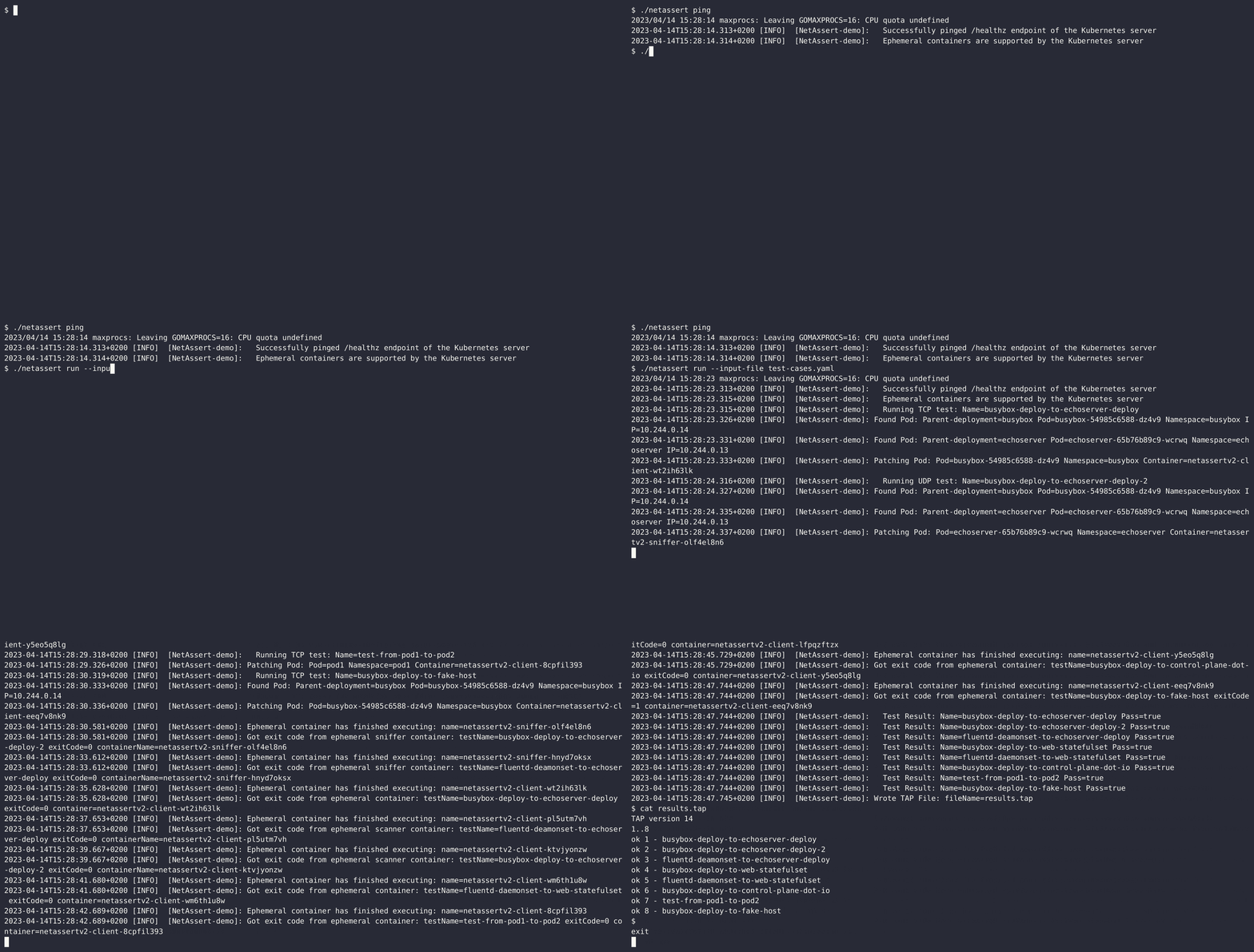
❯ bin/netassert run --input-file ./e2e/manifests/test-cases.yaml

❯ cat results.tap
TAP version 14
1..9
ok 1 - busybox-deploy-to-echoserver-deploy
ok 2 - busybox-deploy-to-echoserver-deploy-2
ok 3 - fluentd-deamonset-to-echoserver-deploy
ok 4 - busybox-deploy-to-web-statefulset
ok 5 - web-statefulset-to-busybox-deploy
ok 6 - fluentd-daemonset-to-web-statefulset
ok 7 - busybox-deploy-to-control-plane-dot-io
ok 8 - test-from-pod1-to-pod2
ok 9 - busybox-deploy-to-fake-host
- To see the results when a check fails, run:
❯ just netpol-rm-apply
  kubectl delete -f ./e2e/manifests/networkpolicies.yaml
  networkpolicy.networking.k8s.io "web" deleted

❯ bin/netassert run --input-file ./e2e/manifests/test-cases.yaml

❯ cat results.tap
TAP version 14
1..9
ok 1 - busybox-deploy-to-echoserver-deploy
ok 2 - busybox-deploy-to-echoserver-deploy-2
ok 3 - fluentd-deamonset-to-echoserver-deploy
ok 4 - busybox-deploy-to-web-statefulset
not ok 5 - web-statefulset-to-busybox-deploy
  ---
  reason: ephemeral container netassertv2-client-aihlpxcys exit code for test web-statefulset-to-busybox-deploy
  is 0 instead of 1
  ...
ok 6 - fluentd-daemonset-to-web-statefulset
ok 7 - busybox-deploy-to-control-plane-dot-io
ok 8 - test-from-pod1-to-pod2
ok 9 - busybox-deploy-to-fake-host
Compatibility
NetAssert is architected for compatibility with Kubernetes versions that offer support for ephemeral containers. We have thoroughly tested NetAssert with Kubernetes versions 1.25 to 1.35, confirming compatibility and performance stability.
For broader validation, our team has also executed comprehensive end-to-end tests against various Kubernetes distributions and CNIs which is detailed below:
| Kubernetes Distribution | Supported Version | Container Network Interface (CNI) |
|---|---|---|
| Amazon EKS | 1.34 and higher | AWS VPC CNI |
| Amazon EKS | 1.34 and higher | Calico (Version 3.26 or later) |
| Google GKE | 1.33 and higher | Google Cloud Platform VPC CNI |
| Google GKE | 1.33 and higher | Google Cloud Dataplane V2 |
Checking for ephemeral container support
You can check for ephemeral container support using the following command:
❯ netassert ping
2023-03-27T11:25:28.421+0100 [INFO]  [NetAssert-v2.0.0]: ✅ Successfully pinged /healthz endpoint of the Kubernetes server
2023-03-27T11:25:28.425+0100 [INFO]  [NetAssert-v2.0.0]: ✅ Ephemeral containers are supported by the Kubernetes server
Increasing logging verbosity
You can increase the logging level to debug by passing --log-level argument:
❯ netassert run --input-file ./e2e/manifests/test-cases.yaml --log-level=debug
RBAC Configuration
This tool can be run according to the Principle of Least Privilege (PoLP) by properly configuring the RBAC.
The list of required permissions can be found in the netassert ClusterRole rbac/cluster-role.yaml, which could be redefined as a Role for namespacing reasons if needed. This role can then be bound to a "principal" either through a RoleBinding or a ClusterRoleBinding, depending on whether the scope of the role is supposed to be namespaced or not. The ClusterRoleBinding rbac/cluster-rolebinding.yaml is an example where the user netassert-user is assigned the role netassert using a cluster-wide binding called netassert
Limitations
- When performing UDP scanning, the sniffer container image needs
cap_net_rawcapability so that it can bind and read packets from the network interface. As a result, admission controllers or other security mechanisms must be modified to allow thesnifferimage to run with this capability. Currently, the Security context used by the ephemeral sniffer container looks like the following:
...
...
   securityContext:
     allowPrivilegeEscalation: false
     capabilities:
       add:
       - NET_RAW
     runAsNonRoot: true
...
...
-
Although they do not consume any resources, ephemeral containers that are injected as part of the test(s) by
NetAssertwill remain in the Pod specification -
Service meshes are not be currently supported
E2E Tests
- Please check this README.md
Questions
What is netassert?
controlplaneio/netassert is a public repo on GitHub by controlplaneio. Network security testing for Kubernetes DevSecOps workflows.
Is netassert open source?
It declares the Apache-2.0 license on GitHub.
Does netassert run on macOS, Windows or Linux?
Its maker has not tagged a system, so it is unknown here. Its README says what it needs.
How do I install netassert?
Open "Take it" on its page: Take My Repo writes an install plan for your machine and hands it to your AI agent (Claude Code, Codex or Cursor), which asks you before each step. Take My Repo has not tested it on any machine.
Is netassert still maintained?
Its last change on GitHub was on 2026-10-07. Take My Repo does not judge from that whether it is maintained.
What do people who ran netassert say?
Nobody has reviewed it on Take My Repo yet, which says nothing about its quality.