| /cozystack:wizard |
Entry point. Opens with a free-form "tell me about your setup and goal" question so context comes through in the operator's own words and pre-fills the structured questions. Then asks Talos / Ubuntu / Existing, builds a chain, dispatches downstream skills via a cluster config directory the operator picks. Artifacts (inventory, kubeconfig, state, platform-package YAML) all live there — operator manages git on their own. Every skill in the chain matches the operator's natural language. |
| /cozystack:talos-bootstrap |
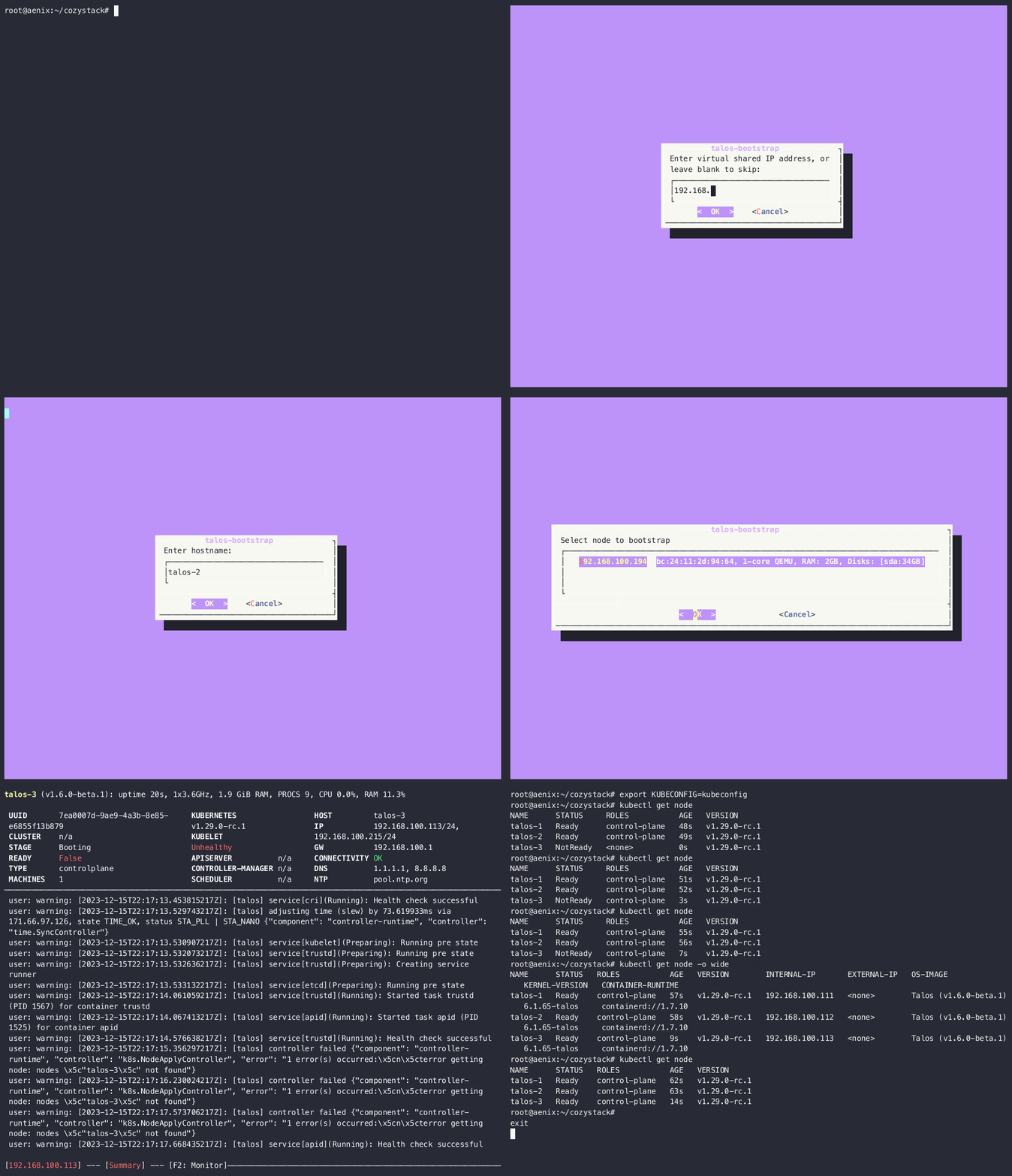
Bootstrap Talos nodes via talm. Default: probe nodes for maintenance mode (Talos-1.12-aware get disks --insecure); if ready, write per-node multidoc machine-config stubs with VIP-link static IPv4, run NAT-provider cert-SAN guardrail (auto-populates values.yaml.certSANs with public IPs before first talm apply), then talm apply + talosctl bootstrap + kubeconfig fetch + cozystack-tuned shape verification with auto-upgrade to tuned image when nodes booted from base Talos. Opt-in boot-method picker (OCI Custom Image / boot-to-talos / ISO / PXE) only when nodes aren't yet imaged. |
| /cozystack:talos-reset |
Cloud-provider recovery helper when Talos nodes are unrecoverable from inside the cluster (cert-SAN trap, broken machine-config, lost talosconfig). Wraps oci / aws / gcloud / hcloud to terminate + relaunch from the cozystack-tuned image while preserving block volumes, secondary VNICs, NSG memberships. Sequential per-node to maintain etcd quorum. Hands off to cozystack:talos-bootstrap for re-bootstrap. |
| /cozystack:ubuntu-bootstrap |
Bootstrap Ubuntu / Debian nodes by wrapping cozystack/ansible-cozystack/examples/ubuntu/ — OS prep, drbd-dkms for Secure Boot, ZFS + KubeVirt modules, k3s install with cozystack-compatible flags, kubeconfig retrieval. Stops before Cozystack itself. |
| /cozystack:cluster-install |
Cozystack on a ready cluster — node-readiness validation, variant picker, interactive values, per-node ZFS pool provisioning, extractedprism for kube-apiserver HA, cozy-installer chart, Platform Package apply, root Tenant ingress patch, wait until every HelmRelease is Ready, NOTES summary. |
| /cozystack:debug |
Investigate a stuck or broken Cozystack install. Gathers symptoms, classifies (operator error / config drift / upstream bug / not-yet-supported), applies fixes or workarounds, drafts upstream issues with diagnostic bundle on approval. Never opens PRs or files silently. Auto-dispatched by the wizard when any chain step fails. |
| /cozystack:cluster-upgrade |
Guided upgrade of a running Cozystack v1.x cluster — release-notes analysis, prechecks, stop gates, helm upgrade, targeted post-upgrade verification, known-failure recovery. |
| /cozystack:package-deploy |
Deploy a single Cozystack package to a dev cluster via make + cozyhr — handles fresh install and dev-loop iteration with ExternalArtifact support. |
| /cozystack:package-bump |
Bump a single package inside the cozystack monorepo — reads upstream changelog, adapts to breaking changes, regenerates schema, optionally deploys to a dev cluster. |
| /cozystack:external-app-create |
Scaffold a new Cozystack external app package with dependency integration (managed CNPG Postgres, external secret references). |
| /cozystack:dev-ui-bootstrap |
Bootstrap a UI dev sandbox — Playwright + Vite dev server for cozystack-ui pointed at a chosen kubeconfig. Creates a feature worktree, installs @playwright/test and Chromium, writes playwright.config.ts, adds dev:e2e / test:e2e scripts, and brings up kubectl proxy + Vite on a free port. Use when fixing, debugging, or writing tests against the Cozystack console. |
| /cozystack:comment-audit |
Audit a change's code comments for design-doc prose — product rationale, before/after narrative, incident retelling, editorializing — and report which comments to cut, which earn their place, and which arguments are restated at several sites. Reports only; modifies nothing. Repository-agnostic: works on any codebase, not just Cozystack ones. |
| /cozystack:comment-trim |
Apply a comment audit — delete the prose, keep every comment that documents a real mechanism, replace sync-with-the-design-doc comments with a pointer, then prove with the bundled comments-only.py that no code moved. Leaves the edits in the working tree; does not commit or push. Repository-agnostic. |