theia
Eclipse Theia is an open-source platform for building custom IDEs and tools for browser and desktop. It includes Theia AI, the vendor-neutral AI harness platform, and powers the AI-native Theia IDE.
- 22k
- TypeScript
- EPL-2.0
- 10 h ago
⛰️ LifeOS — The AI-powered Life Operating System that helps you hill climb to wherever you're going.
Repo danielmiessler/LifeOS, read from GitHub 7 h ago. danielmiessler has not joined Take My Repo.
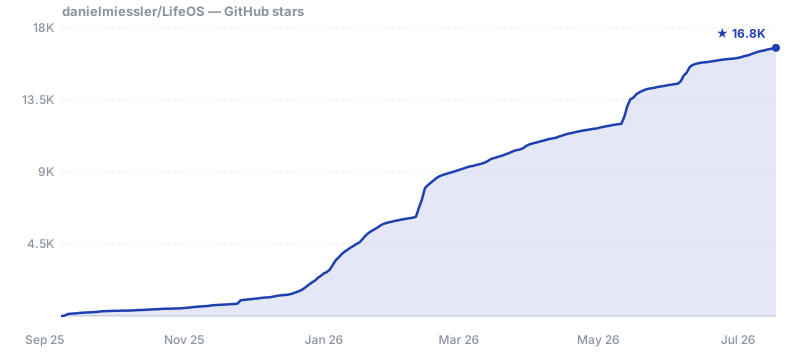
danielmiessler/LifeOS is a public repo on GitHub by danielmiessler. ⛰️ LifeOS — The AI-powered Life Operating System that helps you hill climb to wherever you're going. It declares the MIT license on GitHub. It is written mainly in TypeScript, has 19,952 stars and last changed on 2026-11-18. Nobody has reviewed it on Take My Repo yet, which says nothing about its quality. Read from GitHub on 2026-11-21.

LifeOS is a General Purpose AI Harness for doing anything you want to do in life and work with AI. It captures who you are, what you care about, and where you're trying to go, then uses AI that knows you to help you get there.
And because it has your full context, it makes everything you do more efficient and effective, from building apps, to starting a business, to creative projects…basically anything.
Note
The whole system works on one central concept: moving from your Current State to your Ideal State — in pursuit of Euphoric Surprise.
Stars help more people find the project and keep it moving. It takes one click.
LifeOS is fundamentally one person's personal AI harness, published as-is, and it is constantly in flux: security features are added, enhanced, removed, modified and adjusted from release to release. The security of any LifeOS component, and of the system as a whole, is not guaranteed. Responsibility for the security of your system is yours, not the LifeOS authors' or contributors'.
Before anything is installed, the installer asks: "Do you understand that you are responsible for the security of your own system and that we are not responsible?" It goes ahead only if you answer yes. See SECURITY.md.
Give it to your AI. LifeOS is installed by an AI, so the install is just a prompt. Paste this into your AI coding harness — Claude Code, Cursor, Codex, Hermes, or any capable agent — and it does the whole setup for you:
Read https://ourlifeos.ai/install and install LifeOS for me.
Your AI reads the install page and walks the setup, asking permission before it touches anything.
Prefer the terminal? There's a one-line shortcut for Claude Code on macOS/Linux:
curl -fsSL https://ourlifeos.ai/install.sh | bashEither path needs a capable AI coding harness — we build and run on Claude Code — and bun.
The unique features — the parts you won't find anywhere else. Anything a good harness already provides on its own (built-in subagents, for example) isn't listed; this is only what LifeOS adds. See them live and click through on ourlifeos.ai.
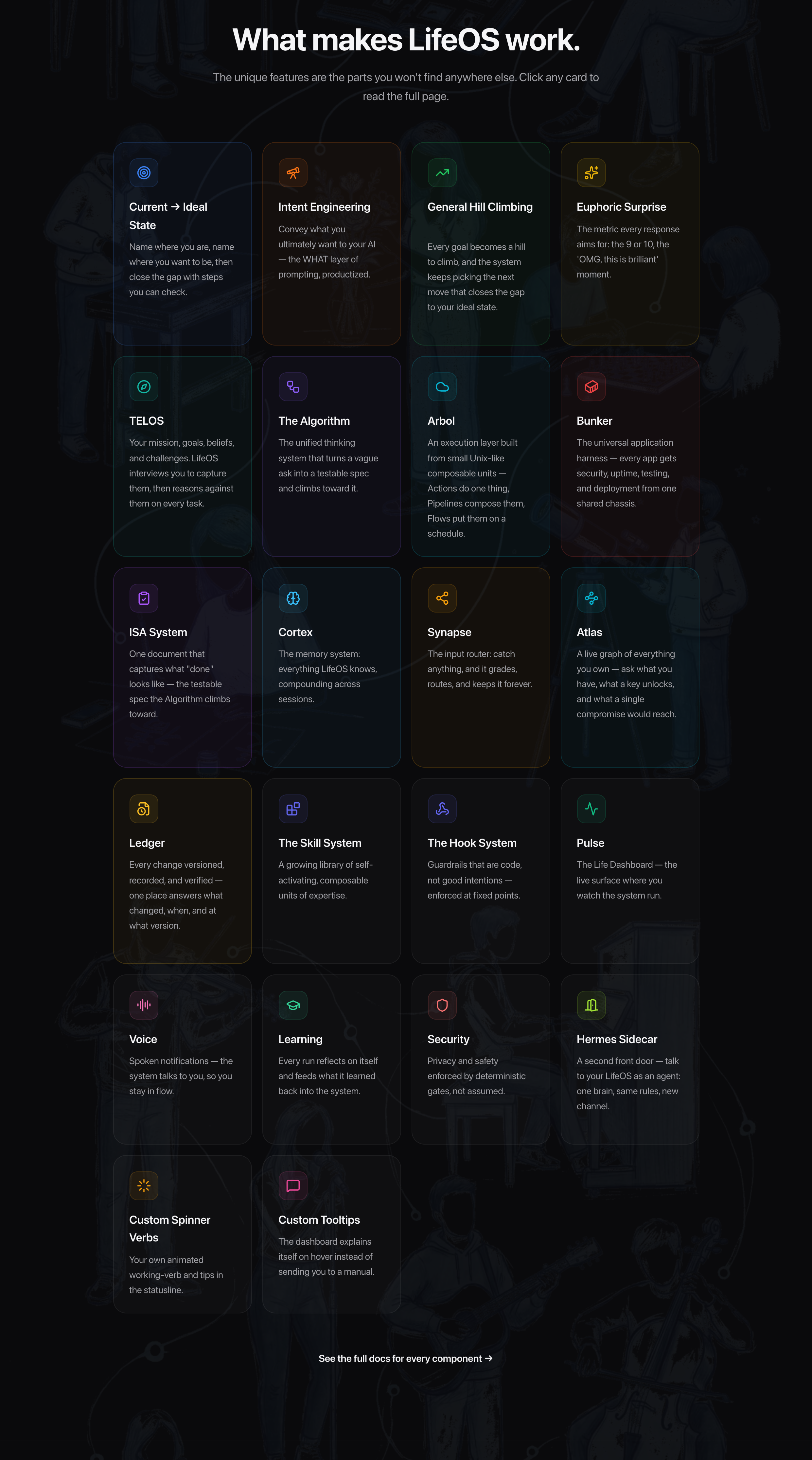
LifeOS ships 97 public skills, from research, security, writing and art to video, publishing and your home. Browse them all on the site.
Your harness gives you raw capability. LifeOS is the layer on top that makes it yours — a system that knows your goals, people, and context, and keeps working toward them:
Your harness is the engine. LifeOS is everything else that makes it your car.
Any high-end one. LifeOS is harness-agnostic by design — it's built on universal primitives (hooks, skills, context files, agentic routing), not one vendor's features. The code is TypeScript and Bash, and the core ideas — TELOS, the Algorithm, skills, memory — port to any capable agent.
Daniel builds and runs it on Claude Code, so that's the most-tested path today. But LifeOS isn't locked to it, and it's designed to run wherever your AI does.
Fabric is a collection of AI prompts (patterns) for specific tasks. It's focused on what to ask AI.
LifeOS is infrastructure for how your DA operates—memory, skills, routing, context, self-improvement. They're complementary. Many LifeOS users integrate Fabric patterns into their skills.
Recovery is straightforward:
cp -r ~/.claude ~/.claude-backup-$(date +%Y%m%d)USER/ are never touched by the installer or upgrades| Feature | Description |
|---|---|
| Local Model Support | Run LifeOS with local models (Ollama, llama.cpp) for privacy and cost control |
| Remote Access | Access your LifeOS from anywhere—mobile, web, other devices |
| Outbound Phone Calling | Voice capabilities for outbound calls |
| External Notifications | Robust notification system for Email, Discord, iMessage, Slack |
GitHub Discussions: Join the conversation
Community Discord: LifeOS is discussed in the community Discord along with other AI projects
Twitter/X: @danielmiessler
Blog: danielmiessler.com
We welcome contributions! See our GitHub Issues for open tasks.
MIT License - see LICENSE for details.
Anthropic and the Claude Code team — First and foremost. You are moving AI further and faster than anyone right now. Claude Code is the foundation that makes all of this possible.
IndyDevDan — For great videos on meta-prompting and custom agents that have inspired parts of LifeOS.
LifeOS is built in the open, and the community's pull requests, forensic bug reports, and fresh-install writeups directly shape every release. The public repo is generated from a private source tree, so community PRs are ported into source with credit rather than merged directly — same fix, durable across releases.


The 28 highest-commit contributors — see all on the contributors graph. Avatars are committers only, so the lists below carry everyone the graph can't see.
fayerman-source — Google Cloud TTS provider integration and Linux audio support for the voice system.
Matt Espinoza — Extensive testing, ideas, and feedback, plus roadmap contributions.
Code contributions (merged or ported PRs): adamlevoy · alloutflo · anikinsasha · asdf8675309 · atabisz · chrisglick · christauff · Chuckos · erf1nd0r · HotSauceHacker · imrathion · J0UH · jbmml · jnpkr · justinkatz94-glitch · ksylvan · m4nt0de4 · m8ryx · MarvinDontPanic · maxolasersquad · Mutdogus · neilinger · neilsoult · pybe · qozle · rathko · rpriven · runnerr0 · salmanmkc · sauldataman · Seadubb · Spirotot · StarksLabs · thatsjet · tzioup
Bug reports, fresh-install forensics, and design feedback: badosanjos · benoitdepaire · bnkath2o · brycemagera · catchingknives · DAESA24 · deleyva · DRAZY · DennisTraub · docxology · DolphusCY · donovan-sec · DonovanJonesUK · eccentricnode · fjp-veo · harryf · hjbrandt · HyggeHacker · ichoosetoaccept · infinitelyloopy-bt · jacobo-ortiz · JElliottMiller · jdrolls · jlacour-git · jmmarkiewicz · karlwaldman · klausagnoletti · lexilexikon · lgangitano · loudoguno · luccomo · MatiasBarboza · MHoroszowski · michaelaye · mygirleatsmayo · nbost130 · NodarDavituri · NorthwoodsSentinel · packetsherpa · Piroshki · ricklesgibson · rikitikitavi2012-debug · Riskjuggler · sbusc · simeonzickert · Steffen025 · stratofax · tzioup · vanvonlj · vichong · virtualian · vpzed · waveman2020-sudo · wojteksbt · xmasyx
Refreshed with each release. If your contribution is missing, open an issue — that's a bug too.
LifeOS is free and open-source forever. If you find it valuable, you can sponsor the project.
v8.761.0 — The One Loop
v7.28.3 — Cortex, Hermes, and hardened releases
v7.1.1 — Install Awareness
bun LIFEOS/TOOLS/Doctor.ts reports the real state of every optional capability (live, broken, declined, stale) and reconciles hooks on disk against what's registered.v7.0.0 — The Bitter Pill Release
v6.0.3 (2026-07-04) — Comprehensive AI-native install
lifeos launch alias wires --append-system-prompt-file so the constitutional layer actually loadsv6.0.2 (2026-07-03) — .md-first AI-native install
.md-first installv6.0.0 (2026-07-02) — One Skill, One Install
LifeOS/): the orchestrator (SKILL.md + Workflows + Tools) plus a complete install payload (system prompt, Algorithm, 49 skills, hooks, agents, Pulse, statusline, USER + MEMORY scaffolds). One directory, one install.curl … | bash shortcut lays it down from a terminal too.v5.0.0 (2026-04-30) — Life Operating System
/interview walks you through naming your DA, picking a voice, capturing TELOS.v4.0.3 (2026-03-01) — Community PR Patch
v4.0.0 (2026-02-27) — Lean and Mean
v3.0.0 (2026-02-15) — The Algorithm Matures
v2.4.0 (2026-01-23) — The Algorithm
v2.0.0 (2025-12-28) — v2 Launch
Built with ❤️ by Daniel Miessler and the LifeOS community
Augment yourself.
danielmiessler/LifeOS is a public repo on GitHub by danielmiessler. ⛰️ LifeOS — The AI-powered Life Operating System that helps you hill climb to wherever you're going.
It declares the MIT license on GitHub.
Its maker has not tagged a system, so it is unknown here. Its README says what it needs.
Open "Take it" on its page: Take My Repo writes an install plan for your machine and hands it to your AI agent (Claude Code, Codex or Cursor), which asks you before each step. Take My Repo has not tested it on any machine.
Its last change on GitHub was on 2026-11-18. Take My Repo does not judge from that whether it is maintained.
Nobody has reviewed it on Take My Repo yet, which says nothing about its quality.
Eclipse Theia is an open-source platform for building custom IDEs and tools for browser and desktop. It includes Theia AI, the vendor-neutral AI harness platform, and powers the AI-native Theia IDE.
An agentic skills framework & software development methodology that works.
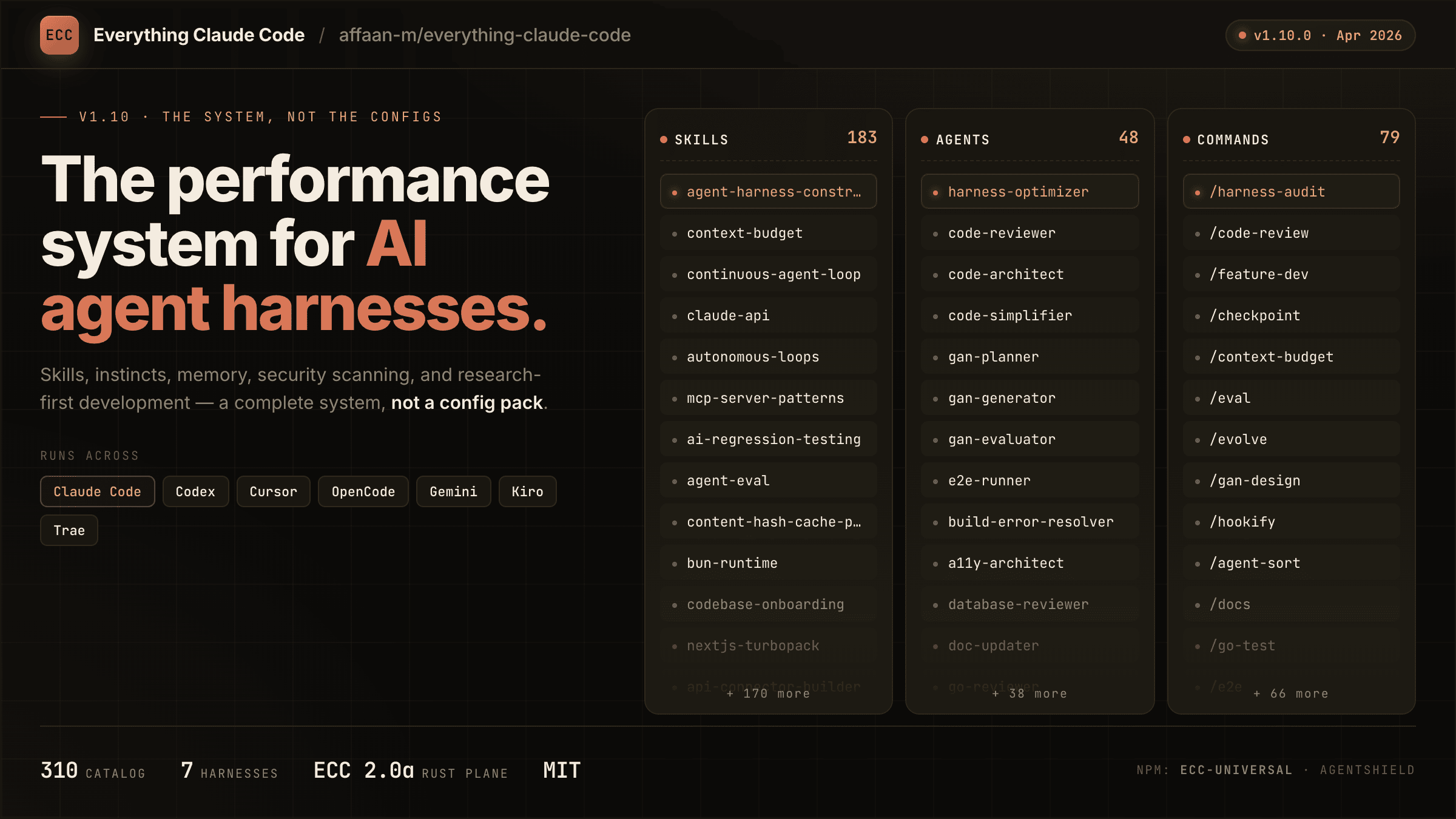
The agent harness performance optimization system. Skills, instincts, memory, security, and research-first development for Claude Code, Codex, Opencode, Cursor and beyond.
Reverse engineer anything with agents, from app behavior down to native binaries.
A Collection of application ideas which can be used to improve your coding skills.
SecLists is the security tester's companion. It's a collection of multiple types of lists used during security assessments, collected in one place. List types include usernames, passwords, URLs, sensitive data patterns, fuzzing payloads, web shells, and many more.
Fabric is an open-source framework for augmenting humans using AI. It provides a modular system for solving specific problems using a crowdsourced set of AI prompts that can be used anywhere.
Telos is an open-sourced framework for creating Deep Context about things that matter to humans.
A curated list of the most common and most interesting robots.txt disallowed directories.
An Open-source Framework for Human Understanding, Meaning, and Progress.