
data-engineering-zoomcamp
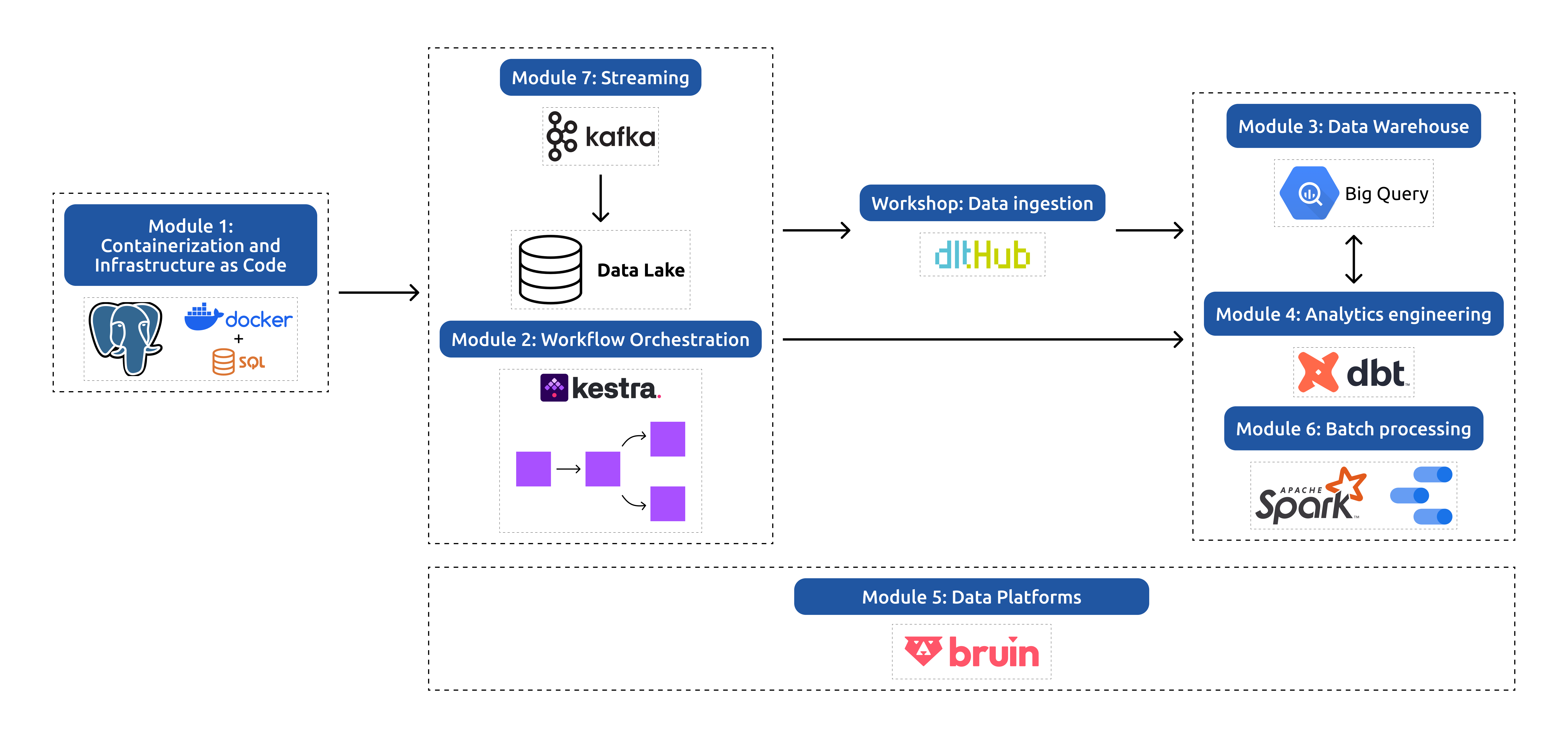
Data Engineering Zoomcamp is a free 9-week course on building production-ready data pipelines. Join the course here 👇🏼
- 47k
- Jupyter Notebook
- 8 d ago
Turning the JSON artifacts that data tools spit out into typed, validated Python objects
Repo datnguye/artifact-parser, read from GitHub 10 h ago. datnguye has not joined Take My Repo.
datnguye/artifact-parser is a public repo on GitHub by datnguye. Turning the JSON artifacts that data tools spit out into typed, validated Python objects. It declares the MIT license on GitHub. It is written mainly in Python, has 2 stars and last changed on 2026-11-20. Nobody has reviewed it on Take My Repo yet, which says nothing about its quality. Read from GitHub on 2026-11-23.
Data Engineering Zoomcamp is a free 9-week course on building production-ready data pipelines. Join the course here 👇🏼
Turn data-tool JSON artifacts into typed, validated Python objects
A small, pluggable framework for turning the JSON artifacts that data tools spit out into typed, validated Python objects. Point it at a blob, get back a pydantic model — no manual key-spelunking, no guessing which schema version you're holding.
The framework is deliberately source-agnostic. Each plugin owns one family of artifacts and registers itself with a shared registry. The first one ships in the box: a full dbt-core parser (catalog, manifest, run-results, sources).
uv add artifact-parser # or: pip install artifact-parser
The headline entry point sniffs any supported artifact and routes it to the right plugin — you don't have to know what you're holding:
import json
from artifact_parser import parse

artifact = json.loads(open("target/manifest.json").read())
model = parse(artifact)  # -> a ManifestV12 (or whatever version it is)
print(model.metadata.dbt_schema_version)
When you do know the artifact family, the dbt plugin's typed helpers are more precise (and give better editor autocomplete):
from artifact_parser.dbt import parse_manifest, parse_catalog

manifest = parse_manifest(json.loads(open("target/manifest.json").read()))
catalog = parse_catalog(json.loads(open("target/catalog.json").read()))
Hand it something it doesn't recognise and it tells you so, loudly, instead of returning a half-populated object:
from artifact_parser import parse, UnknownArtifactError

try:
    parse({"metadata": {"dbt_schema_version": "made-up/v99.json"}})
except UnknownArtifactError as exc:
    print(exc)  # No registered parser recognises this artifact. Tried: dbt.
| Artifact | Versions | Generic parser | Version-pinned parsers |
|---|---|---|---|
catalog |
v1 | parse_catalog |
parse_catalog_v1 |
manifest |
v1–v12 | parse_manifest |
parse_manifest_v1 … _v12 |
run-results |
v1–v6 | parse_run_results |
parse_run_results_v1 … _v6 |
sources |
v1–v3 | parse_sources |
parse_sources_v1 … _v3 |
dbt 2.0 can write a queryable "information schema" (dbt ... --generate-info-schema)
to target/info_schema/v1/<schema>.<table>.parquet. It is its own plugin family,
artifact_parser.dbt_info_schema, and the loader needs the optional pyarrow
extra (everything else works without it):
pip install "artifact-parser[info-schema]"
from artifact_parser.dbt_info_schema import load_info_schema, parse_info_schema

tables = load_info_schema("target/info_schema/v1")  # {"dbt.models": [row, ...], ...}
info = parse_info_schema("target/info_schema/v1")  # InfoSchemaV1

for model in info.dbt_models:
    print(model.unique_id, model.config)  # JSON columns arrive as dicts/lists
Only the public dbt.* and dbt_rt.* tables are read; dbt_internal.* is
skipped because dbt says it is not part of the contract. InfoSchemaV1 has one
list field per table, named after it with the dot as an underscore
(dbt.models -> dbt_models, dbt_rt.run_results -> dbt_rt_run_results); an
absent table is an empty list. Unknown columns are ignored and missing ones are
None, so a newer dbt does not break you. The registry dispatches on a
dbt.project table whose schema_version is known, so parse(tables) works too.
Unknown versions raise UnknownArtifactError.
There is no JSON Schema upstream, so the models are generated from a committed
snapshot of the parquet columns: codegen dbt-info-schema regenerates them, and
--snapshot-from <info_schema/v1 dir> re-derives the snapshot from a real run.
src/artifact_parser/
├── core/                 # the framework — no knowledge of any specific tool
│   ├── base.py           #   BaseArtifactModel (shared pydantic root)
│   ├── parser.py         #   ArtifactParser (the plugin contract)
│   ├── registry.py       #   ParserRegistry + the shared `registry` instance
│   └── exceptions.py     #   ArtifactParserError + friends
└── dbt/                  # the first plugin: dbt-core artifacts
    ├── plugin.py         #   DbtArtifactParser (implements ArtifactParser)
    ├── utils.py          #   schema-version sniffing
    ├── resources/        #   committed dbt-core JSON schemas (codegen input)
    └── generated/        #   droppable, rebuilt by `codegen dbt`
        ├── parser.py     #     parse_<artifact>[_vN] public API
        ├── version_map.py#     schema-version URL -> model class
        └── models/       #     typed pydantic models, one module per version
The generated code is walled off in generated/. You can rm -rf that whole
directory and rebuild it with codegen dbt (the package still imports while it's
gone — the dbt plugin just sits out until you regenerate).
The flow: a plugin answers "is this mine?" (can_parse) and "make it typed"
(parse). The registry tries plugins in registration order and returns the first
match. dbt registers itself on import, so parse(...) works out of the box.
The whole point of the core/ framework is that the second parser is cheap.
By hand:
src/artifact_parser/<tool>/.BaseArtifactModel.ArtifactParser (name, can_parse, parse) in plugin.py.__init__.py: registry.register(MyParser()).artifact_parser/__init__.py.That's it — parse() now routes matching artifacts to your plugin.
This project uses uv and Task. Common targets:
| Goal | Task |
|---|---|
| Sync the environment | task install |
| Format + autofix | task format |
| Lint (format-check + ruff) | task lint |
| Run tests at 100% coverage | task test |
task --list shows everything. The test suite enforces 100% coverage of the
framework and dbt dispatch code (the generated dbt models are excluded — they're
schema, not logic). Beyond the synthetic fixtures, real artifacts from a live dbt
build live in tests/data/ and round-trip through the public parse() in
tests/artifact_parser/dbt/test_roundtrip.py — the only tests that exercise
populated nodes end to end.
One non-obvious rule the generator enforces: the generated models are relaxed to
pydantic extra="ignore" (not the extra="forbid" dbt's schemas imply), because
real artifacts carry fields the published schema omits. A strict model would
reject a perfectly good manifest.json. See CLAUDE.md for the why.
GitHub Actions back the same gates:
| Workflow | What it does |
|---|---|
ci.yml |
Lint + 100%-coverage tests on Python 3.10–3.13, plus a codegen-in-sync job that fails if the committed generated/ drifts from a fresh regen. |
schema-watch.yml |
Weekly (and on demand): probes dbt's published schemas, regenerates, and opens a PR if a new version appeared. |
release.yml |
Build + coverage gate, then PyPI Trusted Publishing on a published Release (or TestPyPI via manual dispatch). |
Action versions and Python deps are kept current by Dependabot.
This repo is wired for Claude Code: a project
CLAUDE.md, a parser-author subagent that owns src/, slash commands
(/test, /codegen), secret-blocking and post-edit lint hooks, and the
context7 MCP for pulling fresh library
docs. See CLAUDE.md for the full tour. It will not write your code for you, but
it tries hard to keep you from shipping a failing coverage gate.
If this saved you from hand-spelunking a manifest.json, consider fuelling the
next release:
datnguye/artifact-parser is a public repo on GitHub by datnguye. Turning the JSON artifacts that data tools spit out into typed, validated Python objects.
It declares the MIT license on GitHub.
Its maker has not tagged a system, so it is unknown here. Its README says what it needs.
Open "Take it" on its page: Take My Repo writes an install plan for your machine and hands it to your AI agent (Claude Code, Codex or Cursor), which asks you before each step. Take My Repo has not tested it on any machine.
FastAPI framework, high performance, easy to learn, fast to code, ready for production
Transforms complex documents like PDFs and Office docs into LLM-ready markdown/JSON for your Agentic workflows.
🧙 Build, run, and manage data pipelines for integrating and transforming data.
For developers, who are building real-time data-driven applications, Redis is the preferred, fastest, and most feature-rich cache, data structure server, and document and vector query engine.
Its last change on GitHub was on 2026-11-20. Take My Repo does not judge from that whether it is maintained.
Nobody has reviewed it on Take My Repo yet, which says nothing about its quality.
Take My Repo cannot say: it does not audit code and has not run artifact-parser. What is known comes from GitHub. It declares the MIT license on GitHub. Its last change was on 2026-11-20. It has 2 stars, which measure popularity, not safety. Nobody has reviewed it on Take My Repo yet, which says nothing about its quality. Read the source before you run it. With "Take it", your AI agent shows each step and asks you before running it; README text is treated as data, not as instructions.


