ObfuXtreme
ObfuXtreme is an advanced Python obfuscation tool for security research, reverse engineering education, and analysis of how obfuscation impacts static and signature-based detection.
- 233
- Python
- AGPL-3.0
- 11 mo ago
I got tired of writing good code so I made good code to make bad code
Repo davidteather/python-obfuscator, read from GitHub 26 min ago. davidteather has not joined Take My Repo.
davidteather/python-obfuscator is a public repo on GitHub by davidteather. I got tired of writing good code so I made good code to make bad code. It declares the MIT license on GitHub. It is written mainly in Python, has 171 stars and last changed on 2026-04-03. Nobody has reviewed it on Take My Repo yet, which says nothing about its quality. Read from GitHub on 2026-11-23.

A Python source-code obfuscator built on the standard-library ast module. It applies multiple independent techniques — each individually togglable — to make code harder to read while keeping it fully executable. See Known limitations before use.
If this project is useful to you, consider sponsoring development.
pip install python-obfuscator
Requires Python ≥ 3.10.
pip install -e ".[dev]"
Or with Poetry:
poetry install
(poetry install pulls dev dependencies from the lockfile; use poetry run <command> to run tools inside that environment.)
# Writes obfuscated/your_file.py (path structure is preserved)
pyobfuscate -i your_file.py

# Print to stdout
pyobfuscate -i your_file.py --stdout

# Disable specific techniques
pyobfuscate -i your_file.py --disable dead_code_injector --disable exec_wrapper

# Show version
pyobfuscate --version
from python_obfuscator import obfuscate

source = "x = 1\nprint(x + 2)"
result = obfuscate(source)
print(result)
from python_obfuscator import obfuscate, ObfuscationConfig

# All techniques except dead-code injection
config = ObfuscationConfig.all_enabled().without("dead_code_injector")
result = obfuscate(source, config=config)

# Only string encoding
config = ObfuscationConfig.only("string_hex_encoder")
result = obfuscate(source, config=config)
from python_obfuscator import Obfuscator, ObfuscationConfig

obf = Obfuscator(ObfuscationConfig.all_enabled())
for path in my_files:
    path.write_text(obf.obfuscate(path.read_text()))
cfg = ObfuscationConfig.all_enabled()   # every registered technique
cfg = ObfuscationConfig.only("variable_renamer", "exec_wrapper")
cfg = cfg.without("exec_wrapper")       # returns a new frozen config
cfg = cfg.with_added("dead_code_injector")
| Name | Priority | What it does |
|---|---|---|
variable_renamer |
10 | Renames local variables, function names, parameters, and class names to visually ambiguous identifiers (lIIllIlI…). Excludes builtins, imports, dunders, and attribute-accessed names. |
string_hex_encoder |
20 | Replaces every string literal "hi" with bytes.fromhex('6869').decode('utf-8'). Skips f-strings. |
dead_code_injector |
30 | Injects dead variable assignments at every scope level — module body, function bodies, class bodies, if/for/while/try/with branches. Some assignments reference other dead variables to simulate computation. |
exec_wrapper |
100 | Wraps the entire module in a single exec("…") call, reducing the top-level AST to one statement. Runs last. |
Techniques are applied in priority order (lowest first).
Input
def greet(name):
    msg = "Hello, " + name
    print(msg)

greet("world")
Output (all techniques enabled — abridged)
exec('def lIlIllI(IIlIlII):\n lIllIlI = bytes.fromhex(\'48656c6c6f2c20\').decode(\'utf-8\') + IIlIlII\n ...\nlIlIllI(bytes.fromhex(\'776f726c64\').decode(\'utf-8\'))')
Benchmarks run on an Apple M-series machine, 20 iterations each. The test programs cover OOP, algorithms, functional patterns, number theory, and string processing.
| Program | Original | Obfuscated | Overhead |
|---|---|---|---|
algorithms.py |
0.94 ms | 1.98 ms | +112% |
cipher.py |
1.37 ms | 2.67 ms | +95% |
data_structures.py |
0.72 ms | 2.20 ms | +207% |
functional.py |
0.67 ms | 1.71 ms | +155% |
number_theory.py |
1.84 ms | 3.16 ms | +72% |
oop_simulation.py |
0.68 ms | 1.66 ms | +144% |
| Technique | Avg overhead | Notes |
|---|---|---|
variable_renamer |
~5% | Pure rename — negligible at runtime |
string_hex_encoder |
~12% | bytes.fromhex call per string literal |
dead_code_injector |
~85% | Dominant cost — dead assignments execute every iteration |
exec_wrapper |
~2% | Single extra exec layer |
The dead-code injector's overhead scales with the number of scopes and loop iterations in the original program. Programs with tight inner loops see the most overhead.
obj.method) cannot be safely renamed without full type-inference, so the renamer conservatively excludes them.fn(key=val) call-site keyword strings are bare AST strings, not Name nodes, and are not updated when a parameter is renamed.After a dev install (from source):
pytest
Coverage is enforced at ≥ 95% on every CI run.
# With coverage report
coverage run -m pytest && coverage report

# E2E tests with benchmark output
pytest tests/e2e/ -v -s
With Poetry, run the same commands through the project environment, for example poetry run pytest, poetry run coverage run -m pytest, and poetry run pytest tests/e2e/ -v -s.
David Teather — davidteather
MIT — see LICENSE.
davidteather/python-obfuscator is a public repo on GitHub by davidteather. I got tired of writing good code so I made good code to make bad code.
It declares the MIT license on GitHub.
Its maker has not tagged a system, so it is unknown here. Its README says what it needs.
Open "Take it" on its page: Take My Repo writes an install plan for your machine and hands it to your AI agent (Claude Code, Codex or Cursor), which asks you before each step. Take My Repo has not tested it on any machine.
Its last change on GitHub was on 2026-04-03. Take My Repo does not judge from that whether it is maintained.
Nobody has reviewed it on Take My Repo yet, which says nothing about its quality.
ObfuXtreme is an advanced Python obfuscation tool for security research, reverse engineering education, and analysis of how obfuscation impacts static and signature-based detection.
A powerful obfuscator for JavaScript and Node.js
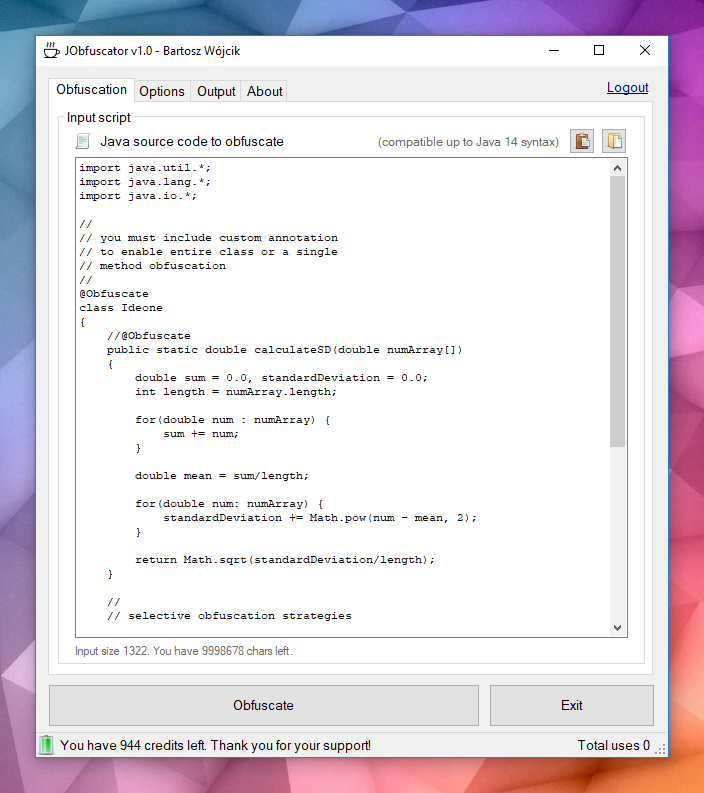
JObfuscator is a source code obfuscator for the Java language. Protect Java source code & algorithms from hacking, cracking, reverse engineering, decompilation & technology theft. PHP package for the composer.
Learn everything web scraping with David Teather Codes on YouTube
A TikTokBot that downloads trending tiktok videos and compiles them using FFmpeg
Generate cover letters, resumes, and more with chatGPT!
MOVED TO https://github.com/davidteather/everything-web-scraping
This is a commissioned instagram bot that will auto assign instagram account proxies and execute a job list to follow, like, or comment on a post.