
MiroFish
A Simple and Universal Swarm Intelligence Engine, Predicting Anything. 简洁通用的群体智能引擎,预测万物
- 86k
- Python
- AGPL-3.0
- 6 wk ago
Drop-in AI memory layer with 2x faster retrieval and 10x lower cost. Fully compatible with Mem0 API. Migrate in 5 minutes without any code changes. Self-host for free.
Repo deepmemteam/deepmem, read from GitHub 6 h ago. deepmemteam has not joined Take My Repo.
deepmemteam/deepmem is a public repo on GitHub by deepmemteam. Drop-in AI memory layer with 2x faster retrieval and 10x lower cost. Fully compatible with Mem0 API. Migrate in 5 minutes without any code changes. Self-host for free. It declares the MIT license on GitHub. It is written mainly in Python, has 114 stars and last changed on 2026-08-17. Nobody has reviewed it on Take My Repo yet, which says nothing about its quality. Read from GitHub on 2026-11-24.
A Simple and Universal Swarm Intelligence Engine, Predicting Anything. 简洁通用的群体智能引擎,预测万物
Drop-in AI memory layer with 2× faster response and 10× lower cost.
Fully compatible with Mem0 API. Migrate in 5 minutes - one import line.
Self-hostable. No auth, no payment, no lock-in. Or use the managed cloud at deepmem.dev.
Cloud · Self-host · Benchmarks · Reproduce them
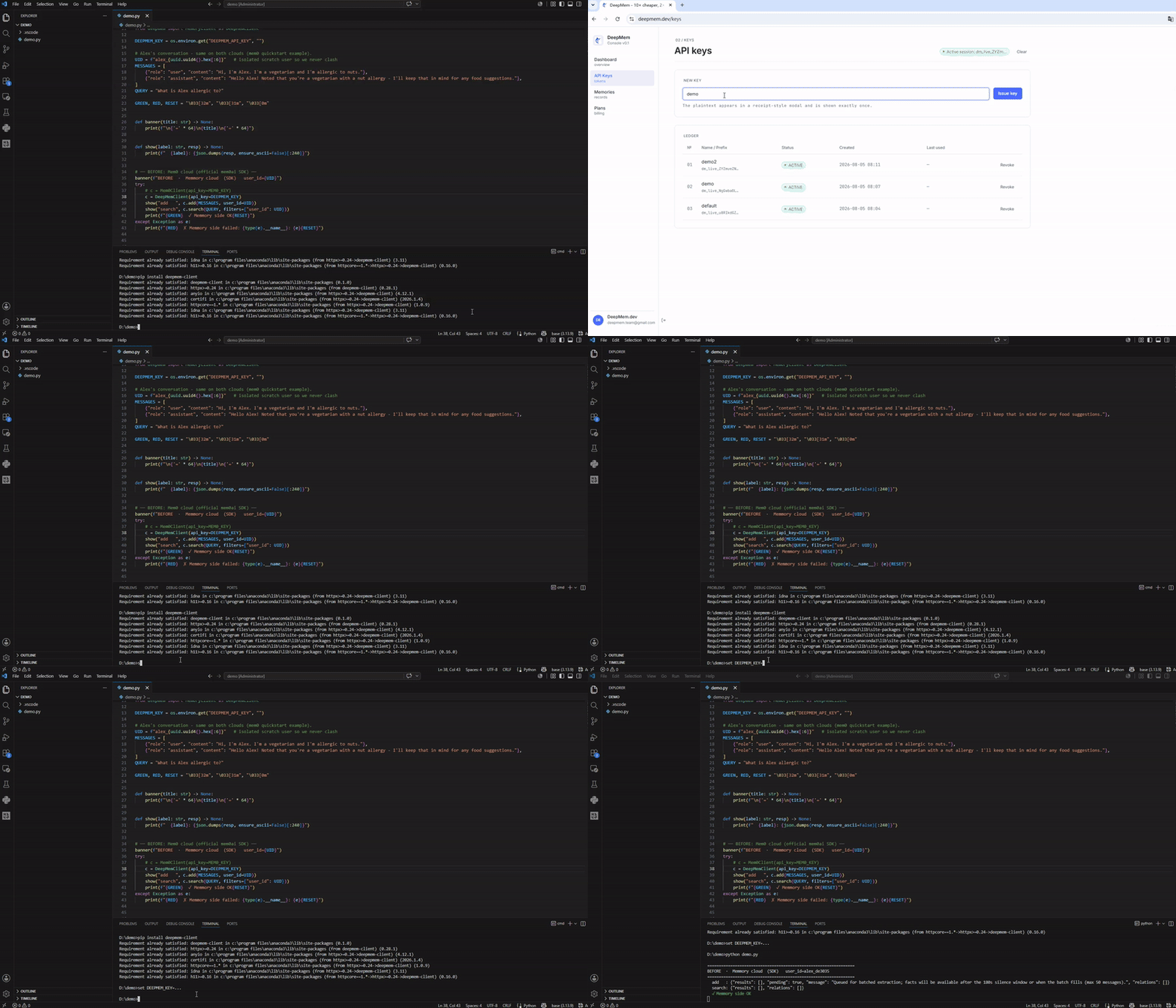
Migrate from Mem0 in one line - same MemoryClient, same method signatures:
# Before - Mem0
from mem0 import MemoryClient
client = MemoryClient(api_key="m0-...")

# After - DeepMem (only the import changes)
from deepmem import MemoryClient
client = MemoryClient(api_key="dm_live-...")   # get a key at deepmem.dev
pip install deepmem-client
Turn conversations into searchable long-term memory: a FastAPI HTTP API in
front of a Qdrant vector store, with LLM fact extraction, hybrid retrieval
(vector + BM25 + entity boost + time-decay), semantic caching, async batched
distillation, GDPR controls, and a built-in MCP server. It runs in open
mode - no API key, no user registration - so you can deploy it for your own
agents in minutes. Multi-tenant isolation is driven by user_id in the
request body.
Prefer not to self-host? DeepMem Cloud is the managed version of this exact engine at deepmem.dev - same API, no infra. Sign up, grab a key (
dm_live_...), point your base URL athttps://deepmem.dev, done. The cloud and the open-source server speak the same Mem0-compatible API, so client code is identical.
Already using Mem0? Switch to DeepMem cloud in one line. The deepmem-client
package mirrors mem0.MemoryClient - same class name, same method signatures,
same filters={"user_id": ...} style - so everything after the import stays
untouched.
pip install deepmem-client
# before (Mem0)
from mem0 import MemoryClient
client = MemoryClient(api_key="m0-...")
client.add(messages, user_id="alex")
client.search("What can Alex cook?", filters={"user_id": "alex"})

# after (DeepMem cloud) - change one import line
from deepmem import MemoryClient
client = MemoryClient(api_key="dm_live_...")        # key at https://deepmem.dev
client.add(messages, user_id="alex")                # identical calls
client.search("What can Alex cook?", filters={"user_id": "alex"})
add(infer=True) (the default) is asynchronous on DeepMem cloud - it
returns pending=True with results=[] and extracted facts land a few
seconds later. (Mem0 cloud's add is async too - it returns PENDING.) Pass
infer=False for synchronous raw-text storage that's immediately searchable.relations is always []. Mem0's graph features aren't
replicated.reset differs - Mem0's is account-wide; DeepMem's is per-user_id with
a confirm guard.DeepMem Cloud is 10x cheaper than Mem0 at every paid tier - the same shape of plans, a tenth of the price.
| Tier | DeepMem | Mem0 cloud |
|---|---|---|
| Hobby | Free | Free |
| Starter | $1.9/mo | $19/mo |
| Growth | $7.9/mo | $79/mo |
| Professional | $24.9/mo | $249/mo |
Self-host instead and it's $0 - you pay only your own LLM/embedding provider (the same LLM cost Mem0 charges on top of its plan price), with no memory-service markup. Batched distillation also cuts LLM calls ~80%, so even your provider bill is smaller than per-message extractors.
Plans and limits: deepmem.dev · mem0.ai.
No cherry-picked headline. The scripts and workload ship in
/benchmarks - run them yourself. Here's what we
measured and the exact config that produced it:
| Metric | DeepMem self-hosted ¹ | DeepMem cloud | Mem0 cloud |
|---|---|---|---|
| Search p50 | 73 ms | 643 ms | 653 ms |
| Search p95 | 86 ms | 811 ms | 710 ms |
| Search hits (40 queries) | - | 195 | 84 |
| Add p50 (raw store) | 899 ms ² | 792 ms | 695 ms ³ |
¹ BGE-M3 on a GTX 1070 GPU (2016-era), local file Qdrant,
infer=False, 100 ops, concurrency 1. ² Dominated by local-file Qdrant I/O - a Qdrant server cuts this sharply. ³ Mem0 has no raw-store mode;addalways runs LLM extraction, so this row isn't apples-to-apples.
/benchmarks from a low-RTT location for your own
numbers.Agent frameworks keep re-discovering that they need persistent, retrievable memory. The hosted options bill per call and send your data to someone else's cloud. DeepMem is the self-hostable alternative: the same Mem0-shaped API you can drop in, but it runs on your box, with your embedder, your LLM key, and your Qdrant - and the code is right here to verify it.
How does DeepMem compare to other Mem0 alternatives? Most are hosted-only or layer memory on top of someone else's vector DB. DeepMem combines three things at once: it's self-hostable (your data stays on your box - $0 beyond your own LLM key), MCP-native (Claude Desktop / Cursor read and write memories directly as tools), and fully open-source - and the managed cloud runs the exact same engine, so cloud and self-host are one API, not two products.
| Without DeepMem | With DeepMem |
|---|---|
| Re-explain who you are and what you're working on every session | The agent recalls identity, projects, and preferences automatically |
| Lose debugging and research context between sessions | Past root causes, dead ends, and findings are recalled, so work isn't repeated |
| Manually restate preferences every session | Preferences persist across sessions, agents, and projects |
| Hosted memory services that bill per call and hold your data | Self-host on your infra, or use the cloud - your call, same API |
Three ways to run. All speak the same Mem0-compatible API.
export DEEPMEM_API_KEY=dm_live_...      # from https://deepmem.dev
curl https://deepmem.dev/v1/memories \
  -H "Authorization: Bearer $DEEPMEM_API_KEY" -H "Content-Type: application/json" \
  -d '{"messages":[{"role":"user","content":"I am Pat, I live in Lisbon."}],"user_id":"pat","infer":false}'
curl https://deepmem.dev/v1/memories/search \
  -H "Authorization: Bearer $DEEPMEM_API_KEY" -H "Content-Type: application/json" \
  -d '{"query":"Where does Pat live?","user_id":"pat"}'
cp .env.example .env          # add an LLM key
docker compose up --build     # DeepMem (HTTP :8000 + MCP :8001) + Qdrant sidecar
curl http://localhost:8000/health
Or pull the published image:
docker pull langdeepmem/deepmem:latest
docker run -p 8000:8000 -p 8001:8001 -e DEEPSEEK_API_KEY=sk-... langdeepmem/deepmem:latest
The image exposes :8000 (HTTP) and :8001 (MCP). The Dockerfile
and docker-compose.yml cover the GPU variant (CUDA torch + BGE_DEVICE=cuda)
and BGE-M3 model-download options (HF mirror, proxy, or local mount).
git clone https://github.com/deepmemteam/deepmem.git && cd deepmem
pip install -r requirements.txt
cp .env.example .env          # add an LLM key + embedder config
python server/start.py        # HTTP :8000 + MCP :8001
Write and search in three lines:
import httpx
httpx.post("http://localhost:8000/v1/memories",
    json={"messages":[{"role":"user","content":"I'm Pat, I live in Lisbon."}],
          "user_id":"pat"})
print(httpx.post("http://localhost:8000/v1/memories/search",
    json={"query":"Where does Pat live?","user_id":"pat"}).json()["results"])
user_idis optional (defaults to"default"); send differentuser_ids to isolate end-users.infer: falsestores raw text immediately (test-friendly); the defaultinfer: truequeues for LLM fact extraction.
Multi-provider by config, not code. Both layers switch on env vars:
| Layer | Options | Selector |
|---|---|---|
| LLM (fact extraction) | OpenAI · Anthropic (native SDK) · any OpenAI-compatible (DeepSeek / vLLM / Ollama / Groq / LM Studio) | LLM_PROVIDER + LLM_API_KEY / ANTHROPIC_API_KEY / DEEPSEEK_API_KEY |
| Embeddings | BGE-M3 (local, GPU/CPU) · Google Gemini · any OpenAI-compatible | EMBEDDING_PROVIDER + BGE_M3_PATH / GOOGLE_API_KEY / OPENAI_API_KEY |
BGE_DEVICE=auto|cpu|cuda picks GPU when available, else CPU (force cpu
on small-VRAM cards to avoid multi-process contention). BYOK overrides the
LLM per-request.
Hybrid retrieval. Vector similarity + BM25 keyword + entity boost + time-decay, fused into one score. Over-fetch, re-rank, return.
Async batched distillation. Writes queue behind a silence window and are extracted in batches - ~80% fewer LLM calls than per-message extraction.
Semantic cache. Repeat adds/searches hit a similarity-gated cache and return cached facts without re-embedding or re-querying Qdrant.
Stores preferences, not code. extraction_filter strips large fenced
code blocks before LLM extraction, so the store fills with durable facts,
not pasted implementations.
MCP server. deepmem_write / deepmem_search / deepmem_delete tools
for Claude Desktop, Cursor, and any MCP client.
GDPR. Soft-delete with retention window, hard-delete reset, SHA-256
id masking in logs, export/import for portability.
| Method | Path | Description |
|---|---|---|
| POST | /v1/memories |
Write messages; LLM-extract facts (infer=false stores raw) |
| POST | /v1/memories/search |
Semantic search (vector + BM25 + entity + time-decay) |
| GET | /v1/memories |
List all for a user_id (paginated) |
| GET | /v1/memories/{id} |
Get one by ID |
| PUT | /v1/memories/{id} |
Update one memory's text |
| DELETE | /v1/memories/{id} |
Soft-delete one |
| DELETE | /v1/memories |
Soft-delete all for a user_id (GDPR) |
| GET | /v1/memories/{id}/history |
ADD/UPDATE/DELETE audit log |
| POST | /v1/reset |
Hard-delete all + history (needs confirm_user_id) |
| GET | /v1/export · POST /v1/import |
Portable JSON export / import |
| GET | /health · /ready |
Liveness / readiness probes |
agent_id / run_id optionally scope writes/reads (mirrors Mem0's three-level
isolation: user -> agent -> run). Interactive docs at /docs.
The cloud exposes a remote MCP endpoint (streamable HTTP):
URL:    https://deepmem.dev/mcp
Auth:   Authorization: Bearer dm_live_...   (your deepmem.dev API key)
Tools:  deepmem_write / deepmem_search
Works with Claude Code, Claude Desktop, Cursor, and any MCP-compatible client.
Claude Code - one command:
deepmemteam/deepmem is a public repo on GitHub by deepmemteam. Drop-in AI memory layer with 2x faster retrieval and 10x lower cost. Fully compatible with Mem0 API. Migrate in 5 minutes without any code changes. Self-host for free.
It declares the MIT license on GitHub.
Its maker tagged it for macOS, Windows and Linux, or as Docker or cross-platform. That is declared by the maker; Take My Repo has not tested it.
Open "Take it" on its page: Take My Repo writes an install plan for your machine and hands it to your AI agent (Claude Code, Codex or Cursor), which asks you before each step. Take My Repo has not tested it on any machine.
The agent harness performance optimization system. Skills, instincts, memory, security, and research-first development for Claude Code, Codex, Opencode, Cursor and beyond.
Persistent Context Across Sessions for Every Agent – Captures everything your agent does during sessions, compresses it with AI, and injects relevant context back into future sessions. Works with Claude Code, OpenClaw, Codex, Gemini, Hermes, Copilot, OpenCode + More
Reverse engineer anything with agents, from app behavior down to native binaries.
🌊 The original agent harness. Deploy intelligent multi-player swarms, coordinate autonomous workflows, and build conversational AI systems. Features adaptive memory, self-learning intelligence, federation, vector RAG integration, and native Claude Code / Codex / Hermes and many more Integrated
Its last change on GitHub was on 2026-08-17. GitHub counts 1 open issue and pull requests. Take My Repo does not judge from that whether it is maintained.
Nobody has reviewed it on Take My Repo yet, which says nothing about its quality.
Take My Repo cannot say: it does not audit code and has not run deepmem. What is known comes from GitHub. It declares the MIT license on GitHub. Its last change was on 2026-08-17. It has 114 stars, which measure popularity, not safety. Nobody has reviewed it on Take My Repo yet, which says nothing about its quality. Read the source before you run it. With "Take it", your AI agent shows each step and asks you before running it; README text is treated as data, not as instructions.




