jscpd
Copy/paste detector for source code. 220+ languages, Rust engine, SARIF/HTML/badge reporters, GitHub Action, MCP server for AI agents.
- 6.6k
- Rust
- MIT
- 18 h ago
Keep your gradle builds dry 干
Repo diffplug/blowdryer, read from GitHub 1 min ago. diffplug has not joined Take My Repo.
diffplug/blowdryer is a public repo on GitHub by diffplug. Keep your gradle builds dry 干. It declares the Apache-2.0 license on GitHub. It is written mainly in Java, has 29 stars and last changed on 2026-08-27. Nobody has reviewed it on Take My Repo yet, which says nothing about its quality. Read from GitHub on 2026-11-22.
 Blowdryer: keep your gradle builds dry
If you have multiple loosely-related gradle projects in separate repositories, then you probably have these problems:
Blowdryer lets you centralize your build scripts, config files, and properties into a single repository, with an easy workflow for pulling those resources into various projects that use them, improving them in-place, then cycling those improvements back across the other projects.
First, make a public github repository (diffplug/blowdryer-diffplug is a good example), and push the stuff that you want to centralize into the src/main/resources subdirectory of that repo.
Then, in the settings.gradle for the project that you want to suck these into, do this:
plugins {
  id 'com.diffplug.blowdryerSetup' version '1.8.0'
}

blowdryerSetup {
  github('acme/blowdryer-acme', 'tag', 'v1.4.5')
  //                         or 'commit', '07f588e52eb0f31e596eab0228a5df7233a98a14'
  //                         or 'tree',   'a5df7233a98a1407f588e52eb0f31e596eab0228'

  // or gitlab('acme/blowdryer-acme', 'tag', 'v1.4.5').authToken('abc123').customDomainHttp('acme.org')
  // or bitbucket('acme/blowdryer-acme', 'tag', 'v1.4.5').authToken('abc123').customDomainHttps('acme.org')
}
Now, in only your root build.gradle, do this: apply plugin: 'com.diffplug.blowdryer'. Now, in any project throughout your gradle build (including subprojects), you can do this:
apply from: Blowdryer.file('someScript.gradle')
somePlugin {
  configFile Blowdryer.file('somePluginConfig.xml')
  configProp Blowdryer.prop('propfile', 'key') // key from propfile.properties
}
Blowdryer.file() returns a File which was downloaded to your system temp directory, from the src/main/resources folder of acme/blowdryer-acme, at the v1.4.5 tag. Only one download will ever happen for the entire machine, and it will cache it until your system temp directory is cleaned. To force a clean, you can run gradlew blowdryerWipeEntireCache.
Blowdryer.prop() parses a java .properties file which was downloaded using Blowdryer.file(), and then returns the value associated with the given key.
If you like brevity and unicode, you can replace Blowdryer with 干. We'll use 干 throughout the rest of the readme, but you can find-replace 干 with Blowdryer and get the same results.
apply from: 干.file('someScript.gradle')
somePlugin {
  configFile 干.file('somePluginConfig.xml')
  configProp 干.prop('propfile', 'key')
}
When you call into a script plugin, you might want to set some configuration values first. You can read them inside the script using 干.proj('propertyName', 'property description for error message'):
// build.gradle
ext.pluginPass = 'supersecret'
ext.keyFile = new File('keyFile')
apply from: 干.file('someScript.gradle')

// someScript.gradle
somePlugin {
  pass 干.proj('pluginPass', 'password for the keyFile')
  // if the property isn't a String, you have to specify the class you expect
  keyFile 干.proj(File.class, 'keyFile', 'location of the keyFile')
}
If the property isn't set, you'll get a nice error message describing what was missing, along with links to gradle's documentation on how to set properties (gradle.properties, env variables, ext, etc).
Script plugins can't import any classes that were loaded from a third-party plugin on the build.gradle classpath. There is an easy workaround, which is to declare all plugins and their versions in the settings.gradle file. Blowdryer includes a mechanism for centralizing plugins and their versions, see plugin versions below.
To change and test scripts before you push them up to GitHub, you can do this:
// settings.gradle
blowdryerSetup {
  //github 'acme/blowdryer-acme', 'tag', 'v1.4.5'
  devLocal '../path-to-local-blowdryer-acme'
}
The call to devLocal means that all calls to Blowdryer.file will skip caching and get served from that local folder's src/main/resources subfolder. This sets up the following virtuous cycle:
devLocal '../blowdryer-acme'acme/blowdryer-acmeblowdryer-acme version is immutably pinned per-project, you'll never break existing builds as you make changesrepoSubfolderIf you want your scripts to come from a different subfolder, you can change it:
// settings.gradle
blowdryerSetup {
  repoSubfolder 'some/other/dir/but/why'
  github 'acme/blowdryer-acme', 'tag', 'v1.4.5'
}
The nice thing about the default src/main/resources is that if you ever want to, you can package the files into a plain-old jar and pull the resources from that jar rather than from a github repository.
// settings.gradle
blowdryerSetup {
  localJar(file('/absolute/path/to/dependency.jar'))
}
If you'd rather pull the jar from a maven repository, declare it in the plugins block of settings.gradle and let classpathJar find it on the classpath by (a substring of) its filename:
// settings.gradle
plugins {
  id 'com.diffplug.blowdryerSetup' version '1.8.0'
  id 'acme.blowdryer-scripts' version '3.0.0'
}
blowdryerSetup {
  classpathJar('acme.blowdryer-scripts')
}
If your acme.blowdryer-scripts jar bundles its own Plugin<Settings> which calls blowdryerSetup { classpathJar(...) } internally, then applying that one plugin is all a consumer has to do - they don't need a blowdryerSetup block of their own at all.
We recommend that your settings.gradle should look like this:
plugins {
  id 'com.diffplug.blowdryerSetup' version '1.8.0'
  id 'acme.java' version '1.0.0' apply false
  id 'acme.kotlin' version '2.0.0' apply false
}
blowdryerSetup {
  github('acme/blowdryer-acme', 'tag', 'v1.4.5')
  setPluginsBlockTo {
    it.file('plugin.versions')
  }
}
First note that every plugin has apply false except for com.diffplug.blowdryerSetup. That is on purpose. We need to apply blowdryerSetup so that we can use the blowdryerSetup {} block, and we need to do apply false on the other plugins because we're just putting them on the classpath, not actually using them (yet).
The second thing to note is setPluginsBlockTo { it.file('plugin.versions') }. That means that if you go to github.com/acme/blowdryer-acme and then open the v1.4.5 tab and then go into the src/main/resources folder, you will find a file called plugin.versions. And the content of that file will be
  id 'com.diffplug.blowdryerSetup' version '1.8.0'
  id 'acme.java' version '1.0.0' apply false
  id 'acme.kotlin' version '2.0.0' apply false
Blowdryer is using the same immutable file mechanism described earlier, but this time it's using it to set just that one section of your settings.gradle using a workflow very similar to the spotlessCheck / spotlessApply idea.
The workflow goes like this:
devLocal mode (demonstrated above)plugin.versions filesettings.gradle plugins block has the wrong content. Add -DsetPluginVersions to overwrite
-DsetPluginVersions to your command linesettings.gradle plugins block was written successfully. Plugin versions have been updated, try again.
plugin.versionsIt doesn't have to be called plugin.versions, it's just using the 干.file mechanism and sticking that file in. So you could have plugin-java.versions and plugin-kotlin.versions. Also, you have other methods you can call:
setPluginsBlockTo {
  it.file('plugin.versions')
  it.file('kotlin-extras.versions')
  it.add("  id 'special-plugin-for-just-this-project' version '1.0.0'")
  it.remove("   id 'acme.java' version '1.0.0' apply false")
  it.replace('1.7.20', '1.8.0') // update Kotlin version but only for this build
}
Recent versions of Gradle shipped a flexible version catalog feature. You can use that in combination with blowdryer's setPluginsBlockTo. The problem is that every plugin you use throughout the build still has to be declared in the settings.gradle with apply false. Just having the version in the catalog isn't enough. See script plugin gotchas above for the gory classloader details.
Disappointingly, you can't use libs.versions.toml inside the settings.gradle file, which is exactly the place that we need it.
You have to apply the com.diffplug.blowdryerSetup plugin in your settings.gradle. But you don't actually have to apply plugin: 'com.diffplug.blowdryer' in your build.gradle, you can also just use these static methods (even in settings.gradle or inside the code of other plugins).
// com.diffplug.blowdryer.干 is alias of com.diffplug.blowdryer.Blowdryer
static File   干.file(String resource)
static String 干.prop(String propFile, String key)
static String 干.proj(Project proj, String String key, String description)
static <T> T  干.proj(Project proj, Class<T> clazz, String String key, String description)
static File   干.immutableUrl(String guaranteedImmutableUrl)
static File   干.immutableUrl(String guaranteedImmutableUrl, String fileSuffix)
  // 干.immutableUrl('https://foo.org/?file=blah.foo&rev=7') returns a file which ends in `.foo-rev-7`
  // 干.immutableUrl('https://foo.org/?file=blah.foo&rev=7', '.foo') returns a file which ends in `.foo`
If you do apply plugin: 'com.diffplug.blowdryer' then every project gets an extension object (code) where the project field has been filled in for you, which is why we don't pass it explicitly in the examples before this section. If you don't apply the plugin, you can still call these static methods and pass project explicitly for the proj() methods.
The Gradle Kotlin DSL doesn't play well with the name-based extension object that we use in Groovy, but you can just call the static methods above.
// settings.gradle.kts
plugins {
  id("com.diffplug.blowdryerSetup") version "1.8.0"
}
import com.diffplug.blowdryer.BlowdryerSetup
import com.diffplug.blowdryer.BlowdryerSetup.GitAnchorType
configure<BlowdryerSetup> {
  github("acme/blowdryer-acme", GitAnchorType.TAG, "v1.4.5")
  //devLocal("../path-to-local-blowdryer-acme")
}

// inside settings.gradle.kts, build.gradle.kts, or any-script.gradle.kts
import com.diffplug.blowdryer.干 // or .Blowdryer

apply(from = 干.file("script.gradle.kts"))
somePlugin {
  configFile 干.file("somePluginConfig.xml")
  configProp 干.prop("propfile", "key")
  pass       干.proj(project, "pluginPass", "password for the keyFile")
  keyFile    干.proj(project, File.class, "keyFile", "location of the keyFile")
}
Blowdryer.immutableUrl returns a File containing the downloaded content of the given URL. It's on you to guarantee that the content of that URL is immutable.
When you setup the Blowdryer plugin in your settings.gradle, you're telling Blowdryer what URL scheme to use when resolving a call to Blowdryer.file, for example:
//blowdryer {
//  github 'acme/blowdryer-acme', 'tag', 'v1.4.5'
public GitHub github(String repoOrg, GitAnchorType anchorType, String anchor) {
  String root = "https://raw.githubusercontent.com/" + repoOrg + "/" + anchor + "/" + repoSubfolder + "/";
  Blowdryer.setResourcePlugin(resource -> root + resource);
  return <fluent_configurator_for_optional_auth_token>;
}
If you develop support for other git hosts, please open a PR! You can test prototypes with the code below, and clean up your mistakes with gradlew blowdryerWipeEntireCache.
blowdryerSetup {
  experimental { source -> 'https://someImmutableUrlScheme/' + source }
}
Here are resource repositories in the wild (PRs welcome for others!)
It would be handy to have something like this for other script-based build systems. It would be great to standardize on 干, feel free to name your project blowdryer-foo. If you find or build one, whatever names it chooses, let us know with an issue, and we'll link to it here!
Requires Java 8+ and Graadle 6.8+.
diffplug/blowdryer is a public repo on GitHub by diffplug. Keep your gradle builds dry 干.
It declares the Apache-2.0 license on GitHub.
Its maker has not tagged a system, so it is unknown here. Its README says what it needs.
Open "Take it" on its page: Take My Repo writes an install plan for your machine and hands it to your AI agent (Claude Code, Codex or Cursor), which asks you before each step. Take My Repo has not tested it on any machine.
Its last change on GitHub was on 2026-08-27. GitHub counts 5 open issues and pull requests. Take My Repo does not judge from that whether it is maintained.
Nobody has reviewed it on Take My Repo yet, which says nothing about its quality.
Copy/paste detector for source code. 220+ languages, Rust engine, SARIF/HTML/badge reporters, GitHub Action, MCP server for AI agents.
Adaptable, fast automation for all
A utility (Gradle Plugin + CLI) to convert Jetpack Compose compiler metrics and reports to beautified HTML page.
This project exemplifies the implementation and dockerization of a simple Razor Web MVC Core consuming a full GraphQL 4 Web API, build in a .NET 6 multi-layer project, considering development best practices, like SOLID and DRY, applying Domain-Driven concepts in a Onion Architecture.
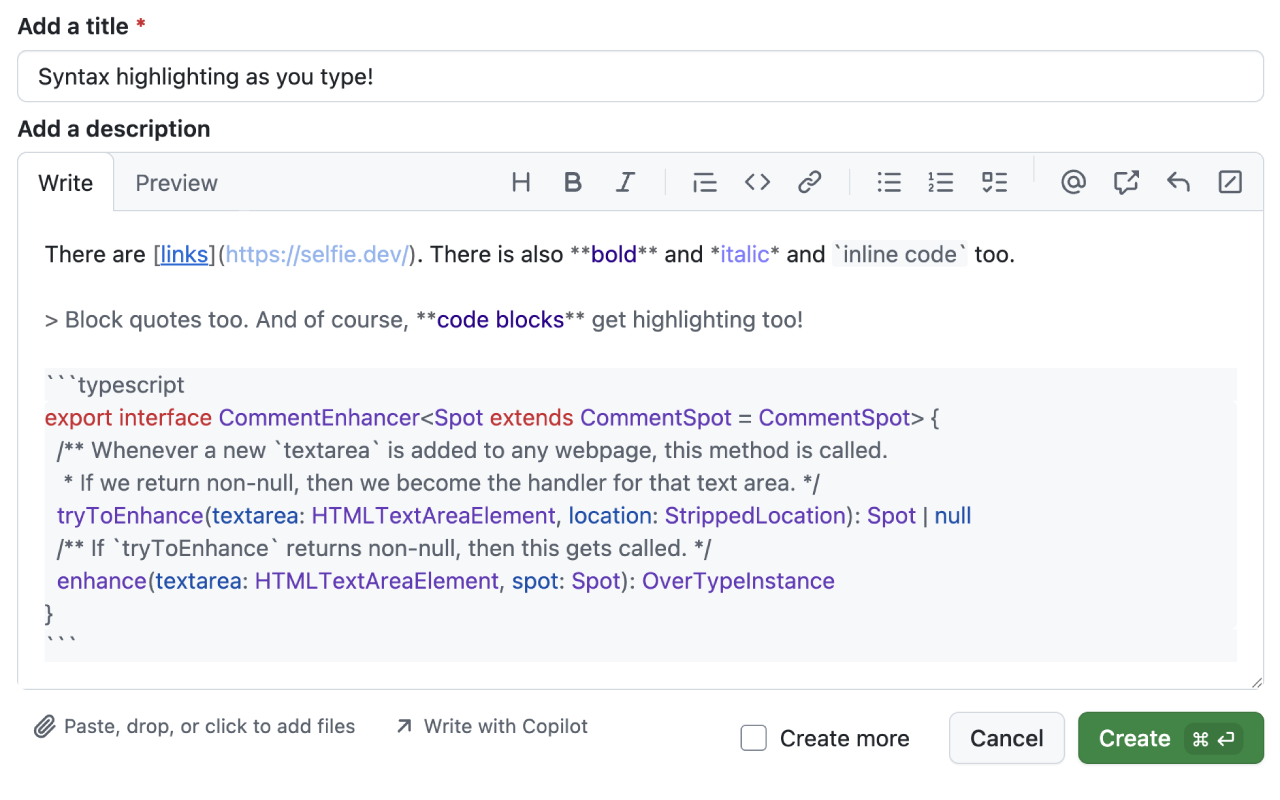
Syntax highlighting for the GitHub issue/pr editor. Also, never lose a draft comment again!